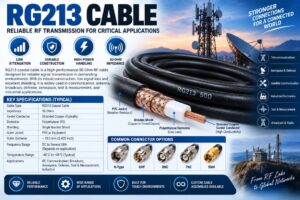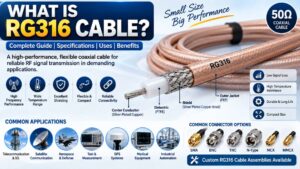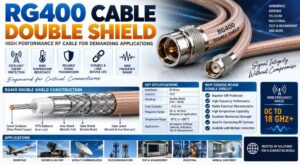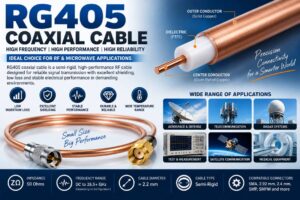
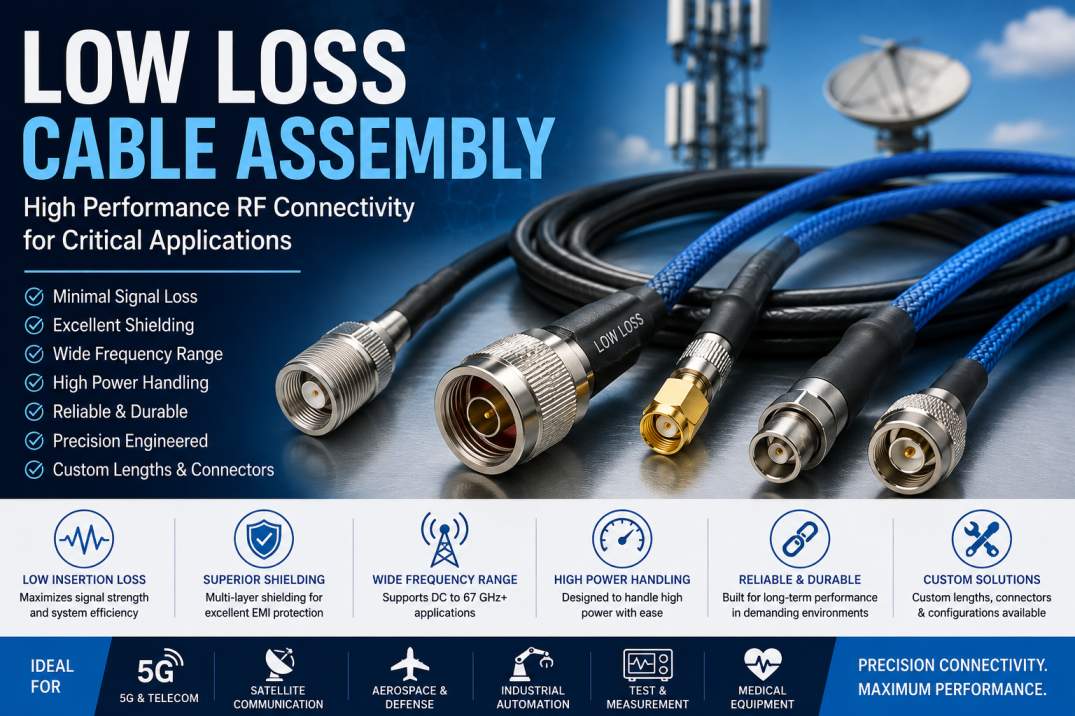
A Low Loss Cable Assembly is a high-performance radio frequency (RF) and microwave interconnect solution designed to transmit electrical signals with minimal signal attenuation over a specified distance. As wireless communication technologies continue to evolve, the demand for efficient signal transmission has become increasingly important. From 5G infrastructure and satellite communication to aerospace, defense, medical equipment, broadcasting, and test laboratories, low loss cable assemblies play a critical role in maintaining signal integrity and ensuring reliable system performance.
Unlike conventional coaxial cable assemblies, low loss cable assemblies are engineered with advanced dielectric materials, precision shielding, and optimized conductor designs to significantly reduce insertion loss. This enables higher signal strength, improved data transmission, and greater efficiency in high-frequency applications.
Modern RF systems often operate at frequencies extending beyond 40 GHz, where even small cable losses can negatively affect overall system performance. A high-quality low loss cable assembly minimizes these losses while maintaining excellent impedance matching, shielding effectiveness, and mechanical durability.
Whether used in communication networks, military systems, laboratory measurements, or industrial automation, low loss cable assemblies provide consistent electrical performance, making them one of the most essential components in RF and microwave engineering.
What Is a Low Loss Cable Assembly?
A Low Loss Cable Assembly is a pre-terminated coaxial cable specifically designed to transmit high-frequency RF and microwave signals with minimal power loss. It consists of a high-quality coaxial cable fitted with RF connectors on both ends to create a ready-to-use cable solution.
The primary purpose of a low loss cable assembly is to reduce attenuation while maintaining excellent electrical performance across a wide frequency range.
Compared to standard RF cables, low loss cable assemblies utilize thicker conductors, low-loss dielectric insulation, multiple shielding layers, and precision-manufactured connectors to minimize insertion loss and maximize signal efficiency.
These cable assemblies are commonly manufactured with characteristic impedances of 50 Ohms or 75 Ohms depending on the application.
How Does a Low Loss Cable Assembly Work?
A low loss cable assembly transfers RF energy from one device to another while minimizing the amount of energy dissipated inside the cable.
The center conductor carries the RF signal while the dielectric material maintains conductor spacing and minimizes electrical losses. The outer conductor or shielding protects the signal from electromagnetic interference (EMI) and prevents signal leakage. Finally, the outer protective jacket safeguards the cable from environmental damage.
By using premium dielectric materials such as foam polyethylene or PTFE along with silver-plated copper conductors and precision shielding, the cable assembly significantly reduces conductor loss, dielectric loss, and radiation loss.
The result is higher signal efficiency, lower insertion loss, and improved communication reliability.
Components of a Low Loss Cable Assembly
A high-quality low loss cable assembly consists of several precision-engineered components.
Center Conductor
The center conductor carries the RF signal. It is typically manufactured from copper, silver-plated copper, or copper-clad aluminum depending on performance requirements.
Dielectric Insulation
The dielectric separates the center conductor from the outer conductor while minimizing electrical losses. Common dielectric materials include PTFE, foam polyethylene, and expanded PTFE.
Outer Shield
The shield protects against electromagnetic interference and maintains signal integrity. Premium cable assemblies often use double-braided, triple-shielded, or foil-plus-braid shielding.
Protective Jacket
The outer jacket provides mechanical protection against moisture, abrasion, UV exposure, chemicals, and harsh environmental conditions.
RF Connectors
Precision connectors ensure low reflection, excellent impedance matching, and secure mechanical connections.
Key Features of Low Loss Cable Assemblies
Low insertion loss
Excellent shielding effectiveness
Wide operating frequency range
Stable impedance
Superior return loss
Low VSWR
High power handling
Excellent phase stability
Flexible construction
Long service life
Weather-resistant jackets
Precision connector termination
Types of Low Loss Cable Assemblies
Flexible Low Loss Cable Assemblies
Flexible assemblies are ideal for installations requiring frequent movement or bending.
Applications include laboratory testing, antenna systems, telecommunications, and industrial equipment.
Semi-Rigid Cable Assemblies
Semi-rigid cables provide excellent electrical performance with minimal signal loss and exceptional phase stability.
They are widely used in aerospace, military systems, radar, and microwave communication.
Hand Formable Cable Assemblies
Hand-formable assemblies combine the flexibility of standard cables with the stability of semi-rigid cables.
They maintain their shape after bending without requiring special forming tools.
Armored Cable Assemblies
Armored cable assemblies feature stainless steel or metallic protective coverings that provide superior mechanical protection in harsh environments.
Outdoor Low Loss Cable Assemblies
Outdoor assemblies are manufactured with UV-resistant and waterproof jackets for long-term environmental durability.
Common RF Connector Types
Low loss cable assemblies are available with numerous connector options.
SMA
N-Type
TNC
BNC
2.92 mm
2.4 mm
MCX
MMCX
F-Type
7/16 DIN
4.3-10
QMA
Each connector supports different frequency ranges and power handling capabilities.
Common Cable Types Used
Several premium coaxial cables are commonly used in low loss assemblies.
LMR-100
LMR-195
LMR-240
LMR-300
LMR-400
LMR-600
RG-142
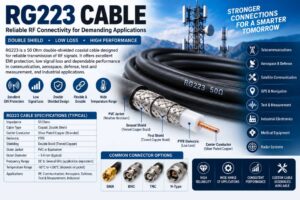
RG-223
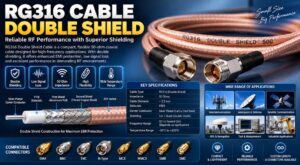
RG-316
RG-400
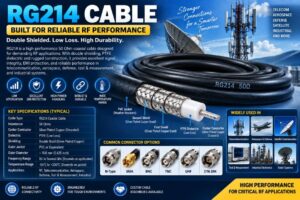
RG-214
Sucoflex
Ecoflex
Times Microwave cables
Each cable offers different attenuation characteristics, flexibility, and power handling capabilities.
Frequency Range
Low loss cable assemblies are available for frequencies including:
DC to 1 GHz
DC to 3 GHz
DC to 6 GHz
DC to 12 GHz
DC to 18 GHz
DC to 26.5 GHz
DC to 40 GHz
DC to 50 GHz
DC to 67 GHz
Some precision microwave assemblies operate beyond 110 GHz.
Importance of Low Loss Cable Assemblies
Signal loss directly affects communication quality and measurement accuracy.
Using low loss cable assemblies provides several benefits.
Improved signal strength
Reduced transmission loss
Greater communication range
Higher measurement accuracy
Improved antenna performance
Reduced system noise
Better network reliability
Enhanced receiver sensitivity
Longer transmission distances
Improved overall system efficiency
Applications of Low Loss Cable Assemblies
5G Communication Networks
5G infrastructure requires ultra-low-loss cable assemblies for high-frequency signal transmission between antennas and base station equipment.
`Satellite Communication
Satellite ground stations rely on low loss cables to minimize signal degradation over long cable runs.
Aerospace
Aircraft communication systems use low loss cable assemblies because of their lightweight construction and excellent RF performance.
Military and Defense
Radar systems, electronic warfare equipment, communication systems, and missile guidance systems require precision cable assemblies with minimal signal loss.
Medical Equipment
MRI machines, RF imaging equipment, and medical diagnostic devices depend on high-performance RF cable assemblies.
Broadcasting
Television and radio broadcasting stations use low loss cables for reliable RF transmission.
Laboratory Testing
RF laboratories require precision cable assemblies for accurate measurements and calibration.
Industrial Automation
Wireless automation systems depend on stable RF cable assemblies for uninterrupted communication.
IoT Infrastructure
Smart cities, wireless sensors, industrial IoT, and connected devices rely on efficient RF connectivity.
Advantages of Low Loss Cable Assemblies
Minimal insertion loss
Excellent shielding
Higher signal quality
Long service life
Superior durability
Excellent flexibility
Reliable impedance matching
High-frequency compatibility
Reduced electromagnetic interference
Weather resistance
Improved power handling
Easy installation
Cost-effective over long-term operation
Limitations
Higher initial cost
Larger cable diameter
Requires precision connectors
Improper installation can reduce performance
Longer lead times for custom assemblies
Important Specifications
When selecting a low loss cable assembly, engineers should evaluate:
Cable attenuation
Operating frequency
Connector type
Impedance
VSWR
Return loss
Power handling
Cable flexibility
Shielding effectiveness
Minimum bend radius
Operating temperature
Environmental resistance
Cable length
Connector plating
RoHS compliance
How to Choose the Right Low Loss Cable Assembly
Determine your operating frequency.
Calculate acceptable insertion loss.
Select the proper impedance.
Choose compatible connectors.
Consider installation environment.
Verify power handling.
Check cable flexibility.
Evaluate shielding performance.
Select appropriate cable length.
Purchase from a trusted manufacturer.
Maintenance Tips
Avoid excessive cable bending.
Protect connectors from contamination.
Use torque wrenches for precision connectors.
Store cables properly.
Inspect connectors regularly.
Avoid crushing or twisting the cable.
Replace damaged cable assemblies immediately.
Future Trends
The rapid expansion of 5G, satellite internet, autonomous vehicles, aerospace systems, and future 6G communication is driving demand for next-generation low loss cable assemblies. Manufacturers are developing lighter materials, improved dielectric technologies, enhanced shielding, and ultra-low-loss constructions capable of operating beyond 110 GHz. Future cable assemblies will provide even greater signal integrity, lower attenuation, and higher durability for increasingly demanding RF and microwave applications.
Conclusion
Low Loss Cable Assemblies are essential components in modern RF and microwave communication systems, providing reliable, high-performance signal transmission with minimal attenuation. By combining premium coaxial cables, precision connectors, advanced dielectric materials, and superior shielding, these assemblies help maintain signal integrity across a broad range of frequencies and applications. Whether used in 5G networks, satellite communications, aerospace, defense, medical equipment, broadcasting, laboratory testing, or industrial automation, low loss cable assemblies improve efficiency, reduce signal degradation, and enhance overall system reliability. Selecting the correct cable type, connector, impedance, frequency rating, and environmental protection ensures long-lasting performance and optimal results in demanding RF environments.
Frequently Asked Questions (FAQs)
1. What is a Low Loss Cable Assembly?
A Low Loss Cable Assembly is a pre-terminated RF coaxial cable designed to transmit high-frequency signals with minimal signal attenuation and excellent impedance matching.
2. Why are Low Loss Cable Assemblies important?
They reduce signal loss, improve communication quality, enhance measurement accuracy, and increase the overall efficiency of RF and microwave systems.
3. What industries use Low Loss Cable Assemblies?
They are widely used in telecommunications, 5G infrastructure, satellite communication, aerospace, defense, broadcasting, medical equipment, industrial automation, and RF testing laboratories.
4. What is the difference between a standard cable and a Low Loss Cable Assembly?
Low loss cable assemblies use premium materials, advanced shielding, and precision connectors to minimize attenuation, whereas standard cables typically experience higher signal loss over long distances.
5. What connector types are available?
Common connector options include SMA, N-Type, BNC, TNC, 7/16 DIN, 4.3-10, MCX, MMCX, 2.92 mm, and F-Type connectors.
6. What impedance values are commonly available?
Most low loss cable assemblies are manufactured in 50 Ohm and 75 Ohm impedance configurations.
7. Can Low Loss Cable Assemblies be customized?
Yes. Manufacturers offer custom cable lengths, connector combinations, jacket materials, shielding options, and electrical specifications to meet application-specific requirements.
8. How do I select the right Low Loss Cable Assembly?
Choose based on operating frequency, attenuation requirements, cable length, connector compatibility, impedance, power handling, environmental conditions, and flexibility.
9. What is insertion loss?
Insertion loss is the reduction in signal power that occurs when a cable assembly is inserted into an RF transmission path. Lower insertion loss indicates better cable performance.
10. What frequencies do Low Loss Cable Assemblies support?
Depending on the cable type and connectors, low loss cable assemblies can support frequencies from DC up to 67 GHz or higher for specialized microwave applications.
11. Are Low Loss Cable Assemblies suitable for outdoor use?
Yes. Outdoor-rated cable assemblies are available with UV-resistant, weatherproof, and moisture-resistant jackets for reliable long-term performance in harsh environments.
12. How long do Low Loss Cable Assemblies last?
With proper installation and maintenance, high-quality low loss cable assemblies can provide reliable performance for many years, even in demanding industrial and outdoor applications.