Reliable communication is critical in environments where traditional radio signals struggle to penetrate. Locations such as underground mines, tunnels, subways, airports, industrial facilities, and large commercial buildings often face significant challenges in maintaining seamless wireless connectivity. This is where Leaky Feeder Cable technology becomes an essential solution.
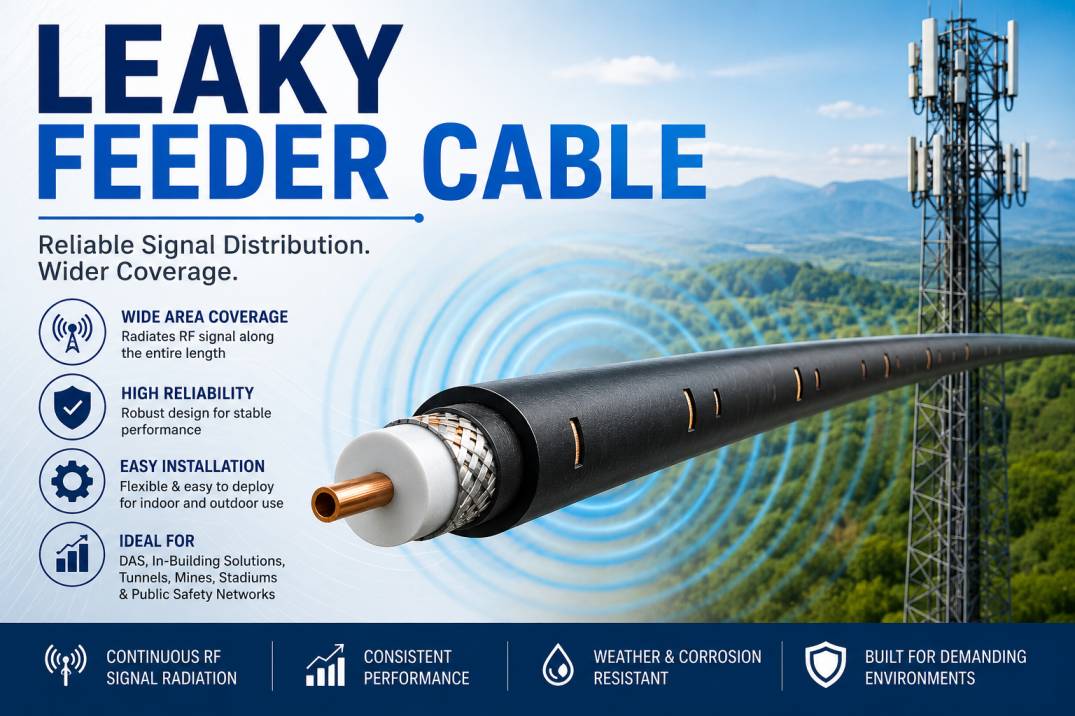
A Leaky Feeder Cable acts as a distributed antenna system that enables continuous radio frequency (RF) signal transmission along its entire length. Unlike conventional coaxial cables that contain RF signals within the cable, leaky feeder cables are specifically designed to “leak” radio signals through slots or openings in the outer conductor, creating consistent wireless coverage over long distances.
Widely used in mining, transportation, public safety networks, and in-building communication systems, leaky feeder technology has become a vital component of modern communication infrastructure.
In this comprehensive guide, we will explore what a leaky feeder cable is, how it works, its components, advantages, applications, installation methods, and future trends in wireless communication.
What Is a Leaky Feeder Cable?
A Leaky Feeder Cable, also known as a Radiating Cable, is a specially designed coaxial cable that functions as both a transmission line and an antenna.
Unlike standard RF coaxial cables that prevent signal leakage, a leaky feeder cable intentionally allows RF signals to radiate through precisely engineered slots or apertures in the outer conductor.
This unique design enables wireless devices to communicate with the cable at any point along its length, providing continuous signal coverage throughout the installation area.
Leaky feeder systems are commonly used when conventional antennas cannot provide reliable coverage due to obstacles, underground environments, or complex structures.
How Does a Leaky Feeder Cable Work?
The operation of a leaky feeder cable is based on controlled RF signal radiation.
Signal Transmission
An RF signal from a radio transmitter, repeater, or base station enters one end of the cable.
Controlled Radiation
The cable contains carefully engineered slots in its outer conductor. These slots allow a portion of the RF energy to escape uniformly along the cable’s length.
Bidirectional Communication
Wireless devices such as handheld radios, mobile phones, and communication terminals can transmit and receive signals through the cable.
Continuous Coverage
Because the cable radiates signals throughout its entire length, users experience uninterrupted communication even in challenging environments.
The result is a highly reliable communication system capable of covering areas where conventional antenna systems may fail.
Main Components of a Leaky Feeder Cable
A leaky feeder cable consists of several critical components.
Inner Conductor
The central conductor carries RF signals throughout the cable.
Typically made from:
- Copper
- Copper-clad aluminum
- Silver-plated conductors
The inner conductor plays a crucial role in minimizing signal loss.
Dielectric Insulation
The dielectric layer surrounds the inner conductor and maintains signal integrity.
Functions include:
- Electrical insulation
- Signal propagation
- Impedance control
Common dielectric materials include polyethylene and foam polyethylene.
Slotted Outer Conductor
The outer conductor is the most distinctive feature of a leaky feeder cable.
It contains precision-engineered slots that enable RF radiation.
Benefits include:
- Controlled signal leakage
- Uniform coverage
- Reduced dead zones
Protective Outer Jacket
The outer jacket protects the cable from environmental damage.
Protection against:
- Moisture
- Chemicals
- UV exposure
- Mechanical stress
This ensures long-term durability in harsh environments.
Types of Leaky Feeder Cables
Different applications require different cable designs.
Standard Leaky Feeder Cable
Provides balanced signal radiation and coverage.
Applications:
- Underground mines
- Tunnels
- Industrial facilities
Broadband Leaky Feeder Cable
Supports multiple frequency bands simultaneously.
Ideal for:
- Public safety networks
- Cellular communication
- Wi-Fi coverage
Low-Loss Leaky Feeder Cable
Designed to minimize attenuation over long distances.
Benefits:
- Extended coverage
- Improved performance
- Reduced repeater requirements
Fire-Resistant Leaky Feeder Cable
Manufactured with fire-retardant materials.
Used in:
- Metro systems
- Airports
- Commercial buildings
- Emergency communication networks
Key Features of Leaky Feeder Cables
Continuous RF Coverage
Provides communication access throughout the cable route.
Wide Frequency Support
Supports multiple communication technologies including:
- VHF
- UHF
- LTE
- GSM
- 4G
- 5G
- Wi-Fi
High Reliability
Maintains communication even in challenging environments.
Flexible Installation
Can be mounted along walls, ceilings, tunnels, and underground pathways.
Long Service Life
Engineered for demanding industrial and outdoor applications.
Advantages of Leaky Feeder Cable Systems
Eliminates Communication Dead Zones
Traditional antennas often leave coverage gaps.
Leaky feeder systems provide consistent signal availability throughout the coverage area.
Improved Worker Safety
Reliable communication is essential in hazardous environments such as mines and tunnels.
Benefits include:
- Emergency communication
- Worker tracking
- Faster response times
Cost-Effective Coverage
Instead of installing numerous antennas, a single leaky feeder cable can provide extensive coverage.
This reduces:
- Infrastructure costs
- Installation complexity
- Maintenance expenses
Enhanced Network Reliability
Distributed signal transmission minimizes single points of failure.
The system continues to operate efficiently even under demanding conditions.
Supports Multiple Services
A single cable infrastructure can support:
- Voice communication
- Data transmission
- Public safety networks
- Cellular coverage
Applications of Leaky Feeder Cables
Leaky feeder technology serves a wide range of industries.
Underground Mining
Mining operations represent one of the largest applications of leaky feeder systems.
Benefits include:
- Worker communication
- Emergency response
- Equipment monitoring
- Vehicle tracking
Underground environments make traditional radio communication difficult due to rock formations and tunnel structures.
Leaky feeder systems solve this challenge effectively.
Railway and Metro Tunnels
Subway systems require uninterrupted communication for:
- Train operators
- Maintenance crews
- Emergency responders
Leaky feeder cables ensure consistent signal coverage throughout underground transit networks.
Road Tunnels
Highway tunnels require communication infrastructure for:
- Traffic management
- Emergency services
- Security operations
Leaky feeder systems provide dependable connectivity in enclosed tunnel environments.
Airports
Large airport facilities use leaky feeder cables for:
- Security communication
- Ground operations
- Passenger services
- Emergency coordination
Commercial Buildings
Modern buildings often contain areas where cellular signals are weak.
Applications include:
- Shopping malls
- Hospitals
- Data centers
- Corporate campuses
Leaky feeder systems improve indoor wireless coverage.
Military and Defense
Defense organizations utilize leaky feeder systems for secure communications in:
- Underground facilities
- Bunkers
- Tactical operations centers
Public Safety Networks
Police, fire departments, and emergency responders rely on dependable communication systems.
Leaky feeder cables support mission-critical communication during emergencies.
Leaky Feeder Cable vs Traditional Antenna Systems
| Feature | Leaky Feeder Cable | Traditional Antenna |
|---|---|---|
| Coverage Type | Continuous | Point Coverage |
| Tunnel Performance | Excellent | Limited |
| Dead Zones | Minimal | Common |
| Installation Flexibility | High | Moderate |
| Maintenance | Low | Moderate |
| Coverage Uniformity | Excellent | Variable |
For enclosed environments, leaky feeder systems often outperform traditional antenna-based solutions.
Installation of Leaky Feeder Cables
Proper installation is essential for optimal performance.
Site Survey
Engineers first evaluate:
- Coverage requirements
- Frequency bands
- Environmental conditions
Route Planning
Cable routes are designed to maximize signal coverage while minimizing signal loss.
Mounting and Support
The cable is installed using:
- Cable clamps
- Mounting brackets
- Support systems
Proper spacing ensures consistent performance.
Signal Amplification
Long cable runs may require repeaters or amplifiers.
These devices maintain signal strength throughout the system.
Testing and Optimization
After installation, technicians perform:
- Signal strength testing
- VSWR measurements
- Coverage verification
- Performance optimization
Challenges and Limitations
Although highly effective, leaky feeder systems have certain considerations.
Signal Attenuation
Signal strength gradually decreases along the cable length.
Repeaters may be necessary for long installations.
Initial Installation Cost
The initial investment can be higher than simple antenna systems.
However, lower maintenance and better coverage often result in long-term savings.
Specialized Design Requirements
Different applications require customized engineering and frequency planning.
Proper system design is crucial for success.
Future of Leaky Feeder Technology
As wireless communication continues to evolve, leaky feeder systems are adapting to support new technologies.
5G Integration
Modern radiating cables are being designed to support 5G frequency bands.
Benefits include:
- Higher capacity
- Faster data speeds
- Enhanced connectivity
Smart Mining
Leaky feeder infrastructure supports Industry 4.0 initiatives by enabling:
- IoT devices
- Remote monitoring
- Autonomous vehicles
- Predictive maintenance
Public Safety Enhancement
Governments worldwide are upgrading emergency communication systems using advanced leaky feeder networks.
Smart Transportation Systems
Future railways and tunnels will increasingly rely on radiating cable solutions for connected infrastructure.
Best Practices for Choosing a Leaky Feeder Cable
When selecting a leaky feeder cable, consider:
Frequency Range
Ensure compatibility with required communication technologies.
Cable Attenuation
Lower attenuation improves performance over long distances.
Environmental Conditions
Choose suitable jackets for:
- Underground installations
- Outdoor exposure
- Chemical environments
Fire Safety Requirements
Use fire-resistant cables where required by regulations.
Future Scalability
Select broadband solutions capable of supporting future communication upgrades.
Conclusion
Leaky Feeder Cable technology has revolutionized wireless communication in challenging environments where conventional antennas cannot provide reliable coverage. By functioning as both a transmission medium and a distributed antenna, these specialized cables deliver continuous RF coverage throughout tunnels, mines, transportation systems, industrial facilities, and large commercial buildings.
The ability to eliminate dead zones, improve worker safety, support multiple communication services, and provide dependable connectivity makes leaky feeder systems an essential part of modern communication infrastructure.
As industries continue adopting 5G, IoT, smart transportation, and advanced public safety networks, the demand for high-performance leaky feeder cable systems will continue to grow. Organizations investing in this technology gain a future-ready communication solution that enhances operational efficiency, safety, and reliability.