BNC adapters are essential RF and coaxial connectivity components used to connect, convert, or extend connections between compatible coaxial connectors. BNC stands for Bayonet Neill–Concelman, a connector interface known for its bayonet-style coupling mechanism. This mechanism allows users to connect and disconnect compatible connectors quickly without requiring a threaded connection.
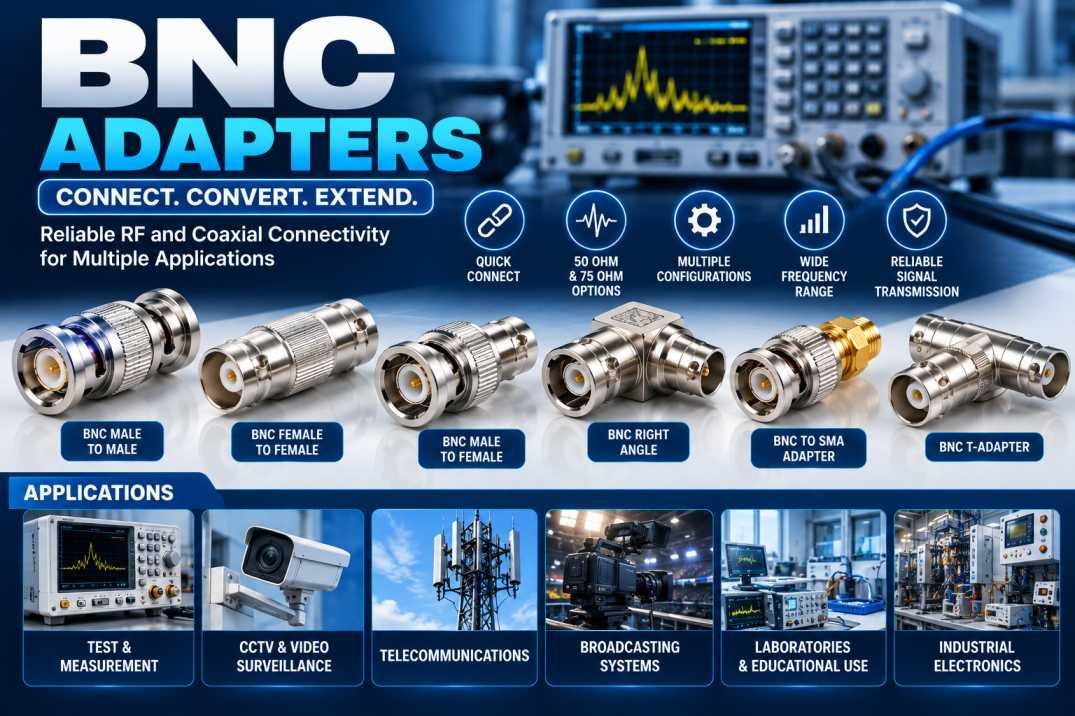
BNC adapters are widely used in test and measurement equipment, CCTV surveillance systems, broadcasting, telecommunications, laboratory instrumentation, and electronic devices. They are available in different configurations, including BNC male-to-male, female-to-female, male-to-female, right-angle adapters, and adapters that convert BNC interfaces to other connector types.
Understanding BNC adapters, their types, electrical specifications, and applications helps engineers select the appropriate component for reliable signal transmission.
What Are BNC Adapters?
BNC adapters are passive electrical components designed to connect two compatible RF or coaxial interfaces. Depending on their configuration, they can join connectors of the same type, change the gender of a connection, or convert a BNC interface to another connector standard.
Most BNC adapters used in RF applications are designed for 50-ohm or 75-ohm systems. The appropriate impedance depends on the application and the equipment being connected. For example, 50-ohm BNC interfaces are common in RF instrumentation, while 75-ohm interfaces are frequently used in video and broadcasting systems.
A suitable BNC adapter maintains the intended electrical connection between components. However, actual performance depends on its design, operating frequency, impedance, manufacturing quality, and compatibility with the connected equipment.
How Do BNC Adapters Work?
BNC adapters provide a mechanical and electrical connection between two interfaces. Their bayonet coupling mechanism typically uses pins and a quarter-turn locking action to secure compatible connectors.
The center contact carries the signal, while the outer conductive body provides the return path and shielding. The internal dielectric separates the center conductor from the outer conductor and helps maintain the intended impedance.
For dependable performance, the adapter must match the connector interface and impedance requirements of the system. An unsuitable adapter can introduce impedance discontinuities, signal reflections, insertion loss, or unreliable mechanical contact.
Types of BNC Adapters
1. BNC Male-to-Male Adapter
A BNC male-to-male adapter provides two male interfaces. It is used when two female BNC connections need to be joined through a suitable adapter configuration.
2. BNC Female-to-Female Adapter
A BNC female-to-female adapter has female interfaces at both ends. It can connect two BNC male-ended cables or components when the mechanical arrangement and electrical specifications are compatible.
3. BNC Male-to-Female Adapter
This adapter features one male and one female BNC interface. It is useful for extending a connection or adapting between equipment and cables with different connector genders.
4. BNC Right-Angle Adapter
A BNC right-angle adapter changes the direction of a connection, typically by approximately 90 degrees. It is useful in compact installations, equipment racks, test benches, and locations where cable clearance is limited.
5. BNC-to-SMA Adapter
A BNC-to-SMA adapter connects a compatible BNC interface to an SMA interface. It can be useful when integrating RF instruments, modules, antennas, or cables that use different connector standards. Impedance and frequency compatibility must be verified before use.
6. BNC-to-N-Type Adapter
A BNC-to-N-Type adapter connects BNC equipment or cables to compatible N-Type interfaces. It may be used in RF test setups, communication systems, and laboratory environments.
7. BNC T-Adapter
A BNC T-adapter provides three connection points in a T-shaped arrangement. It is used in certain signal distribution and test configurations. However, a passive T-adapter does not provide isolation or active signal splitting, and its use can affect impedance matching and signal quality.
Key Features of BNC Adapters
BNC adapters offer several practical features for coaxial connectivity:
- Quick-connect bayonet coupling for convenient installation
- Availability in male, female, and mixed-gender configurations
- Options for 50-ohm and 75-ohm systems
- Compact designs for equipment panels and laboratory setups
- Compatibility with selected coaxial cables and connector interfaces
- Availability in straight and right-angle configurations
- Conductive outer bodies that support shielding and signal return
- Options for different body materials, contact finishes, and mounting arrangements
The exact features vary according to the adapter model and manufacturer.
Technical Specifications of BNC Adapters
When choosing a BNC adapter, review its technical specifications rather than relying only on its physical appearance.
| Specification | Description |
|---|---|
| Connector Type | BNC |
| Interface Configuration | Male-to-male, female-to-female, male-to-female, or other types |
| Impedance | Commonly 50 ohms or 75 ohms, depending on model |
| Frequency Range | Manufacturer-specified operating range |
| VSWR | Indicates impedance matching performance |
| Insertion Loss | Signal power lost through the adapter |
| Return Loss | Indicates the amount of reflected signal |
| Body Material | Often brass or another suitable conductive material |
| Contact Plating | Depends on the design and performance requirements |
| Coupling Mechanism | Bayonet-style coupling |
| Mounting Style | Inline, panel-mounted, or other model-specific configurations |
These are general specification categories, not guaranteed ratings for every BNC adapter. Consult the manufacturer’s datasheet for exact frequency limits, electrical performance, dimensions, and environmental ratings.
Applications of BNC Adapters
Test and Measurement Equipment
BNC adapters are used with oscilloscopes, signal generators, frequency counters, and other instruments that provide compatible BNC interfaces. They help engineers configure measurement connections without replacing existing cables.
CCTV and Video Surveillance
BNC interfaces are used in various analog video systems. Suitable 75-ohm BNC adapters can connect compatible video cables, cameras, monitors, and recording equipment.
Telecommunications and RF Systems
In RF environments, BNC adapters can connect selected communication devices, coaxial cables, and test equipment. The adapter must support the system’s impedance and operating frequency.
Broadcasting Systems
Broadcasting equipment may use 75-ohm BNC interfaces for video and related signal connections. Correct impedance matching is important to help reduce signal reflections.
Laboratories and Educational Institutions
BNC adapters are useful in electronics laboratories, engineering workshops, and educational environments where test instruments and circuit assemblies require different connector configurations.
Industrial Electronics
Industrial measurement equipment and monitoring systems may use BNC connections for signal acquisition, instrumentation, and diagnostic tasks.
Advantages of Using BNC Adapters
BNC adapters provide a convenient way to adapt existing coaxial connections without replacing an entire cable assembly. Their quick-connect coupling supports efficient installation and removal, making them useful for frequently changed test setups.
Different connector configurations provide flexibility when connecting compatible equipment. Right-angle adapters can also help address space constraints, while BNC-to-SMA and BNC-to-N-Type models can bridge selected connector interfaces.
These advantages depend on choosing the correct adapter for the intended electrical and mechanical requirements.
How to Choose the Right BNC Adapter
Before selecting a BNC adapter, consider the following factors:
- Connector configuration: Identify the required male, female, or conversion interfaces.
- Impedance: Match 50-ohm or 75-ohm requirements to the connected system.
- Frequency range: Ensure the adapter is rated for the highest operating frequency.
- RF performance: Review VSWR, insertion loss, and return loss where relevant.
- Physical dimensions: Check overall length, clearance, and mounting requirements.
- Material and plating: Select a suitable construction for the operating environment.
- Application: Choose a model designed for RF instrumentation, video, broadcasting, or another intended use.
- Manufacturer specifications: Confirm the exact ratings and compatibility before installation.
Common Mistakes to Avoid
Using a 50-ohm adapter in a 75-ohm system, or vice versa, can introduce impedance mismatch. Assuming that every BNC adapter supports the same frequency range can also lead to unsuitable component selection.
Other common mistakes include using incompatible connector genders, overlooking mechanical clearance, applying excessive force during mating, and ignoring the adapter’s rated electrical performance. For demanding RF applications, the complete connection—including the cable and both mating interfaces—should be evaluated.
Conclusion
BNC adapters are versatile connectivity components used in RF instrumentation, video surveillance, broadcasting, telecommunications, laboratories, and industrial electronics. Their bayonet-style coupling makes connections quick and convenient, while different configurations support a wide range of interface requirements.
Selecting the right BNC adapter requires attention to connector type, impedance, frequency range, electrical performance, and mechanical compatibility. By checking these parameters against the manufacturer’s specifications, engineers and technicians can build dependable coaxial connections for their applications.
Frequently Asked Questions (FAQs)
1. What does BNC stand for?
BNC stands for Bayonet Neill–Concelman, referring to the connector interface and its bayonet-style coupling mechanism.
2. What is a BNC adapter used for?
A BNC adapter connects compatible coaxial interfaces, changes connector gender, converts between selected connector standards, or adapts a connection to suit an installation.
3. Are BNC adapters available in 50-ohm and 75-ohm versions?
Yes. BNC adapters are available for both 50-ohm and 75-ohm systems. The correct type depends on the connected equipment and application.
4. What is the difference between 50-ohm and 75-ohm BNC adapters?
The main difference is their intended characteristic impedance and associated design. Using an adapter with the wrong impedance can cause signal reflections and affect system performance.
5. Can a BNC adapter connect to an SMA connector?
Yes. BNC-to-SMA adapters are available, but the interface, impedance, frequency range, and electrical ratings must be compatible with the system.
6. Do BNC adapters support high-frequency RF signals?
Some BNC adapters are suitable for RF applications, but their maximum operating frequency varies by model. Always check the manufacturer’s datasheet.
7. What is a BNC right-angle adapter?
A BNC right-angle adapter redirects a connection, usually by approximately 90 degrees, helping accommodate restricted space or cable-routing requirements.
8. Do BNC adapters cause signal loss?
All practical adapters can introduce some insertion loss and impedance discontinuity. The amount depends on the adapter design, frequency, and quality of the complete connection.
9. Can BNC T-adapters split a signal?
A BNC T-adapter provides three connection points, but it is a passive junction rather than an isolated signal splitter. It may affect impedance matching and signal levels.
10. How do I select the right BNC adapter?
Check the connector genders, impedance, frequency rating, VSWR, insertion loss, physical dimensions, and compatibility with the intended equipment.