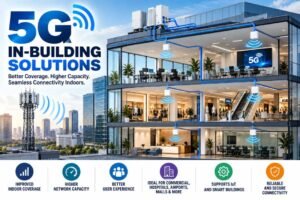
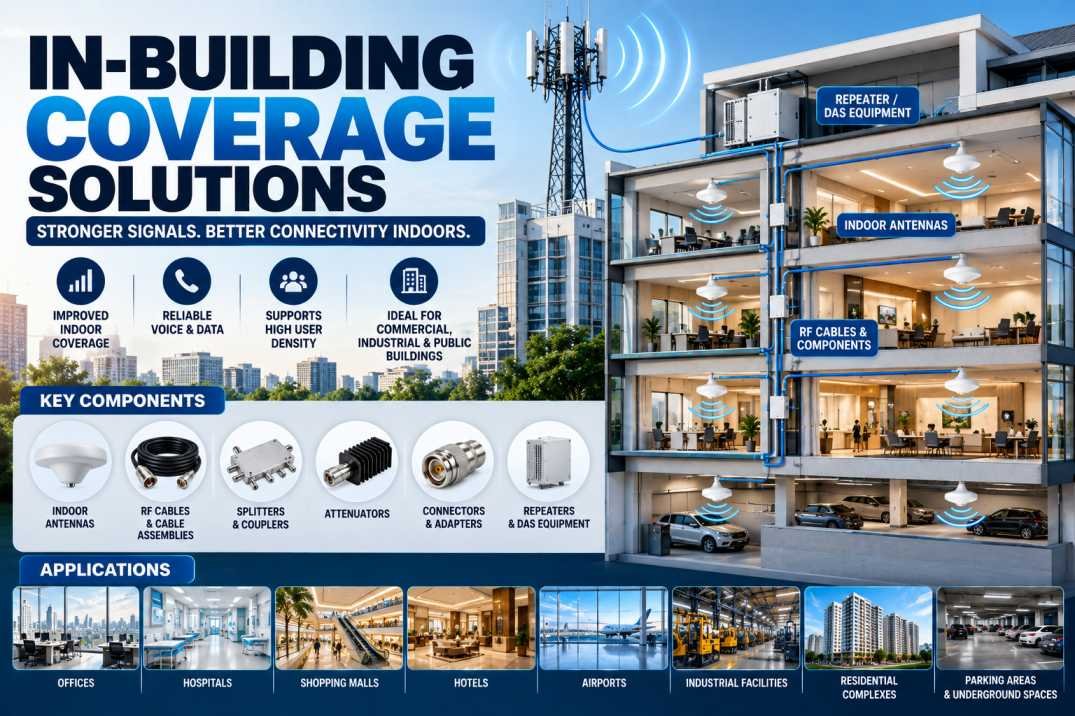
In-building coverage solutions are communication systems designed to improve indoor wireless connectivity where mobile signals are weak, unreliable, or unavailable. These solutions help provide consistent voice and data coverage inside buildings such as offices, hospitals, shopping malls, hotels, airports, industrial facilities, residential complexes, and underground parking areas.
Modern buildings often use concrete walls, metal structures, coated glass, and other materials that weaken outdoor cellular signals. As a result, users may experience dropped calls, slow internet speeds, poor voice quality, and network dead zones. In-building coverage solutions address these challenges by distributing wireless signals throughout indoor spaces.
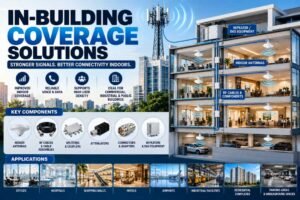
These systems are essential for modern telecom infrastructure, enterprise connectivity, and critical communication networks. Depending on building size, network requirements, and the available outdoor signal, solutions may include Distributed Antenna Systems (DAS), repeaters, small cells, indoor antennas, RF cables, splitters, couplers, and other RF components.
What Are In-Building Coverage Solutions?
In-building coverage solutions are systems that extend and distribute wireless signals inside buildings to improve network availability, signal strength, and communication reliability.
They receive signals from an external network or dedicated indoor radio equipment and distribute them to strategically placed indoor antennas. These antennas help deliver coverage to areas that outdoor base stations cannot adequately reach.
An in-building coverage system can support cellular voice, mobile broadband, enterprise wireless services, and, where specifically designed, critical communication technologies such as TETRA.
The exact system configuration depends on the required coverage area, number of users, frequency bands, network operators, and expected data capacity.
Why Are In-Building Coverage Solutions Important?
Indoor connectivity is essential because people spend a significant amount of time inside buildings, where wireless signals may be weakened by structural barriers.
1. Weak Indoor Mobile Signals
Concrete walls, basements, elevators, and metal structures can reduce signal penetration. Indoor coverage systems help deliver wireless signals to these challenging locations.
2. Dropped Calls and Poor Voice Quality
Weak signals can result in interrupted conversations and unreliable mobile services. Properly designed indoor coverage helps improve communication consistency.
3. Slow Mobile Data Connectivity
Poor radio conditions can affect mobile data performance. An appropriate indoor system can improve signal availability and support better user experiences, subject to network capacity and backhaul performance.
4. High User Density
Places such as shopping malls, stadiums, offices, and airports may contain hundreds or thousands of simultaneous users. Coverage planning must consider both signal distribution and network capacity.
5. Critical Communication Requirements
Hospitals, transportation facilities, industrial plants, and emergency response environments may require dependable indoor communication. Dedicated systems can be designed to support relevant public-safety or mission-critical networks.
Types of In-Building Coverage Solutions
1. Distributed Antenna System (DAS)
A Distributed Antenna System distributes wireless signals across multiple indoor antennas connected through a shared infrastructure. DAS may use passive coaxial components, active equipment, or a hybrid architecture.
DAS is commonly deployed in airports, hospitals, commercial buildings, hotels, stadiums, and large public facilities.
Key benefits include wide-area indoor coverage, flexible antenna placement, and support for multiple zones or services when the system is appropriately designed.
2. RF Repeaters and Bi-Directional Amplifiers
RF repeaters receive an existing wireless signal, amplify it, and retransmit it to improve coverage in selected indoor areas. A repeater generally requires a suitable outdoor donor signal and correctly installed donor and service antennas.
Bi-directional amplifiers can amplify signals in both uplink and downlink directions. Their use must comply with applicable telecom regulations and operator requirements. Poorly installed equipment can create interference, so professional design and commissioning are important.
3. Small Cells
Small cells are compact cellular access nodes installed inside or near buildings to provide localized coverage and capacity. They connect to the operator’s network through an appropriate backhaul connection.
Small cells are suitable for offices, enterprise campuses, retail environments, and locations where additional cellular capacity is needed.
4. Indoor Antenna Systems
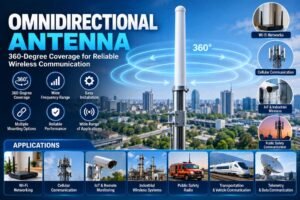
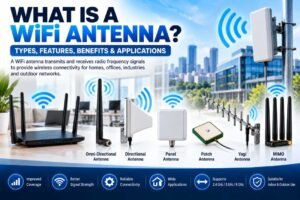
Indoor antennas distribute wireless signals throughout designated coverage areas. Common antenna types include omnidirectional ceiling antennas, directional panel antennas, and other specialized antenna designs.
Antenna selection depends on the frequency band, mounting location, coverage pattern, building layout, and required performance.
5. TETRA and Critical Communication Coverage
TETRA is used for professional mobile radio and mission-critical communication in sectors such as public safety, transportation, utilities, and industrial operations.
Dedicated in-building systems can extend TETRA coverage into basements, tunnels, control rooms, and other areas where reliable radio communication is necessary. Requirements differ from ordinary cellular systems and should be assessed separately.
Key Components of In-Building Coverage Solutions
An effective in-building coverage system combines several RF and telecom components.
| Component | Function |
|---|---|
| Indoor antennas | Distribute wireless signals within the building |
| RF cables and cable assemblies | Carry RF signals between system components |
| Splitters and power dividers | Divide signals between multiple distribution paths |
| Directional couplers | Transfer a defined portion of RF power to a branch |
| Attenuators | Control RF signal levels and balance the network |
| RF connectors and adapters | Provide reliable connections between components |
| Repeaters or amplifiers | Improve signal levels where suitable and permitted |
| DAS equipment | Distribute RF or digital signals across indoor coverage zones |
| Small cells | Provide localized cellular coverage and capacity |
Selecting compatible components is essential for controlling signal loss, maintaining impedance matching, and achieving dependable network performance.
Benefits of In-Building Coverage Solutions
Improved Indoor Connectivity
These systems help extend wireless service into areas where outdoor signals are weak or blocked.
Better Voice and Data Experience
Improved radio conditions can reduce coverage-related call interruptions and support more consistent mobile data performance.
Wider Coverage Across Complex Buildings
Carefully positioned antennas can provide connectivity in basements, corridors, stairwells, conference rooms, and other challenging spaces.
Support for Multiple Communication Services
Depending on the design, infrastructure may support multiple cellular bands, network operators, enterprise services, or dedicated radio systems.
Enhanced Operational Reliability
Reliable indoor communication can support business operations, facility management, and critical communication workflows.
Scalable Network Infrastructure
A properly planned system can be expanded or upgraded as building occupancy, technology, and communication requirements change.
Applications of In-Building Coverage Solutions
Commercial Buildings and Offices
Indoor coverage systems support mobile communication, employee connectivity, meetings, and business operations in multi-storey buildings.
Hospitals and Healthcare Facilities
Reliable wireless coverage supports communication among staff, mobile devices, and connected equipment where compatible systems are deployed.
Airports and Railway Stations
Large transport facilities need broad coverage across terminals, waiting areas, platforms, service corridors, and underground spaces.
Shopping Malls and Hotels
Indoor coverage improves connectivity for visitors, staff, digital services, and building operations.
Industrial Plants and Warehouses
Wireless systems support communication across production areas, control rooms, storage facilities, and large industrial structures.
Residential Complexes
Apartments, high-rise buildings, and underground parking facilities can benefit from improved mobile signal distribution.
Tunnels and Underground Facilities
Specialized antenna and cable-distribution systems can extend communication into environments where direct outdoor radio coverage is limited.
How to Choose the Right In-Building Coverage Solution
Selecting the appropriate system requires a structured technical assessment.
- Conduct a coverage survey: Identify weak-signal zones, dead spots, building materials, and existing outdoor signal conditions.
- Define network requirements: Determine the required operators, frequency bands, technologies, and communication services.
- Evaluate building size and occupancy: Estimate coverage areas, user density, traffic demand, and capacity requirements.
- Select the architecture: Compare DAS, small cells, repeaters, or dedicated radio systems according to the site requirements.
- Calculate RF losses: Consider cable length, connectors, splitters, couplers, and other distribution components.
- Plan antenna locations: Use radio-frequency planning to achieve suitable coverage while controlling interference.
- Verify compliance: Confirm operator approvals, applicable regulations, safety requirements, and equipment compatibility.
- Test and optimize: Measure signal levels and service quality after installation, then adjust the system as needed.
Conclusion
In-building coverage solutions are an important part of modern telecom infrastructure. They help overcome indoor signal limitations and improve wireless communication across commercial buildings, hospitals, airports, hotels, industrial facilities, and underground environments.
Technologies such as Distributed Antenna Systems, small cells, repeaters, and indoor antenna networks provide different approaches to improving coverage and capacity. The right choice depends on the building structure, required frequency bands, user density, existing signal conditions, and network objectives.
For reliable performance, system design must account for antenna placement, RF cable losses, connectors, splitters, couplers, signal levels, and regulatory requirements. A professionally planned and tested solution can provide dependable indoor connectivity and support evolving communication needs.
FAQs About In-Building Coverage Solutions
1. What are in-building coverage solutions?
They are wireless communication systems designed to improve mobile and radio signal coverage inside buildings where outdoor signals are weak or obstructed.
2. What is the purpose of an in-building coverage system?
Its purpose is to extend wireless coverage, reduce indoor dead zones, improve communication reliability, and support indoor voice and data services.
3. What is DAS in telecom?
DAS stands for Distributed Antenna System. It distributes wireless signals through multiple antennas to provide coverage across different areas of a building.
4. What is the difference between DAS and a repeater?
DAS distributes signals across an antenna network and may use passive, active, or hybrid equipment. A repeater receives, amplifies, and retransmits an existing signal. Their suitability depends on coverage, capacity, and network requirements.
5. Which components are used in in-building coverage solutions?
Typical components include antennas, RF cables, cable assemblies, connectors, splitters, couplers, attenuators, repeaters, DAS equipment, and small cells.
6. Where are in-building coverage solutions used?
They are used in offices, hospitals, airports, railway stations, shopping malls, hotels, factories, warehouses, tunnels, and residential complexes.
7. Can in-building coverage solutions support TETRA?
Yes. Dedicated systems can be designed to distribute TETRA signals indoors for professional and mission-critical communication, subject to the required radio architecture and coverage specifications.
8. Do in-building coverage solutions improve internet speed?
They can improve radio conditions and support better mobile data performance. Actual speeds also depend on network capacity, backhaul, interference, and the user’s device.
9. What factors affect in-building coverage performance?
Building materials, frequency bands, antenna locations, cable losses, interference, user density, outdoor signal quality, and network capacity all affect performance.
10. Why is professional installation important?
Professional design and installation help ensure suitable coverage, correct RF power levels, compatible components, regulatory compliance, and reduced risk of network interference.