A BNC Adaptor is an RF coaxial connector accessory used to connect, convert, or extend connections between compatible BNC interfaces and other coaxial connector types. BNC adaptors are widely used in telecommunications, RF systems, broadcasting, test and measurement equipment, CCTV systems, laboratory instruments, and electronic communication networks.
BNC stands for Bayonet Neill–Concelman. The connector uses a bayonet-style coupling mechanism that allows quick connection and disconnection without requiring a threaded locking process. A BNC adaptor provides flexibility when integrating different devices, cables, and instruments while maintaining a suitable electrical connection.
What Is a BNC Adaptor?
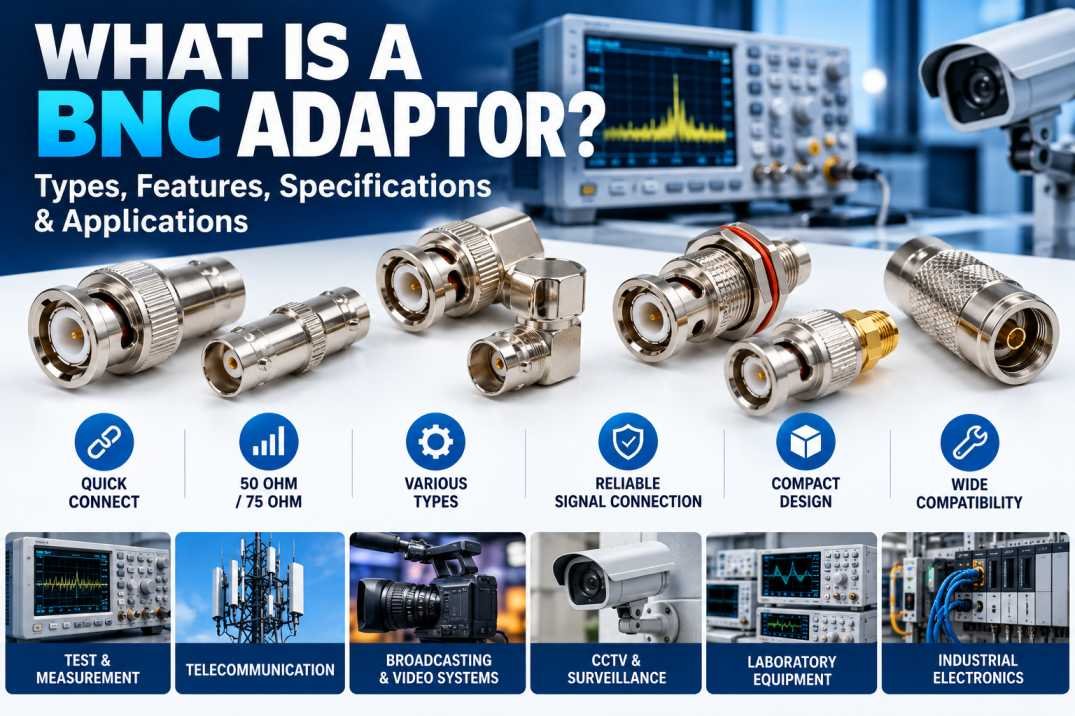
A BNC Adaptor is a compact RF component designed to join two connectors, convert between different connector interfaces, or provide a connection between coaxial cables and electronic equipment. Depending on its configuration, it may connect BNC male to BNC female, BNC male to SMA female, BNC female to N-type male, or other compatible interfaces.
BNC adaptors are available in straight, right-angle, bulkhead, and connector-conversion configurations. They are commonly used in 50-ohm RF systems and 75-ohm video systems, depending on the specific product design.
Selecting the correct BNC Adaptor is important because impedance, frequency range, connector gender, and mechanical compatibility can affect overall system performance.
How Does a BNC Adaptor Work?
A BNC Adaptor connects the center contacts and outer conductors of two compatible interfaces. The center contact carries the signal, while the outer conductor provides the return path and shielding.
The bayonet locking mechanism on a BNC interface uses pins and slots to secure the mating connector. This arrangement enables fast installation and removal, making it practical for test benches, broadcasting equipment, and systems requiring frequent connections.
For reliable performance, the adaptor must match the intended connector interfaces and electrical requirements. Poor mating, damaged contacts, or impedance mismatch can increase signal reflections and transmission losses.
Types of BNC Adaptors
1. BNC Male to BNC Female Adaptor
This adaptor connects a BNC male interface to a BNC female interface. It is useful for extending connections, changing interface orientation, or adapting existing cables to equipment ports.
2. BNC Female to BNC Female Adaptor
Also known as a BNC barrel adaptor or coupler, this component joins two BNC male-ended cables. It is commonly used to extend coaxial connections in laboratories, video systems, and electronic test setups.
3. BNC Male to SMA Female Adaptor
This adaptor connects compatible BNC and SMA interfaces. It is useful when integrating BNC-equipped instruments with RF modules or cable assemblies that use SMA connectors. The adaptor’s impedance and frequency ratings must match the application.
4. BNC to N-Type Adaptor
A BNC-to-N-type adaptor connects equipment or cables using these two connector families. It can be used in RF communication, antenna testing, and instrumentation when the connector specifications are compatible.
5. Right-Angle BNC Adaptor
A right-angle BNC adaptor changes the direction of the cable connection, helping reduce clearance requirements behind equipment panels or inside compact enclosures. Care should be taken to avoid excessive cable bending.
6. Bulkhead BNC Adaptor
A bulkhead BNC adaptor is designed for panel mounting. It provides an accessible connector interface through an enclosure or equipment panel and may include a threaded mounting section and retaining hardware.
Key Features of BNC Adaptor
BNC adaptors offer several practical features for RF and electronic systems:
- Quick-connect bayonet coupling for compatible BNC interfaces.
- Compact construction for convenient installation.
- Connector conversion between compatible interface types.
- Straight and right-angle configurations.
- Panel-mount and bulkhead options.
- Metal construction for mechanical durability and shielding.
- Availability in 50-ohm and 75-ohm configurations.
- Compatibility with selected RF, video, and test equipment.
- Reusable connections for systems requiring frequent setup changes.
Actual features depend on the adaptor model, materials, plating, and manufacturer specifications.
Technical Specifications of BNC Adaptor
The following table outlines common specification categories to review when selecting a BNC Adaptor. Exact values vary by model.
| Specification | Details |
|---|---|
| Connector Type | BNC adaptor |
| Interface | BNC-to-BNC or connector conversion |
| Impedance | Typically 50 ohms or 75 ohms |
| Coupling Mechanism | Bayonet coupling for BNC interfaces |
| Frequency Range | Depends on adaptor design |
| Body Material | Commonly brass or other conductive metal |
| Plating | Varies by model |
| Mounting Type | Inline, right-angle, or bulkhead |
| Applications | RF, video, telecom, and instrumentation |
Always consult the manufacturer’s datasheet for the supported frequency range, VSWR, insertion loss, voltage rating, and environmental limits.
Applications of BNC Adaptor
RF and Microwave Testing
BNC adaptors help connect test instruments, signal generators, oscilloscopes, and RF equipment with compatible coaxial interfaces. They make it easier to configure test setups without replacing existing cables.
Telecommunications
Communication systems use coaxial connections for selected signal paths, monitoring interfaces, and equipment testing. BNC adaptors can help integrate devices with different connector interfaces.
Broadcasting and Video Systems
BNC connectors are widely used in professional video equipment. Compatible 75-ohm BNC adaptors can support video connections in production studios, monitoring systems, and broadcast installations.
CCTV and Surveillance
BNC adaptors can connect compatible coaxial cables and video equipment in surveillance installations. The selected adaptor must suit the system’s connector type and signal requirements.
Laboratory and Educational Equipment
Laboratories and educational institutions use BNC adaptors to simplify connections between instruments, test boards, and signal sources. Their quick-connect design is useful when connections must be changed frequently.
Industrial Electronics
BNC adaptors are also used in electronic test equipment, monitoring systems, and industrial instrumentation where compatible coaxial interfaces are required.
Advantages of Using a BNC Adaptor
A BNC Adaptor offers flexibility by allowing existing cables and devices to connect without replacing the entire cable assembly. Its quick-lock mechanism supports convenient installation, while different adaptor configurations accommodate various mounting and clearance requirements.
Using the correct adaptor can also simplify equipment maintenance, reduce the need for custom cable assemblies, and improve compatibility between instruments. However, an adaptor cannot compensate for an unsuitable cable, incorrect impedance, or a connector with inadequate frequency performance.
How to Choose the Right BNC Adaptor
Consider the following factors before purchasing a BNC Adaptor:
- Connector interface: Confirm the connector types on both sides, such as BNC male, BNC female, SMA, or N-type.
- Impedance: Match the adaptor to the system’s 50-ohm or 75-ohm requirement.
- Frequency range: Ensure the adaptor supports the full operating frequency of the application.
- Mounting configuration: Choose inline, right-angle, or bulkhead mounting as needed.
- Electrical performance: Review VSWR, insertion loss, and return loss specifications.
- Material and plating: Consider durability, corrosion resistance, and operating environment.
- Application requirements: Select a model suitable for RF testing, video transmission, telecommunications, or instrumentation.
Conclusion
A BNC Adaptor is a useful component for connecting compatible coaxial interfaces across RF, telecommunications, broadcasting, CCTV, laboratory, and industrial applications. Its bayonet coupling mechanism supports quick connections, while different interface and mounting configurations provide installation flexibility.
For reliable performance, select a BNC Adaptor according to connector gender, impedance, frequency range, mounting dimensions, and electrical specifications. Matching the adaptor to the complete cable and equipment system helps maintain dependable signal transmission and mechanical compatibility.
FAQs About BNC Adaptor
1. What is a BNC Adaptor used for?
A BNC Adaptor connects compatible BNC interfaces or converts between BNC and other coaxial connector types.
2. What does BNC stand for?
BNC stands for Bayonet Neill–Concelman, referring to the connector’s bayonet-style coupling mechanism and its associated name.
3. Are BNC adaptors available in 50 ohms and 75 ohms?
Yes. Both types are available. The correct impedance depends on the application and the equipment being connected.
4. What is a BNC barrel adaptor?
A BNC barrel adaptor, commonly configured as BNC female-to-female, joins two compatible BNC male connectors.
5. Can a BNC Adaptor connect BNC to SMA?
Yes. BNC-to-SMA adaptors are available in different gender combinations. Check interface compatibility, impedance, and frequency ratings before use.
6. What is a bulkhead BNC Adaptor?
A bulkhead BNC Adaptor is designed to mount through a panel or enclosure, providing an accessible connector interface.
7. Does a BNC Adaptor affect signal quality?
It can. An unsuitable adaptor, impedance mismatch, poor contact, or operation beyond its rated frequency can increase signal loss and reflections.
8. How do I select the correct BNC Adaptor?
Check connector gender, interface type, impedance, operating frequency, mounting style, electrical performance, and environmental requirements before purchasing.