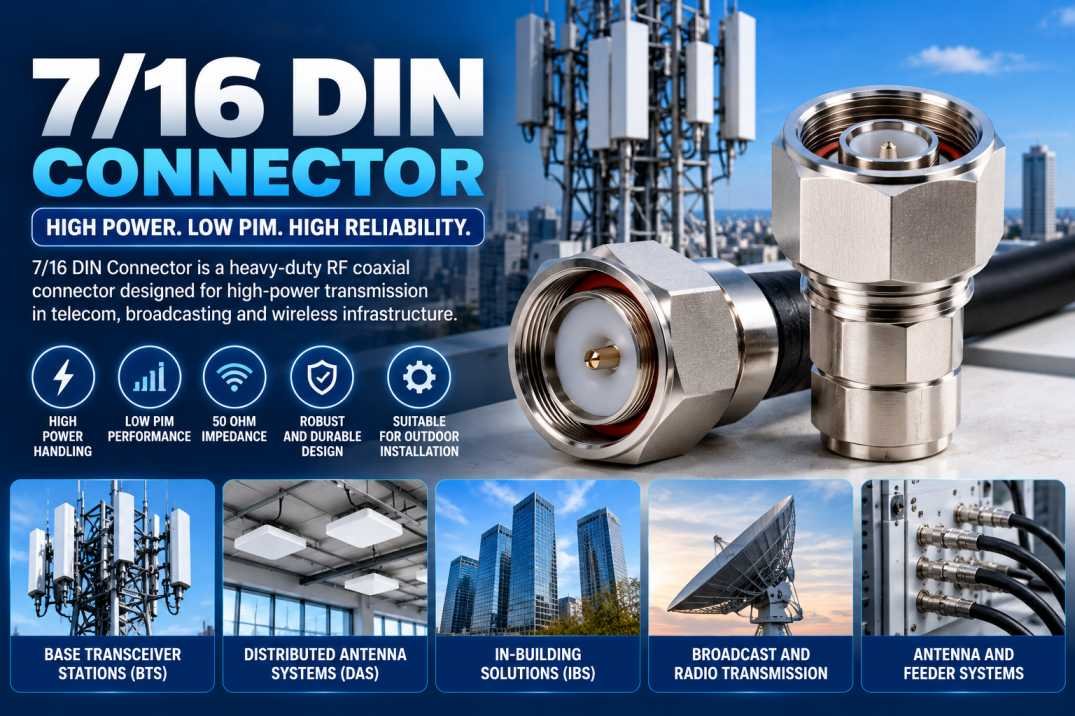
A 7/16 DIN connector is a heavy-duty RF coaxial connector designed for high-power radio frequency transmission in telecommunications, broadcasting, antenna systems, and wireless communication infrastructure. It is widely used in base transceiver stations (BTS), distributed antenna systems (DAS), in-building solutions (IBS), and outdoor RF installations where reliable signal transmission and low passive intermodulation (PIM) are essential.
The name 7/16 DIN refers to the approximate dimensions of the connector interface: a 7 mm inner contact and a 16 mm outer contact. The connector follows the DIN 47223 interface standard and is engineered to provide a secure mechanical connection, excellent electrical performance, and durability in demanding operating environments.
What Is a 7/16 DIN Connector?
A 7/16 DIN connector is a threaded, 50-ohm coaxial RF connector developed for applications requiring high power handling, low signal loss, and dependable performance. Its robust construction makes it suitable for connecting RF cables to antennas, transmitters, combiners, filters, amplifiers, and other telecommunications equipment.
Compared with smaller RF connectors, the 7/16 DIN connector has a larger interface and stronger mechanical construction. This makes it particularly useful in cellular base stations and other infrastructure where RF power levels, environmental exposure, and long-term reliability are important.
The connector is available in various configurations, including straight and right-angle designs, male and female interfaces, cable-mount versions, and panel-mount options. The appropriate model depends on the cable type, equipment interface, frequency range, and installation requirements.
Construction of a 7/16 DIN Connector
The performance of a 7/16 DIN connector depends on its mechanical design, contact materials, insulation, and shielding.
1. Inner Contact
The inner contact carries the RF signal through the connector. It is typically manufactured from conductive materials such as copper alloys and may feature silver or other suitable plating to improve conductivity and contact performance.
2. Outer Conductor
The outer conductor provides the return path for the RF signal and contributes to electromagnetic shielding. Its large contact area helps support high-power operation and reliable electrical continuity.
3. Dielectric Insulator
The dielectric separates the inner and outer conductors while maintaining the required electrical characteristics. Its material and dimensions influence impedance matching, frequency response, and power-handling capability.
4. Connector Body
The connector body provides mechanical strength and protects the internal components. It is generally manufactured from durable conductive metals with suitable surface finishes for the intended environment.
5. Coupling Mechanism
The threaded coupling mechanism secures the mating connectors and maintains stable contact under normal operating conditions. Correct mating and tightening are important for reliable electrical performance.
Key Features of 7/16 DIN Connectors
The 7/16 DIN connector offers several advantages for professional RF installations:
- 50-ohm impedance: Designed for standard RF communication systems.
- High power handling: Suitable for demanding RF transmission applications, depending on frequency and operating conditions.
- Low PIM performance: Special low-PIM designs help minimize unwanted intermodulation products in cellular networks.
- Low insertion loss: Properly selected and installed connectors help reduce signal loss.
- Robust mechanical design: Suitable for installations requiring durable connections.
- Reliable threaded coupling: Helps maintain a secure interface.
- Outdoor installation options: Weatherproof versions are available for exposed environments.
- Wide equipment compatibility: Available for multiple RF cable sizes and equipment interfaces.
Actual performance depends on the specific connector model, cable assembly, frequency, temperature, and installation quality.
Technical Specifications of a 7/16 DIN Connector
The following table provides a general specification overview. Exact values vary by manufacturer and model.
| Parameter | Typical Description |
|---|---|
| Connector Type | 7/16 DIN coaxial RF connector |
| Interface Standard | DIN 47223 |
| Impedance | 50 Ohms |
| Frequency Range | Model-dependent; commonly used in cellular RF systems up to several GHz |
| Coupling Mechanism | Threaded |
| Contact Materials | Conductive metal alloys, often plated |
| Mounting Options | Cable mount, panel mount, straight and right-angle |
| Power Handling | Depends on frequency, cooling, cable and connector design |
| PIM Performance | Low-PIM versions available |
| Applications | BTS, DAS, antennas, transmitters and RF infrastructure |
For engineering or procurement purposes, always verify the manufacturer’s datasheet for maximum frequency, peak and average power ratings, insertion loss, VSWR, PIM performance, environmental sealing, and mating dimensions.
Applications of 7/16 DIN Connectors
1. Cellular Base Transceiver Stations
7/16 DIN connectors are widely used in BTS installations to connect antennas, feeder cables, RF filters, combiners, and radio equipment. Their robust design makes them suitable for high-power transmission paths.
2. Distributed Antenna Systems (DAS)
DAS installations distribute cellular signals across large buildings, airports, stadiums, shopping centres, and transport facilities. 7/16 DIN connectors help provide reliable RF connections in compatible high-power feeder and distribution systems.
3. In-Building Solutions (IBS)
In-building wireless systems use antennas, splitters, combiners, and coaxial feeder cables to improve indoor mobile coverage. Suitable 7/16 DIN connectors help maintain connection integrity in these systems.
4. Broadcast and Radio Transmission
Broadcasting and radio infrastructure may use 7/16 DIN connectors in RF transmission equipment where connector durability and electrical performance are important.
5. Antenna and Feeder Systems
The connector can be used to connect coaxial feeder cables to compatible antennas, surge protection devices, filters, and RF distribution components.
6. RF Amplifiers and Filters
Power amplifiers, combiners, duplexers, and filters may use 7/16 DIN interfaces where higher power capacity and a mechanically secure connection are required.
Advantages of 7/16 DIN Connectors in Telecom Infrastructure
Selecting the right 7/16 DIN connector can improve the reliability of an RF installation. Its threaded interface supports secure mating, while the larger contact geometry is suitable for demanding transmission environments.
Low-PIM versions are particularly important in cellular networks because passive intermodulation can interfere with sensitive receiver signals. Selecting the appropriate low-PIM connector and cable assembly, following the recommended installation procedure, and avoiding contaminated or damaged mating surfaces can help reduce this risk.
Weatherproof connector designs can also support outdoor deployment when installed with the specified sealing components and procedures.
7/16 DIN Connector vs Other RF Connectors
Different RF connectors serve different applications. The correct choice depends on power, frequency, size, environmental conditions, and interface requirements.
| Feature | 7/16 DIN | N-Type | SMA |
|---|---|---|---|
| General Design | Heavy-duty | Medium-duty | Compact |
| Impedance | 50 Ohms | Commonly 50 Ohms; other versions exist | Typically 50 Ohms |
| Coupling | Threaded | Threaded | Threaded |
| Typical Use | Telecom infrastructure | RF equipment and antennas | Compact RF and microwave systems |
| Power Capability | Often high | Model-dependent | Generally lower than large telecom connectors |
| Low-PIM Options | Available | Available in suitable designs | Application-dependent |
These are general comparisons rather than guaranteed performance rankings. Specific model datasheets should guide connector selection.
How to Choose the Right 7/16 DIN Connector
Before selecting a 7/16 DIN connector, consider the following factors:
- Cable compatibility: Confirm that the connector matches the cable type and diameter.
- Frequency range: Ensure the connector supports the system’s complete operating band.
- Power rating: Check average and peak power limits under the intended conditions.
- PIM performance: Choose a low-PIM model when required for cellular infrastructure.
- Environmental protection: Select an appropriate weatherproof design for outdoor installations.
- Mounting configuration: Verify whether a straight, right-angle, cable-mount, or panel-mount connector is required.
- Electrical performance: Review VSWR, insertion loss, and return loss specifications.
- Installation requirements: Follow the manufacturer’s cable preparation, assembly, and tightening instructions.
Conclusion
A 7/16 DIN connector is an important RF interconnection component for telecommunications, cellular base stations, DAS, IBS, antenna feeder systems, and high-power radio installations. Its 50-ohm interface, threaded coupling, robust construction, and availability in low-PIM and weatherproof versions make it suitable for demanding RF infrastructure.
For dependable performance, select a connector that matches the cable, frequency range, power requirements, and environmental conditions. Correct assembly and installation are equally important for maintaining signal quality and long-term system reliability.
FAQs About 7/16 DIN Connectors
1. What does 7/16 DIN mean?
The name refers to the approximate dimensions of the connector interface: a 7 mm inner contact and a 16 mm outer contact.
2. What is the impedance of a 7/16 DIN connector?
A standard 7/16 DIN RF connector is designed for a nominal impedance of 50 ohms.
3. Where are 7/16 DIN connectors used?
They are commonly used in cellular base stations, DAS, IBS, antenna feeder systems, broadcast equipment, RF filters, and high-power transmitters.
4. Can 7/16 DIN connectors be used outdoors?
Yes. Weatherproof models are available for outdoor installations when installed using the manufacturer’s specified sealing method.
5. What is a low-PIM 7/16 DIN connector?
A low-PIM connector is designed to minimize passive intermodulation, which can generate unwanted signals and affect cellular network performance.
6. What is the difference between a 7/16 DIN and an N-Type connector?
A 7/16 DIN connector is generally designed for heavier-duty telecom applications, while N-Type connectors are used across a broad range of RF equipment and antenna systems. Exact performance depends on the model.
7. How do I select a 7/16 DIN connector for an RF cable?
Check cable compatibility, impedance, frequency range, power rating, PIM requirements, mounting type, and environmental protection.
8. Why is proper installation important?
Incorrect cable preparation, loose connections, damaged contacts, or improper sealing can increase signal loss, degrade PIM performance, and reduce connection reliability.