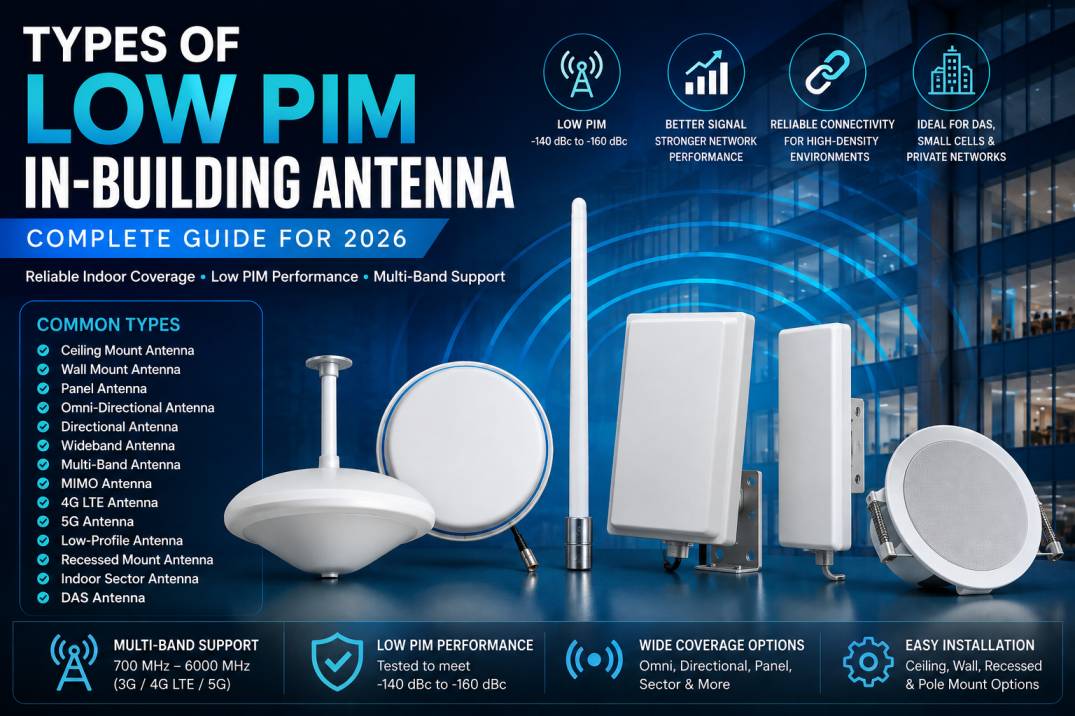
Low PIM in-building antennas are critical components of modern indoor wireless communication systems. They are designed to distribute cellular and RF signals throughout buildings while minimizing Passive Intermodulation, commonly known as PIM.
As indoor mobile connectivity becomes increasingly important, buildings such as offices, airports, hospitals, hotels, shopping malls, stadiums, warehouses, universities, and transportation hubs require reliable RF coverage. Distributed Antenna Systems (DAS), Small Cell networks, and other indoor wireless infrastructure rely on antennas, coaxial cables, connectors, splitters, couplers, and other passive RF components.
In these systems, even a small amount of passive intermodulation can degrade network performance. Low PIM antennas are therefore engineered using suitable materials, mechanical structures, connector technologies, and manufacturing processes to reduce unwanted intermodulation products.
This guide explains the major types of Low PIM in-building antennas, their working principles, construction, frequency coverage, PIM performance, applications, installation requirements, and factors to consider when selecting a Low PIM antenna.
What Is a Low PIM In-Building Antenna?
A Low PIM in-building antenna is an indoor RF antenna designed to provide cellular or wireless coverage while generating very low levels of passive intermodulation under high-power RF conditions.
The antenna is generally connected to a DAS or other RF distribution network and radiates cellular signals into indoor spaces.
The term Low PIM refers to the antenna’s ability to minimize unwanted intermodulation products generated by passive components when two or more RF signals pass through them.
Low PIM antennas are commonly specified using PIM performance values such as:
- -140 dBc
- -150 dBc
- -155 dBc
- -160 dBc
The exact specification depends on the antenna design, test conditions, frequency range, and manufacturer.
What Is Passive Intermodulation?
Passive Intermodulation is an unwanted RF interference phenomenon generated by passive components when multiple RF signals interact through nonlinear behavior.
Ideally, passive RF components should behave linearly. However, real-world components can contain microscopic nonlinearities caused by materials, contact surfaces, corrosion, contamination, mechanical junctions, or poor manufacturing.
When two or more high-power RF signals interact, additional frequencies can be generated.
For example, if two carrier frequencies are represented by F1 and F2, third-order intermodulation products can include:
2F1 − F2
and
2F2 − F1
These unwanted signals can fall within sensitive receiver bands and reduce receiver performance.
Why Low PIM Matters in Indoor Wireless Networks
Modern indoor wireless systems often combine multiple frequency bands and transmit significant RF power through shared passive infrastructure.
A poor-PIM component can generate unwanted intermodulation products that interfere with cellular receivers.
Low PIM performance can help improve:
- Receiver sensitivity
- Uplink performance
- Network reliability
- Coverage quality
- Signal-to-noise performance
- Multi-band system performance
- Overall RF system efficiency
PIM becomes particularly important in high-density indoor environments where multiple operators, bands, and technologies share the same passive infrastructure.
Main Types of Low PIM In-Building Antennas
The most common types of Low PIM in-building antennas include:
- Low PIM Ceiling-Mount Antenna
- Low PIM Wall-Mount Antenna
- Low PIM Panel Antenna
- Low PIM Omni-Directional Antenna
- Low PIM Directional Antenna
- Low PIM Wideband Antenna
- Low PIM Multi-Band Antenna
- Low PIM MIMO Antenna
- Low PIM 4G LTE Antenna
- Low PIM 5G Antenna
- Low PIM DAS Antenna
- Low PIM Low-Profile Antenna
- Low PIM Indoor Sector Antenna
- Low PIM Recessed-Mount Antenna
1. Low PIM Ceiling-Mount Antenna
Ceiling-mount Low PIM antennas are among the most commonly used antenna types in indoor Distributed Antenna Systems.
They are installed on or below ceilings and are designed to provide broad RF coverage throughout rooms, corridors, offices, and other indoor areas.
Key Features
- Low-profile construction
- Broad indoor coverage
- Low PIM performance
- Multi-band operation
- Easy ceiling installation
- Suitable for DAS deployments
- Compact appearance
Applications
Ceiling antennas are commonly installed in:
- Office buildings
- Hotels
- Hospitals
- Airports
- Universities
- Shopping malls
- Convention centers
- Railway stations
2. Low PIM Wall-Mount Antenna
Wall-mount Low PIM antennas are installed vertically on walls and are designed to provide controlled indoor coverage.
They are particularly useful when ceiling installation is difficult or when the RF coverage area needs to be directed toward a specific section of a building.
Applications
- Corridors
- Commercial buildings
- Retail environments
- Industrial facilities
- Warehouses
- Underground facilities
Advantages
- Simple installation
- Controlled radiation pattern
- Space-efficient design
- Suitable for indoor DAS
- Low visual impact
3. Low PIM Panel Antenna
A Low PIM panel antenna uses a directional radiation pattern to focus RF energy toward a particular coverage area.
Panel antennas can be used where a broad omnidirectional pattern is not appropriate.
Applications
- Large indoor facilities
- Warehouses
- Airports
- Stadiums
- Industrial buildings
- Long corridors
- Large open areas
Advantages
- Directional coverage
- High efficiency
- Controlled RF distribution
- Suitable for challenging indoor environments
4. Low PIM Omnidirectional Antenna
An omnidirectional Low PIM antenna provides broad horizontal RF coverage around the antenna.
It is commonly used in areas where cellular users may be located in multiple directions.
Applications
- Offices
- Retail stores
- Hotels
- Public buildings
- Small indoor spaces
- DAS networks
The antenna radiation pattern should be considered together with ceiling height, room dimensions, building materials, and required coverage.
5. Low PIM Directional Antenna
Directional Low PIM antennas concentrate RF energy toward a specific direction.
They are useful for large indoor areas, corridors, high-ceiling spaces, and locations where coverage needs to be controlled.
Benefits
- Focused coverage
- Reduced unwanted radiation
- Better RF planning
- Suitable for larger areas
- Useful for challenging indoor environments
6. Low PIM Wideband Antenna
A wideband Low PIM antenna is designed to operate across a broad frequency range.
This is particularly useful in multi-operator and multi-band DAS installations where different cellular frequency bands share the same passive infrastructure.
A wideband antenna can reduce the need for separate antennas for each frequency range.
Typical Applications
- Multi-operator DAS
- Enterprise cellular networks
- Public venues
- Transportation facilities
- Large commercial buildings
7. Low PIM Multi-Band Antenna
Multi-band Low PIM antennas support multiple cellular frequency ranges within one antenna.
Depending on the design, they may support combinations of:
- Low-band cellular frequencies
- Mid-band cellular frequencies
- LTE bands
- 5G sub-6 GHz bands
Advantages
- Multi-band coverage
- Simplified installation
- Reduced antenna count
- Lower infrastructure complexity
- Suitable for multi-operator deployments
8. Low PIM MIMO Antenna
MIMO stands for Multiple Input Multiple Output.
A Low PIM MIMO antenna contains multiple antenna elements designed to support multiple spatial streams.
MIMO is important for modern LTE and 5G networks because multiple RF paths can improve throughput and network capacity.
Applications
- 4G LTE DAS
- 5G indoor networks
- Private cellular networks
- Enterprise wireless systems
- High-capacity venues
Important Consideration
MIMO antenna elements must be designed with suitable isolation and RF characteristics to provide reliable performance across the intended frequency range.
9. Low PIM 4G LTE Antenna
Low PIM LTE antennas are designed for indoor cellular systems operating across LTE frequency bands.
They are commonly used in DAS installations where multiple LTE carriers share passive RF infrastructure.
Applications
- LTE DAS
- Enterprise networks
- Shopping centers
- Airports
- Hotels
- Industrial facilities
- Public buildings
10. Low PIM 5G Antenna
5G indoor deployments require antennas capable of supporting appropriate 5G frequency bands and system architectures.
Low PIM 5G antennas may support sub-6 GHz frequencies used for indoor cellular deployments.
Features
- Wide frequency coverage
- Low PIM performance
- High efficiency
- Multi-band capability
- Support for modern cellular networks
- Suitable for DAS and small-cell environments
The appropriate antenna must be selected according to the specific 5G bands being deployed.
11. Low PIM DAS Antenna
DAS antennas are specifically designed for Distributed Antenna Systems.
A DAS distributes RF signals from a centralized source through cables, splitters, couplers, remote units, and antennas.
Because multiple high-power signals can travel through the passive network, low PIM performance is particularly important.
Applications
- Airports
- Stadiums
- Hospitals
- Hotels
- Shopping malls
- Convention centers
- Universities
- Transportation hubs
- High-rise buildings
12. Low PIM Low-Profile Antenna
Low-profile antennas are designed to minimize their visual and physical footprint.
They are particularly useful in architectural environments where antennas need to blend into ceilings or walls.
Applications
- Hotels
- Corporate offices
- Hospitals
- Retail stores
- Airports
- Public buildings
Low-profile designs can provide a balance between aesthetics, RF performance, and installation requirements.
13. Low PIM Indoor Sector Antenna
Sector antennas provide coverage over a defined angular area rather than equally in all directions.
They can be useful for large indoor facilities where RF energy needs to be distributed into specific zones.
Applications
- Stadiums
- Exhibition halls
- Warehouses
- Transportation facilities
- Large industrial buildings
14. Low PIM Recessed-Mount Antenna
A recessed-mount antenna is installed partially or completely within a ceiling or wall structure.
This provides a cleaner architectural appearance while maintaining RF coverage.
Advantages
- Minimal visual impact
- Professional appearance
- Suitable for premium buildings
- Controlled indoor coverage
- Compatible with architectural RF installations
Low PIM Antenna Construction
The construction of a Low PIM antenna plays an important role in its RF performance.
Important design considerations include:
RF Conductive Materials
Conductive materials and their surface quality can influence passive intermodulation performance.
Mechanical Joints
Mechanical interfaces must be carefully designed because poorly controlled metal-to-metal contact can contribute to PIM.
Connector Design
RF connectors must provide reliable electrical contact and mechanical stability.
Surface Treatment
Appropriate plating and surface treatment can help reduce corrosion and maintain consistent electrical contact.
Radome Material
The radome protects the antenna elements while allowing RF signals to pass through with minimal impact.
Internal Assembly
Internal components must be securely mounted to reduce mechanical movement and unwanted nonlinear contact points.
Low PIM Antenna PIM Ratings
PIM is commonly expressed in dBc, or decibels relative to the carrier.
A more negative PIM value generally represents lower intermodulation.
For example:
| PIM Rating | General Interpretation |
|---|---|
| -140 dBc | Low PIM |
| -150 dBc | Very Low PIM |
| -155 dBc | Very Low PIM |
| -160 dBc | Extremely Low PIM |
Actual acceptance criteria depend on the system designer, network operator, test methodology, frequency combination, input power, and applicable specifications.
A PIM rating should therefore never be evaluated independently from the test conditions.
PIM Test Conditions
PIM performance can depend on the conditions under which the component is tested.
Important test parameters may include:
- Test frequencies
- Input power
- Two-tone test configuration
- PIM product order
- Measurement bandwidth
- Connector configuration
- Test fixture
- Temperature
- Mechanical condition
When comparing two Low PIM antennas, it is important to ensure that their test conditions are comparable.
Low PIM Antenna Frequency Range
Indoor cellular antennas can be designed to cover one or several frequency ranges.
Common cellular frequency regions include:
| Frequency Region | Example Applications |
|---|---|
| 600–900 MHz | Low-band cellular |
| 900 MHz | Cellular services |
| 1700–1900 MHz | Cellular and LTE |
| 1900–2200 MHz | Cellular networks |
| 2300–2700 MHz | LTE and other wireless services |
| 3300–3800 MHz | 5G sub-6 GHz |
The actual operating frequency must always be verified against the antenna manufacturer’s specification.
Low PIM Antenna Gain
Antenna gain indicates how effectively the antenna concentrates RF energy.
Indoor antennas generally use moderate gain because the objective is often to provide controlled coverage rather than maximize point-to-point range.
Typical gain values vary depending on antenna type and frequency.
| Antenna Type | Typical Gain Range |
|---|---|
| Ceiling Omni | 2–6 dBi |
| Panel | 5–10 dBi |
| Directional | 7–12 dBi |
| Sector | 8–15 dBi |
| Specialized High-Gain | 10 dBi or higher |
These are general ranges and should not be treated as universal specifications.
Low PIM Antenna VSWR
VSWR, or Voltage Standing Wave Ratio, measures impedance matching between the antenna and the RF transmission system.
A properly matched antenna minimizes reflected RF power.
Low VSWR is important because poor impedance matching can result in:
- Increased reflected power
- Reduced RF efficiency
- Lower transmitted signal
- Increased system losses
Antenna VSWR should be evaluated across the entire intended operating frequency range.
Low PIM Antenna Return Loss
Return loss describes the amount of RF power reflected from the antenna because of impedance mismatch.
Higher return loss generally indicates better impedance matching.
Return loss and VSWR are closely related RF parameters and are frequently included in antenna specifications.
Low PIM Antenna Isolation
Isolation becomes particularly important in MIMO and multi-port antenna systems.
High isolation between antenna ports helps reduce unwanted coupling between antenna elements.
Good isolation can contribute to:
- Better MIMO performance
- Reduced correlation
- Improved spatial stream performance
- Better system efficiency
Low PIM Antenna Polarization
Indoor cellular antennas may use:
- Vertical polarization
- Horizontal polarization
- Dual polarization
- Cross-polarization
The polarization arrangement should be selected according to the DAS architecture and radio system.
Low PIM Antenna Connector Types
Common RF connector configurations include:
- N-Type
- 4.3-10
- 7/16 DIN
- SMA
- TNC
- Other RF connector configurations
For professional DAS applications, connector selection is important because connector quality and installation practices can directly influence PIM performance.
Why 4.3-10 Connectors Are Used in Low PIM Systems
The 4.3-10 connector has become popular in modern cellular infrastructure because it provides robust mechanical performance and is designed for demanding RF applications.
It is particularly suitable for:
- DAS
- Base station infrastructure
- Cellular antennas
- High-power RF systems
- Multi-band wireless networks
Connector selection should always match the RF system, cable assembly, power requirements, and PIM specifications.
Low PIM Antennas in Distributed Antenna Systems
A DAS consists of multiple components that distribute cellular signals throughout a building.
A typical passive DAS may include:
- RF source
- Main feeder cable
- Splitters
- Directional couplers
- Power dividers
- Coaxial cables
- Connectors
- Low PIM antennas
Every passive component can potentially contribute to system PIM.
This means using a Low PIM antenna alone is not enough. The entire RF path should be designed and installed using appropriate low-PIM components and practices.
Passive DAS vs Active DAS
Passive DAS
A passive DAS distributes RF signals primarily through passive components such as coaxial cables, splitters, couplers, and antennas.
Low PIM performance is particularly important because multiple high-power RF signals travel through the passive network.
Active DAS
An active DAS uses active electronics and remote units to distribute RF signals.
Although the architecture differs from passive DAS, antenna performance and RF installation quality remain important.
Low PIM Antennas for 5G Indoor Networks
Indoor 5G deployments are increasing the demand for broadband and multi-band Low PIM antennas.
5G indoor systems may require:
- Wider bandwidth
- Multiple frequency bands
- MIMO
- High port isolation
- Low PIM
- High efficiency
- Compact physical designs
For sub-6 GHz 5G, antennas need to support the appropriate frequency range while maintaining acceptable RF performance.
Low PIM Antennas for Private 5G
Private 5G networks are being deployed in industrial facilities, warehouses, ports, manufacturing plants, campuses, and logistics environments.
Low PIM antennas can be useful in private cellular networks where multiple RF signals and high reliability are required.
Applications
- Smart factories
- Warehouses
- Ports
- Mining
- Manufacturing
- Logistics
- Enterprise campuses
Low PIM Antennas for High-Density Venues
Large public venues create challenging RF environments because thousands of users may access cellular networks simultaneously.
Examples include:
- Stadiums
- Airports
- Convention centers
- Shopping malls
- Railway stations
- Arenas
Low PIM antennas help maintain the RF integrity of the indoor distribution network.
Low PIM Antennas for Hospitals
Hospitals require reliable wireless connectivity for communication, operational systems, asset tracking, and connected equipment.
Indoor antennas must be carefully positioned to provide appropriate coverage while meeting building and installation requirements.
Low-profile ceiling and wall-mount antennas are commonly considered for such environments.
Low PIM Antennas for Warehouses
Warehouses often feature:
- High ceilings
- Large open spaces
- Metal racks
- Industrial equipment
- Moving vehicles
These factors can affect RF propagation.
Directional and ceiling-mounted Low PIM antennas can be selected according to the required coverage pattern and building architecture.
Low PIM Antennas for Hotels
Hotels require cellular coverage across:
- Guest rooms
- Corridors
- Lobbies
- Restaurants
- Conference rooms
- Parking areas
Low-profile ceiling antennas are often useful where aesthetics are important.
Low PIM Antenna Installation Best Practices
Proper installation is essential for maintaining Low PIM performance.
Use Proper Torque
RF connectors should be tightened according to the connector manufacturer’s recommended torque.
Over-tightening or under-tightening can create mechanical and electrical problems.
Keep Connectors Clean
Dirt, moisture, oils, and contamination can affect RF connections.
Avoid Damaged Cables
Crushed, sharply bent, or damaged coaxial cables can degrade RF performance.
Use Appropriate Cable Routing
Maintain the recommended bend radius and avoid unnecessary mechanical stress.
Avoid Unnecessary Metal Contact
Uncontrolled metal-to-metal contact can create potential PIM sources.
Secure Mechanical Components
Loose hardware, brackets, and antenna mounts can contribute to mechanical instability and potentially affect PIM.
Common Causes of PIM in Indoor RF Systems
PIM can originate from multiple sources.
Common causes include:
- Loose connectors
- Corroded metal surfaces
- Damaged cables
- Contaminated connectors
- Poor-quality RF components
- Dissimilar metal contact
- Loose mounting hardware
- Improper connector torque
- Mechanical vibration
- Poor installation practices
Therefore, PIM control must be treated as a complete system-level engineering requirement.
Low PIM Antenna vs Standard Indoor Antenna
| Feature | Low PIM Antenna | Standard Antenna |
|---|---|---|
| PIM Performance | Optimized for low PIM | May not be optimized |
| Multi-Band Support | Common | Depends on design |
| DAS Applications | Excellent | Depends on specification |
| High-Power RF | Suitable when specified | Depends on model |
| Mechanical Design | PIM-conscious | General purpose |
| Connector Options | Professional RF options | Varies |
| 4G/5G Applications | Common | Depends on frequency |
Benefits of Low PIM In-Building Antennas
The major advantages include:
Reduced RF Interference
Low PIM design helps reduce unwanted intermodulation products.
Improved Uplink Performance
Reducing interference near receiver frequencies can help maintain receiver sensitivity.
Multi-Band Compatibility
Many Low PIM antennas are designed to support multiple cellular bands.
Reliable Indoor Coverage
Properly selected antennas can provide consistent coverage throughout buildings.
Long-Term Reliability
High-quality materials and robust mechanical construction can improve long-term system stability.
Suitable for High-Density Networks
Low PIM antennas are particularly valuable in systems carrying multiple high-power cellular signals.
How to Choose a Low PIM In-Building Antenna
Several factors should be evaluated before selecting an antenna.
1. Frequency Range
Verify that the antenna supports all required cellular bands.
2. PIM Rating
Check the specified PIM performance and test conditions.
3. Input Power
Ensure that the antenna can safely handle the expected RF power.
4. Gain
Select gain based on the required coverage and DAS design.
5. Radiation Pattern
Choose omnidirectional, directional, panel, or sector coverage based on the building layout.
6. VSWR
Check impedance matching across the entire frequency range.
7. Connector
Select a connector compatible with the RF cable and DAS equipment.
8. MIMO Configuration
For multi-port systems, verify the number of antenna ports and isolation between elements.
9. Mounting Method
Consider ceiling, wall, recessed, pole, or other installation configurations.
10. Environmental Conditions
For difficult environments, verify temperature, humidity, dust, mechanical strength, and other environmental specifications.
Low PIM Antenna Testing
Professional Low PIM antennas are typically evaluated using controlled RF test setups.
Testing can include:
- PIM testing
- VSWR testing
- Return loss measurement
- Gain measurement
- Radiation pattern measurement
- Efficiency measurement
- Isolation testing
- Power handling testing
The test method should be consistent with the antenna’s intended application.
Low PIM Antenna Quality Control
Quality control is particularly important because PIM performance can be influenced by small mechanical and material variations.
Manufacturing quality control may include:
- Connector inspection
- Material inspection
- Surface finish inspection
- Mechanical assembly inspection
- RF testing
- PIM testing
- VSWR testing
- Environmental testing
Consistent manufacturing is essential for reliable Low PIM performance.
Applications of Low PIM In-Building Antennas
Low PIM indoor antennas are used across many industries.
Telecommunications
Indoor cellular coverage and DAS networks.
Airports
Passenger terminals, baggage areas, offices, and operational facilities.
Hospitals
Indoor cellular connectivity and communication infrastructure.
Hotels
Guest rooms, conference areas, lobbies, and service areas.
Shopping Malls
Retail floors, parking areas, restaurants, and common spaces.
Stadiums
High-density cellular networks supporting large numbers of simultaneous users.
Universities
Classrooms, libraries, laboratories, dormitories, and campus buildings.
Manufacturing
Private cellular networks and industrial communication.
Warehouses
Connected logistics, tracking, automation, and worker communications.
Transportation
Railway stations, metro systems, terminals, and other transportation facilities.
Future Trends in Low PIM In-Building Antennas
The development of indoor cellular networks is driving demand for more advanced antenna designs.
Important trends include:
- Multi-band Low PIM antennas
- 5G indoor coverage
- Private 5G networks
- Higher-order MIMO
- Wider bandwidth
- Compact low-profile designs
- Improved connector technology
- Higher-power handling
- Better antenna efficiency
- Integrated multi-technology antennas
- Advanced DAS infrastructure
As buildings become increasingly connected, indoor cellular antenna systems will continue to play an important role in reliable wireless communication.
Conclusion
Low PIM in-building antennas are essential components of modern indoor cellular infrastructure. They are specifically designed to minimize passive intermodulation while providing reliable RF coverage across multiple cellular frequency bands.
Ceiling-mount, wall-mount, panel, omnidirectional, directional, wideband, multi-band, MIMO, DAS, low-profile, and 5G antennas provide different solutions for different indoor environments.
For successful deployment, antenna selection should consider frequency range, PIM rating, gain, radiation pattern, VSWR, return loss, isolation, connector type, power handling, mounting method, and environmental requirements.
Most importantly, Low PIM performance should be considered at the system level. Antennas, cables, connectors, splitters, couplers, and installation practices must all be appropriately selected and installed to achieve a low-PIM RF network.
Frequently Asked Questions
1. What is a Low PIM in-building antenna?
A Low PIM in-building antenna is an indoor RF antenna designed to provide cellular coverage while minimizing passive intermodulation generated by multiple RF signals.
2. What does PIM mean in RF systems?
PIM stands for Passive Intermodulation. It is the generation of unwanted RF frequencies when multiple signals interact through nonlinear behavior in passive components.
3. Why is Low PIM important in DAS?
Low PIM is important in DAS because multiple high-power RF signals share cables, connectors, splitters, couplers, and antennas. Unwanted intermodulation products can interfere with receiver frequencies.
4. What are the main types of Low PIM in-building antennas?
Common types include ceiling-mount, wall-mount, panel, omnidirectional, directional, wideband, multi-band, MIMO, DAS, low-profile, recessed, and 5G Low PIM antennas.
5. What is a Low PIM ceiling antenna?
A Low PIM ceiling antenna is designed for ceiling installation and provides broad indoor cellular coverage. It is commonly used in offices, hotels, airports, hospitals, malls, and DAS networks.
6. What is a Low PIM panel antenna?
A Low PIM panel antenna is a directional indoor antenna that focuses RF energy toward a defined coverage area. It is useful in large buildings, warehouses, corridors, and industrial environments.
7. What is a good PIM rating for an indoor antenna?
Low PIM antennas may have specifications such as -140 dBc, -150 dBc, -155 dBc, or -160 dBc depending on the design and test conditions. The required rating should be based on the system specification.
8. Is -160 dBc better than -140 dBc?
Yes. A more negative PIM value represents lower intermodulation. Therefore, -160 dBc represents lower PIM than -140 dBc under comparable test conditions.
9. What frequency bands do Low PIM indoor antennas support?
Depending on the model, Low PIM antennas can support multiple cellular bands ranging from low-band frequencies through mid-band LTE and 5G sub-6 GHz frequencies.
10. Are Low PIM antennas suitable for 5G?
Yes. Low PIM antennas can be designed for appropriate 5G sub-6 GHz frequency ranges and are used in indoor DAS and private cellular network deployments.
11. What is a Low PIM MIMO antenna?
A Low PIM MIMO antenna contains multiple antenna elements designed to support multiple RF spatial streams while maintaining low passive intermodulation performance.
12. Why are connectors important for Low PIM performance?
Connectors are potential sources of PIM. Proper connector materials, plating, mechanical construction, cleanliness, and installation torque can help maintain low PIM performance.
13. What connector is commonly used for Low PIM DAS antennas?
Professional DAS antennas can use connectors such as N-Type, 4.3-10, and 7/16 DIN depending on the system requirements and antenna design.
14. Can a standard indoor antenna be used in a DAS?
It depends on the antenna specification. A DAS antenna should meet the required frequency, power, VSWR, gain, and PIM specifications for the intended system.
15. Does the antenna alone determine the PIM performance of a DAS?
No. PIM is a system-level consideration. Cables, connectors, splitters, couplers, mounting hardware, and installation practices can all contribute to overall system PIM.
16. How can PIM be reduced during antenna installation?
PIM can be reduced by using qualified Low PIM components, properly torquing connectors, keeping RF connections clean, avoiding damaged cables, preventing corrosion, and securing mechanical components.
17. What is the difference between Low PIM and standard antennas?
Low PIM antennas are specifically engineered and tested to minimize passive intermodulation under defined RF conditions, while standard antennas may not have the same PIM performance specification.
18. Are Low PIM antennas suitable for high-density venues?
Yes. Low PIM antennas are widely suited to high-density indoor environments such as stadiums, airports, convention centers, malls, and transportation hubs where multiple cellular signals are present.
19. What is the advantage of a multi-band Low PIM antenna?
A multi-band Low PIM antenna can support several cellular frequency bands using one antenna, simplifying installation and making it suitable for multi-operator and multi-technology DAS deployments.
20. What factors should be checked before buying a Low PIM in-building antenna?
Important specifications include frequency range, PIM rating, test conditions, gain, radiation pattern, VSWR, return loss, isolation, input power, connector type, mounting configuration, dimensions, and environmental specifications.