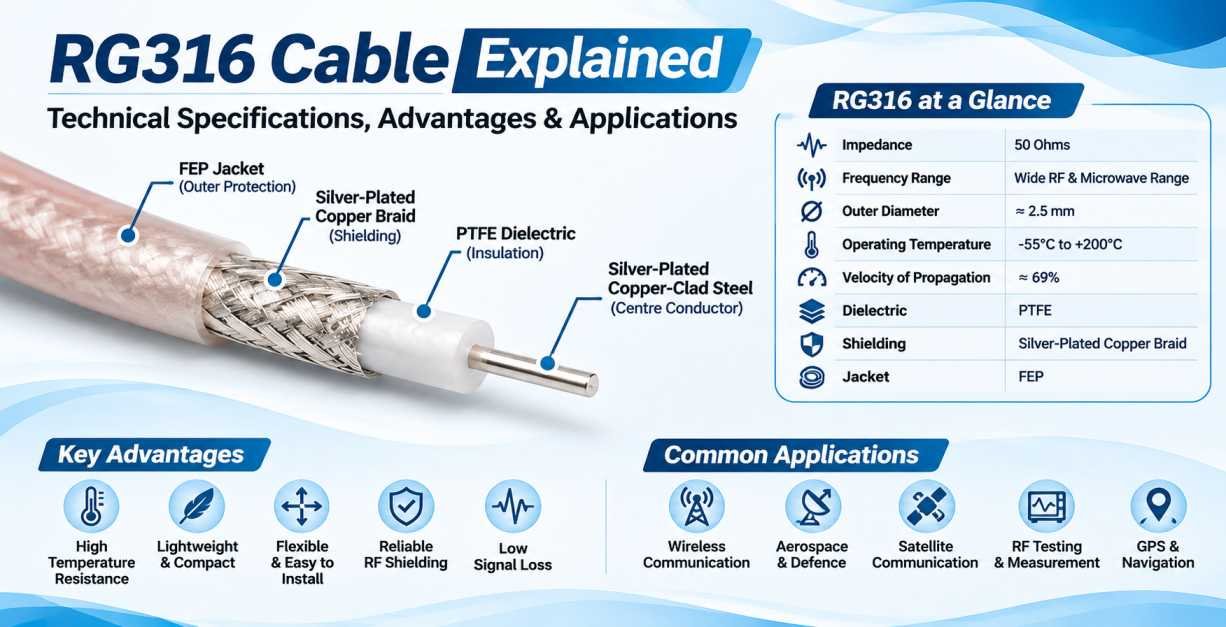
RG316 cable is a flexible, 50-ohm coaxial cable widely used in RF (Radio Frequency), microwave, telecommunications, aerospace, defence, and electronic communication applications. It is designed to transmit high-frequency signals while providing flexibility, reliable electrical performance, and resistance to demanding operating temperatures.
One of the most important characteristics of RG316 coaxial cable is its PTFE (Polytetrafluoroethylene) dielectric insulation, which offers excellent thermal stability and electrical properties. Its silver-plated copper-clad steel centre conductor and silver-plated copper shielding help provide reliable signal transmission and effective electromagnetic shielding.
Due to its compact diameter, flexibility, and high-temperature capability, RG316 cable is commonly used in applications where space is limited and dependable RF connectivity is essential.
RG316 coaxial cable is available in different configurations and can be supplied as a standard cable or manufactured into custom RF cable assemblies with connectors such as SMA, BNC, TNC, and N-type, depending on the application requirements.
In this guide, we will explore RG316 cable construction, technical specifications, electrical characteristics, advantages, applications, comparisons with other coaxial cables, and important factors to consider before selecting the right cable.
What Is RG316 Cable?
RG316 is a miniature, flexible, 50-ohm coaxial cable designed for transmitting RF and microwave signals in electronic and communication systems.
The term RG stands for Radio Guide, a designation historically associated with military and government coaxial cable specifications. RG316 belongs to a family of miniature coaxial cables developed for applications requiring compact dimensions, controlled impedance, and reliable electrical performance.
Unlike larger coaxial cables such as RG213 and RG214, RG316 has a smaller outer diameter, making it suitable for compact electronic equipment, internal RF connections, and installations where routing flexibility is important.
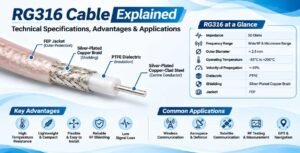
The cable typically consists of four primary layers:
- Inner conductor
- Dielectric insulation
- Metallic shielding
- Outer protective jacket
Each layer performs a specific function in maintaining signal integrity, electrical insulation, shielding effectiveness, and mechanical protection.
RG316 cable is particularly suitable for RF applications that require a combination of flexibility, compact construction, and high-temperature resistance.
RG316 Cable Construction and Materials
The construction of RG316 coaxial cable plays an important role in determining its electrical performance, flexibility, durability, and temperature resistance.
Let’s understand the different layers of RG316 cable.
1. Inner Conductor
The inner conductor is responsible for carrying the RF signal through the cable.
RG316 commonly uses silver-plated copper-clad steel (SPCCS) as its centre conductor.
This construction combines the mechanical strength of steel with the electrical conductivity of copper and the surface conductivity benefits of silver plating.
Key Characteristics:
- Silver-plated surface for improved conductivity.
- Copper-clad steel construction.
- Good mechanical strength.
- Suitable for high-frequency signal transmission.
- Helps maintain consistent electrical performance.
The centre conductor design is important for maintaining the cable’s characteristic impedance and supporting reliable signal transmission.
2. Dielectric Insulation
The dielectric layer surrounds the inner conductor and separates it electrically from the outer shielding.
RG316 generally uses PTFE (Polytetrafluoroethylene) as its dielectric material.
PTFE is widely used in RF coaxial cables because of its excellent electrical insulation, low dielectric loss, and high-temperature resistance.
Key Characteristics:
- Excellent electrical insulation.
- Low dielectric loss.
- High thermal stability.
- Low moisture absorption.
- Good chemical resistance.
- Suitable for demanding RF environments.
The dielectric material influences important electrical parameters such as capacitance, velocity of propagation, and attenuation.
3. Outer Shielding
The shielding layer surrounds the dielectric and helps protect the transmitted RF signal from external electromagnetic interference.
RG316 typically uses silver-plated copper braid as its shielding material.
The braid provides an additional conductive path and helps reduce unwanted signal leakage and electromagnetic interference.
Key Characteristics:
- Silver-plated copper construction.
- Effective electromagnetic shielding.
- Helps reduce external interference.
- Provides a conductive return path.
- Supports reliable RF transmission.
Shielding performance depends on braid coverage, construction quality, frequency, and installation conditions.
4. Outer Jacket
The outer jacket is the protective covering of the cable.
RG316 commonly uses FEP (Fluorinated Ethylene Propylene) as its outer jacket material.
FEP provides excellent thermal and chemical resistance while protecting the internal cable structure from environmental exposure.
Key Characteristics:
- High-temperature resistance.
- Good flexibility.
- Chemical resistance.
- Moisture resistance.
- Abrasion protection.
- Electrical insulation.
The outer jacket helps maintain the cable’s mechanical integrity during installation and operation.
RG316 Cable Technical Specifications
Understanding the technical specifications of RG316 cable is essential when selecting it for RF and microwave applications.
The following table provides commonly encountered specifications for standard RG316 constructions. Actual values may vary depending on the manufacturer, applicable specification, and cable design.
| Technical Parameter | Typical Specification |
|---|---|
| Cable Type | RG316 Coaxial Cable |
| Characteristic Impedance | 50 Ohms |
| Inner Conductor | Silver-Plated Copper-Clad Steel |
| Dielectric Material | PTFE |
| Shielding | Silver-Plated Copper Braid |
| Outer Jacket | FEP |
| Nominal Outer Diameter | Approximately 2.5 mm |
| Operating Temperature | Typically -55°C to +200°C |
| Velocity of Propagation | Approximately 69% |
| Capacitance | Approximately 95 pF/m |
| Impedance | 50 Ohms |
| Cable Construction | Flexible Coaxial |
| Shielding Type | Single Braided Shield |
| Application | RF, Microwave and Communication Systems |
Note: These are representative values, not guaranteed specifications for every RG316 cable. Always verify the manufacturer’s datasheet before making a purchasing or engineering decision.
Electrical Characteristics of RG316 Cable
Electrical characteristics determine how effectively RG316 coaxial cable transmits RF signals.
Several important parameters should be considered when evaluating its performance.
1. Characteristic Impedance
RG316 cable has a nominal characteristic impedance of 50 ohms.
Impedance is an important parameter in RF systems because it determines the electrical compatibility between connected components.
Most professional RF equipment, antennas, transmitters, receivers, and microwave communication systems use 50-ohm interfaces.
Using a properly matched 50-ohm RG316 cable helps minimize signal reflections and maintain efficient power transfer.
2. Frequency Range
RG316 cable is used in RF and microwave applications across a broad frequency range.
Its actual usable frequency range depends on attenuation, return loss, cable length, connector performance, and application requirements.
It is commonly used in applications involving frequencies from relatively low RF bands through several GHz.
For higher-frequency applications, engineers should evaluate the manufacturer’s attenuation and electrical performance specifications rather than relying on the cable designation alone.
3. Attenuation
Attenuation refers to the reduction in signal power as an RF signal travels through a coaxial cable.
It is generally measured in decibels per unit length, such as dB/m or dB/100 ft.
Attenuation in RG316 cable increases as operating frequency and cable length increase.
Factors influencing attenuation include:
- Operating frequency.
- Conductor material.
- Dielectric properties.
- Cable diameter.
- Shielding construction.
- Connector quality.
- Cable installation conditions.
For applications involving long cable runs or high-frequency signals, engineers should compare attenuation values with alternative cable types before making a selection.
4. Velocity of Propagation
Velocity of propagation describes how quickly an electromagnetic signal travels through the cable compared with the speed of light in a vacuum.
RG316 cable typically has a velocity of propagation of approximately 69%.
This characteristic is influenced by the dielectric material and its relative permittivity.
Velocity of propagation is important in applications involving signal timing, phase matching, and cable length calculations.
5. Capacitance
Capacitance refers to the electrical charge-storage capability between the inner conductor and outer shielding.
RG316 typically has a capacitance of approximately 95 pF/m, depending on its construction.
Capacitance affects the electrical characteristics of RF transmission systems and should be considered when designing high-frequency circuits and signal paths.
6. Shielding Effectiveness
Shielding effectiveness describes the cable’s ability to reduce electromagnetic interference and unwanted RF signal leakage.
RG316 uses a braided metallic shield to provide protection against external interference.
Its actual shielding effectiveness depends on braid coverage, cable construction, operating frequency, and connector termination quality.
For applications requiring higher isolation or improved EMI protection, double-shielded or specialized coaxial cable constructions may be more appropriate.
What Is the Frequency Range of RG316 Cable?
RG316 coaxial cable is commonly used in a wide range of RF and microwave applications.
However, it is important to understand that RG316 does not have one universal maximum operating frequency applicable to every manufacturer and construction.
The practical frequency capability depends on:
- Cable attenuation.
- Impedance stability.
- Return loss.
- Connector frequency rating.
- Cable length.
- Installation conditions.
- Required signal quality.
For example, RG316 cable may be used in RF testing, GPS equipment, wireless communication devices, antenna connections, and microwave electronic assemblies.
When selecting RG316 for a specific frequency, always check the manufacturer’s attenuation and VSWR specifications at the intended operating frequency.
Advantages of RG316 Coaxial Cable
RG316 coaxial cable offers several advantages that make it suitable for compact and demanding RF applications.
1. High-Temperature Resistance
One of the biggest advantages of RG316 cable is its PTFE dielectric and FEP jacket construction.
These materials provide excellent thermal stability.
Standard RG316 constructions are commonly specified for operating temperatures up to approximately +200°C, although the exact rating must be verified with the manufacturer.
This makes the cable suitable for equipment exposed to elevated temperatures.
2. Compact and Lightweight Design
RG316 has a relatively small outer diameter of approximately 2.5 mm.
Its compact design makes it suitable for installations where space and weight are important considerations.
It is commonly used in compact electronic devices, RF modules, and communication equipment.
3. Excellent Flexibility
RG316 is a flexible coaxial cable that can be routed through compact equipment and restricted installation spaces.
Its flexibility helps simplify cable routing and integration into electronic assemblies.
However, it should always be installed within the manufacturer’s minimum bend radius.
4. Good Electrical Insulation
PTFE dielectric provides excellent electrical insulation and low dielectric loss.
These characteristics help maintain reliable signal transmission and electrical separation between the centre conductor and shielding.
5. Chemical and Environmental Resistance
PTFE and FEP materials offer excellent resistance to many chemicals, moisture, and environmental conditions.
This makes RG316 useful in industrial, laboratory, and aerospace-related applications.
6. Reliable RF Shielding
Its silver-plated copper braid provides electromagnetic shielding to help minimize interference and signal leakage.
Proper connector termination is important to maintain the shielding performance of the complete cable assembly.
7. Suitable for Custom Cable Assemblies
RG316 can be manufactured into custom RF cable assemblies with different connector configurations and cable lengths.
Common connector options include:
- SMA Male.
- SMA Female.
- BNC Male.
- BNC Female.
- TNC Male.
- TNC Female.
- N-Type Male.
- N-Type Female.
- U.FL and other miniature RF interfaces, where compatible with the assembly design.
The final connector selection should match the equipment interface and required operating frequency.
Applications of RG316 Coaxial Cable
RG316 cable is used across several industries because of its compact size, flexibility, and high-temperature characteristics.
1. Wireless Communication Systems
RG316 cable is used in wireless communication equipment to connect RF modules, antennas, transceivers, and other electronic components.
Its compact construction makes it useful in equipment where limited installation space requires smaller coaxial cables.
Common applications include:
- Wireless communication devices.
- RF transmitter and receiver systems.
- Antenna connections.
- Communication modules.
- RF signal routing.
2. GPS and Navigation Systems
GPS and navigation equipment use RF signals to receive information from satellites.
RG316 cable can be used in compatible GPS antenna assemblies and RF signal connections.
Its flexibility and compact dimensions make it useful in navigation devices and communication equipment.
3. Aerospace Applications
Aerospace electronics require reliable electrical connections that can operate under demanding environmental conditions.
RG316 is used in selected aerospace-related RF applications because of its compact construction, PTFE dielectric, and high-temperature capability.
Potential applications include:
- Avionics equipment.
- RF communication assemblies.
- Navigation systems.
- Antenna connections.
- Electronic instrumentation.
Cable selection must consider the applicable aerospace qualification and environmental requirements.
4. Defence and Military Communication
Defence communication equipment often requires compact and dependable RF connectivity.
RG316 cable can be used in communication devices, RF modules, antenna systems, and electronic assemblies.
Its temperature-resistant materials make it suitable for certain demanding operating environments.
However, military applications may require cables meeting specific qualification and testing standards.
5. RF and Microwave Testing Equipment
RG316 is commonly used in RF laboratories and electronic testing environments.
It can connect RF instruments, signal generators, receivers, and other electronic devices.
Common applications include:
- RF test setups.
- Signal transmission.
- Electronic measurement systems.
- Laboratory instrumentation.
- RF module testing.
For precision measurements, cable phase stability, connector quality, and calibration requirements should also be considered.
6. Antenna Systems
RG316 coaxial cable is used in antenna assemblies to connect antennas with RF communication equipment.
Its compact construction makes it useful in internal antenna connections and short RF cable runs.
It can be supplied with suitable connectors depending on the antenna interface.
7. Industrial Electronics
Industrial electronic systems often require compact cables that can withstand temperature variations and mechanical constraints.
RG316 may be used in selected control systems, RF monitoring equipment, and electronic instrumentation.
8. Medical and Laboratory Equipment
Certain medical and laboratory instruments use RF signals for testing, measurement, and electronic communication.
RG316 can be used in compatible equipment where its electrical and mechanical specifications meet the design requirements.
9. Satellite Communication Equipment
Satellite communication systems use microwave and RF components to transmit and receive signals.
RG316 may be used for short internal RF connections within satellite communication equipment and related electronic assemblies.
The cable must be selected according to the system’s frequency, attenuation, and environmental requirements.
10. Automotive and Transportation Electronics
RG316 can be used in selected vehicle communication, antenna, and electronic systems where compact RF connectivity is required.
Its temperature-resistant construction may be beneficial in certain equipment installations.
However, automotive applications should use cables meeting the required vibration, temperature, and environmental qualifications.
RG316 Cable vs RG174 Cable
RG316 and RG174 are both miniature 50-ohm coaxial cables used in RF and electronic applications.
However, they differ in dielectric materials, temperature capability, construction, and electrical characteristics.
| Parameter | RG316 Cable | RG174 Cable |
|---|---|---|
| Impedance | 50 Ohms | 50 Ohms |
| Dielectric | PTFE | PE (Polyethylene), commonly |
| Centre Conductor | Silver-Plated Copper-Clad Steel, commonly | Copper or copper-clad construction, depending on type |
| Shielding | Silver-Plated Copper Braid, commonly | Copper or tinned copper braid, depending on type |
| Outer Jacket | FEP, commonly | PVC, commonly |
| Temperature Resistance | Typically up to +200°C | Generally lower; manufacturer dependent |
| Outer Diameter | Approximately 2.5 mm | Approximately 2.8 mm |
| Flexibility | Flexible | Flexible |
| Common Applications | High-temperature RF assemblies | General-purpose RF connections |
Which cable should you choose?
Choose RG316 when high-temperature resistance, PTFE dielectric, and compact RF connectivity are important.
Choose RG174 when general-purpose RF connectivity and cost-effective cable solutions are the main requirements and its temperature and electrical ratings are suitable.
RG316 Cable vs RG58 Cable
RG316 and RG58 are widely used 50-ohm coaxial cables, but their construction and applications are different.
| Parameter | RG316 Cable | RG58 Cable |
|---|---|---|
| Impedance | 50 Ohms | 50 Ohms |
| Outer Diameter | Approximately 2.5 mm | Approximately 5 mm |
| Dielectric | PTFE | PE, commonly |
| Centre Conductor | Silver-Plated Copper-Clad Steel, commonly | Copper or copper-clad construction, depending on type |
| Shielding | Silver-Plated Copper Braid | Copper or tinned copper braid, depending on type |
| Jacket | FEP, commonly | PVC or other specified material |
| Temperature Rating | Typically up to +200°C | Generally lower; manufacturer dependent |
| Size | Miniature | Standard flexible coaxial cable |
| Application | Compact RF assemblies | General RF communication and instrumentation |
Which cable is better?
Neither cable is universally better.
RG316 is more suitable for compact installations and applications requiring higher temperature resistance.
RG58 may be preferable when a larger, general-purpose 50-ohm cable is required.
RG316 Cable vs RG402 Cable
RG316 and RG402 are both commonly used in RF and microwave systems, but they have different mechanical structures.
RG316 is a flexible coaxial cable, whereas RG402 is a semi-rigid coaxial cable.
| Parameter | RG316 Cable | RG402 Cable |
|---|---|---|
| Cable Type | Flexible Coaxial | Semi-Rigid Coaxial |
| Impedance | 50 Ohms | 50 Ohms |
| Outer Diameter | Approximately 2.5 mm | Approximately 3.6 mm |
| Dielectric | PTFE | PTFE |
| Centre Conductor | Silver-Plated Copper-Clad Steel, commonly | Copper, commonly |
| Shielding | Braided Shield | Solid Outer Conductor |
| Flexibility | Flexible | Rigid after forming |
| Shielding Performance | Good, construction dependent | Generally higher |
| Applications | Flexible RF connections | Precision microwave assemblies |
Which one should you choose?
RG316 is suitable for flexible routing and compact cable assemblies.
RG402 is more appropriate for applications requiring stable mechanical geometry, improved shielding, and precision RF performance.
RG316 Cable Assembly: What Is It?
An RG316 cable assembly is a complete RF cable solution manufactured using RG316 coaxial cable and suitable connectors at one or both ends.
These assemblies are used to connect RF equipment, antennas, electronic modules, and communication systems.
A standard RG316 cable assembly generally includes:
- RG316 coaxial cable.
- RF connectors.
- Centre conductor termination.
- Shield termination.
- Connector housing.
- Protective assembly components, where required.
Cable assemblies can be manufactured in different lengths and connector configurations according to customer requirements.
Common RG316 Cable Assembly Configurations
1. SMA Male to SMA Male RG316 Cable Assembly
Used for connecting two RF devices with SMA female interfaces.
2. SMA Male to SMA Female RG316 Cable Assembly
Used where different SMA connector genders are required.
3. SMA to BNC RG316 Cable Assembly
Used for connecting SMA-based RF equipment with BNC-compatible test instruments.
4. SMA to N-Type RG316 Cable Assembly
Used to connect compact RF equipment with N-type interfaces.
5. U.FL to SMA RG316 Cable Assembly
Used in wireless modules and compact electronic devices where miniature RF interfaces are required.
The connector configurations listed above are examples. Actual availability depends on connector compatibility, cable termination design, and operating frequency.
Important Factors to Consider Before Buying RG316 Cable
Selecting the right RG316 coaxial cable requires evaluating several technical and installation-related factors.
1. Operating Frequency
Determine the frequency range of your RF application.
Check the cable’s attenuation, return loss, and electrical performance at the required frequency.
2. Cable Length
Cable length directly influences signal attenuation.
Longer cable runs generally result in higher signal loss.
Choose an appropriate cable length to balance installation requirements and signal performance.
3. Characteristic Impedance
RG316 is generally a 50-ohm coaxial cable.
Ensure that the connected equipment, antennas, connectors, and RF components are compatible with a 50-ohm transmission system.
4. Operating Temperature
Check the operating temperature requirements of the application.
RG316 commonly supports temperatures up to +200°C, depending on the manufacturer and construction.
5. Connector Compatibility
Select the correct connector type according to the connected equipment.
Connector gender, interface dimensions, frequency rating, and termination method should all be verified.
6. Shielding Requirements
Evaluate the required shielding effectiveness.
For applications involving high electromagnetic interference, consider whether a single-braided RG316 cable provides sufficient shielding.
7. Flexibility and Bend Radius
RG316 is designed for flexible installations, but excessive bending can damage the internal conductor and dielectric.
Follow the manufacturer’s minimum bend-radius specifications.
8. Environmental Conditions
Consider whether the cable will be exposed to moisture, chemicals, vibration, extreme temperatures, or outdoor conditions.
Select a construction that meets the environmental requirements.
9. Manufacturer Quality
Choose a reliable cable manufacturer or supplier that provides technical datasheets and product specifications.
Check conductor materials, dielectric construction, shielding, jacket material, and test reports before purchasing.
How to Install RG316 Coaxial Cable Correctly
Correct installation is important for maintaining the electrical and mechanical performance of RG316 coaxial cable.
Follow these practices during installation:
1. Measure the Required Cable Length
Measure the required cable length before cutting or terminating the cable.
Avoid unnecessary cable length because it can increase signal attenuation.
2. Use the Correct Cable Stripping Tools
Use suitable coaxial cable preparation tools to remove the outer jacket, braid, and dielectric without damaging the centre conductor.
3. Select Compatible Connectors
Choose connectors specifically designed for RG316 cable dimensions and construction.
4. Maintain Proper Shield Termination
Ensure that the cable shielding makes proper electrical contact with the connector body.
Poor shield termination can negatively affect RF performance.
5. Avoid Excessive Bending
Do not bend the cable beyond its recommended minimum bend radius.
Excessive bending can deform the dielectric and affect impedance stability.
6. Check Connector Tightness
Tighten connectors according to the manufacturer’s recommended torque specifications.
Avoid excessive tightening, which may damage connector threads or interfaces.
7. Perform Electrical Testing
After installation, inspect the assembly and verify its electrical performance using suitable RF test equipment.
Depending on the application, measurements may include continuity, insertion loss, return loss, and VSWR.
Common Problems in RG316 Cable and Their Solutions
Even a properly manufactured RG316 cable can experience performance issues due to incorrect installation, mechanical damage, or unsuitable operating conditions.
1. High Signal Attenuation
Possible Causes:
- Excessive cable length.
- High operating frequency.
- Poor-quality connectors.
- Damaged cable structure.
- Improper cable termination.
Solutions:
Check the manufacturer’s attenuation specifications, inspect the cable assembly, and verify connector termination quality.
2. Poor Signal Transmission
Possible Causes:
- Impedance mismatch.
- Damaged centre conductor.
- Incorrect connector installation.
- Loose RF connections.
Solutions:
Check the cable’s electrical continuity, inspect connector interfaces, and verify that all connected components support 50-ohm impedance.
3. Electromagnetic Interference
Possible Causes:
- Damaged shielding.
- Incomplete braid termination.
- Poor connector assembly.
- External interference.
Solutions:
Inspect the shielding and connector termination. Consider a cable with higher shielding effectiveness if the application requires additional EMI protection.
4. Cable Damage Due to Bending
Possible Causes:
- Excessive bending.
- Repeated flexing.
- Incorrect routing.
- Mechanical pressure.
Solutions:
Maintain the recommended bend radius and avoid sharp bends, crushing, or unnecessary movement.
5. Connector Failure
Possible Causes:
- Incorrect connector selection.
- Improper installation.
- Excessive tightening.
- Mechanical stress.
Solutions:
Use connectors specifically designed for RG316 cable and follow the manufacturer’s assembly instructions.
How to Test RG316 Coaxial Cable Performance
Testing RG316 cable helps verify that it meets the electrical requirements of the intended RF application.
Several instruments and testing methods can be used.
1. Digital Multimeter
A digital multimeter can be used to check electrical continuity between the cable conductors and identify unwanted short circuits.
It is useful for basic electrical inspection but does not measure high-frequency RF performance.
2. Vector Network Analyser (VNA)
A vector network analyser is used to evaluate the RF characteristics of the cable assembly.
It can measure:
- S11: Input reflection coefficient.
- S21: Forward transmission coefficient.
- Return loss.
- Insertion loss.
- VSWR.
These measurements help evaluate impedance matching and signal transmission performance across the specified frequency range.
3. Time Domain Reflectometer (TDR)
A time domain reflectometer can help identify impedance discontinuities and locate cable faults.
It is useful for analysing cable damage, connector problems, and transmission-line irregularities.
4. Visual Inspection
Visual inspection helps identify:
- Damaged outer jackets.
- Exposed shielding.
- Bent connectors.
- Loose terminations.
- Crushed cable sections.
- Incorrect connector assembly.
Combining visual inspection with electrical testing provides a more complete evaluation of RG316 cable assemblies.
Industries That Use RG316 Coaxial Cable
RG316 is used across various industries where compact RF connections and reliable electrical performance are important.
| Industry | Common Applications |
|---|---|
| Telecommunications | RF modules, antenna connections and wireless equipment |
| Aerospace | Avionics and communication assemblies |
| Defence | RF communication and electronic systems |
| Satellite Communication | Internal RF signal connections |
| Automotive | Antenna and electronic communication systems |
| Medical Electronics | RF instrumentation and compatible medical equipment |
| Research Laboratories | RF testing and measurement |
| Industrial Electronics | RF monitoring and electronic instrumentation |
| Navigation | GPS and antenna connections |
| Wireless Communication | Transceivers and compact RF assemblies |
Why Choose SRFS Teleinfra for RG316 Cable and RF Connectivity Solutions?
SRFS Teleinfra provides RF and microwave connectivity products designed for telecommunications, wireless communication, electronic systems, and industrial applications.
The company’s product portfolio includes RF coaxial cables, cable assemblies, coaxial connectors, adapters, attenuators, terminations, antennas, and other RF components.
For RG316 cable requirements, selecting the right cable construction and connector configuration is essential for achieving reliable electrical performance.
SRFS Teleinfra focuses on providing connectivity solutions for different RF applications, including customized cable assembly requirements.
Whether you need RG316 coaxial cable for RF equipment, antenna connections, wireless communication systems, or electronic assemblies, selecting the correct specifications is important.
Frequently Asked Questions (FAQs) About RG316 Cable
1. What is RG316 cable?
RG316 is a flexible, 50-ohm miniature coaxial cable commonly used in RF, microwave, telecommunications, aerospace, and electronic applications. It typically features a silver-plated copper-clad steel conductor, PTFE dielectric, silver-plated copper braid, and FEP jacket.
2. What is the impedance of RG316 cable?
RG316 cable has a nominal characteristic impedance of 50 ohms, making it suitable for standard 50-ohm RF communication and microwave systems.
3. What is the outer diameter of RG316 cable?
The nominal outer diameter of standard RG316 cable is approximately 2.5 mm. Actual dimensions may vary depending on the manufacturer and cable construction.
4. What is the maximum frequency of RG316 cable?
RG316 does not have one universal maximum frequency applicable to every construction. Its practical operating frequency depends on attenuation, return loss, connector performance, cable length, and manufacturer specifications.
5. What is the temperature range of RG316 cable?
Standard RG316 cable constructions commonly support operating temperatures from approximately -55°C to +200°C. Always verify the specific manufacturer’s temperature rating.
6. What dielectric material is used in RG316 cable?
RG316 generally uses PTFE (Polytetrafluoroethylene) as its dielectric material because of its excellent electrical insulation, low dielectric loss, and high-temperature resistance.
7. What is the conductor material of RG316 cable?
RG316 commonly uses silver-plated copper-clad steel as its centre conductor. This construction provides mechanical strength and suitable electrical characteristics for RF signal transmission.
8. Is RG316 a 50-ohm cable?
Yes. RG316 is a 50-ohm coaxial cable designed for RF and microwave signal transmission.
9. What is the difference between RG316 and RG174 cable?
RG316 typically uses PTFE dielectric and FEP jacket materials, offering higher temperature resistance. RG174 commonly uses polyethylene dielectric and PVC jacket construction and is generally intended for less demanding temperature environments.
10. What is the difference between RG316 and RG58 cable?
RG316 is a miniature coaxial cable with an approximately 2.5 mm diameter, while RG58 is a larger coaxial cable with an approximately 5 mm diameter. RG316 is useful for compact installations, whereas RG58 is commonly used for general-purpose RF connections.
11. Is RG316 cable suitable for high-frequency applications?
Yes. RG316 is used in RF and microwave applications. However, its suitability depends on the required frequency, attenuation, cable length, and connector specifications.
12. Can RG316 cable be used for GPS antennas?
Yes. RG316 can be used in compatible GPS antenna assemblies and RF connections, provided its attenuation and connector specifications meet the system requirements.
13. What connectors are available for RG316 cable assemblies?
Common connector options include SMA, BNC, TNC, N-type, and miniature RF connectors such as U.FL, depending on the cable assembly design.
14. Is RG316 cable flexible?
Yes. RG316 is a flexible coaxial cable designed for compact RF installations and applications requiring flexible cable routing.
15. What is the shielding material used in RG316 cable?
Standard RG316 cable commonly uses silver-plated copper braid as its outer shielding material to help reduce electromagnetic interference and unwanted signal leakage.
16. What is the velocity of propagation of RG316 cable?
RG316 typically has a velocity of propagation of approximately 69%, meaning that the signal travels through the cable at around 69% of the speed of light in a vacuum.
17. What is the capacitance of RG316 cable?
The typical capacitance of RG316 cable is approximately 95 pF/m. Actual values may vary according to cable construction and manufacturer specifications.
18. Can RG316 cable be used in aerospace applications?
Yes. RG316 is used in selected aerospace RF and electronic assemblies because of its compact construction and high-temperature capability. Specific aerospace applications may require additional qualification and testing.
19. Can RG316 cable be customized with different connectors?
Yes. RG316 can be manufactured into custom cable assemblies with different connector types, genders, and cable lengths according to the application requirements.
20. How do I choose the right RG316 cable?
Consider operating frequency, impedance, attenuation, cable length, temperature rating, connector compatibility, shielding requirements, flexibility, and environmental conditions before selecting RG316 cable.
21. Is RG316 cable suitable for outdoor applications?
RG316 may be used in suitable outdoor assemblies, but the complete cable and connector assembly must meet the required UV, moisture, temperature, and environmental protection specifications.
22. What is the difference between RG316 and RG402 cable?
RG316 is a flexible coaxial cable with braided shielding, while RG402 is a semi-rigid coaxial cable with a solid outer conductor. RG402 generally offers better shielding and mechanical stability for precision microwave applications.
23. What is the voltage rating of RG316 cable?
The voltage rating depends on the cable manufacturer, construction, and applicable test conditions. Check the manufacturer’s datasheet for the maximum operating voltage rather than relying on a generic RG316 rating.
24. How can I reduce signal loss in RG316 cable?
Use shorter cable lengths, select suitable connectors, avoid unnecessary bends, maintain proper impedance matching, and choose a cable with attenuation specifications suitable for the operating frequency.
Conclusion
RG316 coaxial cable is a versatile RF transmission solution designed for applications requiring compact dimensions, flexibility, reliable signal transmission, and high-temperature resistance.
Its 50-ohm impedance, PTFE dielectric, silver-plated copper-clad steel conductor, braided shielding, and FEP outer jacket make it suitable for a wide range of RF and microwave applications.
From wireless communication and GPS systems to aerospace electronics, defence equipment, antenna assemblies, and RF testing laboratories, RG316 cable supports reliable connectivity across different industries.
Before selecting RG316 coaxial cable, engineers should carefully evaluate its frequency range, attenuation, temperature rating, connector compatibility, shielding effectiveness, and mechanical requirements.
Choosing the right cable and properly designed RF cable assembly can help improve signal integrity, minimize transmission losses, and ensure dependable performance in electronic and communication systems.