
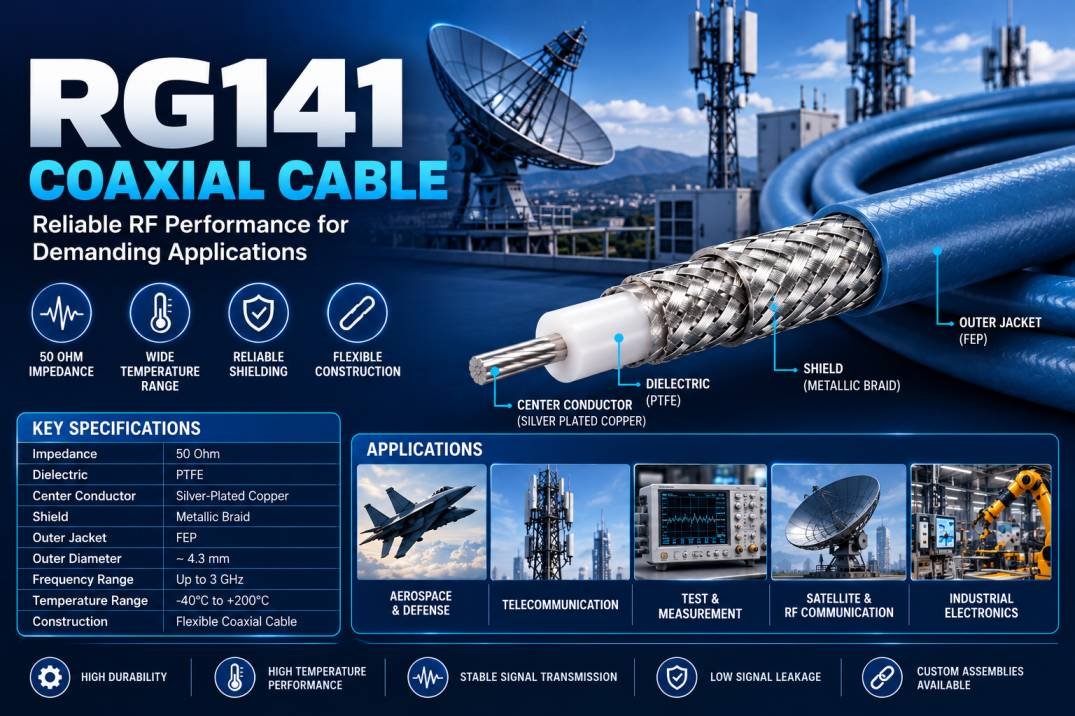
RG141 Coaxial Cable is a 50-ohm RF coaxial cable designed for reliable signal transmission in high-frequency communication, microwave, test and measurement, aerospace, defense, and electronic systems. It uses a PTFE dielectric and silver-plated conductor construction, providing a combination of electrical stability, mechanical durability, and temperature resistance.
Unlike general-purpose coaxial cables, RG141 is designed for applications where controlled impedance, shielding, and reliable RF performance are important. Standard references list RG141 as a 50-ohm PTFE coaxial cable, making it suitable for many RF and microwave interconnections.
What Is RG141 Coaxial Cable?
RG141 Coaxial Cable is a 50-ohm RF cable consisting of a center conductor, PTFE insulation, metallic braided shield, and protective outer jacket. Its coaxial structure keeps the electromagnetic field contained around the center conductor, helping provide controlled RF transmission and shielding against external interference.
A typical RG141 construction uses a silver-clad copper center conductor, PTFE dielectric, silver-clad copper braid, and FEP jacket. One commonly specified version has a cable diameter of approximately 4.3 mm and an operating temperature range of about -40°C to +200°C. Specifications can vary between manufacturers and constructions, so the supplier datasheet should always be checked for the exact version.
RG141 Cable Construction
The performance of RG141 depends heavily on its layered construction.
Center Conductor
The center conductor carries the RF signal. Silver-plated or silver-clad copper is commonly used because it provides good electrical conductivity and maintains performance in demanding environments.
PTFE Dielectric
PTFE separates the center conductor from the outer shield. It provides stable electrical insulation and supports operation across a broad temperature range.
Metallic Shield
The braided outer conductor provides shielding and serves as the return path for the RF signal. It also helps reduce unwanted electromagnetic interference.
Outer Jacket
The outer jacket protects the internal structure from mechanical stress and environmental exposure. FEP is used in commonly available RG141 constructions.
RG141 Coaxial Cable Specifications
| Parameter | Typical RG141 Specification |
|---|---|
| Cable Type | Flexible RF Coaxial Cable |
| Impedance | 50 Ohm |
| Dielectric | PTFE |
| Center Conductor | Silver-Clad Copper |
| Shield | Silver-Clad Copper Braid |
| Jacket | FEP |
| Outer Diameter | Approx. 4.3 mm |
| Maximum Frequency | Up to approximately 3 GHz |
| Temperature Range | Approx. -40°C to +200°C |
These values represent a commonly specified RG141 construction; exact electrical and mechanical characteristics can differ by manufacturer and cable version.
Key Features of RG141 Cable
1. 50 Ohm Controlled Impedance
RG141 is designed around a 50-ohm impedance, making it compatible with many RF and microwave systems, instruments, antennas, and communication equipment.
2. PTFE Insulation
The PTFE dielectric provides electrical insulation and contributes to stable RF performance across changing temperatures.
3. High-Temperature Capability
RG141 constructions are available for demanding temperature environments, with some specifications reaching approximately +200°C.
4. Effective RF Shielding
The metallic braid helps protect transmitted signals from external electromagnetic interference while also reducing unwanted RF radiation.
5. Mechanical Durability
The solid PTFE dielectric and robust cable construction can provide useful crush resistance for applications where cable durability is important.
RG141 Coaxial Cable Applications
RG141 is used where dependable RF interconnection is required. Common application areas include:
- Aerospace and avionics systems
- Defense and military electronics
- RF and microwave equipment
- Wireless communication systems
- Antenna connections
- Test and measurement equipment
- Laboratory RF systems
- Industrial electronics
- Communication infrastructure
- High-temperature electronic systems
Its 50-ohm impedance makes it suitable for integration with many standard RF components and test equipment.
RG141 Cable vs RG188 Cable
RG188 Cable is another 50-ohm PTFE-based RF coaxial cable, but it is generally smaller in diameter than RG141. A typical RG188 construction is around 2.6 mm in diameter and is specified for operation up to approximately 3 GHz, depending on the manufacturer and construction.
| Feature | RG141 Cable | RG188 Cable |
|---|---|---|
| Impedance | 50 Ohm | 50 Ohm |
| Dielectric | PTFE | PTFE |
| Typical Diameter | ~4.3 mm | ~2.6 mm |
| Shield | Metallic braid | Metallic braid |
| Frequency | Up to ~3 GHz in common specification | Up to ~3 GHz |
| Typical Focus | Robust RF interconnection | Compact flexible RF interconnection |
The correct choice depends on required diameter, attenuation, temperature rating, mechanical environment, power handling, and connector configuration.
How to Select RG141 Coaxial Cable
Before purchasing RG141, consider:
- Operating frequency – Confirm the cable’s maximum frequency and attenuation at the required frequency.
- Impedance – Ensure the system requires 50 ohms.
- Temperature – Select a jacket and dielectric construction suitable for the operating environment.
- Shielding – Check braid material and coverage when EMI protection is important.
- Length – Longer cables generally introduce greater insertion loss.
- Connectors – Select compatible SMA, N-Type, TNC, or other RF connectors according to the equipment interface.
- Assembly performance – For cable assemblies, verify VSWR, insertion loss, connector quality, and testing requirements.
Why Use RG141 Coaxial Cable?
RG141 offers a useful balance between RF performance, temperature capability, shielding, and mechanical strength. Its 50-ohm configuration makes it suitable for professional RF systems, while PTFE insulation supports demanding environmental conditions.
For applications requiring a smaller and lighter cable, RG188 Cable may be considered as an alternative depending on the required specifications. However, cable selection should always be based on the actual electrical, mechanical, and environmental requirements of the system.
Frequently Asked Questions About RG141 Coaxial Cable
What is RG141 Coaxial Cable?
RG141 is a 50-ohm RF coaxial cable commonly constructed with a silver-clad copper conductor, PTFE dielectric, metallic braid, and FEP jacket.
Is RG141 a 50-ohm cable?
Yes. RG141 is specified as a 50-ohm coaxial cable.
What dielectric is used in RG141?
PTFE is commonly used as the dielectric material.
What is the typical frequency range of RG141?
A commonly specified RG141 version supports frequencies up to approximately 3 GHz, although the actual limit depends on the cable construction and manufacturer.
What is RG141 used for?
It is commonly used in aerospace, defense, RF, microwave, communication, antenna, and test and measurement applications.
Is RG141 suitable for high-temperature applications?
Yes. Certain RG141 constructions are specified for temperatures up to approximately +200°C. Always verify the manufacturer’s datasheet for the exact cable.
What is the difference between RG141 and RG188 Cable?
Both are commonly 50-ohm PTFE RF cables, but RG141 is generally larger in diameter, while RG188 provides a more compact cable construction.
Can RG141 be supplied as a cable assembly?
Yes. RG141 can be terminated with compatible RF connectors to create application-specific cable assemblies.
Is RG141 suitable for RF testing?
Yes. Its controlled 50-ohm impedance and RF-oriented construction make it suitable for various test and measurement interconnections.
How should RG141 be selected?
Consider frequency, attenuation, impedance, temperature, shielding, cable length, connector type, mechanical requirements, and required assembly performance before selection.
Conclusion
RG141 Coaxial Cable is a robust 50-ohm RF cable designed for demanding communication, aerospace, defense, microwave, and test applications. Its PTFE dielectric, metallic shielding, and temperature-resistant construction make it suitable for systems requiring dependable RF interconnection. When comparing it with RG188 Cable, factors such as cable diameter, flexibility, attenuation, environmental conditions, and system requirements should guide the final selection.