The RF (Radio Frequency) and telecommunications industry is evolving at an unprecedented pace. As global demand for faster connectivity, intelligent networks, and high-frequency communication continues to rise, 2026 has become a defining year for innovation. Technologies such as 5G Advanced, Open RAN, AI-powered networking, satellite communication, and early 6G research are reshaping how people, businesses, and industries communicate.
These advancements are driving new opportunities across telecommunications, aerospace, defense, healthcare, industrial automation, IoT, autonomous transportation, and smart cities. At the heart of these innovations are high-performance RF components, including connectors, cable assemblies, antennas, filters, attenuators, adapters, and waveguide components, which ensure reliable signal transmission at increasingly higher frequencies.
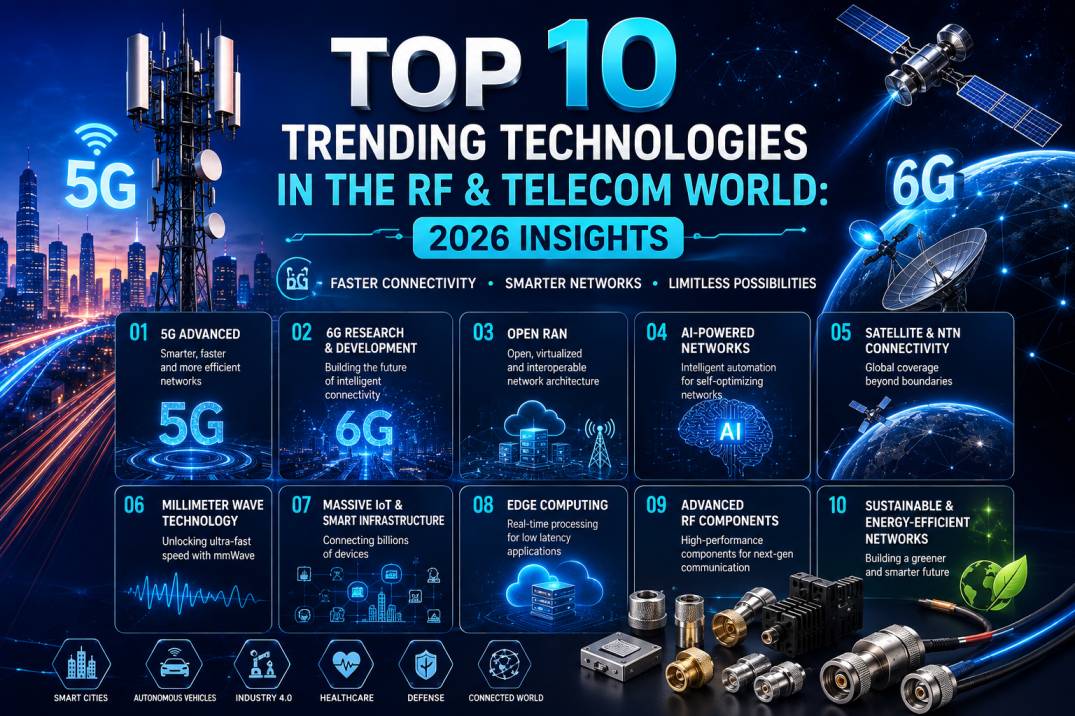
This article explores the Top 10 Trending Technologies in the RF & Telecom World in 2026, highlighting their significance, applications, and future impact.
1. 5G Advanced (5G-A)
While 5G deployment continues worldwide, the industry has shifted its focus to 5G Advanced, also known as 5G Release 18. This technology bridges the gap between 5G and future 6G networks by introducing enhanced performance, greater intelligence, and improved efficiency.
Key Features
- Higher network capacity
- AI-driven optimization
- Improved uplink performance
- Enhanced Massive MIMO
- Better energy efficiency
- Support for industrial IoT
Applications
- Smart factories
- Autonomous vehicles
- Remote healthcare
- Industrial automation
- High-density urban networks
2. 6G Research and Development
Although commercial deployment is expected around 2030, research into 6G wireless technology is accelerating in 2026. Governments, telecom operators, universities, and equipment manufacturers are investing heavily in future communication systems capable of supporting terabit-per-second speeds and AI-native networking.
Expected Capabilities
- Up to 1 Tbps data rates
- Ultra-low latency
- Terahertz communication
- Digital twins
- Holographic communication
- Space-air-ground integrated networks
3. Open RAN (Open Radio Access Network)
Open RAN has become one of the most disruptive developments in telecom infrastructure.
Traditional mobile networks rely on proprietary hardware and software from a single vendor. Open RAN allows operators to mix equipment from multiple manufacturers, reducing costs and encouraging innovation.
Benefits
- Vendor flexibility
- Lower deployment cost
- Faster innovation
- Easier upgrades
- Improved interoperability
Industry Adoption
Leading telecom operators worldwide are actively deploying Open RAN solutions to modernize their wireless infrastructure.
4. AI-Powered Telecom Networks
Artificial Intelligence has become essential in network management.
Modern telecom systems now use AI to monitor network performance, predict failures, optimize bandwidth, detect cyber threats, and automate maintenance.
AI Applications
- Network optimization
- Predictive maintenance
- Traffic management
- Self-healing networks
- Automated fault detection
- Customer experience optimization
AI is expected to become the foundation of future 6G communication.
5. Satellite Internet and Non-Terrestrial Networks (NTN)
Satellite communication is transforming global connectivity by extending internet access beyond traditional cellular infrastructure.
Low Earth Orbit (LEO) satellite constellations provide broadband connectivity to remote and underserved regions.
Advantages
- Global coverage
- Low latency compared to traditional satellites
- Rural connectivity
- Maritime communication
- Aviation broadband
- Emergency communication
Non-Terrestrial Networks are expected to become an integral part of future telecom ecosystems.
6. Millimeter Wave (mmWave) Communication
Millimeter Wave technology continues to expand as demand for ultra-high-speed communication increases.
Operating between approximately 24 GHz and 100 GHz, mmWave enables significantly larger bandwidth compared to conventional frequency bands.
Benefits
- Multi-gigabit speeds
- Higher spectrum availability
- Increased network capacity
- Low latency
- Dense urban deployment
Applications
- 5G small cells
- Fixed wireless access
- Smart stadiums
- Airports
- Industrial campuses
7. Massive IoT and Smart Infrastructure
The Internet of Things continues to expand rapidly in 2026.
Billions of connected devices require reliable RF communication systems capable of supporting low power consumption and massive scalability.
IoT Applications
- Smart cities
- Environmental monitoring
- Agriculture
- Healthcare
- Asset tracking
- Smart energy grids
- Industrial automation
Advanced RF modules and antennas play a critical role in enabling reliable IoT communication.
8. Edge Computing for Telecom
Edge computing moves data processing closer to end users instead of relying entirely on centralized cloud infrastructure.
This significantly reduces latency and improves real-time decision-making.
Benefits
- Faster response times
- Reduced bandwidth usage
- Enhanced privacy
- Improved reliability
- Better support for AI applications
Use Cases
- Autonomous vehicles
- Smart manufacturing
- Video analytics
- AR/VR
- Industrial robotics
9. Advanced RF Components for High-Frequency Applications
As communication frequencies continue to increase, demand for precision RF components has grown significantly.
Modern telecom infrastructure depends on reliable high-frequency products capable of operating with minimal signal loss.
Trending RF Components
- RF Connectors
- RF Cable Assemblies
- Low Loss RF Cables
- RF Adapters
- RF Attenuators
- RF Terminations
- Waveguide Components
- Directional Couplers
- Power Dividers
- RF Filters
- Horn Antennas
- Test Cables
Manufacturers are focusing on components supporting frequencies above 40 GHz for next-generation communication systems.
10. Sustainable and Energy-Efficient Telecom Networks
Sustainability has become a major priority across the telecom industry.
Network operators are investing in technologies that reduce power consumption while maintaining high performance.
Green Telecom Initiatives
- AI energy optimization
- Efficient power amplifiers
- Smart cooling systems
- Renewable energy integration
- Low-power RF hardware
- Energy-efficient data centers
Future telecom networks are expected to balance performance with environmental responsibility.
Emerging Technologies to Watch
Several additional innovations are gaining momentum and are expected to influence the RF and telecom industry over the next few years.
Quantum Communication
Quantum communication promises ultra-secure data transmission through quantum encryption techniques.
Digital Twins
Digital replicas of telecom infrastructure enable predictive maintenance and real-time optimization.
Intelligent Reflective Surfaces (IRS)
These smart surfaces improve wireless coverage by intelligently reflecting radio signals.
Private 5G Networks
Enterprises increasingly deploy dedicated private cellular networks for secure industrial communication.
Network Automation
Automation reduces operational costs while improving service quality and reliability.
Impact on RF Component Manufacturers
The rapid evolution of wireless communication creates significant opportunities for RF component manufacturers.
Growing demand exists for:
- High-frequency RF connectors
- Precision cable assemblies
- Low insertion loss adapters
- Microwave attenuators
- High-performance filters
- Waveguide assemblies
- Millimeter-wave components
- Test and measurement solutions
Manufacturers capable of delivering products supporting higher frequencies, tighter tolerances, and superior reliability will play a crucial role in future telecom infrastructure.
Industries Benefiting from These Technologies
The latest RF and telecom innovations are transforming numerous sectors.
Telecommunications
- Mobile operators
- Network infrastructure providers
- Internet service providers
Aerospace and Defense
- Radar systems
- Electronic warfare
- Satellite communication
Healthcare
- Remote diagnostics
- Connected medical devices
- Telemedicine
Automotive
- Connected vehicles
- Autonomous driving
- Vehicle-to-Everything (V2X)
Manufacturing
- Industry 4.0
- Smart factories
- Robotics
- Predictive maintenance
Smart Cities
- Intelligent traffic systems
- Public safety
- Smart utilities
- Environmental monitoring
The Role of RF Components in Future Networks
Every emerging telecom technology relies on advanced RF hardware to ensure efficient signal transmission and network performance.
Essential RF components include:
- RF Connectors
- RF Cable Assemblies
- Coaxial Adapters
- RF Filters
- Directional Couplers
- Power Dividers
- RF Attenuators
- RF Terminations
- Waveguide Components
- Test Cables
- Horn Antennas
- Millimeter-Wave Accessories
These components are fundamental to supporting higher frequencies, lower losses, improved impedance matching, and enhanced reliability in next-generation communication systems.
Future Outlook
The RF and telecom industry is entering one of its most transformative periods. Technologies such as 5G Advanced, Open RAN, AI-driven networks, satellite communication, edge computing, and early 6G research are redefining how the world connects. At the same time, demand for advanced RF components capable of supporting higher frequencies and greater performance continues to grow.
Organizations that embrace these technologies and invest in future-ready infrastructure will be better positioned to meet the increasing demand for faster, smarter, and more reliable communication networks.
Conclusion
The year 2026 marks a significant milestone in the evolution of RF and telecommunications. From AI-powered networking and Open RAN to 5G Advanced, satellite communication, and the early foundations of 6G, the industry is moving toward intelligent, software-defined, and highly connected ecosystems.
Behind every breakthrough lies a robust RF infrastructure powered by high-quality connectors, cable assemblies, antennas, filters, waveguides, and other precision RF components. As innovation accelerates, these technologies will continue to shape the future of global communication, enabling smarter industries, connected societies, and next-generation digital experiences.
Frequently Asked Questions (FAQs)
What are the top RF and telecom trends in 2026?
The leading trends include 5G Advanced, 6G research, Open RAN, AI-powered networks, satellite communication, edge computing, massive IoT, millimeter-wave technology, advanced RF components, and sustainable telecom infrastructure.
Why is Open RAN important?
Open RAN allows telecom operators to use equipment from multiple vendors, reducing costs, increasing flexibility, and encouraging innovation.
How does AI improve telecom networks?
AI optimizes traffic management, predicts equipment failures, automates maintenance, enhances security, and improves overall network performance.
Why are RF components critical for next-generation networks?
RF components ensure efficient signal transmission, low insertion loss, impedance matching, and reliable performance in high-frequency communication systems.
Will 6G replace 5G?
6G is expected to complement and eventually succeed 5G after 2030, introducing terahertz communication, AI-native networking, and intelligent global connectivity.
Which industries benefit most from these technologies?
Telecommunications, aerospace, defense, healthcare, automotive, manufacturing, smart cities, logistics, and industrial automation are among the sectors benefiting most from the latest RF and telecom advancements.