
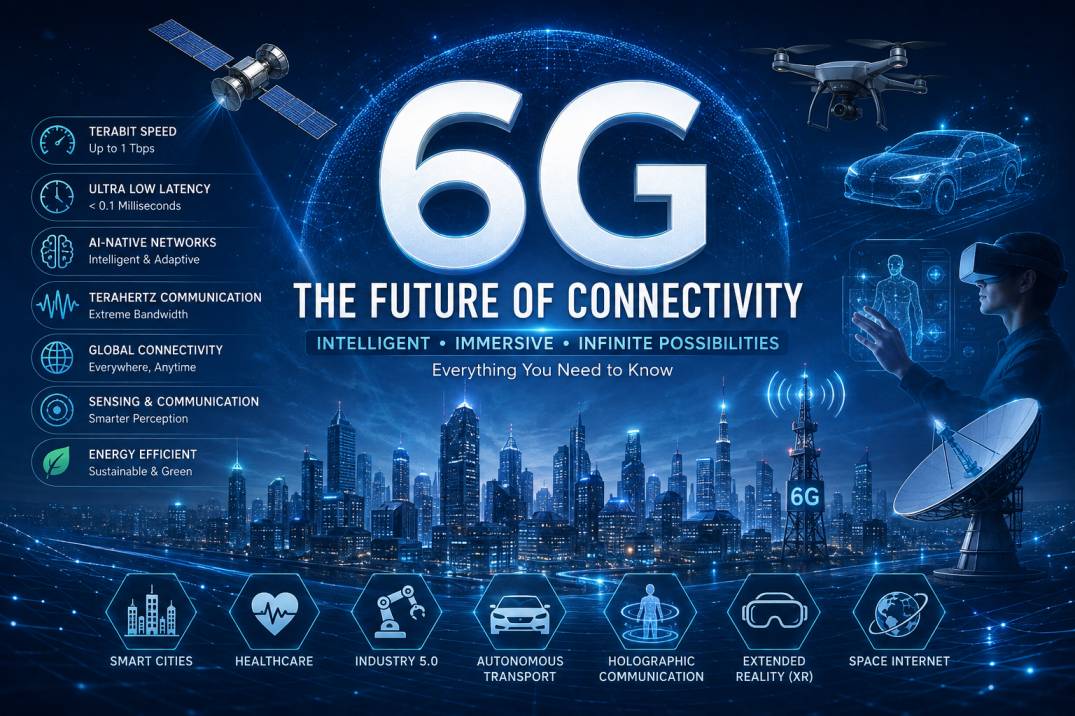
The world has witnessed rapid advancements in wireless communication over the last few decades. From 2G enabling digital voice calls to 3G introducing mobile internet, 4G revolutionizing high-speed data, and 5G powering smart cities and autonomous technologies, every generation has transformed how people connect and communicate.
Now, researchers, telecom companies, and governments are preparing for the next revolution—6G. Although commercial deployment is expected around 2030, development is already underway worldwide. 6G is expected to provide unprecedented speeds, ultra-low latency, intelligent networking, and seamless integration between physical and digital environments.
In this comprehensive guide, you’ll learn everything about 6G technology, including its features, architecture, benefits, applications, challenges, and how it differs from 5G.
What is 6G?
6G (Sixth Generation Wireless Technology) is the successor to 5G mobile networks. It is the next generation of wireless communication that aims to deliver data speeds up to 100 times faster than 5G while enabling intelligent, AI-driven communication systems.
Unlike previous generations that primarily focused on increasing speed, 6G is designed to create a fully connected intelligent ecosystem where humans, machines, robots, sensors, vehicles, satellites, and digital twins communicate instantly.
The primary objective of 6G is to create a network that is:
- Ultra-fast
- Highly intelligent
- Extremely reliable
- Energy efficient
- Globally connected
- Secure by design
Evolution of Mobile Networks
| Generation | Launch Period | Maximum Speed | Primary Purpose |
|---|---|---|---|
| 1G | 1980s | Analog | Voice Calls |
| 2G | 1990s | 64 Kbps | Digital Voice & SMS |
| 3G | 2000s | 2 Mbps | Mobile Internet |
| 4G LTE | 2010s | 1 Gbps | HD Streaming & Apps |
| 5G | 2020s | 20 Gbps | IoT, Smart Cities, AI |
| 6G | Around 2030 | Up to 1 Tbps | Intelligent Connected World |
Why Do We Need 6G?
Although 5G is still expanding globally, future technologies will demand significantly more bandwidth, intelligence, and reliability.
Emerging technologies include:
- Artificial Intelligence
- Digital Twins
- Extended Reality (XR)
- Metaverse
- Holographic Communication
- Autonomous Transportation
- Space Internet
- Smart Manufacturing
- Remote Robotic Surgery
- Massive Industrial IoT
These applications require network capabilities far beyond what 5G can provide.
Key Features of 6G
Terabit-Level Speeds
One of the biggest improvements expected with 6G is data transfer rates reaching up to 1 Terabit per second (Tbps).
This means:
- Downloading an 8K movie in less than a second
- Instant cloud computing
- Real-time holographic streaming
- Ultra-high-resolution video communication
Ultra-Low Latency
Latency is expected to decrease from approximately 1 millisecond in 5G to nearly 100 microseconds in 6G.
This enables:
- Instant remote control
- Precision robotics
- Autonomous vehicles
- Remote surgeries
- Industrial automation
AI-Native Networks
Unlike 5G, where AI assists network management, 6G will be built with Artificial Intelligence integrated into every layer.
AI will automatically:
- Optimize traffic
- Predict failures
- Improve security
- Allocate bandwidth
- Reduce congestion
- Improve energy efficiency
Terahertz Communication
6G is expected to use Terahertz (THz) frequency bands, providing enormous bandwidth for future communication systems.
Advantages include:
- Higher capacity
- Faster speeds
- Massive device connectivity
- Better spectrum efficiency
Intelligent Connectivity
6G networks will intelligently connect:
- Smartphones
- Smart homes
- Factories
- Vehicles
- Drones
- Satellites
- Medical devices
- Wearables
- Robots
Integrated Sensing and Communication
One unique capability of 6G is combining communication and sensing into a single network.
Applications include:
- Object detection
- Motion tracking
- Indoor navigation
- Environmental monitoring
- Smart security
Digital Twin Support
Digital twins are virtual replicas of physical systems.
6G will enable real-time synchronization between physical objects and their digital counterparts for:
- Smart factories
- Healthcare
- Aviation
- Smart cities
- Industrial automation
Global Satellite Integration
Unlike previous generations, 6G will combine:
- Cellular networks
- Low Earth Orbit satellites
- High Altitude Platforms
- UAV communication
- Maritime communication
This will provide worldwide internet coverage.
Energy-Efficient Networks
6G aims to significantly reduce energy consumption using:
- AI optimization
- Smart sleep modes
- Intelligent routing
- Energy harvesting
- Green communication technologies
Expected Specifications of 6G
| Feature | Expected Capability |
|---|---|
| Peak Speed | Up to 1 Tbps |
| Latency | Below 0.1 ms |
| Frequency | THz Bands |
| AI Integration | Native |
| Device Density | Millions/km² |
| Reliability | 99.99999% |
| Coverage | Global |
| Security | AI-Based |
How Does 6G Work?
6G combines several advanced technologies into one intelligent communication platform.
Core technologies include:
Artificial Intelligence
AI will optimize every aspect of the network automatically.
Machine Learning
Predictive algorithms will continuously improve network performance.
Edge Computing
Data processing will occur closer to users for lower latency.
Cloud Computing
High-performance cloud infrastructure will support massive workloads.
Quantum Computing Integration
Future quantum systems may accelerate data processing and encryption.
Blockchain
Blockchain could improve network authentication and security.
Terahertz Radio
Ultra-high-frequency communication enables extreme bandwidth.
Intelligent Reflective Surfaces
Smart surfaces will enhance wireless signal coverage inside buildings.
Applications of 6G
Smart Cities
Future cities will use 6G for:
- Intelligent traffic systems
- Energy management
- Public safety
- Smart lighting
- Environmental monitoring
Healthcare
6G will transform healthcare through:
- Remote robotic surgery
- AI diagnosis
- Wearable monitoring
- Real-time patient data
- Holographic consultations
Manufacturing
Industry 5.0 will benefit from:
- Connected robots
- Predictive maintenance
- Digital twins
- Autonomous production
- AI quality control
Transportation
Future transportation systems will include:
- Autonomous vehicles
- Smart highways
- Connected drones
- Intelligent logistics
- Air taxis
Education
6G enables immersive learning through:
- Virtual classrooms
- Holographic teachers
- Mixed Reality
- Interactive simulations
Entertainment
Users can expect:
- Holographic gaming
- 16K streaming
- Cloud gaming
- Immersive virtual concerts
- Real-time metaverse experiences
Defense and Aerospace
6G will support:
- Military communication
- Battlefield intelligence
- Satellite communication
- Autonomous surveillance
- Radar systems
6G vs 5G
| Feature | 5G | 6G |
|---|---|---|
| Maximum Speed | 20 Gbps | Up to 1 Tbps |
| Latency | 1 ms | Less than 0.1 ms |
| Frequency | Sub-6 GHz & mmWave | THz Spectrum |
| Intelligence | AI Assisted | AI Native |
| Connectivity | Massive IoT | Intelligent Everything |
| Coverage | Cellular | Cellular + Satellite |
| Applications | Smart Cities | Digital Twin, XR, Holograms |
Advantages of 6G
Major advantages include:
- Extremely high-speed connectivity
- AI-powered intelligent networking
- Global coverage
- Better cybersecurity
- Massive device connectivity
- Lower latency
- Energy-efficient communication
- Improved spectrum utilization
- Advanced automation
- Enhanced user experience
Challenges of 6G
Despite its promise, 6G faces several challenges.
Infrastructure Cost
Building a completely new communication ecosystem will require significant investment.
Spectrum Availability
Terahertz frequencies present propagation and hardware challenges.
Device Compatibility
New chipsets, antennas, RF connectors, filters, and communication hardware will be required.
Power Consumption
Although more efficient, ultra-high-speed processing may initially require increased computing power.
Cybersecurity
Future intelligent networks must defend against increasingly sophisticated cyber threats.
Role of RF Components in 6G Networks
The success of 6G depends heavily on advanced RF and microwave components.
Key components include:
- RF Connectors
- RF Cable Assemblies
- Low Loss RF Cables
- RF Adapters
- RF Attenuators
- RF Terminations
- Power Dividers
- Directional Couplers
- Waveguide Components
- Filters
- Antennas
- Millimeter Wave Components
- Terahertz Test Equipment
High-frequency RF components capable of operating beyond 100 GHz will become increasingly important for 6G infrastructure.
When Will 6G Be Available?
Research and standardization are already underway.
Expected timeline:
- 2025–2027: Research and prototype development
- 2028–2029: Pilot testing and standardization
- 2030: Initial commercial deployment
- 2035: Wider global adoption
Future of 6G
6G represents far more than another increase in mobile internet speed. It will serve as the foundation for an intelligent digital society where humans, machines, AI, satellites, and autonomous systems communicate seamlessly.
From holographic communication and autonomous transportation to digital twins and immersive extended reality, 6G has the potential to redefine industries, businesses, healthcare, education, manufacturing, and everyday life. As research continues and global standards evolve, 6G is expected to become one of the most transformative technologies of the next decade.
Frequently Asked Questions (FAQs)
What is 6G?
6G is the sixth generation of wireless communication technology designed to provide terabit-level speeds, ultra-low latency, AI-native networking, and intelligent global connectivity.
Is 6G available today?
No. 6G is currently in the research and development phase, with commercial deployment expected around 2030.
How fast will 6G be?
6G is expected to deliver peak data speeds of up to 1 Terabit per second (1 Tbps).
What frequency bands will 6G use?
6G is expected to utilize Terahertz (THz) frequency bands in addition to existing microwave and millimeter-wave spectrum.
What industries will benefit from 6G?
Healthcare, manufacturing, defense, aerospace, telecommunications, transportation, education, smart cities, logistics, and entertainment are expected to benefit significantly.
Will 6G replace 5G?
Eventually, 6G will complement and gradually succeed 5G as next-generation infrastructure is deployed, but both technologies are likely to coexist for several years.
Why is AI important in 6G?
Artificial Intelligence will enable autonomous network optimization, predictive maintenance, enhanced security, intelligent resource allocation, and improved overall network performance.
What RF components are essential for 6G infrastructure?
Essential RF components include RF connectors, cable assemblies, antennas, filters, attenuators, waveguide components, adapters, power dividers, directional couplers, and high-frequency test solutions capable of supporting Terahertz communication.