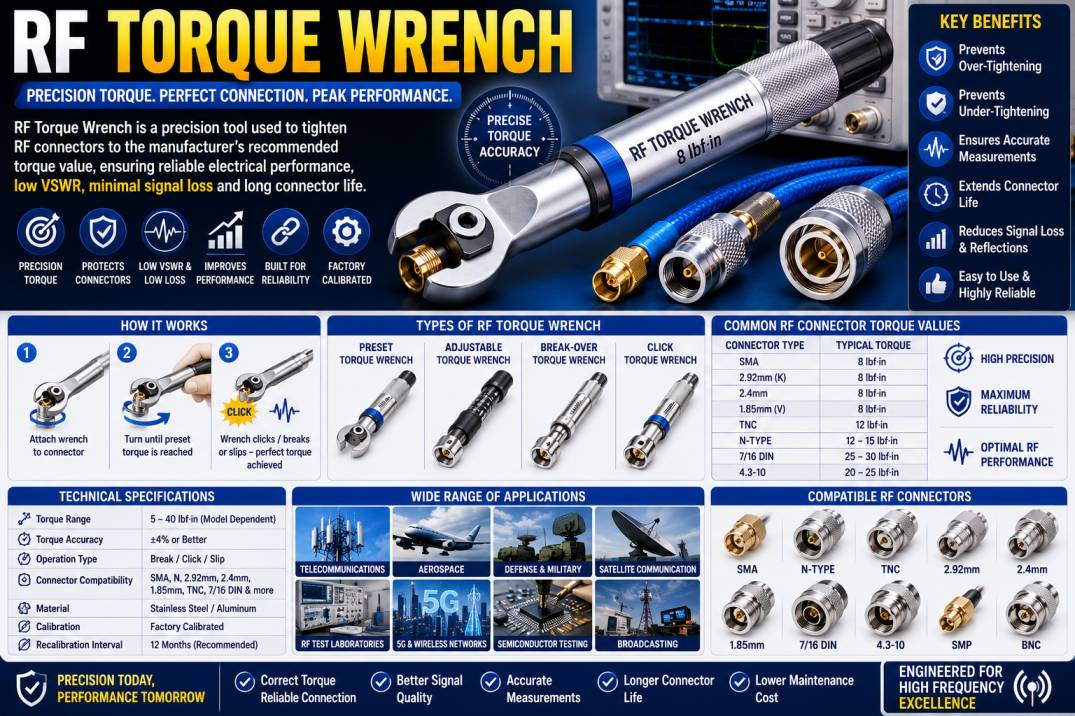
An RF Torque Wrench is a precision hand tool specifically designed to tighten RF (Radio Frequency) connectors to the manufacturer’s recommended torque value. In high-frequency communication systems, even a slight variation in connector tightness can significantly affect electrical performance, resulting in increased insertion loss, poor return loss, higher Voltage Standing Wave Ratio (VSWR), signal reflections, and premature connector wear. An RF torque wrench eliminates these issues by applying a precise amount of torque during connector installation.
RF Torque Wrenches are essential tools in telecommunications, aerospace, defense, satellite communication, wireless networking, laboratory testing, semiconductor manufacturing, broadcasting, and 5G infrastructure. They ensure consistent connector mating force, improve measurement accuracy, and extend the service life of expensive RF connectors and test equipment.
Modern RF systems operate at frequencies ranging from several megahertz to over 110 GHz. As operating frequencies increase, connector precision becomes even more critical. RF Torque Wrenches help engineers maintain reliable electrical performance while protecting delicate connector interfaces from damage caused by over-tightening or under-tightening.
This comprehensive guide explains everything you need to know about RF Torque Wrenches, including their construction, working principle, types, specifications, applications, advantages, and selection criteria.
What Is an RF Torque Wrench?
An RF Torque Wrench is a calibrated mechanical tool that applies a predetermined amount of rotational force to RF connectors during installation or removal.
Unlike standard wrenches, RF Torque Wrenches are specifically engineered for precision RF connectors such as SMA, N-Type, TNC, 2.92mm, 2.4mm, 1.85mm, 7/16 DIN, 4.3-10, and other microwave connector interfaces.
The tool automatically limits the applied torque, preventing connector damage while ensuring reliable electrical and mechanical performance.
Why Is an RF Torque Wrench Important?
RF connectors are precision-machined components designed with strict mechanical tolerances.
Improper tightening may cause:
- Increased insertion loss
- Higher VSWR
- Poor return loss
- Signal reflections
- Connector deformation
- Damaged center contacts
- Reduced measurement accuracy
- Shortened connector lifespan
- Loose RF connections
- Mechanical failure
Using a calibrated RF Torque Wrench ensures every connection is tightened according to the connector manufacturer’s specifications.
How Does an RF Torque Wrench Work?
An RF Torque Wrench applies a controlled rotational force to the connector coupling nut.
Once the preset torque value is reached, the wrench either “breaks,” “slips,” or “clicks,” preventing additional force from being applied.
This mechanism protects both the connector and the mating interface from excessive mechanical stress while ensuring a secure electrical connection.
Construction of an RF Torque Wrench
Handle
The handle provides a comfortable grip and allows controlled torque application.
Common materials include:
- Aluminum Alloy
- Stainless Steel
- High-strength Polymer
Torque Mechanism
The internal torque mechanism determines the maximum applied force.
Common designs include:
- Break-over mechanism
- Click mechanism
- Slip clutch mechanism
Wrench Head
The head interfaces with the RF connector.
It is manufactured with precision tolerances to prevent connector damage.
Calibration System
Every high-quality RF Torque Wrench is factory calibrated to ensure repeatable accuracy.
Key Features of RF Torque Wrenches
- Precision torque control
- Factory calibrated
- Repeatable accuracy
- Prevents over-tightening
- Prevents under-tightening
- Extends connector life
- Improves RF performance
- Easy to use
- Lightweight construction
- High durability
- Excellent reliability
- Suitable for laboratory and field applications
Technical Specifications
| Specification | Typical Value |
| Torque Range | 5–40 lbf·in (Model Dependent) |
| Torque Accuracy | ±4% or Better |
| Operation Type | Break, Click, or Slip |
| Material | Stainless Steel / Aluminum |
| Handle Type | Ergonomic |
| Calibration | Factory Calibrated |
| Recalibration Interval | 12 Months Recommended |
| Connector Compatibility | Multiple RF Connector Types |
| Weight | Lightweight |
| Service Life | Thousands of Tightening Cycles |
Common RF Torque Values
The recommended torque depends on the connector type.
| Connector Type | Typical Torque |
| SMA | 8 lbf·in |
| 2.92mm (K) | 8 lbf·in |
| 2.4mm | 8 lbf·in |
| 1.85mm (V) | 8 lbf·in |
| TNC | 12 lbf·in |
| N-Type | 12–15 lbf·in |
| 7/16 DIN | Higher Torque Requirement |
| 4.3-10 | Manufacturer Specification |
Always follow the connector manufacturer’s recommended torque specification.
Types of RF Torque Wrenches
Preset Torque Wrench
Applies one fixed torque value.
Ideal for repetitive production work.
Adjustable Torque Wrench
Allows users to adjust torque settings for multiple connector types.
Break-Over Torque Wrench
The handle bends slightly once the preset torque is reached.
Click Torque Wrench
Produces an audible click when the specified torque is achieved.
Slip Torque Wrench
The internal clutch slips after reaching the preset torque, preventing over-tightening.
Compatible RF Connectors
RF Torque Wrenches are commonly used with:
- SMA
- N-Type
- TNC
- BNC
- 2.92mm (K)
- 2.4mm
- 1.85mm (V)
- SMP
- SMPM
- 7/16 DIN
- 4.3-10
- MCX
- MMCX
Applications of RF Torque Wrenches
Telecommunications
Used during installation of cellular base stations, antennas, and RF communication equipment.
5G Infrastructure
Ensures proper connector installation in massive MIMO antennas and small cell networks.
Aerospace
Supports precision RF connections in aircraft communication and avionics systems.
Defense
Used for radar, electronic warfare, missile guidance, and military communication systems.
Satellite Communication
Ensures reliable connector performance in ground stations and satellite payload testing.
RF Laboratories
Essential for accurate vector network analyzer (VNA) measurements and calibration.
Semiconductor Testing
Used in high-frequency wafer probing and microwave component testing.
Broadcasting
Maintains reliable RF connections in television and radio transmission equipment.
Medical Equipment
Supports RF imaging systems, MRI equipment, and microwave diagnostic devices.
Advantages of RF Torque Wrenches
- Prevents connector damage
- Ensures accurate connector torque
- Improves RF measurement accuracy
- Reduces insertion loss
- Maintains low VSWR
- Extends connector lifespan
- Increases installation consistency
- Easy operation
- High repeatability
- Factory calibrated
- Suitable for precision RF applications
- Reduces maintenance costs
Limitations of RF Torque Wrenches
- Higher cost than standard wrenches
- Requires periodic recalibration
- Connector-specific torque values
- Improper storage may affect calibration
- Not intended for general mechanical applications
How to Choose the Right RF Torque Wrench
Before selecting an RF Torque Wrench, consider the following:
- Connector type
- Required torque value
- Torque accuracy
- Wrench mechanism
- Calibration certificate
- Frequency of use
- Environmental conditions
- Ergonomic design
- Material quality
- Manufacturer reputation
RF Torque Wrench vs Standard Wrench
| Feature | RF Torque Wrench | Standard Wrench |
| Torque Control | Precise | Manual |
| Calibration | Yes | No |
| Connector Protection | Excellent | Limited |
| RF Applications | Designed Specifically | Not Recommended |
| Repeatability | High | Low |
| Measurement Accuracy | Excellent | Variable |
| Over-Tightening Protection | Yes | No |
| Cost | Higher | Lower |
Industries Using RF Torque Wrenches
RF Torque Wrenches are widely used in:
- Telecommunications
- Aerospace
- Defense
- Satellite Communication
- Broadcasting
- Medical Electronics
- Semiconductor Manufacturing
- Scientific Research
- RF Test Laboratories
- Industrial Automation
Maintenance Tips
To maximize the lifespan of an RF Torque Wrench:
- Store in a protective case.
- Keep the wrench clean and dry.
- Avoid dropping the tool.
- Recalibrate annually or according to manufacturer recommendations.
- Do not exceed the specified torque range.
- Use only on compatible RF connectors.
- Inspect the wrench before each use.
Future Trends of RF Torque Wrenches
As RF communication technologies evolve toward higher frequencies with the expansion of 5G Advanced, 6G, satellite internet, aerospace communication, and millimeter-wave systems, connector precision is becoming increasingly important. Future RF Torque Wrenches will feature digital torque measurement, electronic calibration records, Bluetooth connectivity, smart maintenance tracking, and enhanced ergonomic designs. These innovations will improve installation accuracy, simplify calibration management, and support next-generation high-frequency communication systems.
Conclusion
RF Torque Wrenches are essential precision tools for ensuring reliable and repeatable installation of RF connectors in high-frequency communication systems. By applying the correct torque, these tools protect connectors from mechanical damage, improve electrical performance, reduce signal reflections, and extend equipment life. Whether used in telecommunications, aerospace, defense, satellite communication, laboratory testing, or semiconductor manufacturing, an RF Torque Wrench is a critical investment for maintaining the integrity and performance of modern RF systems.
Frequently Asked Questions (FAQs)
1. What is an RF Torque Wrench?
An RF Torque Wrench is a precision tool designed to tighten RF connectors to a specified torque value, ensuring reliable electrical performance and preventing connector damage.
2. Why is an RF Torque Wrench important?
It prevents over-tightening and under-tightening, helping maintain low VSWR, low insertion loss, accurate measurements, and longer connector life.
3. Which RF connectors require a torque wrench?
Common connectors include SMA, N-Type, TNC, 2.92mm, 2.4mm, 1.85mm, SMP, SMPM, 7/16 DIN, and 4.3-10 connectors.
4. What is the typical torque value for SMA connectors?
Most SMA connectors require approximately 8 lbf·in, although the exact value should always follow the connector manufacturer’s specifications.
5. How often should an RF Torque Wrench be calibrated?
Most manufacturers recommend recalibration every 12 months or after a specified number of tightening cycles.
6. What are the benefits of using an RF Torque Wrench?
Benefits include improved connector reliability, reduced signal loss, consistent torque application, extended connector lifespan, and enhanced RF measurement accuracy.
7. Can an RF Torque Wrench be used for general mechanical work?
No. RF Torque Wrenches are designed specifically for precision RF connectors and should not replace general-purpose torque tools.
8. What types of RF Torque Wrenches are available?
Common types include preset, adjustable, break-over, click, and slip torque wrenches.
9. Which industries commonly use RF Torque Wrenches?
They are widely used in telecommunications, aerospace, defense, satellite communication, broadcasting, semiconductor manufacturing, medical electronics, and RF laboratories.
10. How do I choose the right RF Torque Wrench?
Choose a wrench based on connector type, required torque value, calibration accuracy, operating environment, ergonomic design, and manufacturer specifications.