Modern communication systems require stable signal transmission even in challenging environments such as tunnels, underground mines, metros, industrial plants, parking basements, and long corridors. Traditional antennas often fail in these enclosed spaces because radio waves cannot travel efficiently through thick concrete, metal structures, or underground rock formations. This is where leaky cables become highly effective.
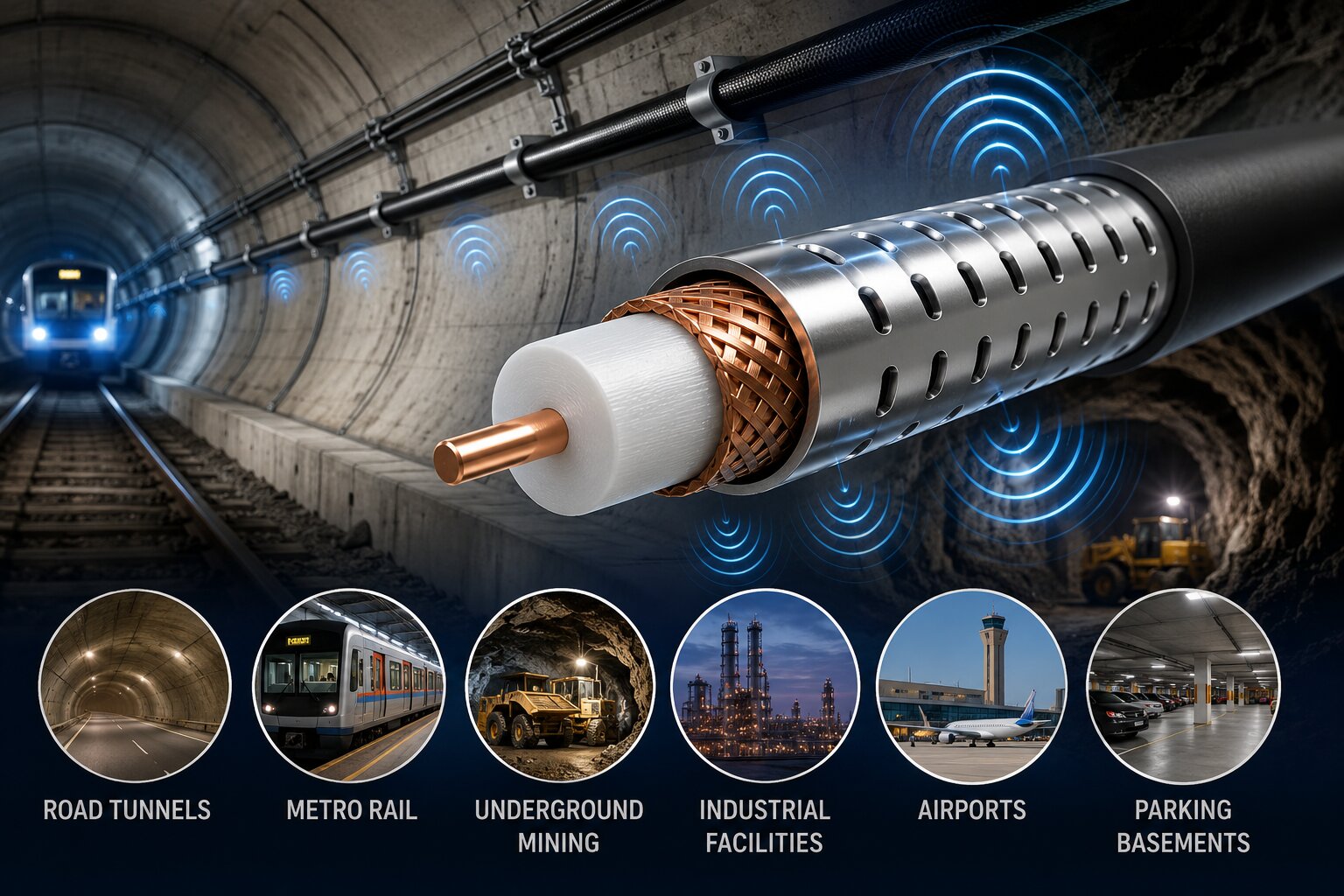
A leaky cable, also known as a leaky feeder cable or radiating cable, is specially designed to transmit and receive radio frequency signals along its entire length. Unlike standard coaxial cables that are designed to prevent signal leakage, leaky cables intentionally allow controlled radiation of signals through slots or openings in the outer conductor.
Leaky feeder systems are widely used in underground mining, metro rail systems, tunnels, airports, industrial facilities, military installations, and smart infrastructure projects because they provide continuous wireless coverage in areas where standard communication systems cannot perform efficiently.
Introduction to Leaky Cable
A leaky cable functions as an extended antenna system. Instead of transmitting signals from a single antenna point, the cable continuously radiates radio signals throughout its entire length. This allows uninterrupted communication coverage in confined or difficult environments.
The term “leaky” refers to the controlled leakage of radio signals through specially engineered slots in the cable’s outer conductor. These slots allow the signal to move in and out of the cable, enabling two-way wireless communication.
Leaky feeder systems are commonly integrated with:
- VHF communication systems
- UHF communication systems
- LTE and 4G systems
- TETRA communication networks
- Wi-Fi distribution systems
- Emergency communication networks
- Public safety radio systems
These systems ensure seamless connectivity across long underground or enclosed paths.
How Does a Leaky Cable Work?
The working principle of a leaky cable is based on controlled electromagnetic radiation.
A standard coaxial cable keeps RF energy confined inside the cable structure. However, a leaky cable contains periodic slots or gaps in its outer conductor. These slots allow a portion of the RF energy to radiate outside the cable.
When installed along tunnels or underground pathways, the cable behaves like a long distributed antenna.
The communication process works in the following way:
- RF signals are transmitted through the cable.
- Slots in the outer conductor radiate the signal into surrounding areas.
- Mobile radios or wireless devices receive the signal.
- Signals transmitted from portable devices are captured back by the cable.
- The signal is carried through the cable to the control station.
This creates continuous communication coverage across the entire installation area.
Construction of Leaky Feeder Cable
A typical leaky feeder cable consists of several layers:
Inner Conductor
The central conductor carries the RF signal.
Dielectric Insulation
The dielectric layer separates the inner conductor from the outer conductor while maintaining signal integrity.
Outer Conductor with Slots
This is the most important component. Carefully designed slots or apertures allow controlled RF leakage.
Protective Jacket
The outer jacket protects the cable from moisture, chemicals, abrasion, UV radiation, and harsh environmental conditions.
Some advanced cables also include flame-retardant and low-smoke materials for metro and tunnel safety applications.
Types of Leaky Cables
Leaky cables are available in different configurations depending on frequency range, installation environment, and application requirements.
Slotted Leaky Cable
This is the most common type of leaky feeder cable
It contains evenly spaced slots cut into the outer conductor. These slots provide uniform signal radiation throughout the cable length.
Applications include:
- Underground mines
- Railway tunnels
- Metro communication systems
- Industrial plants
Corrugated Leaky Cable
Corrugated leaky cables provide better flexibility and mechanical strength. They are widely used in harsh industrial environments.
Advantages include:
- Improved durability
- Better bending performance
- Enhanced shielding performance
Broadband Radiating Cable
Broadband radiating cables support multiple frequency bands simultaneously.
These cables are ideal for:
- LTE systems
- 4G and 5G applications
- Multi-network communication systems
- Public safety networks
Low Smoke Zero Halogen Leaky Cable
LSZH leaky cables are specially designed for underground and enclosed public spaces.
They produce:
- Low smoke emissions
- Minimal toxic gases
- Improved fire safety
These cables are widely used in metro rail systems and tunnels.
Key Components of a Leaky Feeder System
A complete leaky feeder communication system includes multiple components.
Leaky Cable
Acts as the distributed antenna.
Base Station
Controls communication between portable devices and the central network.
Line Amplifiers
Boost signal strength after specific intervals because RF signals weaken over long distances.
Amplifiers are typically installed every 350 to 500 meters.
Splitters and Couplers
Used to divide signals across multiple cable sections.
Portable Radios
Handheld radios communicate with the leaky cable network.
Power Supply System
Provides stable electrical power to amplifiers and network components.
Frequency Range of Leaky Feeder Cables
Leaky feeder systems generally operate in VHF and UHF frequency ranges.
Common frequency bands include:
- 150 MHz
- 450 MHz
- 700 MHz
- 800 MHz
- 900 MHz
Most systems operate below 1 GHz because higher frequencies experience greater signal loss and require more repeaters.
Modern broadband systems may also support:
- LTE
- Wi-Fi
- 4G communication
- TETRA networks
Applications of Leaky Cable
Leaky feeder cables are used in industries where reliable communication is essential.
Underground Mining
Mining is one of the largest applications of leaky feeder systems.
Underground mines face serious communication challenges because rock formations block radio signals. Leaky cables provide reliable communication between miners and control rooms.
Benefits in mining include:
- Improved worker safety
- Emergency communication
- Real-time coordination
- Equipment tracking
- Operational efficiency
Metro Rail and Railway Tunnels
Leaky feeder systems are extensively used in underground railway systems.
They support:
- Driver communication
- Passenger mobile coverage
- Emergency services
- Security systems
- Tunnel communication
Many metro systems worldwide use leaky feeder technology for uninterrupted underground connectivity.
Road Tunnels
Road tunnels require reliable communication for emergency response and traffic management.
Leaky cables support:
- Police communication
- Fire services
- Ambulance systems
- Tunnel monitoring
Industrial Facilities
Large industrial buildings and factories often contain heavy machinery and metal structures that interfere with wireless signals.
Leaky feeder systems provide stable connectivity for:
- Industrial automation
- Security communication
- Maintenance coordination
- Wireless monitoring
Airports
Airports use radiating cables in:
- Underground passages
- Baggage handling areas
- Utility tunnels
- Maintenance zones
Military Installations
Military facilities use leaky feeder systems for secure underground communication networks.
Parking Basements
Multi-level underground parking areas often suffer poor cellular coverage.
Leaky feeder cables improve:
- Mobile network availability
- Security communication
- Emergency communication systems
Benefits of Leaky Cable Systems
Leaky feeder systems provide several advantages over traditional antenna systems.
Continuous Coverage
The cable radiates signals continuously throughout its length, eliminating dead zones.
Reliable Communication
Leaky cables provide stable communication in difficult environments.
Improved Safety
Reliable communication is critical during emergencies in mines, tunnels, and underground facilities.
Easy Expansion
Additional cable sections and amplifiers can extend the system easily.
Multi-Service Support
Modern leaky feeder systems support multiple services simultaneously, including:
- Voice communication
- Data transmission
- LTE
- Wi-Fi
- Public safety networks
Better Signal Uniformity
Signal strength remains more consistent compared to standard antenna systems.
Lower Infrastructure Requirement
Instead of installing many antennas, a single cable can cover long distances.
Challenges of Leaky Feeder Systems
Although leaky cables provide many benefits, they also have limitations.
Signal Loss
RF signals weaken over long cable distances, requiring amplifiers.
Installation Cost
Initial installation can be expensive in large tunnel systems.
Frequency Limitations
Higher frequencies suffer greater attenuation.
Maintenance Requirement
Periodic inspection is necessary to maintain performance.
Environmental Exposure
Harsh underground conditions may affect cable durability over time.
Leaky Cable vs Standard Coaxial Cable
| Feature | Leaky Cable | Standard Coaxial Cable |
|---|---|---|
| Signal Radiation | Controlled leakage | No leakage |
| Function | Distributed antenna | Signal transmission |
| Coverage | Continuous wireless coverage | Point-to-point connection |
| Applications | Tunnels, mines, metros | General RF transmission |
| Installation | Along pathways and tunnels | Standard network systems |
| Communication | Two-way wireless support | Direct cable transmission |
Installation Guidelines for Leaky Cable
Proper installation is essential for reliable system performance.
Route Planning
The cable should follow the entire communication path.
Amplifier Placement
Amplifiers must be installed at regular intervals to maintain signal strength.
Proper Mounting
Cable mounting brackets should provide stable support.
Environmental Protection
Use flame-retardant and weather-resistant cables where required.
Signal Testing
After installation, complete RF testing should verify coverage quality.
Regular Maintenance
Periodic inspections ensure long-term reliability.
Safety Standards for Leaky Feeder Systems
Underground communication systems must comply with safety standards.
Important requirements include:
- Fire-resistant cable jackets
- Low smoke emission
- Electrical safety compliance
- Emergency communication capability
- Environmental protection standards
Metro and mining projects often require LSZH leaky feeder cables for enhanced safety.
Future of Leaky Cable Technology
Leaky feeder technology continues to evolve with modern wireless communication demands.
Emerging trends include:
- 5G tunnel communication
- Smart mining systems
- IoT integration
- Real-time tracking systems
- AI-powered monitoring
- High-bandwidth underground communication
Research is also being conducted to optimize slot spacing and improve broadband performance for advanced communication systems.
Choosing the Right Leaky Cable
Selecting the correct leaky feeder cable depends on several factors.
Frequency Range
Choose cables compatible with the operating frequency.
Installation Environment
Consider tunnel conditions, temperature, moisture, and fire safety.
Cable Length
Longer installations require low attenuation cables.
Application Type
Mining, metro rail, and industrial projects may require different specifications.
Safety Standards
Ensure compliance with local safety regulations.
Signal Coverage Requirement
Evaluate desired coverage distance and signal strength.
Conclusion
Leaky feeder cables are one of the most effective communication solutions for underground and enclosed environments. Their ability to provide continuous wireless coverage makes them essential for industries such as mining, metro rail, tunnels, industrial facilities, airports, and emergency communication systems.
Unlike traditional antenna systems, leaky cables function as distributed antennas that deliver reliable communication across long distances. These systems improve operational efficiency, worker safety, emergency response capability, and communication reliability in challenging environments.
As industries continue adopting smart infrastructure, IoT systems, LTE, and advanced wireless communication technologies, the demand for high-performance leaky feeder cable systems will continue to grow. Modern radiating cable solutions are becoming increasingly important for supporting future-ready underground communication networks.
For industries requiring uninterrupted communication in difficult environments, leaky feeder cables remain a highly dependable and scalable solution.