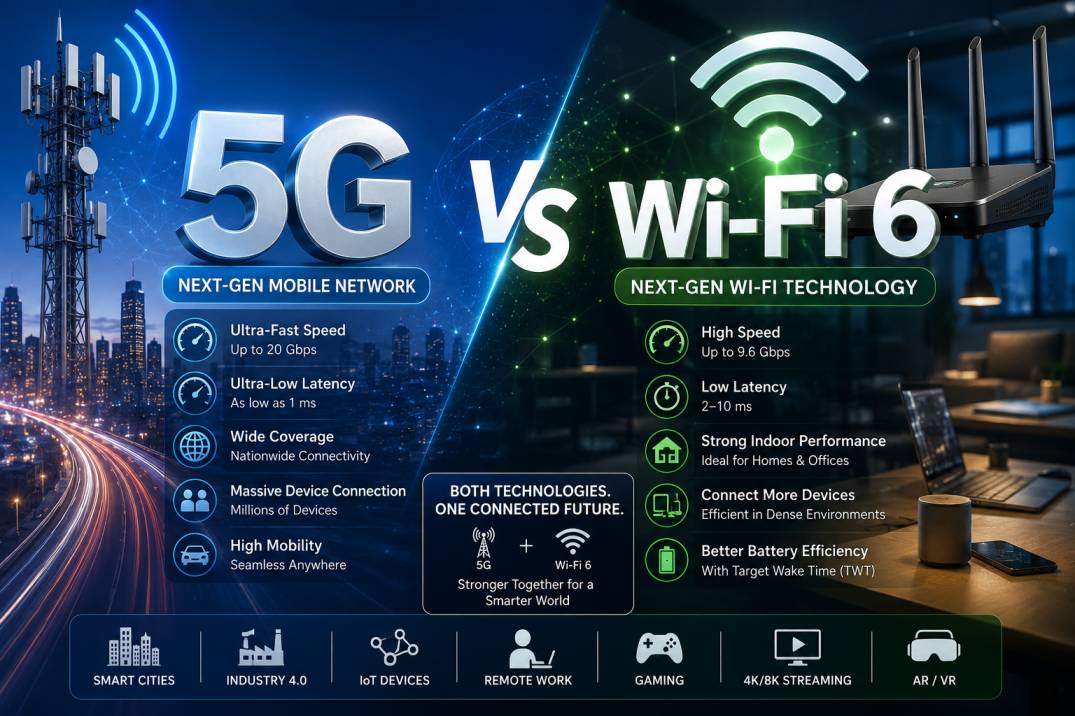
Wireless connectivity has become the backbone of modern communication, enabling everything from video conferencing and online gaming to smart homes, autonomous vehicles, and industrial automation. As digital transformation accelerates, two technologies are leading the next generation of wireless networking: 5G and Wi-Fi 6.
Although both technologies deliver faster speeds, lower latency, and improved connectivity, they serve different purposes. Many people mistakenly believe they compete with each other, but in reality, 5G and Wi-Fi 6 are complementary technologies that together create a seamless wireless ecosystem.
This comprehensive guide explains the differences between 5G and Wi-Fi 6, including their architecture, speed, coverage, security, applications, advantages, disadvantages, and how to choose the right technology for your business or personal use.
What is 5G?
5G (Fifth Generation Mobile Network) is the latest cellular communication technology developed by the 3GPP (3rd Generation Partnership Project). It provides significantly faster mobile internet, ultra-low latency, and the ability to connect millions of devices simultaneously.
Unlike Wi-Fi, 5G is delivered by telecom operators through licensed spectrum and cellular infrastructure consisting of base stations, antennas, and mobile core networks.
Key characteristics include:
- Nationwide and global coverage
- Ultra-fast mobile internet
- Low latency
- Massive IoT support
- High mobility
- AI-powered network optimization
What is Wi-Fi 6?
Wi-Fi 6 (IEEE 802.11ax) is the latest generation of wireless local area networking (WLAN) technology designed to improve speed, efficiency, and performance in homes, offices, campuses, airports, and public hotspots.
Wi-Fi 6 operates using wireless routers and access points instead of cellular towers.
Its primary objective is to provide better wireless performance in dense environments where multiple devices connect simultaneously.
Key features include:
- Faster local wireless networking
- Better device management
- Improved battery life
- Higher efficiency
- Lower network congestion
Why Compare 5G and Wi-Fi 6?
Both technologies promise:
- Faster internet
- Better user experience
- Low latency
- High reliability
- Massive connectivity
However, their deployment methods, infrastructure, coverage, mobility, and intended use cases are entirely different.
Understanding these differences helps businesses and consumers choose the right wireless solution.
5G vs Wi-Fi 6 at a Glance
| Feature | 5G | Wi-Fi 6 |
|---|---|---|
| Network Type | Cellular Network | Wireless LAN |
| Standard | 3GPP | IEEE 802.11ax |
| Coverage | Nationwide | Local Area |
| Mobility | Full Mobility | Limited |
| Spectrum | Licensed | Unlicensed |
| Infrastructure | Cellular Towers | Wi-Fi Routers |
| Maximum Speed | Up to 20 Gbps | Up to 9.6 Gbps |
| Typical Range | Several Kilometers | 30–100 Meters |
| Best For | Outdoor Connectivity | Indoor Networking |
How 5G Works
5G networks rely on:
- Macro cell towers
- Small cells
- Massive MIMO antennas
- Beamforming
- Edge computing
- Cloud-native core networks
The network dynamically connects users while maintaining mobility across cities, highways, airports, and rural areas.
How Wi-Fi 6 Works
Wi-Fi 6 uses wireless access points connected to broadband internet.
Major technologies include:
- OFDMA
- MU-MIMO
- BSS Coloring
- Target Wake Time
- 1024-QAM
- Improved scheduling
These technologies improve network efficiency when dozens or hundreds of devices share the same wireless access point.
Speed Comparison
One of the biggest comparisons between 5G and Wi-Fi 6 is speed.
5G Speed
Peak theoretical speed:
- Up to 20 Gbps
Typical real-world speed:
- 100 Mbps to 1.5 Gbps
Wi-Fi 6 Speed
Maximum theoretical speed:
- Up to 9.6 Gbps
Typical real-world speed:
- 500 Mbps to 2 Gbps
While Wi-Fi 6 can outperform 5G indoors under ideal conditions, 5G offers consistent connectivity across much larger areas.
Latency Comparison
Latency measures how quickly data travels between devices.
5G
Expected latency:
- Around 1 millisecond
Suitable for:
- Autonomous vehicles
- Remote surgery
- Gaming
- Industrial robotics
Wi-Fi 6
Typical latency:
- 2–10 milliseconds
Ideal for:
- Video conferencing
- Streaming
- Online gaming
- Office applications
Coverage Comparison
Coverage is where both technologies differ significantly.
5G Coverage
5G provides:
- City-wide coverage
- Highway coverage
- Rural connectivity
- Nationwide networks
Users remain connected while moving.
Wi-Fi 6 Coverage
Wi-Fi 6 is limited to:
- Homes
- Offices
- Schools
- Shopping malls
- Airports
Coverage depends on router placement.
Mobility
5G
Designed for continuous mobility.
Users can:
- Travel by train
- Drive cars
- Fly drones
- Move between cities
without losing connectivity.
Wi-Fi 6
Wi-Fi is stationary.
Once users leave the router’s coverage area, connectivity ends.
Capacity
Modern networks support thousands of connected devices.
5G
Supports:
- Smart cities
- Connected vehicles
- Massive IoT
- Public infrastructure
Wi-Fi 6
Supports:
- Offices
- Universities
- Stadiums
- Homes
- Shopping centers
It performs exceptionally well in crowded indoor environments.
Frequency Bands
5G Uses
- Low Band
- Mid Band
- Millimeter Wave (mmWave)
Wi-Fi 6 Uses
- 2.4 GHz
- 5 GHz
Wi-Fi 6E additionally supports the 6 GHz band.
Security Comparison
5G Security
5G introduces advanced security features:
- Strong encryption
- Subscriber authentication
- Secure network slicing
- AI threat detection
Wi-Fi 6 Security
Wi-Fi 6 uses:
- WPA3 encryption
- Improved authentication
- Better password protection
- Enhanced privacy
Both technologies provide strong security when configured correctly.
Device Connectivity
5G
Supports millions of connected devices per square kilometer.
Ideal for:
- Smart cities
- Sensors
- Connected factories
- Autonomous systems
Wi-Fi 6
Supports hundreds of devices connected to a single access point.
Ideal for:
- Offices
- Homes
- Educational institutions
Power Efficiency
Wi-Fi 6 introduces Target Wake Time (TWT), allowing devices to sleep between transmissions, improving battery life.
5G also includes energy-saving features, but battery usage depends on signal strength, device optimization, and network conditions.
Infrastructure Requirements
5G Requires
- Mobile towers
- Small cells
- Fiber backhaul
- Licensed spectrum
- Core network infrastructure
Deployment costs are high.
Wi-Fi 6 Requires
- Broadband connection
- Wi-Fi router
- Access points
- Ethernet switches
Deployment is significantly more affordable.
Applications of 5G
5G powers advanced mobile and industrial applications, including:
- Autonomous vehicles
- Smart cities
- Remote healthcare
- Industrial automation
- Drone communication
- Connected transportation
- Military communication
- Public safety
- Agriculture
- Massive IoT
Applications of Wi-Fi 6
Wi-Fi 6 excels in local networking environments, such as:
- Homes
- Corporate offices
- Universities
- Hotels
- Airports
- Shopping malls
- Hospitals
- Smart classrooms
- Warehouses
Advantages of 5G
- Wide-area coverage
- Ultra-low latency
- High mobility
- Massive IoT support
- Reliable outdoor connectivity
- Future-ready infrastructure
- Supports autonomous technologies
Advantages of Wi-Fi 6
- High indoor performance
- Affordable deployment
- Better network efficiency
- Lower congestion
- Faster local transfers
- Excellent for dense environments
- Easy installation
Limitations of 5G
- Expensive infrastructure
- Limited availability in some regions
- Higher deployment costs
- Requires telecom operator support
Limitations of Wi-Fi 6
- Limited coverage area
- Cannot maintain connectivity during travel
- Depends on broadband internet
- Signal quality affected by walls and obstacles
5G vs Wi-Fi 6 for Businesses
Businesses often benefit from using both technologies together.
5G is ideal for:
- Outdoor operations
- Logistics
- Field workforce
- Remote monitoring
- Fleet management
Wi-Fi 6 is ideal for:
- Office networking
- Employee connectivity
- Conference rooms
- Campus environments
- Manufacturing facilities
A hybrid deployment delivers the best user experience.
Role of RF Components in 5G and Wi-Fi 6 Networks
Both technologies rely on high-performance RF and microwave components to ensure reliable signal transmission and network efficiency.
Essential RF components include:
- RF Connectors
- Low Loss RF Cable Assemblies
- RF Adapters
- RF Attenuators
- RF Terminations
- Directional Couplers
- Power Dividers
- RF Filters
- Antennas
- Waveguide Components
- Test Cables
- Millimeter Wave Components
These components play a critical role in minimizing signal loss, improving impedance matching, and supporting high-frequency wireless communication.
Future of Wireless Connectivity
Rather than replacing each other, 5G and Wi-Fi 6 will continue to evolve together. Enterprises, telecom operators, and smart cities are increasingly deploying hybrid wireless infrastructures that combine the strengths of both technologies.
As future standards such as Wi-Fi 7 and 6G emerge, the integration of cellular and Wi-Fi networks will become even more seamless, enabling faster, more reliable, and intelligent wireless communication.
Conclusion
The comparison between 5G and Wi-Fi 6 is not about choosing one over the other but understanding where each technology performs best. 5G is designed for wide-area, high-mobility connectivity with ultra-low latency, making it ideal for smart cities, autonomous vehicles, and industrial IoT. Wi-Fi 6, on the other hand, delivers exceptional indoor wireless performance, supporting high-speed connectivity for homes, offices, campuses, and public venues.
For businesses and organizations planning future-ready wireless infrastructure, combining 5G with Wi-Fi 6 offers the best balance of coverage, speed, reliability, and scalability.
Frequently Asked Questions (FAQs)
Is 5G faster than Wi-Fi 6?
Theoretical 5G speeds can reach 20 Gbps, while Wi-Fi 6 supports up to 9.6 Gbps. Actual performance depends on network conditions and deployment.
Which is better, 5G or Wi-Fi 6?
Neither is universally better. 5G is best for mobile wide-area connectivity, while Wi-Fi 6 is optimized for high-speed indoor local networking.
Can Wi-Fi 6 replace 5G?
No. Wi-Fi 6 provides local wireless access, whereas 5G offers wide-area cellular connectivity with seamless mobility.
Is Wi-Fi 6 more secure than previous Wi-Fi generations?
Yes. Wi-Fi 6 supports WPA3 encryption, offering stronger authentication and improved protection against modern security threats.
Do 5G and Wi-Fi 6 work together?
Yes. Many smartphones, laptops, and enterprise networks use both technologies to provide continuous, high-performance connectivity.
Which technology is better for businesses?
Most businesses benefit from a hybrid approach, using 5G for outdoor/mobile connectivity and Wi-Fi 6 for indoor networking, ensuring optimal performance across different environments.