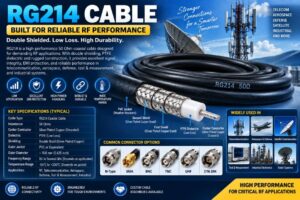
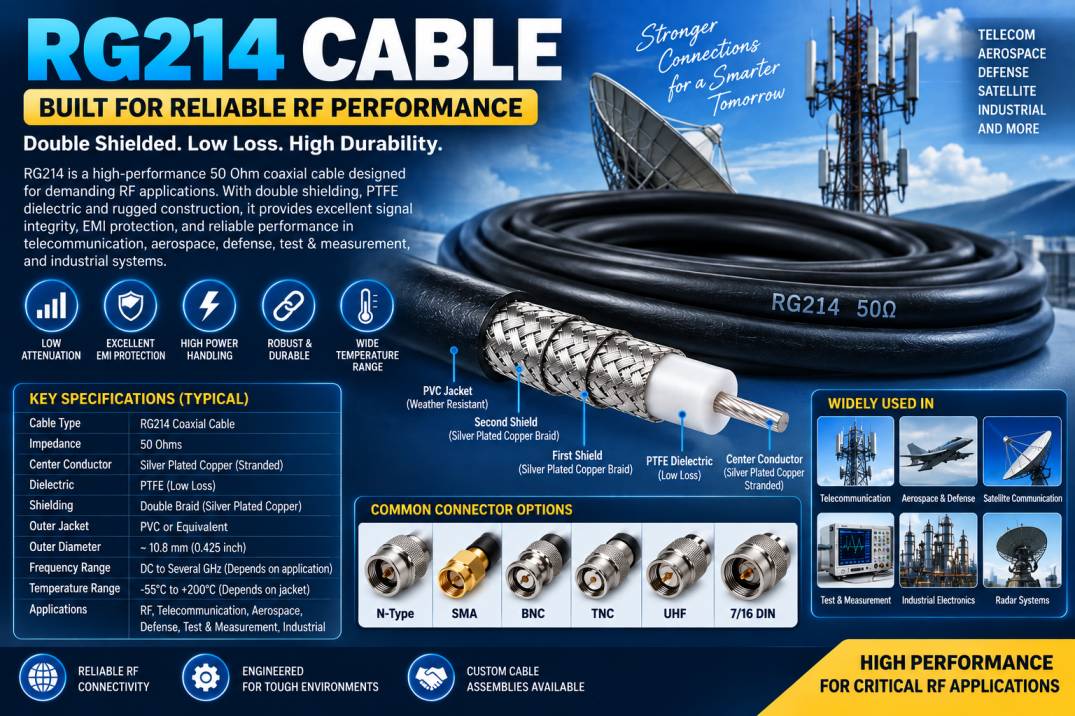
RG214 Cable is a high-performance 50 Ohm coaxial RF cable designed for reliable transmission of radio frequency signals in demanding communication, aerospace, defense, instrumentation, and industrial applications. It is particularly recognized for its robust double-shielded construction, excellent electromagnetic interference protection, and dependable performance across a broad range of RF applications.
Unlike lightweight coaxial cables designed primarily for compact electronics, RG214 uses a larger and more robust construction. Its substantial conductor and dielectric structure help provide good RF performance, while the double-shield arrangement provides enhanced protection against unwanted electromagnetic interference and signal leakage.
RG214 Cable is commonly used in RF test equipment, military electronics, aerospace systems, radar equipment, communication systems, antenna installations, laboratory instruments, and other applications where reliable 50 Ohm signal transmission is essential.
The term RG214 is associated with a particular coaxial cable construction, but specifications can vary between manufacturers and modern cable equivalents. Therefore, the manufacturer’s technical datasheet should always be checked for exact attenuation, frequency range, temperature rating, power handling, shielding effectiveness, and mechanical specifications.
This comprehensive guide explains what RG214 Cable is, how it works, its construction, specifications, advantages, applications, connector options, installation practices, and how to select the right RG214 cable assembly.
What Is RG214 Cable?
RG214 Cable is a 50 Ohm double-shielded coaxial cable used for transmitting RF signals between electronic and communication equipment. Its robust construction makes it suitable for applications where electromagnetic shielding, mechanical durability, and stable RF performance are important.
A typical RG214 cable consists of:
- Center conductor
- Dielectric insulation
- First conductive shield
- Second conductive shield
- Protective outer jacket
The coaxial geometry keeps the center conductor precisely positioned inside the cable and helps maintain a controlled characteristic impedance.
RG214 is generally associated with a 50 Ohm impedance, which is widely used in RF communication, microwave equipment, test and measurement systems, radar, and military electronics.
How Does RG214 Cable Work?
RG214 Cable operates using the principles of coaxial transmission.
The RF signal travels through the center conductor. The surrounding dielectric maintains the correct spacing between the center conductor and shielding layers. The conductive shields provide the RF return path and protect the signal from external electromagnetic interference.
The coaxial construction helps maintain a controlled impedance throughout the cable.
When the cable is correctly terminated with compatible 50 Ohm connectors, the transmission path can provide reliable signal transfer between RF equipment.
The performance of an RG214 cable assembly depends on the cable itself as well as the connectors, termination quality, cable length, operating frequency, installation method, and environmental conditions.
Construction of RG214 Cable
RG214 Cable is built using multiple layers designed to provide reliable electrical and mechanical performance.
Center Conductor
The center conductor carries the RF signal.
RG214 constructions commonly use a stranded silver-plated copper conductor. The conductor material and plating help provide good conductivity and corrosion resistance.
A stranded conductor can also provide improved flexibility compared with a completely solid conductor of similar size.
The center conductor influences:
- RF attenuation
- DC resistance
- Power handling
- Flexibility
- Temperature performance
Dielectric
The dielectric surrounds the center conductor and maintains the required electrical spacing.
PTFE is commonly associated with RG214 cable construction. PTFE offers useful characteristics for RF applications, including low dielectric loss, good insulation performance, and high temperature resistance.
The dielectric influences:
- Characteristic impedance
- Velocity factor
- Capacitance
- Signal propagation
- Dielectric loss
- Temperature stability
Double Shielding
One of the most important characteristics of RG214 Cable is its double-shield construction.
A typical construction uses two layers of braided shielding around the dielectric. Depending on the manufacturer, the shielding material may be silver-plated copper or another conductive material.
The two shielding layers provide improved electromagnetic isolation compared with many single-shield cable constructions.
Double shielding can help:
- Reduce EMI
- Reduce RF leakage
- Improve signal isolation
- Protect sensitive signals
- Improve electromagnetic compatibility
- Reduce unwanted signal coupling
Actual shielding effectiveness depends on braid coverage, material, frequency, connector termination, and cable construction.
Outer Jacket
The outer jacket protects the internal cable structure from mechanical damage and environmental exposure.
Depending on the cable version, jacket materials may be selected for:
- Abrasion resistance
- Temperature resistance
- Moisture resistance
- Chemical resistance
- Flexibility
- Outdoor suitability
Key Features of RG214 Cable
RG214 Cable offers several features that make it suitable for professional RF systems.
- 50 Ohm characteristic impedance
- Double-shielded construction
- Excellent electromagnetic shielding
- Silver-plated conductor options
- PTFE dielectric in common constructions
- Robust mechanical design
- Good RF signal transmission
- Reliable performance in demanding environments
- Suitable for high-frequency RF applications
- Compatible with numerous RF connectors
- Available as custom cable assemblies
- Suitable for test and measurement systems
- Useful in aerospace and defense electronics
RG214 Cable Specifications
Exact specifications vary depending on manufacturer and construction. The following table provides general characteristics for understanding RG214 Cable.
| Parameter | Typical RG214 Cable Characteristics |
|---|---|
| Cable Type | Double-Shielded Coaxial RF Cable |
| Characteristic Impedance | 50 Ohms |
| Center Conductor | Silver-Plated Copper, commonly stranded |
| Dielectric | PTFE |
| Shielding | Double Braided Shield |
| Shield Material | Silver-Plated Copper, construction dependent |
| Outer Jacket | Manufacturer dependent |
| Outer Diameter | Approximately 10.8 mm |
| Frequency Range | Application dependent |
| Temperature Range | Manufacturer dependent |
| Cable Construction | Flexible Coaxial |
| Applications | RF, Aerospace, Defense, Test & Measurement, Communication |
These values are representative rather than universal. The actual manufacturer’s datasheet should be used for final engineering decisions.
RG214 Cable Impedance
RG214 is generally designed as a 50 Ohm coaxial cable.
50 Ohm impedance is widely used in:
- RF communication
- Wireless infrastructure
- Radar
- Satellite communication
- Aerospace electronics
- Defense systems
- RF laboratories
- Test and measurement equipment
Maintaining consistent impedance throughout the RF transmission path helps reduce signal reflections.
For best performance, the cable, connectors, adapters, antennas, and connected equipment should have compatible impedance characteristics.
RG214 Cable Frequency Range
RG214 Cable is designed for RF applications extending into the high-frequency range. The practical operating frequency depends on the specific cable construction and required electrical performance.
Important factors include:
- Cable length
- Operating frequency
- Insertion loss
- VSWR
- Return loss
- Connector performance
- Power level
- Environmental conditions
Engineers should always evaluate the manufacturer’s attenuation and VSWR specifications at the actual operating frequency.
RG214 Cable Attenuation
Attenuation refers to the loss of RF signal power as the signal travels through the cable.
Cable attenuation depends on several factors:
- Frequency
- Cable length
- Conductor material
- Dielectric material
- Cable diameter
- Temperature
- Connector quality
RG214’s relatively large construction can provide lower attenuation than many smaller coaxial cables at comparable frequencies.
However, attenuation increases as frequency and cable length increase.
For this reason, cable length should be carefully considered when designing an RF transmission system.
RG214 Cable VSWR and Return Loss
VSWR
Voltage Standing Wave Ratio measures impedance matching within the RF transmission path.
A lower VSWR generally indicates better impedance matching.
VSWR can be affected by:
- Cable construction
- Connector quality
- Connector installation
- Cable bending
- Impedance discontinuities
- Damaged cable
Return Loss
Return loss measures the amount of signal power reflected toward the source.
Higher return loss generally indicates better impedance matching.
For sensitive RF systems, both VSWR and return loss should be evaluated at the actual operating frequency.
Why Is RG214 Cable Double Shielded?
Double shielding is particularly useful when RF equipment operates in an electrically noisy environment.
The first braided shield provides electromagnetic protection around the dielectric.
The second shield provides another conductive barrier, improving isolation between the signal and surrounding environment.
This can be beneficial when RG214 is installed near:
- Power cables
- Switching power supplies
- Digital electronics
- Motors
- Industrial machinery
- RF transmitters
- High-current wiring
- Other communication systems
The effectiveness of the shielding system depends on the quality of the braid, coverage, materials, connectors, and termination.
Applications of RG214 Cable
Aerospace Applications
Aerospace systems require reliable and mechanically robust RF interconnections.
RG214 Cable can be used in applications such as:
- Avionics
- Aircraft communication
- Navigation equipment
- RF instrumentation
- Aerospace test systems
Its double shielding can be useful for reducing unwanted electromagnetic coupling.
Defense and Military Electronics
RG214 is suitable for many defense RF applications where reliable signal transmission and shielding are important.
Potential applications include:
- Radar systems
- Military communication
- RF monitoring
- Electronic test equipment
- Antenna systems
- RF instrumentation
RF Test and Measurement
RG214 cable assemblies are commonly useful in laboratory environments.
They can connect:
- Spectrum analyzers
- Signal generators
- Network analyzers
- RF power meters
- RF sources
- Antennas
- Calibration equipment
Good-quality cable assemblies can help maintain repeatable RF measurements.
Telecommunications
RG214 can be used for RF interconnections inside communication systems.
Applications may include:
- Radio equipment
- Wireless communication systems
- RF modules
- Signal distribution systems
- Communication test equipment
Radar Systems
Radar equipment depends on reliable RF signal paths.
RG214 can be used for internal RF connections and test systems where its electrical specifications are suitable.
Satellite Communication
Satellite communication equipment requires controlled RF transmission paths.
RG214 cable assemblies may be used between:
- RF modules
- Transceivers
- Filters
- Amplifiers
- Test equipment
- Antenna-related components
Industrial Electronics
Industrial environments can contain high levels of electromagnetic noise.
Double-shielded RF cables can help protect sensitive RF signals when correctly installed.
Medical and Scientific Equipment
RF cables are used in various scientific and specialized medical systems where controlled signal transmission is required.
The selected cable must satisfy the application’s electrical, mechanical, environmental, and regulatory requirements.
Common RG214 Cable Connector Types
RG214 cable assemblies can be terminated with different RF connectors.
Common options include:
- N-Type
- SMA
- TNC
- BNC
- UHF
- 7/16 DIN
- SMC
- SMB
- Other application-specific RF connectors
Connector selection should consider:
- Frequency
- Impedance
- Power
- Mechanical interface
- Cable diameter
- Installation environment
The connector must be properly matched to the RG214 cable construction.
RG214 Cable Assembly Configurations
RG214 Cable can be supplied as a custom RF cable assembly with connectors installed on one or both ends.
Popular configurations include:
N-Type Male to N-Type Male
Suitable for RF communication and antenna equipment.
SMA Male to SMA Male
Useful for RF laboratory equipment and compact RF modules.
SMA Male to N-Type Male
Useful for connecting compact RF equipment to larger RF interfaces.
BNC Male to BNC Male
Common in laboratory and test applications.
TNC Male to TNC Male
Useful in communication and RF equipment requiring threaded RF connectors.
Custom connector combinations can be manufactured according to equipment requirements.
Advantages of RG214 Cable
Excellent Shielding
The double-shielded construction provides enhanced protection against electromagnetic interference.
50 Ohm Impedance
RG214 is compatible with a wide range of professional RF systems using 50 Ohm transmission lines.
Robust Construction
The larger cable structure provides good mechanical durability.
Reliable RF Performance
The controlled coaxial construction supports predictable signal transmission.
PTFE Dielectric
Common RG214 constructions use PTFE, which provides favorable electrical and thermal characteristics.
Silver-Plated Conductors
Silver-plated conductors can provide good conductivity and corrosion resistance.
Customizable Cable Assemblies
RG214 can be manufactured with different connector combinations and cable lengths.
Limitations of RG214 Cable
Although RG214 provides excellent performance for many applications, it has certain limitations.
- Larger than RG316 and other miniature RF cables
- Heavier than small-diameter coaxial cables
- Less flexible than miniature RF cables
- Requires more installation space
- Higher cost than basic RF cables in some applications
- Cable loss increases with frequency and length
- Connector termination must be performed correctly
For compact electronics, smaller cables such as RG316 may be more appropriate.
For very long RF runs, specialized low-loss coaxial cables may offer better performance.
RG214 Cable vs RG213 Cable
| Feature | RG214 Cable | RG213 Cable |
|---|---|---|
| Impedance | 50 Ohms | 50 Ohms |
| Shielding | Double Shield | Single Shield, construction dependent |
| EMI Protection | Excellent | Good |
| Conductor | Commonly Silver-Plated Copper | Copper, construction dependent |
| Dielectric | PTFE | Polyethylene, commonly |
| Diameter | Approximately 10.8 mm | Approximately 10.3 mm |
| Flexibility | Moderate | Moderate |
| Applications | RF, Defense, Aerospace, Test | RF, Radio, Antenna |
| Shielding Requirement | High | Standard to high depending on construction |
RG214 is often selected when additional shielding is required, while RG213 is widely used for general-purpose RF and antenna applications.
RG214 Cable vs RG316 Cable
| Feature | RG214 | RG316 |
|---|---|---|
| Impedance | 50 Ohms | 50 Ohms |
| Diameter | Larger | Much smaller |
| Flexibility | Moderate | High |
| Shielding | Double Shield | Construction dependent |
| Power Handling | Generally higher | Lower |
| Attenuation | Generally lower | Generally higher |
| Weight | Higher | Lower |
| Compact Applications | Moderate | Excellent |
| RF Test Applications | Excellent | Excellent |
| Long RF Connections | Better suited | More limited |
RG316 is generally preferred when compact size and flexibility are important, while RG214 is more suitable when robust construction and enhanced shielding are priorities.
How to Choose the Right RG214 Cable
Selecting the correct RG214 Cable requires evaluating the complete RF system.
Operating Frequency
Confirm that the cable provides suitable attenuation and VSWR performance at the required frequency.
Cable Length
Calculate expected signal loss based on the required cable length.
Impedance
Verify that the cable and connected RF equipment use compatible 50 Ohm impedance.
Shielding
Consider double-shielding when electromagnetic interference is a concern.
Power Handling
Check the manufacturer’s power-handling specifications at the intended frequency and VSWR.
Connector Type
Select connectors that match the equipment interface and support the required frequency and power.
Temperature
Verify the cable’s operating temperature range for the intended environment.
Flexibility
Make sure the cable can be routed without exceeding its recommended bend radius.
RG214 Cable Installation Best Practices
Correct installation is essential for maintaining cable performance.
Avoid sharp bends.
Do not crush the cable.
Do not twist the cable excessively.
Follow the recommended minimum bend radius.
Avoid pulling the cable by its connector.
Use the correct connector torque.
Keep mating surfaces clean.
Avoid unnecessary cable length.
Secure long cable runs properly.
Protect outdoor connections from moisture.
Inspect the cable before installation.
Improper handling can change the cable geometry and negatively affect impedance, VSWR, and attenuation.
RG214 Cable Testing
Professional RG214 cable assemblies can undergo several electrical and mechanical tests.
Common tests include:
- Continuity testing
- Insulation resistance testing
- Insertion loss testing
- Return loss testing
- VSWR testing
- Connector inspection
- Dimensional inspection
- High-voltage testing where applicable
Testing is especially important for aerospace, defense, laboratory, and other critical RF applications.
Custom RG214 Cable Assembly
A custom RG214 Cable Assembly can be manufactured according to specific equipment and installation requirements.
Customization options include:
- Cable length
- Connector type
- Connector gender
- Straight connectors
- Right-angle connectors where supported
- Connector plating
- Heat-shrink protection
- Cable identification
- Protective sleeving
- Custom termination
A professionally manufactured assembly can provide consistent dimensions, reliable connector termination, and repeatable electrical performance.
Environmental Considerations
Before selecting RG214, consider the environment where the cable will be installed.
Important factors include:
- Operating temperature
- Humidity
- Moisture
- UV exposure
- Vibration
- Mechanical movement
- Chemical exposure
- Abrasion
- Indoor or outdoor installation
The cable jacket and connector design should be selected according to the actual environmental requirements.
Maintenance of RG214 Cable
RG214 generally requires minimal maintenance when correctly installed.
Recommended maintenance practices include:
- Inspect the outer jacket
- Check connectors for damage
- Keep RF interfaces clean
- Look for corrosion
- Avoid unnecessary cable movement
- Check for excessive bending
- Inspect cable support
- Check outdoor connector sealing
- Perform RF measurements when necessary
In critical systems, periodic VSWR, return-loss, and insertion-loss measurements can help identify degradation.
Why Choose RG214 for RF Applications?
RG214 offers a combination of robust construction, 50 Ohm impedance, double shielding, and reliable RF performance.
It can be an excellent choice when an RF system requires:
- Enhanced EMI protection
- Reliable signal transmission
- Strong mechanical construction
- Stable impedance
- High-quality RF connectors
- Professional cable assemblies
- Long-term performance
Its larger construction also makes it more suitable for applications where mechanical durability and RF performance are more important than minimum size.
Future Trends in RF Coaxial Cable Technology
The development of 5G, satellite communication, radar, aerospace electronics, defense systems, and advanced RF testing continues to create demand for high-performance coaxial cable assemblies.
Future RF cable technologies are focusing on:
- Lower attenuation
- Improved shielding
- Higher frequency operation
- Better phase stability
- Lightweight construction
- Smaller connector designs
- Improved temperature performance
- Greater mechanical durability
- Better environmental resistance
While newer transmission technologies continue to emerge, coaxial RF cables remain an important interconnection technology for many RF and microwave systems.
Conclusion
RG214 Cable is a robust 50 Ohm double-shielded coaxial RF cable designed for reliable signal transmission in demanding RF environments. Its combination of enhanced electromagnetic shielding, controlled impedance, PTFE dielectric construction, and commonly available silver-plated conductor designs makes it suitable for aerospace, defense, telecommunications, radar, satellite communication, laboratory testing, and industrial electronics.
Compared with smaller RF cables, RG214 offers a more substantial construction and enhanced shielding, although this comes with increased size and weight. Selecting the correct RG214 cable requires careful consideration of operating frequency, attenuation, VSWR, power handling, cable length, connector type, temperature rating, shielding requirements, and installation conditions.
For critical RF applications, the exact manufacturer’s datasheet should always be used to confirm electrical and environmental specifications. When properly selected, professionally terminated, and correctly installed, RG214 Cable can provide dependable and consistent RF connectivity for demanding communication and electronic systems.
Frequently Asked Questions About RG214 Cable
1. What is RG214 Cable?
RG214 Cable is a 50 Ohm double-shielded coaxial RF cable designed for reliable transmission of RF signals in communication, aerospace, defense, test, and industrial applications.
2. What is the impedance of RG214 Cable?
RG214 Cable is generally designed with a 50 Ohm characteristic impedance, making it suitable for a wide range of professional RF systems.
3. What is RG214 Cable used for?
RG214 is used for RF test equipment, aerospace electronics, defense systems, radar, telecommunications, satellite communication, radio systems, and industrial RF applications.
4. Is RG214 a double-shielded cable?
Yes. RG214 is commonly associated with a double-braided shield construction, which provides enhanced electromagnetic isolation compared with many single-shield coaxial cables.
5. What is the dielectric material used in RG214?
PTFE is commonly used as the dielectric material in RG214 constructions, providing good electrical insulation, low RF losses, and high temperature resistance.
6. What type of conductor does RG214 use?
RG214 is commonly manufactured with a silver-plated copper conductor, often in a stranded configuration. Exact conductor construction depends on the manufacturer.
7. Is RG214 suitable for high-frequency applications?
Yes. RG214 is used in RF and high-frequency applications, but the appropriate operating frequency depends on the manufacturer’s specifications, cable length, connectors, attenuation, and VSWR requirements.
8. What connectors are used with RG214 Cable?
Common connector options include N-Type, SMA, BNC, TNC, UHF, 7/16 DIN, SMB, and SMC, depending on the application and cable assembly requirements.
9. What is the difference between RG214 and RG213?
The major distinction is that RG214 is commonly associated with a double-shielded construction, while RG213 is commonly used as a single-shield 50 Ohm coaxial cable. RG214 can therefore provide enhanced shielding where required.
10. What is the difference between RG214 and RG316?
RG214 is significantly larger and more robust, while RG316 is much smaller and more flexible. RG214 is generally better suited to applications requiring enhanced shielding and a larger cable construction.