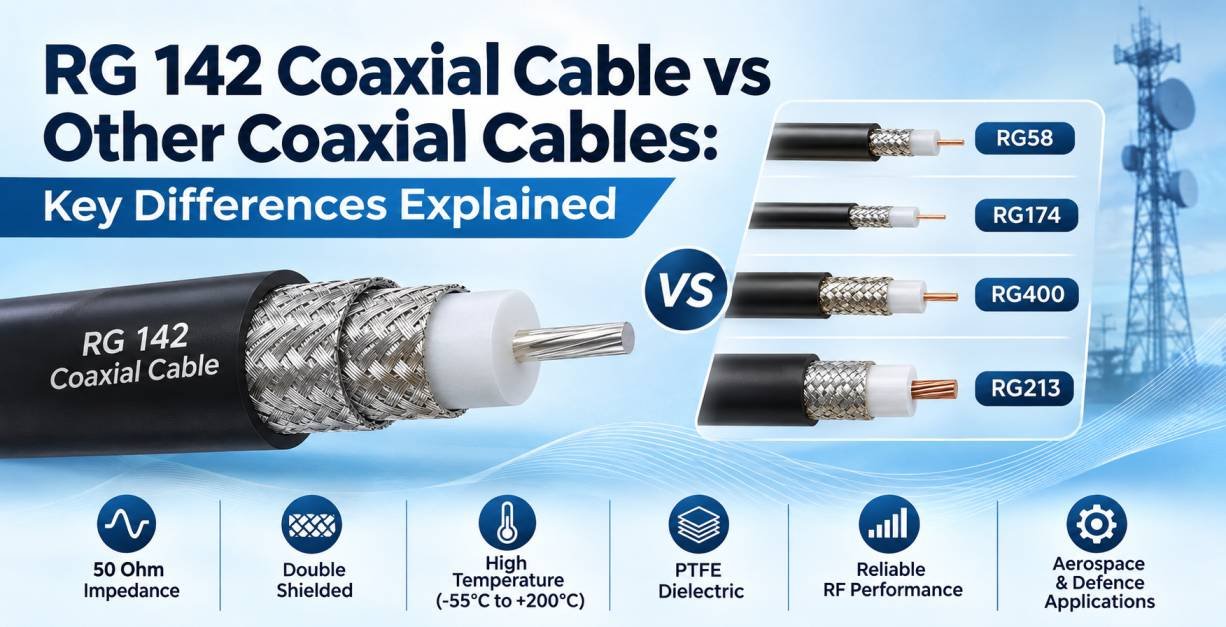
Choosing the right coaxial cable is essential for maintaining reliable signal transmission, minimizing signal loss, and ensuring consistent performance in RF and microwave communication systems. Different coaxial cables are designed to meet specific electrical, mechanical, and environmental requirements. Among the commonly used RF cables, RG 142 Coaxial Cable is known for its double-shielded construction, high-temperature capability, and reliable performance in demanding applications.
RG 142 Coaxial Cable is widely used in aerospace systems, defence electronics, wireless communication equipment, test and measurement instruments, and other applications where dependable RF signal transmission is important. Its construction generally includes a solid inner conductor, PTFE dielectric insulation, and a double-braided shield, making it suitable for applications that require effective shielding and thermal stability.
However, RG142 is not the only coaxial cable available for RF applications. Other popular options, including RG58, RG174, RG400, and RG213, offer different advantages depending on cable diameter, flexibility, shielding effectiveness, power-handling requirements, and operating frequency.
Understanding the differences between these cables helps engineers, system integrators, procurement professionals, and equipment manufacturers select the most suitable cable for their applications.
In this guide, we will compare RG 142 Coaxial Cable with other commonly used coaxial cables, explain their construction and technical differences, and discuss how to choose the right cable for your RF communication requirements.
What Is RG 142 Coaxial Cable?
RG 142 Coaxial Cable is a 50-ohm RF coaxial cable designed for applications requiring reliable signal transmission, effective electromagnetic shielding, and resistance to elevated operating temperatures.
It typically features a silver-plated copper-covered steel centre conductor, a PTFE dielectric, and two silver-plated copper braid shields. The combination of these materials provides mechanical strength, thermal stability, and good electrical performance.
Unlike some lightweight coaxial cables designed primarily for general-purpose communication, RG 142 is intended for more demanding RF environments where shielding and temperature resistance are important considerations.
Key Features of RG 142 Coaxial Cable
- 50 Ohm Impedance: Designed for compatibility with standard RF and microwave systems operating with 50-ohm interfaces.
- Double Shielding: Two braided shielding layers help reduce electromagnetic interference and unwanted signal leakage.
- PTFE Dielectric: Provides excellent thermal stability and reliable electrical insulation.
- High-Temperature Capability: Suitable for applications exposed to elevated temperatures, subject to the manufacturer’s specified operating limits.
- Mechanical Strength: Its conductor and shielding construction provide durability for demanding installations.
- RF Signal Performance: Suitable for transmitting RF signals across a broad range of frequencies, depending on the cable manufacturer’s specifications.
- Reliable Shielding: Supports applications where protection against external electromagnetic interference is important.
Typical Construction of RG 142 Coaxial Cable
The construction of RG 142 Coaxial Cable consists of several layers, with each component contributing to its overall electrical and mechanical performance.
| Component | Typical Material | Function |
|---|---|---|
| Inner Conductor | Silver-plated copper-covered steel | Carries the RF signal |
| Dielectric | PTFE | Maintains electrical insulation and impedance |
| First Shield | Silver-plated copper braid | Provides electromagnetic shielding |
| Second Shield | Silver-plated copper braid | Improves shielding effectiveness |
| Outer Jacket | Fluoropolymer or other specified protective material | Provides environmental and mechanical protection |
The exact construction can vary between manufacturers and product variants. Therefore, the relevant manufacturer’s datasheet should always be checked before selecting a cable.
Why Compare RG 142 Coaxial Cable with Other Coaxial Cables?
Every coaxial cable has a different combination of electrical and mechanical characteristics. Selecting a cable based only on its impedance or physical appearance can result in unnecessary signal loss, poor shielding, installation difficulties, or compatibility problems.
For example, RG174 is a lightweight and compact cable suitable for space-constrained installations, while RG213 is a larger cable commonly selected for applications requiring lower attenuation and greater power-handling capability.
Similarly, RG400 and RG142 both use PTFE dielectric insulation and double-braided shielding in many standard constructions, but they differ in conductor design, flexibility, and electrical performance.
Comparing RG 142 Coaxial Cable with other cables helps determine which option offers the right balance of:
- Signal attenuation and transmission efficiency.
- Operating frequency.
- Shielding effectiveness.
- Power-handling capability.
- Temperature resistance.
- Cable diameter and weight.
- Flexibility and installation requirements.
- Overall system cost.
RG 142 Coaxial Cable vs RG58 Coaxial Cable
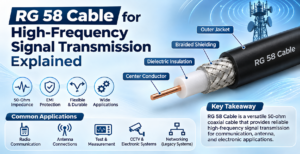
RG58 is a popular 50-ohm coaxial cable used in general-purpose RF communication, networking equipment, radio systems, and antenna connections. It is generally smaller in terms of electrical complexity but offers greater flexibility and is widely used in standard RF installations.
RG142, on the other hand, is designed for more demanding applications where higher temperature resistance and improved shielding are required.
Key Differences Between RG142 and RG58
| Parameter | RG142 Coaxial Cable | RG58 Coaxial Cable |
|---|---|---|
| Impedance | 50 Ohms | 50 Ohms |
| Centre Conductor | Solid silver-plated copper-covered steel | Usually stranded copper |
| Dielectric | PTFE | Usually PE |
| Shielding | Double braided shield | Single braided shield |
| Outer Diameter | Approx. 4.95 mm | Approx. 4.95 mm |
| Temperature Resistance | Typically -55°C to +200°C | Depends on construction, commonly lower |
| Flexibility | Relatively less flexible | More flexible |
| Shielding Performance | Higher shielding potential | Standard shielding |
| Applications | Aerospace, defence, RF systems | Radio, antennas, general RF systems |
RG142 is generally the better option for applications requiring high-temperature performance and additional shielding. RG58 is a practical choice for standard RF installations where flexibility and economical cable solutions are important.
RG 142 Coaxial Cable vs RG174 Coaxial Cable
RG174 is a thin, lightweight coaxial cable commonly used in compact electronic devices, GPS systems, wireless communication equipment, and applications where installation space is limited.
RG142 is significantly more robust in construction and uses a PTFE dielectric with double-braided shielding. RG174 generally uses a polyethylene dielectric and a single shielding layer.
Key Differences Between RG142 and RG174
| Parameter | RG142 Coaxial Cable | RG174 Coaxial Cable |
|---|---|---|
| Impedance | 50 Ohms | 50 Ohms |
| Centre Conductor | Solid conductor | Stranded conductor |
| Dielectric | PTFE | PE |
| Shielding | Double braided | Single braided |
| Outer Diameter | Approx. 4.95 mm | Approx. 2.79 mm |
| Temperature Resistance | Typically -55°C to +200°C | Depends on manufacturer |
| Flexibility | Less flexible | More flexible |
| Signal Loss | Generally lower than RG174 at comparable frequencies | Generally higher |
| Applications | Aerospace, defence, RF testing | GPS, compact wireless devices, electronics |
The primary difference is the balance between physical size and electrical performance. RG174 is suitable for lightweight and space-constrained installations, whereas RG142 is better suited to demanding RF applications requiring improved shielding and thermal stability.
RG 142 Coaxial Cable vs RG400 Coaxial Cable
RG400 is one of the closest alternatives to RG142 because both cables have similar overall dimensions, 50-ohm impedance, PTFE dielectric insulation, and double-braided shielding.
However, an important difference exists in their centre conductor construction.
RG142 typically uses a solid silver-plated copper-covered steel centre conductor, whereas RG400 commonly uses a stranded silver-plated copper centre conductor. This difference affects flexibility and mechanical behaviour.
Key Differences Between RG142 and RG400
| Parameter | RG142 Coaxial Cable | RG400 Coaxial Cable |
|---|---|---|
| Impedance | 50 Ohms | 50 Ohms |
| Centre Conductor | Solid silver-plated copper-covered steel | Stranded silver-plated copper |
| Dielectric | PTFE | PTFE |
| Shielding | Double silver-plated copper braid | Double silver-plated copper braid |
| Outer Diameter | Approx. 4.95 mm | Approx. 4.95 mm |
| Temperature Resistance | Commonly up to +200°C | Commonly up to +165°C |
| Flexibility | Relatively less flexible | More flexible |
| Applications | Aerospace, defence, high-temperature RF systems | RF assemblies, communication equipment, microwave systems |
The main advantage of RG400 is its stranded centre conductor, which generally makes it more suitable for flexible cable assemblies and installations involving tighter routing requirements.
RG142 is often preferred when a solid centre conductor and higher temperature capability are important.
However, temperature limits and attenuation must always be verified against the exact manufacturer’s datasheet.
RG 142 Coaxial Cable vs RG213 Coaxial Cable
RG213 is a larger-diameter coaxial cable commonly used in radio communication, antenna feeder systems, broadcast installations, and high-power RF applications.
Compared with RG142, RG213 has a larger conductor and dielectric structure. This makes it suitable for installations where lower attenuation over longer cable runs and higher power-handling capability are important.
RG213 generally uses a polyethylene dielectric and single-braided shielding, while RG142 uses PTFE insulation and double-braided shielding.
Key Differences Between RG142 and RG213
| Parameter | RG142 Coaxial Cable | RG213 Coaxial Cable |
|---|---|---|
| Impedance | 50 Ohms | 50 Ohms |
| Dielectric | PTFE | PE |
| Shielding | Double braided | Single braided |
| Outer Diameter | Approx. 4.95 mm | Approx. 10.3 mm |
| Temperature Resistance | Typically -55°C to +200°C | Depends on jacket and construction |
| Flexibility | Compact but relatively stiff | Larger and less convenient in tight spaces |
| Installation | Compact RF assemblies | Larger antenna feeder installations |
| Applications | Aerospace, defence, microwave systems | Radio communication, antenna feeders, broadcasting |
RG213 is often suitable for larger installations where cable diameter is not a major limitation. RG142 is more appropriate for compact installations requiring PTFE insulation, double shielding, and high-temperature resistance.
RG 142 Coaxial Cable vs Other Common RF Cables
Apart from RG58, RG174, RG400, and RG213, several other coaxial cables are used in RF and microwave systems.
The selection depends on the application’s electrical specifications, mechanical requirements, and environmental conditions.
Comparison of Popular Coaxial Cables
| Cable Type | Impedance | Dielectric | Shielding | Approx. Outer Diameter |
|---|---|---|---|---|
| RG142 | 50 Ohms | PTFE | Double Braid | 4.95 mm |
| RG400 | 50 Ohms | PTFE | Double Braid | 4.95 mm |
| RG58 | 50 Ohms | PE | Single Braid | 4.95 mm |
| RG174 | 50 Ohms | PE | Single Braid | 2.79 mm |
| RG213 | 50 Ohms | PE | Single Braid | 10.3 mm |
| RG214 | 50 Ohms | PE | Double Braid | 10.8 mm |
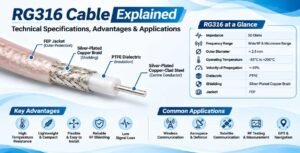
| RG316 | 50 Ohms | PTFE | Single Braid | 2.49 mm |
Note: Dimensions and constructions are representative values. Actual specifications may vary by manufacturer and cable version. thecablecode+3
Technical Specifications of RG 142 Coaxial Cable
Understanding the technical specifications of RG142 is important when evaluating its suitability for RF and microwave applications.
The following table provides representative specifications. Always confirm the exact cable variant before designing or purchasing an assembly.
| Parameter | Typical Specification |
|---|---|
| Cable Type | RG142 |
| Characteristic Impedance | 50 Ohms |
| Maximum Frequency | Up to 12.4 GHz in some specifications |
| Centre Conductor | Solid silver-plated copper-covered steel |
| Centre Conductor Diameter | Approx. 0.94 mm |
| Dielectric Material | PTFE |
| Dielectric Diameter | Approx. 2.95 mm |
| Shielding | Double silver-plated copper braid |
| Overall Diameter | Approx. 4.95 mm |
| Temperature Range | Commonly -55°C to +200°C |
| Nominal Capacitance | Manufacturer-dependent |
| Minimum Bend Radius | Manufacturer-dependent |
| Jacket Material | FEP or specified alternative |
RG142 Coaxial Cable+2
1. Characteristic Impedance
RG142 Coaxial Cable has a nominal characteristic impedance of 50 ohms. This makes it compatible with many standard RF transmission systems, including antennas, transmitters, receivers, test equipment, and microwave components.
Maintaining impedance matching between the cable, connectors, and connected equipment is important for minimizing signal reflections and maintaining good voltage standing wave ratio (VSWR).
2. Frequency Range
RG142 is used in RF and microwave applications requiring broadband signal transmission. Certain manufacturer specifications list operation up to 12.4 GHz.
However, the usable frequency range depends on attenuation, VSWR, connector performance, cable assembly length, and the overall system design.
For high-frequency applications, engineers should evaluate insertion loss and return loss across the complete operating frequency range.
3. Dielectric Material
One of the important characteristics of RG142 is its PTFE dielectric insulation.
PTFE provides excellent thermal stability, electrical insulation, and resistance to various chemicals. These properties make RG142 suitable for applications exposed to elevated temperatures and demanding environmental conditions.
Compared with conventional polyethylene dielectric cables, PTFE-based cables are generally preferred in applications where higher temperature resistance is required.
4. Double Shielding Construction
RG142 generally uses two braided shielding layers made from silver-plated copper.
The double-braided structure helps improve shielding effectiveness and reduce unwanted electromagnetic interference.
This is particularly useful in sensitive RF equipment, aerospace electronics, defence communication systems, and precision test instruments.
5. Temperature Resistance
RG142 is commonly available with an operating temperature range of approximately -55°C to +200°C.
This makes it useful in systems exposed to significant temperature variations.
However, the actual operating limit depends on the jacket material, cable construction, connectors, and termination methods.
Major Applications of RG 142 Coaxial Cable
RG142 is used in several industries where reliable RF signal transmission and high-temperature resistance are important.
1. Aerospace and Aviation Systems
Aerospace applications require cables capable of operating under challenging environmental conditions.
RG142 is used in suitable aircraft RF assemblies, communication systems, navigation equipment, and electronic subsystems.
Its PTFE dielectric and double shielding make it a useful choice for installations requiring electrical stability and temperature resistance.
2. Defence and Military Communication
Defence communication equipment often operates in demanding environments where signal integrity and electromagnetic compatibility are important.
RG142 can be used in RF communication systems, electronic equipment, radar-related assemblies, and other defence electronics where its electrical and mechanical specifications meet system requirements.
3. RF and Microwave Equipment
RG142 is suitable for various RF and microwave assemblies that require 50-ohm impedance and effective shielding.
It can be integrated into test equipment, signal transmission assemblies, RF modules, and microwave communication systems.
4. Wireless Communication Systems
Wireless communication infrastructure uses coaxial cables to connect RF modules, antennas, transmitters, and receivers.
RG142 can be used in suitable equipment-level RF interconnections where its dimensions, frequency response, and temperature ratings meet the requirements.
5. Test and Measurement Instruments
Precision RF testing requires stable connections and proper impedance matching.
RG142 can be used in RF test assemblies, laboratory equipment, microwave measurement systems, and other instrumentation applications.
6. Industrial Electronics
Industrial electronic equipment may be exposed to temperature variations, electrical interference, and demanding operating environments.
RG142 can support RF signal transmission in industrial control and communication equipment where its specifications are appropriate.
Advantages of RG 142 Coaxial Cable Over Other Coaxial Cables
RG142 offers several advantages when compared with conventional coaxial cables. Its suitability depends on the specific operating conditions and system requirements.
1. Improved Electromagnetic Shielding
The double-braided shielding structure provides additional protection against external electromagnetic interference compared with many single-braided coaxial cables.
This is particularly important in RF systems where unwanted interference can affect signal quality and equipment performance.
2. High-Temperature Performance
The PTFE dielectric provides excellent thermal stability. RG142 is commonly available with operating temperatures reaching +200°C, depending on the manufacturer.
This makes it suitable for applications where conventional PVC- or PE-insulated cables may not meet the temperature requirements.
3. Reliable Electrical Performance
The 50-ohm impedance makes RG142 suitable for standard RF communication and microwave equipment.
Proper impedance matching helps reduce signal reflections and maintain reliable transmission.
4. Durable Cable Construction
The combination of a solid centre conductor, PTFE dielectric, and double-braided shielding provides a robust cable construction for demanding applications.
5. Suitability for Compact RF Assemblies
With an approximate outer diameter of 4.95 mm, RG142 offers double shielding and PTFE insulation without the larger dimensions associated with cables such as RG213 and RG214.
How to Choose Between RG142 and Other Coaxial Cables
Selecting the right coaxial cable requires evaluating the technical requirements of the complete RF system.
Here are some important factors to consider.
1. Operating Frequency
Check the required frequency range before selecting a cable. Different cables have different attenuation characteristics at different frequencies.
For microwave applications, evaluate the cable’s insertion loss, return loss, and VSWR.
2. Signal Attenuation
Signal attenuation refers to the reduction in signal strength as it travels through a cable.
For longer cable runs, selecting a cable with lower attenuation at the operating frequency can improve overall system performance.
RG142 is suitable for many RF applications, but larger, purpose-designed low-loss cables may be more appropriate for long-distance installations.
3. Temperature Requirements
If the application involves elevated temperatures, consider cables with PTFE insulation, such as RG142, RG400, and RG316.
Always verify the specified temperature range of the complete cable assembly.
4. Shielding Requirements
For environments with significant electromagnetic interference, double-shielded cables can offer advantages over single-braided alternatives.
RG142, RG400, and RG214 are examples of commonly available double-braided cable constructions.
5. Mechanical Flexibility
Cable flexibility is important when routing cables through compact equipment or around restricted installation areas.
RG400 generally offers greater flexibility than RG142 because of its stranded centre conductor.
RG174 and RG316 are also useful for compact installations where smaller cable dimensions are required.
6. Connector Compatibility
Ensure that the selected cable is compatible with the connectors used in the RF assembly.
Common connector interfaces used in RF systems include:
- SMA Connectors
- N-Type Connectors
- BNC Connectors
- TNC Connectors
- QMA Connectors
- 2.92mm Connectors
The connector must match the cable diameter, dielectric dimensions, centre conductor, and shielding construction.
Common Mistakes to Avoid When Selecting RG 142 Coaxial Cable
Choosing the wrong cable can affect RF system performance, reliability, and installation quality.
Avoid these common mistakes:
1. Selecting a Cable Based Only on Diameter
Two cables may have similar outer diameters but different dielectric materials, shielding structures, and electrical characteristics.
2. Ignoring Frequency-Dependent Attenuation
A cable suitable for a low-frequency application may experience excessive signal loss at higher frequencies.
3. Using Incorrect Connectors
Connectors must be designed for the specific cable type. Incorrect connectors can result in poor electrical contact, impedance mismatch, and unreliable assemblies.
4. Ignoring Minimum Bend Radius
Excessive bending can damage the cable structure and affect electrical performance.
5. Overlooking Temperature Ratings
The cable jacket, dielectric, and connector assembly must all be suitable for the intended operating temperature.
6. Confusing RG142 with RG400
Although these cables have similar dimensions and shielding structures, their centre conductor construction is different. This distinction can influence flexibility and assembly requirements.
RG 142 Coaxial Cable: Which Cable Is Best for Your Application?
The best coaxial cable depends on the application, installation environment, frequency range, and electrical requirements.
| Application Requirement | Recommended Cable |
|---|---|
| High-temperature RF applications | RG142 |
| Flexible RF cable assemblies | RG400 |
| General-purpose RF connections | RG58 |
| Compact and lightweight electronics | RG174 |
| Small flexible RF interconnections | RG316 |
| Larger antenna feeder installations | RG213 |
| Applications requiring larger double-shielded cables | RG214 |
These are general selection guidelines rather than universal recommendations. The final choice should be based on the manufacturer’s datasheet and system requirements.
Frequently Asked Questions About RG 142 Coaxial Cable
1. What is RG 142 Coaxial Cable used for?
RG142 Coaxial Cable is used in RF and microwave communication systems, aerospace electronics, defence equipment, test instruments, and industrial electronic applications. Its PTFE dielectric and double-braided shielding make it suitable for demanding environments.
2. What is the impedance of RG142 Coaxial Cable?
RG142 Coaxial Cable has a nominal characteristic impedance of 50 ohms. It is commonly used in RF systems designed around 50-ohm transmission lines.
3. What is the maximum frequency of RG142 Coaxial Cable?
Some RG142 cable specifications list a maximum operating frequency of up to 12.4 GHz. Actual usable frequency depends on the manufacturer’s electrical specifications and the complete cable assembly.
4. What is the temperature range of RG142 Coaxial Cable?
RG142 is commonly specified for operating temperatures from approximately -55°C to +200°C. The exact temperature rating depends on the manufacturer and cable construction.
5. What is the difference between RG142 and RG400 Coaxial Cable?
The main difference is their centre conductor construction. RG142 typically uses a solid silver-plated copper-covered steel conductor, whereas RG400 commonly uses a stranded silver-plated copper conductor. Both generally feature PTFE dielectric insulation and double-braided shielding.
6. Is RG142 better than RG58?
RG142 is generally better for applications requiring higher temperature resistance and improved shielding. RG58 is more suitable for many standard RF applications where flexibility and economical installation are important.
7. Is RG142 a 50-ohm cable?
Yes. RG142 is a 50-ohm coaxial cable designed for RF and microwave transmission systems.
8. What is the outer diameter of RG142 Coaxial Cable?
The typical outer diameter of RG142 is approximately 4.95 mm. However, the exact diameter can vary depending on the manufacturer and jacket construction.
9. Can RG142 Coaxial Cable be used for microwave applications?
Yes. RG142 can be used in suitable microwave applications, including systems operating within the specified frequency range of the cable. Engineers should verify insertion loss, VSWR, and connector compatibility before selecting it.
10. Which is more flexible, RG142 or RG400?
RG400 is generally more flexible because it uses a stranded centre conductor, whereas RG142 typically uses a solid centre conductor. RG400 is often preferred for applications involving tighter cable routing and flexible assemblies.
Conclusion
RG 142 Coaxial Cable is a reliable option for RF and microwave applications requiring 50-ohm impedance, PTFE dielectric insulation, double-braided shielding, and high-temperature performance.
When compared with RG58, RG174, RG400, RG213, and RG214, RG142 offers a distinctive combination of compact dimensions, shielding, and thermal stability. However, no single coaxial cable is suitable for every application.
RG58 is appropriate for general-purpose RF connections, RG174 is useful for compact electronic devices, RG400 is preferred for flexible RF assemblies, and RG213 is suitable for larger antenna feeder installations.
Understanding these differences helps engineers, manufacturers, and system integrators make informed cable selection decisions and achieve reliable RF transmission performance.
For businesses looking for dependable RF and microwave connectivity solutions, selecting the correct cable construction and compatible connectors is essential for long-term system performance.
SRFS Teleinfra provides RF and microwave connectivity solutions, including coaxial cables, RF cable assemblies, connectors, adapters, and other communication infrastructure components.