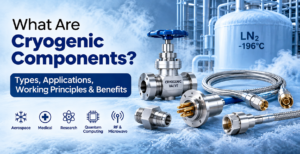
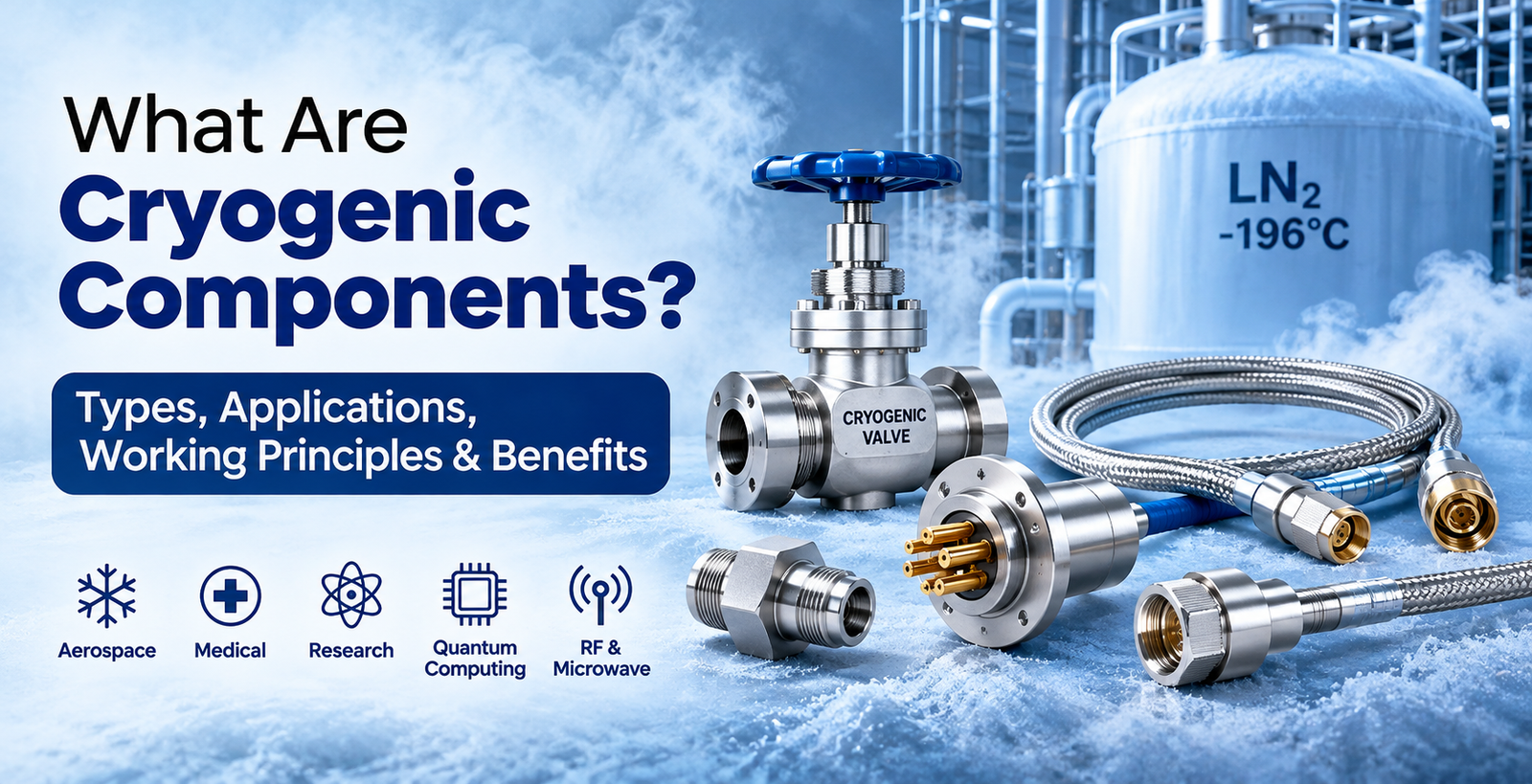
Cryogenic components are specially designed engineering parts and equipment used to operate reliably at extremely low temperatures, generally below -150°C (-238°F). These components are developed to maintain their mechanical strength, dimensional stability, electrical performance and operational reliability in environments where conventional materials and equipment may become brittle, lose efficiency or experience performance variations.
Cryogenic technology plays an important role in several advanced industries, including aerospace, medical equipment, scientific research, semiconductor manufacturing, energy production, quantum computing and telecommunications. It enables the storage, transportation, processing and measurement of gases and materials at extremely low temperatures.
Common examples of cryogenic components include cryogenic valves, connectors, vacuum-insulated pipes, pumps, sensors, heat exchangers, seals, fittings, cables and electrical feedthroughs. Each component is engineered according to specific temperature requirements, pressure ratings, material compatibility and operating conditions.
With the growing demand for advanced scientific instruments, superconducting systems and high-frequency communication technologies, cryogenic components are becoming increasingly important in modern engineering applications.
What Does Cryogenic Mean?
The term cryogenic refers to the science and technology of producing, maintaining and using extremely low temperatures. Cryogenic temperatures are significantly lower than normal industrial refrigeration temperatures and are commonly associated with the behaviour of gases, metals, liquids and other materials under extreme cooling conditions.
Some commonly used cryogenic temperatures include:
- Liquid Nitrogen: Approximately -196°C (77 K).
- Liquid Oxygen: Approximately -183°C (90 K).
- Liquid Argon: Approximately -186°C (87 K).
- Liquid Hydrogen: Approximately -253°C (20 K).
- Liquid Helium: Approximately -269°C (4.2 K).
At these temperatures, materials can exhibit significant changes in their physical and electrical properties. For example, certain metals become more brittle, some gases turn into liquids, and specific materials can exhibit superconductivity.
Cryogenic components are designed to withstand these conditions while maintaining their intended functionality and safety.
How Do Cryogenic Components Work?
Cryogenic components work by controlling, transporting, connecting, monitoring or containing materials and energy within extremely low-temperature environments.
Their operation depends on the application and the type of component being used. However, most cryogenic systems follow a few fundamental engineering principles.
1. Temperature Resistance
Cryogenic components are manufactured using materials that can retain suitable mechanical properties at extremely low temperatures. Materials such as stainless steel, copper alloys, aluminium alloys and selected engineering polymers are commonly used depending on the application.
2. Thermal Insulation
Cryogenic systems must minimise heat transfer from the surrounding environment. Even a small amount of heat entering a cryogenic system can increase the temperature of the stored liquid or cause unwanted evaporation.
Vacuum insulation, multilayer insulation and specialised thermal barriers are commonly used to reduce heat transfer.
3. Pressure Management
Cryogenic liquids can expand significantly when converted into gases. Therefore, cryogenic equipment must be designed to handle pressure variations safely.
Pressure-rated valves, regulators, relief devices and specialised piping systems help maintain controlled operating conditions.
4. Reliable Electrical and Mechanical Connections
Electrical connections, RF interfaces and mechanical joints must remain stable during repeated temperature changes. Specialised connectors, feedthroughs and cable assemblies help maintain signal transmission and electrical continuity in cryogenic environments.
5. Thermal Contraction Management
Most materials contract when cooled. Cryogenic components must account for differences in thermal expansion and contraction between connected materials to prevent mechanical stress, leakage, deformation or connection failure.
Types of Cryogenic Components
Cryogenic systems contain different components depending on their intended function, operating temperature and engineering requirements.
1. Cryogenic Valves
Cryogenic valves control the flow of extremely cold liquids and gases within cryogenic systems. They are designed to operate reliably at low temperatures while maintaining effective sealing and pressure control.
Common types include:
- Cryogenic ball valves
- Cryogenic globe valves
- Cryogenic gate valves
- Cryogenic butterfly valves
- Cryogenic check valves
- Cryogenic control valves
These valves are widely used in LNG facilities, industrial gas plants, liquid nitrogen storage systems and hydrogen processing facilities.
2. Cryogenic Connectors
Cryogenic connectors are specialised electrical or mechanical connection devices designed to operate in extremely low-temperature environments.
Unlike conventional connectors, cryogenic connectors must maintain reliable electrical contact, mechanical stability and dimensional compatibility despite thermal contraction.
Depending on the application, these connectors may be used for power transmission, instrumentation, sensor connections, vacuum feedthroughs and RF signal transmission.
In scientific and high-frequency applications, connector selection requires particular attention to contact resistance, impedance stability, shielding effectiveness and signal integrity.
3. Cryogenic Cables and Cable Assemblies
Cryogenic cables and cable assemblies are designed to transmit electrical signals or power while operating at extremely low temperatures.
These assemblies are used in scientific research, superconducting equipment, quantum computing, MRI systems and specialised instrumentation.
Important design considerations include:
- Conductor material and electrical resistance
- Dielectric performance at low temperatures
- Thermal contraction of conductors and insulation
- Mechanical flexibility
- Shielding effectiveness
- Signal loss and transmission characteristics
For RF and microwave applications, cable assemblies must also maintain the required characteristic impedance, insertion loss and return loss across the operating frequency range.
4. Cryogenic Pumps
Cryogenic pumps are used to transfer or circulate liquefied gases at extremely low temperatures.
They are designed to handle specialised fluids such as liquid nitrogen, liquid oxygen, liquid hydrogen and liquid helium.
These pumps are commonly used in industrial gas production, LNG terminals, aerospace applications and cryogenic research facilities.
5. Cryogenic Heat Exchangers
Cryogenic heat exchangers transfer thermal energy between fluids while maintaining the temperature requirements of the system.
They are essential in gas liquefaction, air separation plants, LNG processing and hydrogen production.
Their design focuses on thermal efficiency, pressure resistance, material compatibility and minimising unwanted heat transfer.
6. Cryogenic Sensors
Cryogenic sensors measure temperature, pressure, liquid level and other operating parameters within low-temperature systems.
Common sensor technologies include resistance temperature detectors (RTDs), silicon diode temperature sensors and specialised cryogenic temperature sensors.
These instruments help engineers monitor system performance and maintain safe operating conditions.
7. Cryogenic Seals and Gaskets
Seals and gaskets prevent fluid or gas leakage in cryogenic equipment.
They must maintain sealing performance despite material contraction, pressure fluctuations and temperature cycling.
Common materials include selected PTFE grades, specialised elastomers and metal sealing materials. The appropriate material depends on temperature, pressure, fluid compatibility and sealing requirements.
8. Cryogenic Fittings and Flanges
Cryogenic fittings and flanges connect pipes, valves, vessels and other equipment within low-temperature systems.
They are designed to provide secure mechanical connections while accommodating thermal contraction and pressure variations.
9. Vacuum-Insulated Components
Vacuum-insulated components reduce heat transfer between the cryogenic fluid and the external environment.
Examples include vacuum-jacketed pipes, insulated storage vessels, transfer lines and specialised cryogenic containers.
Vacuum insulation is particularly important in applications involving liquid nitrogen, liquid helium and LNG.
10. Cryogenic Electrical Feedthroughs
Cryogenic electrical feedthroughs allow electrical signals and power connections to pass through vacuum chambers or cryogenic enclosures without compromising the system’s required sealing and insulation performance.
They are used in laboratory equipment, superconducting systems, scientific instruments and specialised measurement applications.
Materials Used in Cryogenic Components
Material selection is one of the most important factors in cryogenic engineering. Materials that perform well at room temperature may behave differently when exposed to extremely low temperatures.
The selected material must provide suitable mechanical strength, thermal stability, corrosion resistance and compatibility with the operating fluid.
Stainless Steel
Austenitic stainless steels, including grades 304 and 316, are widely used in cryogenic applications because of their good low-temperature toughness and corrosion resistance.
They are commonly used in cryogenic piping, valves, fittings, vessels and structural components.
Aluminium Alloys
Aluminium alloys offer low weight, good thermal conductivity and useful mechanical properties at cryogenic temperatures.
They are frequently used in aerospace equipment, cryogenic storage systems and heat exchangers.
Copper
Copper provides excellent electrical and thermal conductivity. It is particularly useful in cryogenic electrical systems, thermal links, superconducting equipment and specialised cable assemblies.
PTFE and Engineering Polymers
PTFE and selected engineering polymers are used for insulation, sealing and specialised structural applications.
However, polymer selection requires careful evaluation because flexibility, thermal contraction and mechanical properties can change significantly at low temperatures.
Nickel Alloys
Certain nickel-based alloys are used in specialised cryogenic applications requiring particular mechanical, corrosion or thermal properties.
The final material selection depends on the operating temperature, pressure, fluid, mechanical loading and applicable engineering standards.
Applications of Cryogenic Components
Cryogenic components are used across several industries where extremely low temperatures are necessary for specialised processes and equipment.
1. Aerospace and Space Technology
Cryogenic technology is essential in rocket propulsion systems, where liquid hydrogen and liquid oxygen are used as rocket propellants.
Cryogenic valves, pumps, tanks, sensors, fittings and transfer lines help manage these extremely cold fluids during storage and transportation.
Space research facilities also use cryogenic systems for testing instruments and simulating the thermal conditions encountered in space.
2. Medical and Healthcare Equipment
Cryogenic components are widely used in medical equipment and healthcare applications.
Magnetic Resonance Imaging (MRI) systems use superconducting magnets that are commonly cooled using liquid helium or specialised cryogenic refrigeration systems.
Cryogenic storage equipment is also used for preserving biological samples, tissues, cells and other temperature-sensitive materials.
3. Scientific Research and Laboratories
Research laboratories use cryogenic equipment for experiments involving extremely low temperatures, superconductivity, material science and particle physics.
Specialised connectors, sensors, feedthroughs, vacuum components and cryogenic cables support accurate measurements and reliable electrical connections.
4. Quantum Computing
Quantum computing is an important emerging application of cryogenic technology.
Many superconducting quantum processors operate at temperatures close to absolute zero. These temperatures help maintain the quantum properties required for computation.
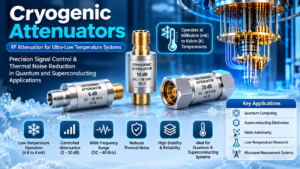
Cryogenic RF cables, microwave connectors, attenuators, filters, thermal anchors and electrical feedthroughs are important parts of quantum computing infrastructure.
These components help transmit microwave signals between room-temperature control electronics and quantum processors while managing heat leakage and signal degradation.
5. Telecommunications and RF/Microwave Engineering
Cryogenic technology also has specialised applications in telecommunications and RF/microwave engineering.
In certain advanced systems, cooling electronic components to cryogenic temperatures can reduce electrical losses and improve receiver sensitivity.
Cryogenic low-noise amplifiers, RF cables, microwave connectors, coaxial components and specialised interconnects may be used in radio astronomy, satellite communication research, scientific instrumentation and high-frequency measurement systems.
These applications require careful control of impedance, insertion loss, return loss, shielding and thermal performance.
6. Liquefied Natural Gas (LNG) Industry
LNG is natural gas cooled to approximately -162°C to convert it into liquid form for efficient storage and transportation.
Cryogenic valves, pumps, storage tanks, transfer lines, heat exchangers and specialised fittings are essential components of LNG infrastructure.
7. Hydrogen Energy Systems
Liquid hydrogen is stored at approximately -253°C, making specialised cryogenic equipment necessary for its handling and transportation.
Cryogenic components support hydrogen storage, transfer, processing and emerging hydrogen energy infrastructure.
8. Semiconductor and Electronics Manufacturing
Certain semiconductor manufacturing and research processes use cryogenic cooling technologies for temperature control and specialised equipment operation.
Cryogenic components help maintain controlled environments in advanced electronic manufacturing and scientific measurement applications.
Cryogenic Components in RF and Microwave Systems
RF and microwave engineering requires reliable signal transmission, precise impedance control and minimal transmission losses. When these systems operate at cryogenic temperatures, component selection becomes even more important.
At extremely low temperatures, electrical conductivity and material properties can change. These changes may influence the performance of RF cables, connectors, attenuators and other microwave components.
Cryogenic RF and microwave systems may include:
- Cryogenic coaxial cables
- Low-temperature RF connectors
- Microwave cable assemblies
- Cryogenic attenuators
- RF filters
- Microwave interconnects
- Low-noise amplifiers
- Specialised electrical feedthroughs
Why Are Cryogenic RF Components Important?
Cryogenic RF components are important because they help maintain reliable signal transmission between equipment operating at different temperature stages.
For example, quantum computing systems require microwave signals to travel from room-temperature electronics to processors operating at extremely low temperatures.
During this process, engineers must consider signal attenuation, heat conduction, impedance matching and thermal management.
Important RF Performance Parameters
When selecting RF and microwave components for cryogenic applications, engineers should evaluate the following parameters:
Characteristic Impedance: Common RF systems use 50-ohm impedance. The component should maintain suitable impedance characteristics throughout the intended operating conditions.
Operating Frequency: The component must support the required frequency range, including any changes in performance at cryogenic temperatures.
Insertion Loss: Insertion loss determines the amount of signal power lost during transmission. It is an important parameter in sensitive microwave systems.
Return Loss: Return loss indicates how effectively a component is impedance-matched to the connected system.
Thermal Contraction: Different materials contract at different rates, potentially affecting connector interfaces, cable dimensions and mechanical stability.
Power Handling: RF components must support the required signal power without excessive heating or performance degradation.
Thermal Conductivity: Heat transfer through cables and connectors must be controlled to avoid unnecessary thermal loading on cryogenic stages.
Benefits of Cryogenic Components
Cryogenic components provide several engineering advantages in applications that require extremely low operating temperatures.
1. Reliable Low-Temperature Operation
They are specifically designed to maintain their required functions under extremely cold operating conditions.
2. Improved System Performance
Cryogenic systems can enable improved performance in applications such as superconducting electronics, sensitive microwave receivers and specialised scientific instruments.
3. Enhanced Material Performance
Certain materials exhibit useful electrical, magnetic and mechanical characteristics at cryogenic temperatures.
4. Efficient Gas Storage and Transportation
Cryogenic equipment enables gases to be stored and transported in liquid form, significantly reducing their volume.
5. Support for Advanced Technologies
Cryogenic components enable the development and operation of quantum computers, superconducting systems, advanced medical equipment and aerospace technologies.
6. Precision Measurement
Specialised cryogenic sensors, cables and electrical connections help researchers perform accurate measurements in controlled low-temperature environments.
Challenges in Designing Cryogenic Components
Despite their advantages, cryogenic components involve several engineering challenges.
Material Brittleness
Some materials become brittle at extremely low temperatures. Material selection must therefore consider low-temperature toughness and fracture resistance.
Thermal Contraction
Different materials contract at different rates, which can create mechanical stress, leakage or connection problems.
Heat Leakage
Unwanted heat entering a cryogenic system can increase operating costs and affect system performance.
Sealing Difficulties
Maintaining reliable seals at cryogenic temperatures is challenging because sealing materials can contract, harden or lose flexibility.
Electrical Performance Variations
Changes in conductor resistance, dielectric properties and material dimensions can affect electrical and RF performance.
Manufacturing Precision
Cryogenic components often require precise machining, surface finishing, dimensional control and specialised testing to meet their intended operating requirements.
Factors to Consider When Selecting Cryogenic Components
Choosing the right cryogenic component is essential for system safety, performance and long-term reliability.
Before selecting a component, engineers should evaluate the following factors:
- Operating Temperature: Confirm the minimum and maximum operating temperatures required by the application.
- Pressure Rating: Ensure that the component can safely handle the expected operating and pressure conditions.
- Material Compatibility: Select materials suitable for the operating temperature and the fluid or gas being handled.
- Thermal Expansion and Contraction: Evaluate dimensional changes and mechanical stress during cooling and warming cycles.
- Electrical Requirements: For electrical and RF components, check voltage, current, impedance, frequency range and power handling.
- Thermal Conductivity: Consider heat transfer through cables, connectors, fittings and other system interfaces.
- Sealing Performance: Verify that seals and connections remain reliable under the specified operating conditions.
- Mechanical Durability: Consider vibration, repeated thermal cycling, mechanical loads and environmental exposure.
- Testing and Certification: Review applicable material specifications, industry standards, qualification reports and testing requirements.
- Application Requirements: Select components according to the actual system design rather than relying only on general product specifications.
Cryogenic Components vs Conventional Components
Cryogenic components differ from conventional industrial components primarily in their material selection, operating temperature range and design requirements.
| Parameter | Cryogenic Components | Conventional Components |
|---|---|---|
| Operating Temperature | Extremely low temperatures | Generally ambient or moderate temperatures |
| Material Selection | Low-temperature compatible materials | Application-specific standard materials |
| Thermal Contraction | Critical design consideration | Usually less demanding |
| Insulation | Often requires specialised thermal insulation | Depends on application |
| Sealing | Designed for low-temperature conditions | Designed for normal operating conditions |
| Testing | May require cryogenic qualification | Standard application-specific testing |
| Applications | LNG, aerospace, quantum computing, MRI | General industrial and commercial systems |
Future of Cryogenic Technology
The demand for cryogenic components is expected to grow as industries continue investing in advanced computing, space exploration, clean energy and scientific research.
Quantum computing is one of the major areas driving the development of specialised cryogenic RF and microwave components. As quantum processors become more advanced, the need for low-loss cables, microwave interconnects, attenuators and precision connectors will continue to increase.
The hydrogen economy is another important growth area. Liquid hydrogen infrastructure requires reliable cryogenic storage, transfer and pressure-control technologies.
Similarly, advancements in superconducting materials, medical imaging, satellite communication and radio astronomy are creating new requirements for specialised low-temperature components.
Future developments are likely to focus on improved thermal efficiency, reduced signal losses, better material performance, miniaturisation and more reliable cryogenic interconnections.
Conclusion
Cryogenic components are essential engineering elements designed to operate reliably in extremely low-temperature environments. From valves, pumps and heat exchangers to specialised RF cables, connectors, sensors and electrical feedthroughs, these components support a wide range of advanced industrial and scientific applications.
Their importance continues to grow in aerospace, LNG infrastructure, medical equipment, quantum computing, superconducting systems and RF/microwave engineering.
Selecting the right cryogenic component requires careful consideration of operating temperature, material compatibility, thermal contraction, pressure requirements, electrical performance and mechanical reliability.
As cryogenic technology advances, high-performance components will continue to play an important role in developing more efficient, reliable and technologically advanced systems.
Frequently Asked Questions (FAQs) About Cryogenic Components
1. What are cryogenic components?
Cryogenic components are specially engineered parts and equipment designed to operate at extremely low temperatures, generally below -150°C. Examples include cryogenic valves, pumps, connectors, cables, sensors, heat exchangers and vacuum-insulated fittings.
2. What temperature is considered cryogenic?
Cryogenic temperatures are generally associated with temperatures below approximately -150°C. Different applications use different temperature ranges depending on the material, gas or equipment involved.
3. What are the most common types of cryogenic components?
Common cryogenic components include valves, pumps, connectors, cable assemblies, sensors, heat exchangers, seals, gaskets, flanges, fittings and vacuum-insulated pipes.
4. Which materials are used in cryogenic components?
Commonly used materials include stainless steel, aluminium alloys, copper, selected nickel alloys, PTFE and specialised engineering polymers. Material selection depends on temperature, pressure and application requirements.
5. Where are cryogenic components used?
Cryogenic components are used in aerospace, medical equipment, LNG facilities, hydrogen storage, quantum computing, scientific research, semiconductor manufacturing and specialised telecommunications systems.
6. What are cryogenic RF components?
Cryogenic RF components are specialised radio frequency and microwave components designed to operate at extremely low temperatures. Examples include coaxial cables, RF connectors, attenuators, filters and microwave interconnects.
7. Why are cryogenic components important in quantum computing?
Many quantum computing platforms use superconducting circuits that operate at temperatures close to absolute zero. Cryogenic cables, connectors, attenuators and filters help transmit microwave signals while controlling heat transfer and maintaining signal quality.
8. What is the difference between cryogenic and refrigeration components?
Conventional refrigeration components generally operate at temperatures used for cooling and preservation. Cryogenic components are designed for much lower temperatures, often below -150°C, and require specialised materials, insulation and sealing arrangements.
9. What is a cryogenic connector?
A cryogenic connector is a specialised connection device designed to maintain electrical or mechanical connectivity at extremely low temperatures. It may be used in instrumentation, scientific research, superconducting systems and RF/microwave applications.
10. What is the role of cryogenic cables?
Cryogenic cables transmit electrical power or signals within low-temperature systems. They are designed with suitable conductors, insulation and mechanical characteristics to maintain reliable performance during temperature changes.
11. Why is material selection important for cryogenic components?
Material selection is important because extremely low temperatures can change mechanical strength, flexibility, electrical resistance and dimensional properties. Suitable materials help prevent cracking, leakage, deformation and performance degradation.
12. How do cryogenic components handle thermal contraction?
Cryogenic components use suitable materials, mechanical tolerances, flexible connections and specialised joint designs to accommodate contraction during cooling and expansion during warming.
13. What industries require cryogenic RF and microwave components?
Quantum computing, radio astronomy, satellite communication research, superconducting electronics and advanced scientific instrumentation may require specialised cryogenic RF and microwave components.
14. How do you select the right cryogenic component?
Consider the operating temperature, pressure rating, material compatibility, thermal conductivity, mechanical strength, electrical requirements, frequency range and applicable qualification standards.
15. What is the future of cryogenic components?
The future of cryogenic components is closely connected to quantum computing, superconducting technologies, space exploration, hydrogen energy, advanced medical imaging and high-performance scientific instrumentation. These industries are creating demand for more efficient and reliable low-temperature engineering solutions