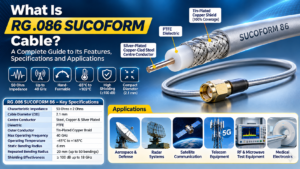
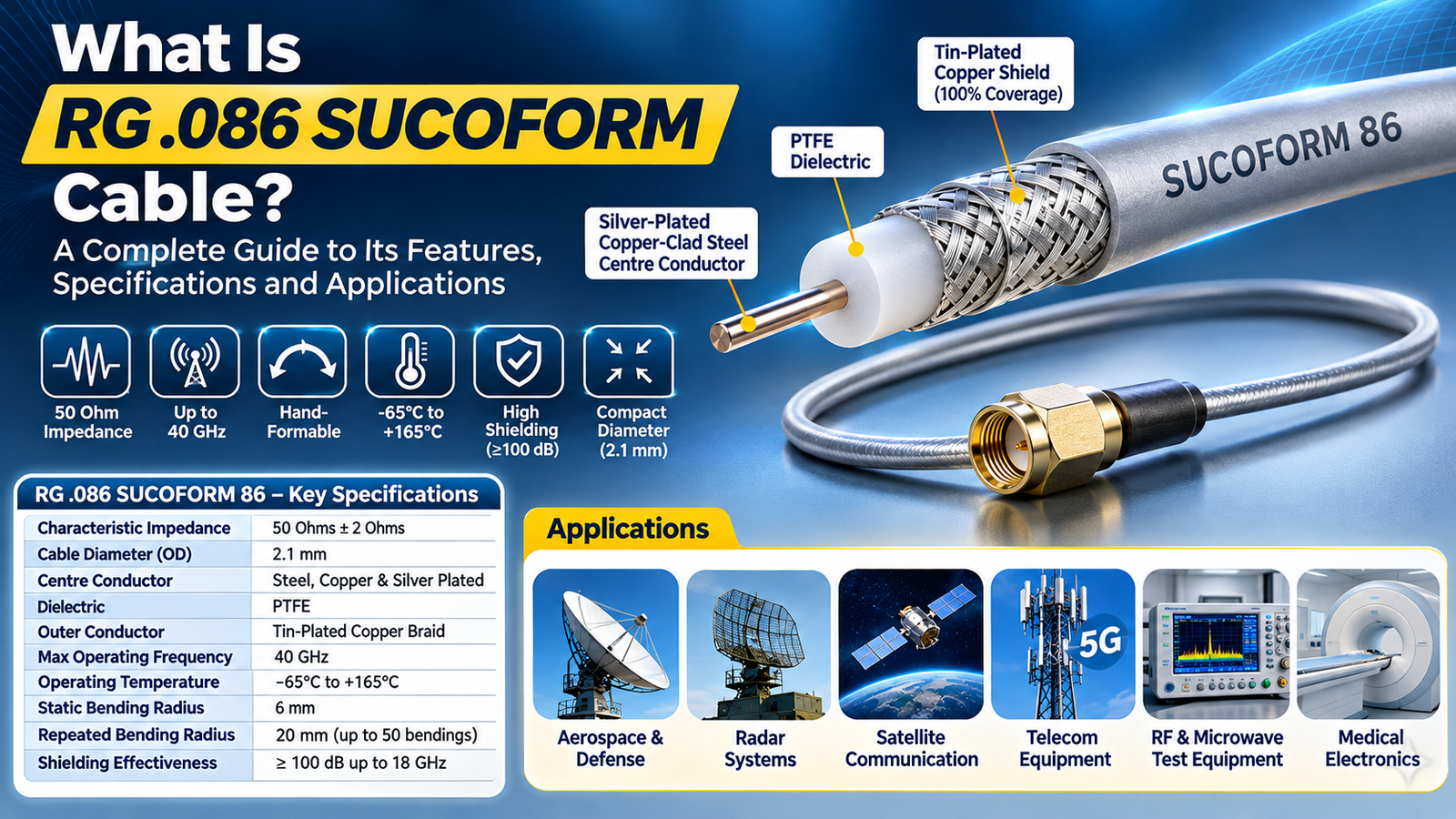
RG .086 SUCOFORM Cable is a high-performance, hand-formable microwave coaxial cable designed for applications requiring excellent electrical performance, stable impedance, flexibility during installation, and reliable high-frequency signal transmission. It is commonly used in RF and microwave communication systems, aerospace electronics, military equipment, radar systems, laboratory instruments, and precision electronic assemblies.
Unlike conventional flexible coaxial cables, SUCOFORM cables combine the electrical characteristics of semi-rigid microwave cables with the convenience of hand-formable construction. This allows engineers and technicians to bend and shape the cable during installation without requiring specialized cable-forming equipment.
The RG .086 dimension refers to the approximate 0.086-inch cable diameter class, equivalent to approximately 2.18 mm. The HUBER+SUHNER SUCOFORM 86 cable has a specified outside diameter of 2.1 mm and is designed for demanding microwave applications.
One of the major advantages of RG .086 SUCOFORM cable is its ability to maintain its formed shape after installation. This makes it particularly suitable for compact RF assemblies, where cable routing, space limitations, and consistent electrical performance are important considerations.
With a 50 Ohm characteristic impedance, PTFE dielectric, silver-plated copper-clad steel centre conductor, and 100% tin-soaked copper braid, SUCOFORM 86 provides a reliable solution for high-frequency signal transmission.
This comprehensive guide explains what RG .086 SUCOFORM cable is, how it works, its construction, technical specifications, frequency performance, advantages, applications, and important factors to consider when selecting the right cable.
What Is RG .086 SUCOFORM Cable?
RG .086 SUCOFORM Cable is a miniature, hand-formable coaxial microwave cable designed to transmit RF signals with controlled impedance and low signal attenuation.
It is manufactured using a precision coaxial construction consisting of a centre conductor, PTFE dielectric insulation, and a metallic outer conductor. These layers work together to provide stable electrical characteristics and effective electromagnetic shielding.
SUCOFORM is a product family of hand-formable microwave cables developed by HUBER+SUHNER. These cables are designed as formable alternatives to conventional semi-rigid microwave cables.
The cable can be manually shaped to fit compact electronic assemblies, allowing engineers to create precise cable routing between RF connectors, microwave components, circuit boards, and other electronic devices.
The SUCOFORM 86 variant is particularly useful in applications where standard flexible cables may not provide sufficient dimensional stability or electrical performance.
Its important characteristics include:
- 50 Ohm characteristic impedance
- 40 GHz maximum operating frequency in the published product specification
- 2.1 mm nominal outside diameter
- PTFE dielectric insulation
- Silver-plated copper-clad steel centre conductor
- Tin-plated copper outer conductor
- 100% shielding coverage
- Hand-formable construction
- High-temperature operating capability
Mouser Electronics+1
How Does RG .086 SUCOFORM Cable Work?
RG .086 SUCOFORM cable works on the principle of coaxial signal transmission. It transfers radio frequency signals through its central conductor while the surrounding dielectric and metallic shielding maintain electrical separation and reduce unwanted electromagnetic interference.
The centre conductor carries the RF signal from the transmitting device to the receiving device. The PTFE dielectric maintains the required spacing between the centre conductor and outer conductor, helping establish the cable’s characteristic impedance.
The outer conductor acts as the electrical return path and provides shielding against external electromagnetic interference.
When the cable is connected to RF equipment through suitable coaxial connectors, it creates a controlled transmission path for high-frequency signals.
Its hand-formable construction allows the cable to be routed around components and through compact spaces while retaining the required shape after installation.
Proper forming is essential because excessive bending, flattening, or repeated mechanical deformation can affect impedance consistency and transmission performance.
Construction of RG .086 SUCOFORM Cable
The construction of RG .086 SUCOFORM cable consists of three primary electrical layers.
1. Centre Conductor
The centre conductor is responsible for carrying the RF signal through the cable.
In the SUCOFORM 86 design, the centre conductor is manufactured using steel with copper and silver plating.
This construction combines mechanical strength with conductive surface properties suitable for high-frequency transmission.
Key characteristics include:
- Silver-plated conductive surface
- Copper-plated steel construction
- Mechanical stability
- Consistent signal transmission
- Resistance to deformation during careful cable forming
2. Dielectric Insulation
The dielectric material separates the centre conductor from the outer conductor.
SUCOFORM 86 uses PTFE (Polytetrafluoroethylene) as its dielectric material.
PTFE is widely used in high-performance RF cables because of its excellent electrical insulation, low dielectric loss, thermal stability, and resistance to environmental degradation.
Its dielectric diameter is specified as 1.65 mm.
Important benefits include:
- Excellent electrical insulation
- Low dielectric loss
- Stable electrical characteristics
- High-temperature resistance
- Reliable high-frequency performance
3. Outer Conductor and Shielding
The outer conductor provides the electrical return path and protects the transmitted signal against external interference.
SUCOFORM 86 uses a tin-plated copper outer conductor with a 100% tin-soaked braid construction.
This shielding design helps minimize electromagnetic interference and reduce unwanted signal leakage.
Key benefits include:
- High shielding effectiveness
- Improved electromagnetic compatibility
- Reduced external interference
- Reliable signal transmission
- Mechanical protection for internal cable layers
RG .086 SUCOFORM Cable Technical Specifications
The following table presents the published technical specifications of HUBER+SUHNER SUCOFORM 86. Always confirm the applicable datasheet revision and ordering variant before final product selection.
| Parameter | Specification |
|---|---|
| Cable Model | SUCOFORM 86 |
| Cable Type | Hand-Formable Microwave Coaxial Cable |
| Cable Diameter | 2.1 mm |
| Characteristic Impedance | 50 Ohms ± 2 Ohms |
| Maximum Operating Frequency | 40 GHz |
| Centre Conductor | Steel, Copper and Silver Plated |
| Centre Conductor Diameter | 0.53 mm |
| Dielectric Material | PTFE |
| Dielectric Diameter | 1.65 mm |
| Outer Conductor | Tin-Plated Copper |
| Shield Construction | 100% Tin-Soaked Braid |
| Capacitance | 95 pF/m |
| Velocity of Propagation | 71% |
| Signal Delay | 4.7 ns/m |
| Screening Effectiveness | At least 100 dB up to 18 GHz |
| Maximum Operating Voltage | 1.5 kVrms |
| Test Voltage | 3 kVrms |
| Operating Temperature | -65°C to +165°C |
| Static Bending Radius | 6 mm |
| Repeated Bending Radius | 20 mm, up to 50 bendings |
| Weight | Approximately 15 g/m |
Mouser Electronics+1
Frequency Range of RG .086 SUCOFORM Cable
Frequency capability is one of the most important characteristics of a microwave cable.
HUBER+SUHNER SUCOFORM 86 supports operating frequencies up to 40 GHz, making it suitable for various RF and microwave applications.
The cable is designed for high-frequency signal transmission where low attenuation, impedance stability, and effective shielding are essential.
Typical application frequency ranges include:
- 1 GHz to 6 GHz
- 6 GHz to 12 GHz
- 12 GHz to 18 GHz
- 18 GHz to 26.5 GHz
- 26.5 GHz to 40 GHz
These are application frequency bands, not separate cable ratings. Actual performance depends on cable length, connector selection, assembly quality, and operating conditions.
Attenuation Performance of RG .086 SUCOFORM Cable
Attenuation refers to the reduction in RF signal power as it travels through a cable. It is generally measured in decibels per metre (dB/m).
In high-frequency applications, cable attenuation increases as operating frequency increases. Therefore, selecting a cable with suitable attenuation characteristics is important for maintaining signal quality.
The published SUCOFORM 86 datasheet provides the following nominal attenuation values:
| Frequency | Nominal Attenuation (dB/m) |
|---|---|
| 2 GHz | 0.97 |
| 4 GHz | 1.42 |
| 6 GHz | 1.78 |
| 8 GHz | 2.10 |
| 10 GHz | 2.39 |
| 12 GHz | 2.66 |
| 14 GHz | 2.91 |
| 16 GHz | 3.15 |
| 18 GHz | 3.39 |
| 20 GHz | 3.61 |
| 26 GHz | 4.24 |
| 30 GHz | 4.64 |
| 40 GHz | 5.57 |
These figures represent nominal cable attenuation, not the total insertion loss of a completed cable assembly. Connector losses and assembly quality must also be considered.pdf.elecfans.com+1
Power Handling Capability
Power handling indicates the maximum RF power that a cable can safely transmit under specified operating conditions.
SUCOFORM 86 has frequency-dependent continuous-wave (CW) power handling. As frequency increases, the maximum power handling generally decreases due to higher conductor and dielectric losses.
Some published power handling values are:
| Frequency | Maximum CW Power |
|---|---|
| 2 GHz | 115 W |
| 4 GHz | 81 W |
| 6 GHz | 66 W |
| 8 GHz | 57 W |
| 10 GHz | 51 W |
| 12 GHz | 47 W |
| 18 GHz | 38 W |
| 20 GHz | 36 W |
| 30 GHz | 30 W |
| 40 GHz | 26 W |
Reference conditions: sea level, 40°C ambient temperature, as stated in the published datasheet. Actual allowable power depends on installation, temperature, VSWR and thermal conditions.pdf.elecfans.com
What Makes SUCOFORM 86 Different from Conventional RF Cables?
Traditional flexible coaxial cables are designed to provide flexibility and convenient installation. However, they may not maintain their exact routing shape after installation.
Semi-rigid coaxial cables offer excellent electrical stability but generally require specialized tools for bending and forming.
SUCOFORM 86 combines the advantages of both constructions.
Its hand-formable design allows technicians to shape the cable manually while maintaining its formed configuration. This reduces installation complexity in compact RF assemblies.
Important differences include:
| Feature | Standard Flexible RF Cable | Semi-Rigid Cable | SUCOFORM 86 |
|---|---|---|---|
| Flexibility | High | Low | Hand-formable |
| Shape Retention | Limited | Excellent | Excellent when properly formed |
| Installation | Easy | Requires forming tools | Manual forming |
| Impedance | Depends on cable | Highly controlled | 50 Ohms |
| High-Frequency Performance | Model dependent | Excellent | Up to 40 GHz |
| Compact Assemblies | Suitable | Suitable | Highly suitable |
Key Features of RG .086 SUCOFORM Cable
Hand-Formable Construction
The cable can be manually shaped according to installation requirements. This feature is particularly beneficial when routing cables through compact electronic assemblies.
High-Frequency Performance
With a specified operating frequency of up to 40 GHz, SUCOFORM 86 supports demanding microwave applications.
Stable 50 Ohm Impedance
The cable is designed with a characteristic impedance of 50 Ohms, making it suitable for standard RF and microwave transmission systems.
PTFE Dielectric
PTFE provides excellent electrical insulation and thermal stability, supporting reliable signal transmission.
Excellent Shielding
The 100% tin-soaked copper braid provides high shielding effectiveness, specified at a minimum of 100 dB up to 18 GHz.
Wide Operating Temperature
The standard SUCOFORM 86 version supports an operating temperature range of -65°C to +165°C.
Compact Diameter
Its 2.1 mm outside diameter makes it suitable for space-constrained installations and miniature microwave assemblies.
Applications of RG .086 SUCOFORM Cable
RG .086 SUCOFORM cable is widely used in industries that require precise RF signal transmission and compact cable routing.
1. Aerospace and Defense
Aerospace and defense systems require reliable microwave signal transmission under demanding environmental conditions.
SUCOFORM 86 is suitable for applications such as:
- Avionics systems
- Military communication equipment
- Radar assemblies
- Electronic warfare equipment
- Navigation systems
- Aerospace RF modules
2. Radar Systems
Radar systems operate using high-frequency microwave signals that require controlled impedance and reliable transmission.
SUCOFORM cables can be used for internal RF connections between radar components, microwave modules, and signal-processing equipment.
3. Telecommunications
Telecommunication equipment requires reliable connections between RF components and communication modules.
Applications include:
- RF communication modules
- Microwave radio equipment
- Wireless communication systems
- Signal distribution assemblies
- RF front-end circuits
4. RF and Microwave Test Equipment
Laboratory and testing environments require accurate signal transmission to achieve reliable measurements.
SUCOFORM 86 is suitable for internal connections in:
- Vector network analyzers
- Spectrum analyzers
- Signal generators
- Microwave test equipment
- RF calibration systems
5. Satellite Communication
Satellite communication systems use high-frequency signals for transmitting and receiving information.
SUCOFORM cables can support internal microwave interconnections in satellite communication equipment, ground station modules, and RF assemblies.
6. Medical Electronics
Specialized medical electronic equipment uses RF and microwave technology for diagnostic and research applications.
The cable may be suitable for internal signal connections in equipment where its electrical and temperature specifications meet the system requirements.
7. Research and Development
Research laboratories frequently develop compact microwave circuits that require reliable and precisely routed coaxial connections.
Hand-formable cables help engineers create customized interconnections during prototype development and RF testing.
Advantages of RG .086 SUCOFORM Cable
RG .086 SUCOFORM cable provides several benefits for advanced RF and microwave systems.
- Compact 2.1 mm cable diameter
- Hand-formable construction
- Stable 50 Ohm impedance
- Operating frequency up to 40 GHz
- PTFE dielectric insulation
- Excellent shielding effectiveness
- High-temperature resistance
- Low signal attenuation for its size and frequency class
- Reliable mechanical shape retention
- Suitable for compact microwave assemblies
- Convenient manual cable routing
- Suitable for aerospace, defense, telecommunications, and laboratory applications
Limitations of RG .086 SUCOFORM Cable
Although SUCOFORM 86 offers excellent electrical and mechanical performance, certain factors should be considered before selecting it.
Limited flexibility compared with ordinary coaxial cables: It is hand-formable rather than continuously flexible. It is not intended for applications requiring frequent movement.
Careful bending required: Excessive deformation can affect impedance and electrical performance.
Connector compatibility: The correct connector series must be selected for the cable’s dimensions and construction.
Cost considerations: Specialized microwave cables may cost more than conventional RG-series cables.
Installation requirements: Proper forming techniques and appropriate tools are important for achieving reliable cable assemblies.
Recommended Connectors for RG .086 SUCOFORM Cable
Selecting the correct connector is essential for maintaining electrical performance.
SUCOFORM 86 is associated with the Y16 cable group and 2 mm / 50 Ohm connector compatibility in the manufacturer’s product documentation.
Depending on the assembly design, suitable precision connector families may include:
- SMA connectors
- 2.92 mm connectors
- 2.4 mm connectors
- Other compatible microwave connector configurations
The connector must be specifically approved for the cable construction, diameter, and intended operating frequency. Mechanical fit alone does not guarantee electrical compatibility.
For high-frequency applications, connector termination quality, return loss, insertion loss, and assembly tolerances are particularly important.Mouser Electronics+1
SUCOFORM 86 vs SUCOFORM 86 PE
HUBER+SUHNER offers a jacketed variant known as SUCOFORM 86 PE.
The standard SUCOFORM 86 and SUCOFORM 86 PE share the same basic coaxial cable construction, but differ in their outer protective design and environmental specifications.
| Parameter | SUCOFORM 86 | SUCOFORM 86 PE |
|---|---|---|
| Cable Diameter | 2.1 mm | 3.2 mm |
| Characteristic Impedance | 50 Ohms | 50 Ohms |
| Maximum Frequency | 40 GHz | 40 GHz |
| Dielectric | PTFE | PTFE |
| Outer Conductor | Tin-Plated Copper Braid | Tin-Plated Copper Braid |
| Outer Jacket | No Additional Jacket | PE Jacket |
| Operating Temperature | -65°C to +165°C | -40°C to +85°C |
| Application | Internal RF Assemblies | Applications Requiring Additional Jacket Protection |
The PE version offers additional mechanical and environmental protection through its polyethylene outer jacket. However, the appropriate version should be selected according to the actual installation and temperature requirements.Mouser Electronics+1
How to Choose the Right RG .086 SUCOFORM Cable
Selecting the right microwave cable requires evaluating the complete electrical, mechanical, and environmental requirements of the application.
Operating Frequency
Confirm that the cable supports the complete frequency range of your RF system. For SUCOFORM 86, the published maximum operating frequency is 40 GHz.
Characteristic Impedance
Most RF and microwave systems use 50 Ohm impedance. Ensure that the cable, connectors, and connected equipment have matching impedance.
Cable Length
Calculate the expected attenuation based on cable length and operating frequency. Shorter cable lengths are generally preferred for high-frequency applications.
Temperature Requirements
Check the operating temperature range of the cable and ensure it is compatible with the surrounding environment.
Bending Radius
Follow the manufacturer’s specified bending radius to avoid damaging the cable or affecting its electrical characteristics.
Connector Compatibility
Select suitable connectors designed for the exact cable dimensions and frequency requirements.
Shielding Requirements
Evaluate shielding effectiveness according to the electromagnetic environment and signal integrity requirements.
Power Handling
Verify the frequency-dependent power rating and consider ambient temperature, VSWR, installation conditions, and thermal dissipation.
Installation and Handling Guidelines
Proper installation is essential for maintaining the electrical and mechanical performance of RG .086 SUCOFORM cable.
Follow these recommendations:
- Avoid bending the cable beyond its specified minimum bending radius.
- Use suitable cable-forming tools when necessary.
- Avoid twisting or flattening the cable during installation.
- Use compatible precision RF connectors.
- Ensure proper connector termination.
- Avoid repeated bending of the same cable section.
- Keep the cable away from excessive mechanical stress.
- Inspect the cable for physical damage before installation.
- Verify insertion loss and VSWR after completing the cable assembly.
- Follow the manufacturer’s handling and installation guidelines.
Future Trends in Hand-Formable Microwave Cables
The demand for compact and high-frequency RF interconnections continues to increase with advancements in 5G infrastructure, satellite communication, aerospace electronics, defense systems, and millimeter-wave technologies.
Hand-formable microwave cables are becoming increasingly important in applications where space limitations, electrical performance, and installation flexibility must be considered together.
Future developments in microwave cable technology are expected to focus on improved shielding, lower attenuation, higher operating frequencies, enhanced thermal performance, smaller cable diameters, and more reliable connector integration.
As RF systems become increasingly compact and sophisticated, cables such as SUCOFORM 86 will continue to support precision microwave interconnections.
Conclusion
RG .086 SUCOFORM cable is a specialized hand-formable microwave coaxial cable designed for high-frequency applications requiring stable impedance, excellent shielding, compact dimensions, and reliable electrical performance.
Its 50 Ohm characteristic impedance, PTFE dielectric, silver-plated copper-clad steel centre conductor, and tin-plated copper shielding make it suitable for demanding RF and microwave applications.
With a 2.1 mm outside diameter and an operating frequency of up to 40 GHz, SUCOFORM 86 provides an effective solution for compact electronic assemblies, radar systems, aerospace equipment, telecommunications, satellite communication, and RF laboratory instruments.
Its hand-formable construction allows engineers to create customized cable routing while maintaining the cable’s formed shape after installation.
Choosing the correct cable, compatible connectors, bending radius, and operating specifications is essential for achieving reliable long-term performance in high-frequency communication systems.
Frequently Asked Questions (FAQs)
1. What is RG .086 SUCOFORM cable?
RG .086 SUCOFORM cable is a miniature, hand-formable 50 Ohm microwave coaxial cable designed for high-frequency signal transmission. It is commonly used in RF assemblies, aerospace, defense, radar, and laboratory equipment.
2. What is the maximum frequency of SUCOFORM 86 cable?
HUBER+SUHNER SUCOFORM 86 supports a maximum operating frequency of 40 GHz, making it suitable for advanced RF and microwave applications.
3. What is the impedance of RG .086 SUCOFORM cable?
The cable has a characteristic impedance of 50 Ohms ± 2 Ohms, making it compatible with standard 50 Ohm RF and microwave systems.
4. What is the outer diameter of SUCOFORM 86 cable?
The standard SUCOFORM 86 cable has a nominal outside diameter of 2.1 mm, making it suitable for compact RF installations.
5. What dielectric material is used in SUCOFORM 86?
SUCOFORM 86 uses PTFE (Polytetrafluoroethylene) as its dielectric material. PTFE provides excellent electrical insulation, low dielectric loss, and high-temperature resistance.
6. Is RG .086 SUCOFORM cable flexible?
SUCOFORM 86 is hand-formable rather than conventionally flexible. It can be manually bent into the required shape and retains its formed configuration, making it suitable for compact RF assemblies.
7. What is the operating temperature of SUCOFORM 86?
The standard SUCOFORM 86 cable supports an operating temperature range of -65°C to +165°C, according to its published technical specifications.
8. What is the difference between SUCOFORM 86 and RG405 cable?
SUCOFORM 86 has dimensions similar to the RG-405 cable class and offers hand-formable construction. However, they should not automatically be considered identical in electrical specifications, materials, or performance. Always compare the manufacturer’s datasheets before selecting a replacement.
9. What are the applications of RG .086 SUCOFORM cable?
Common applications include:
- Aerospace and defense electronics
- Radar systems
- Satellite communication
- RF and microwave test equipment
- Telecommunications
- Medical electronics
- Microwave circuit assemblies
- Research and development laboratories
10. What is the minimum bending radius of SUCOFORM 86?
The published minimum static bending radius is 6 mm, while the repeated bending radius is 20 mm for up to 50 bendings. Following these specifications helps maintain cable performance.
11. What is the shielding effectiveness of SUCOFORM 86?
The cable provides a minimum screening effectiveness of 100 dB up to 18 GHz, helping protect RF signals against external electromagnetic interference.
12. Can SUCOFORM 86 be used for 40 GHz applications?
Yes. The published maximum operating frequency is 40 GHz. However, the complete cable assembly, including connectors and termination quality, must also be suitable for 40 GHz operation.
13. What connectors are compatible with SUCOFORM 86?
SUCOFORM 86 belongs to the Y16 cable group and is associated with 2 mm / 50 Ohm connector compatibility. Connector selection must be based on the manufacturer’s approved cable and connector combinations.
14. What is the difference between SUCOFORM 86 and SUCOFORM 86 PE?
SUCOFORM 86 is an unjacketed hand-formable cable with a 2.1 mm diameter. SUCOFORM 86 PE includes an additional polyethylene protective jacket and has a 3.2 mm overall diameter.
15. Why should I choose RG .086 SUCOFORM cable?
RG .086 SUCOFORM cable is a suitable choice when an RF application requires compact dimensions, hand-formable installation, stable 50 Ohm impedance, effective shielding, and high-frequency performance up to 40 GHz.