
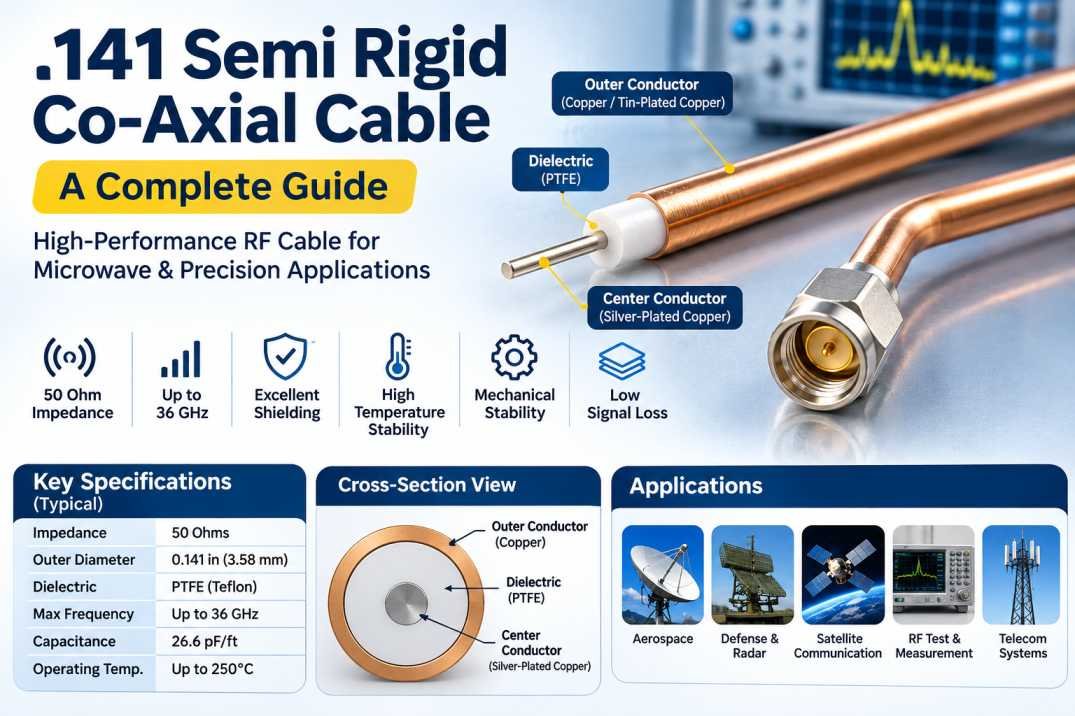
In modern RF and microwave communication systems, reliable signal transmission is essential for achieving accurate performance, minimal signal loss, and stable connectivity. As electronic devices operate at increasingly higher frequencies, engineers require specialized coaxial cables that can maintain consistent electrical characteristics even under demanding operating conditions. One such solution is the .141 Semi Rigid Co-Axial Cable, which is widely used in high-frequency RF applications, microwave communication, aerospace, defense, radar systems, and precision test and measurement equipment.
The .141 Semi Rigid Co-Axial Cable is a precision-engineered 50 Ohm RF cable designed to transmit high-frequency signals with excellent shielding effectiveness, controlled impedance, and reliable electrical performance. Its construction generally consists of a solid center conductor, PTFE dielectric insulation, and a seamless metallic outer conductor. This construction helps maintain a consistent distance between the inner and outer conductors, reducing impedance variations and unwanted electromagnetic interference.
The term .141 refers to the nominal outside diameter of the cable’s metallic outer conductor, which is approximately 0.141 inches or 3.58 mm. Its compact dimensions make it suitable for installations where space is limited but high-frequency performance is essential.
Unlike conventional flexible coaxial cables, semi-rigid cables can be formed into specific shapes during installation. Once properly formed, they maintain their routing position and provide stable electrical characteristics. This makes them particularly useful for internal RF connections, microwave assemblies, and precision electronic equipment.
In this comprehensive guide, we will explore what .141 Semi Rigid Co-Axial Cable is, how it works, its construction, technical specifications, frequency characteristics, advantages, applications, and important factors to consider when selecting the right cable for your RF system.
What Is .141 Semi Rigid Co-Axial Cable?
The .141 Semi Rigid Co-Axial Cable is a high-performance radio frequency cable designed to transmit RF and microwave signals with minimal interference and stable electrical performance.
It is generally manufactured with a solid silver-plated copper or copper-clad steel center conductor, a solid PTFE (Polytetrafluoroethylene) dielectric, and a rigid copper or tin-plated copper outer conductor.
The solid metallic outer conductor provides excellent shielding against external electromagnetic interference (EMI) while maintaining consistent impedance throughout the cable length.
The cable is commonly designed with a characteristic impedance of 50 Ohms, making it compatible with a wide range of RF communication systems, microwave equipment, antennas, transmitters, receivers, and laboratory instruments.
The .141 Semi Rigid Co-Axial Cable is particularly suitable for applications where:
- High-frequency signal transmission is required.
- Excellent electromagnetic shielding is important.
- Stable 50 Ohm impedance must be maintained.
- Precise cable routing is necessary.
- Low signal attenuation is required.
- Reliable microwave connectivity is essential.
Depending on the manufacturer and construction, .141 cables may support operating frequencies up to 20 GHz, 26.5 GHz, 34 GHz, or approximately 36 GHz. The actual frequency limit must always be confirmed from the specific cable datasheet. Precision RF Cable+2
What Does .141 Mean in Semi Rigid Coaxial Cable?
The designation .141 refers to the nominal outside diameter of the cable’s outer metallic conductor.
It represents 0.141 inches, equivalent to approximately 3.58 millimeters.
This dimension is important because it determines the cable’s physical size, compatibility with RF connectors, mechanical characteristics, and installation requirements.
The .141 cable size is widely recognized in the RF and microwave industry. It is commonly associated with RG402-type semi-rigid coaxial cable designs.
However, it is important to understand that .141 describes the cable size and does not automatically guarantee identical electrical specifications across all manufacturers.
Different versions may use different conductor materials, plating, dielectric constructions, shielding designs, and operating temperature ratings.
How Does .141 Semi Rigid Co-Axial Cable Work?
The .141 Semi Rigid Co-Axial Cable works by transmitting high-frequency electrical signals through its center conductor while the surrounding dielectric and metallic outer conductor maintain electrical separation and shielding.
When an RF signal enters the cable, it travels along the center conductor. The surrounding dielectric maintains a controlled spacing between the inner and outer conductors, which determines the cable’s characteristic impedance.
The metallic outer conductor provides the return path for the RF signal and acts as an electromagnetic shield.
This coaxial construction confines the electromagnetic field within the cable structure, reducing external interference and unwanted signal radiation.
The solid outer conductor also provides mechanical stability, helping maintain consistent electrical characteristics when the cable is installed and properly formed.
The combination of controlled impedance, PTFE insulation, and metallic shielding makes .141 Semi Rigid Co-Axial Cable suitable for precision microwave and RF applications.
Construction of .141 Semi Rigid Co-Axial Cable
The electrical and mechanical performance of a .141 Semi Rigid Co-Axial Cable depends on the quality of its internal construction.
It generally consists of three primary layers.
1. Center Conductor
The center conductor is responsible for carrying the RF signal through the cable.
It is commonly manufactured using:
- Silver-plated copper
- Silver-plated copper-clad steel
- Solid copper
Silver plating improves surface conductivity and helps reduce conductor losses at high frequencies.
Copper-clad steel provides mechanical strength while maintaining suitable electrical characteristics.
2. Dielectric Insulation
The dielectric is positioned between the center conductor and the outer conductor.
Most .141 semi-rigid cables use solid PTFE as their dielectric material.
PTFE offers several advantages:
- Excellent electrical insulation
- Low dielectric loss
- High thermal stability
- Low moisture absorption
- Chemical resistance
- Consistent electrical characteristics
The dielectric maintains the required spacing between the conductors, which is essential for controlling characteristic impedance.
3. Outer Conductor
The outer conductor is one of the most important components of a semi-rigid coaxial cable.
It is generally manufactured using copper, bare copper, or tin-plated copper tubing.
Its primary functions include:
- Providing electromagnetic shielding
- Maintaining cable impedance
- Supporting mechanical stability
- Reducing external interference
- Providing the RF return path
The solid metallic construction offers excellent shielding performance compared with conventional braided coaxial cables.
Technical Specifications of .141 Semi Rigid Co-Axial Cable
The following specifications represent the .141 Semi Rigid Co-Axial Cable listed by SRFS Teleinfra. Actual values should be verified against the supplied product datasheet and manufacturing batch.
Construction Specifications Table
| Parameter | Material | Diameter |
|---|---|---|
| Inner Conductor | Silver-Plated Copper / Steel | 0.0362 ± 0.0007 inch |
| Dielectric Insulation | PTFE | 0.1175 ± 0.001 inch |
| Outer Conductor | Tin-Plated Copper | 0.141 ± 0.002 inch |
Electrical and Mechanical Specifications
| Specification | Value |
|---|---|
| Cable Type | Semi-Rigid Coaxial Cable |
| Characteristic Impedance | 50 Ohms |
| Maximum Operating Frequency | 36 GHz |
| Nominal Capacitance | 26.6 pF/ft |
| Capacitance (Metric) | 87.3 pF/m |
| Corona Extinction Voltage | 1900 Vrms |
| Dielectric Strength | 5.0 kVrms |
| Voltage Withstanding | 5000 Vrms |
| Weight | 6.35 g/ft |
| Maximum Operating Temperature | 250°C |
| Minimum Bend Radius | Refer to manufacturer-approved forming specifications |
Specifications are based on the SRFS Teleinfra product listing. Confirm the exact cable variant and its datasheet before engineering or installation. Precision RF Cable
Key Features of .141 Semi Rigid Co-Axial Cable
1. Excellent Shielding Effectiveness
The solid metallic outer conductor provides high shielding effectiveness against external electromagnetic interference. This helps protect sensitive RF signals from unwanted noise and reduces signal leakage.
This feature is especially important in radar systems, military communication equipment, microwave instruments, and precision measurement applications.
2. High-Frequency Performance
The .141 Semi Rigid Co-Axial Cable is designed for high-frequency RF and microwave applications. Depending on the construction, certain versions support frequencies up to 36 GHz.
This makes it suitable for high-frequency test equipment, microwave assemblies, and advanced communication systems.
3. Controlled 50 Ohm Impedance
Maintaining consistent impedance is essential for minimizing signal reflections and achieving reliable RF transmission.
The cable’s precisely controlled conductor spacing and PTFE dielectric help maintain a nominal characteristic impedance of 50 Ohms.
4. Excellent Thermal Stability
PTFE dielectric insulation offers excellent temperature resistance and stable electrical performance.
Depending on the cable construction, different versions can support demanding temperature environments. The actual maximum operating temperature must be checked in the manufacturer’s datasheet.
5. Mechanical Stability
Unlike ordinary flexible coaxial cables, semi-rigid cables feature a solid metallic outer tube that can be formed into a specific routing configuration.
Once correctly formed, the cable maintains its shape, making it suitable for compact electronic assemblies and equipment with limited installation space.
6. Reliable Signal Transmission
The combination of precision conductors, PTFE insulation, and solid metallic shielding helps maintain signal integrity and consistent electrical performance.
7. Compact Design
With an outer conductor diameter of approximately 0.141 inches, the cable offers a compact solution for high-performance RF connections in electronic equipment.
Frequency Range and Attenuation Characteristics
Frequency range and attenuation are two important parameters when selecting an RF coaxial cable.
The .141 Semi Rigid Co-Axial Cable is available in different constructions supporting operating frequencies up to 20 GHz, 26.5 GHz, 34 GHz, and 36 GHz.
Attenuation refers to the reduction in signal power as the RF signal travels through the cable. It is generally measured in decibels per unit length.
As frequency increases, attenuation generally increases because of conductor losses and dielectric losses.
The following table illustrates representative attenuation and power-handling values from a specific .141 cable datasheet.
Attenuation and Power Handling Chart
| Frequency | Attenuation (dB/100 ft) | Average Power (W) |
|---|---|---|
| 0.5 GHz | 8.2 | 605 |
| 1 GHz | 12.2 | 430 |
| 2 GHz | 17.7 | 320 |
| 5 GHz | 29.0 | 198 |
| 10 GHz | 44.2 | 140 |
| 14 GHz | 54.9 | 109 |
| 18 GHz | 61.9 | 98 |
| 26.5 GHz | 73.2 | 87 |
Reference values from a particular RG402-type cable datasheet. These are not universal ratings for every .141 cable. Actual attenuation and power handling depend on construction, temperature, installation, and test conditions. rf-microwave.com
Types of .141 Semi Rigid Co-Axial Cables
Different .141 cable constructions are available depending on the electrical, mechanical, and environmental requirements of the application.
1. Standard .141 Semi Rigid Cable
Standard .141 semi-rigid cable generally features a solid center conductor, PTFE dielectric, and solid copper outer tubing.
It is commonly used in microwave equipment, laboratory instruments, RF test systems, and precision electronic assemblies.
2. Silver-Plated .141 Semi Rigid Cable
Silver-plated versions use silver-plated conductors to provide excellent surface conductivity and support high-frequency signal transmission.
These cables are suitable for applications requiring reliable electrical performance and low conductor losses.
3. Tin-Plated .141 Semi Rigid Cable
Tin-plated copper outer conductors offer corrosion resistance and improved surface protection.
These versions are used in RF assemblies where specific environmental and manufacturing requirements must be satisfied.
4. Custom .141 RF Cable Assemblies
Custom cable assemblies are manufactured with suitable RF connectors, cable lengths, and termination configurations.
Common connector options include:
- SMA Male
- SMA Female
- 2.92 mm Male
- 2.92 mm Female
- 2.4 mm Connectors
- N-Type Connectors
Connector selection depends on the operating frequency, interface compatibility, and electrical requirements of the system.
Applications of .141 Semi Rigid Co-Axial Cable
The .141 Semi Rigid Co-Axial Cable is widely used in industries where precise RF signal transmission, high shielding effectiveness, and mechanical stability are essential.
1. RF and Microwave Systems
Microwave systems require high-performance cables that can transmit signals with controlled impedance and minimal interference.
.141 semi-rigid cables are commonly used for internal connections between microwave components, RF modules, amplifiers, filters, and signal-processing circuits.
2. Aerospace Applications
Aerospace electronics require reliable RF connections that can operate under demanding environmental conditions.
These cables are used in:
- Aircraft communication systems
- Avionics equipment
- Navigation systems
- Microwave assemblies
- Aerospace testing equipment
3. Military and Defense
Military communication and defense systems require cables with excellent shielding and stable electrical performance.
Applications include:
- Radar systems
- Electronic warfare equipment
- Secure communication systems
- RF signal-processing modules
- Military test equipment
4. Radar Systems
Radar systems operate using high-frequency signals that require accurate transmission between different RF components.
.141 semi-rigid cables help maintain signal integrity in radar transmitters, receivers, microwave modules, and associated testing systems.
5. RF Test and Measurement Equipment
Precision RF testing requires low-loss connections and consistent impedance.
These cables are used in:
- Spectrum analyzers
- Vector network analyzers
- Signal generators
- RF power meters
- Microwave test fixtures
- Calibration equipment
6. Telecommunications
Telecommunication equipment uses RF cables to establish reliable connections between RF modules, antennas, filters, and communication devices.
Applications include cellular communication equipment, base station components, RF distribution systems, and wireless infrastructure.
7. Satellite Communication
Satellite communication systems require stable high-frequency signal transmission between microwave components.
.141 cables are used in satellite communication equipment, RF modules, signal converters, and laboratory testing assemblies.
8. Electronic Manufacturing
Electronic manufacturers use semi-rigid cables for internal RF connections where controlled cable routing and consistent electrical performance are necessary.
They are particularly useful in compact assemblies with limited installation space.
Advantages of .141 Semi Rigid Co-Axial Cable
The .141 Semi Rigid Co-Axial Cable offers several benefits for demanding RF and microwave applications.
- Excellent electromagnetic shielding
- Stable 50 Ohm impedance
- High-frequency compatibility
- Low signal attenuation
- PTFE dielectric insulation
- Excellent thermal stability
- Compact cable dimensions
- Reliable mechanical construction
- Consistent electrical performance
- Suitable for precision RF assemblies
- Reduced external electromagnetic interference
- Stable cable routing after forming
Limitations of .141 Semi Rigid Co-Axial Cable
Despite its excellent electrical performance, .141 semi-rigid cable has certain limitations that should be considered before installation.
Limited Flexibility
The solid metallic outer conductor makes the cable less flexible than standard coaxial cables.
It is not suitable for applications requiring continuous movement or repeated bending.
Specialized Installation Tools
Specialized cable-forming tools are generally required to achieve accurate bends without damaging the outer conductor.
Higher Installation Requirements
Proper cable preparation, cutting, forming, and connector termination require skilled technicians and suitable equipment.
Potential Mechanical Damage
Improper bending or repeated reforming can deform the outer conductor and change the cable’s electrical characteristics.
Higher Cost
Semi-rigid cables and their precision connector assemblies may cost more than conventional flexible coaxial cables.
Difference Between .141 Semi Rigid and Flexible Coaxial Cable
Both cable types are designed for RF signal transmission, but their construction and installation characteristics are different.
| Feature | .141 Semi Rigid Cable | Flexible Coaxial Cable |
|---|---|---|
| Outer Conductor | Solid Metallic Tube | Metallic Braid/Foil |
| Flexibility | Limited | High |
| Shielding | Excellent | Depends on Construction |
| Cable Forming | Requires Special Tools | Generally Easy |
| Mechanical Stability | Maintains Form After Bending | Flexible Routing |
| Applications | Microwave & Precision RF | General RF Connections |
| Movement | Not Suitable for Continuous Flexing | Suitable for Flexible Routing |
Difference Between .141 Semi Rigid Cable and RG402 Cable
The terms .141 Semi Rigid Cable and RG402 Cable are often used interchangeably in the RF industry because RG402 is a well-known 0.141-inch semi-rigid cable designation.
However, the distinction is important.
RG402 refers to a particular standardized cable designation, while .141 generally describes the cable’s nominal outside diameter.
Not every cable marketed as .141 necessarily meets the same RG402 construction or qualification requirements.
When selecting a cable, engineers should verify:
- Center conductor material
- Dielectric dimensions
- Outer conductor material
- Characteristic impedance
- Operating frequency
- Attenuation
- Voltage rating
- Temperature rating
- Applicable military or industry standards
This ensures that the selected cable meets the electrical and mechanical requirements of the intended application. Powertec Information Portal+2
How to Choose the Right .141 Semi Rigid Co-Axial Cable
Selecting the right cable is essential for achieving reliable signal transmission and long-term performance.
Consider the following technical parameters before purchasing.
1. Operating Frequency
Determine the maximum frequency required by your RF or microwave system.
Choose a cable that supports the complete operating frequency range with suitable performance margins.
2. Characteristic Impedance
Most .141 semi-rigid cables are designed for 50 Ohm RF systems.
Ensure that the cable impedance matches the connected equipment and RF components.
3. Attenuation
Check the attenuation specifications at the actual operating frequencies.
Lower attenuation helps minimize signal loss, especially in longer cable assemblies.
4. Center Conductor Material
Select silver-plated copper or silver-plated copper-clad steel conductors according to electrical and mechanical requirements.
5. Dielectric Material
PTFE is commonly preferred because of its low dielectric loss, excellent insulation, and temperature stability.
6. Outer Conductor
Verify whether the outer conductor is bare copper, silver-plated copper, or tin-plated copper.
The material and construction influence shielding, conductivity, and environmental performance.
7. Operating Temperature
Check the minimum and maximum operating temperatures according to the installation environment.
8. Connector Compatibility
Ensure that the selected cable is compatible with the required RF connectors, such as SMA, 2.92 mm, or other precision microwave interfaces.
9. Cable Length and Bend Requirements
Determine the required cable length and routing configuration before ordering.
Avoid excessive bending and follow the manufacturer’s recommended forming radius.
Installation and Handling Guidelines
Proper installation is essential for maintaining the electrical performance of .141 semi-rigid coaxial cable.
Follow these recommendations:
- Use specialized cable-forming tools.
- Avoid sharp bends and excessive mechanical force.
- Do not repeatedly bend or reform the cable.
- Maintain the recommended bend radius.
- Use compatible precision RF connectors.
- Ensure proper connector termination.
- Avoid damaging the metallic outer conductor.
- Inspect cable assemblies before installation.
- Perform continuity and RF performance testing after assembly.
Improper cable forming can deform the outer conductor, affect impedance, and increase signal reflections.
Why Is .141 Semi Rigid Co-Axial Cable Important in Modern RF Systems?
Modern RF systems require precise signal transmission, especially when operating at microwave and millimeter-wave frequencies.
Even minor variations in impedance, shielding, and cable construction can affect overall system performance.
The .141 Semi Rigid Co-Axial Cable provides a reliable solution through its controlled conductor geometry, solid PTFE dielectric, and metallic outer shielding.
Its compact size and ability to maintain a formed configuration make it suitable for precision RF assemblies where space, signal integrity, and mechanical stability are important.
As aerospace, defense, satellite communication, radar, and advanced wireless technologies continue developing, the demand for high-performance semi-rigid coaxial cables remains significant.
Conclusion
The .141 Semi Rigid Co-Axial Cable is an important component in modern RF and microwave communication systems. Its precision construction, controlled 50 Ohm impedance, PTFE dielectric insulation, and solid metallic outer conductor provide excellent shielding and reliable high-frequency signal transmission.
With applications in aerospace, defense, radar, telecommunications, satellite communication, and RF test and measurement equipment, this cable offers a dependable solution for demanding electronic assemblies.
Selecting the right cable requires careful consideration of frequency range, attenuation, conductor materials, impedance, temperature rating, connector compatibility, and mechanical requirements.
For applications requiring stable electrical performance, excellent shielding, and precise cable routing, .141 Semi Rigid Co-Axial Cable is a suitable choice for professional RF and microwave engineering systems.
Frequently Asked Questions (FAQs)
1. What is .141 Semi Rigid Co-Axial Cable?
.141 Semi Rigid Co-Axial Cable is a high-frequency RF cable featuring a solid center conductor, PTFE dielectric, and metallic outer conductor. It is designed for reliable signal transmission in RF and microwave applications.
2. What does .141 mean in coaxial cable?
The .141 designation refers to the nominal outside diameter of the metallic outer conductor, which measures approximately 0.141 inches or 3.58 mm.
3. What is the impedance of .141 Semi Rigid Co-Axial Cable?
Most standard .141 semi-rigid RF cables are designed with a characteristic impedance of 50 Ohms, making them suitable for professional RF and microwave systems.
4. What is the maximum frequency of .141 Semi Rigid Co-Axial Cable?
The maximum operating frequency depends on the cable construction and manufacturer. Different versions support frequencies up to 20 GHz, 26.5 GHz, 34 GHz, or approximately 36 GHz.
5. What materials are used in .141 Semi Rigid Co-Axial Cable?
Common materials include silver-plated copper or copper-clad steel for the center conductor, PTFE for dielectric insulation, and copper or tin-plated copper for the outer conductor.
6. What is the difference between .141 Semi Rigid Cable and RG402 Cable?
RG402 is a standardized 0.141-inch semi-rigid coaxial cable designation. The term .141 generally refers to the cable’s nominal outside diameter, while RG402 identifies a particular cable specification.
7. Where is .141 Semi Rigid Co-Axial Cable used?
It is commonly used in radar systems, aerospace electronics, military communication equipment, satellite systems, microwave assemblies, RF laboratories, and precision test and measurement instruments.
8. Is .141 Semi Rigid Co-Axial Cable flexible?
No. It is less flexible than conventional coaxial cables because it uses a solid metallic outer conductor. It can be formed into specific shapes using specialized cable-forming tools.
9. What is the dielectric material used in .141 Semi Rigid Co-Axial Cable?
PTFE (Polytetrafluoroethylene), commonly known as Teflon, is widely used because of its excellent electrical insulation, low dielectric loss, and thermal stability.
10. What connectors are compatible with .141 Semi Rigid Co-Axial Cable?
Common connector options include SMA, 2.92 mm, and other precision microwave connectors specifically designed for 0.141-inch cable.
11. What are the advantages of .141 Semi Rigid Co-Axial Cable?
Its major advantages include excellent shielding, stable impedance, high-frequency compatibility, low signal loss, mechanical stability, and reliable performance in demanding RF applications.
12. Can .141 Semi Rigid Co-Axial Cable be used in aerospace and defense applications?
Yes. It is suitable for many aerospace and defense RF assemblies, including radar, microwave communication, avionics, and electronic warfare equipment, provided its electrical and environmental ratings meet the application requirements.
13. What is the difference between semi-rigid and semi-flexible coaxial cable?
Semi-rigid cable uses a solid metallic outer conductor and maintains its formed shape. Semi-flexible cable generally uses a more flexible outer conductor construction, allowing easier routing while retaining many of the electrical advantages of semi-rigid cable.
14. How do I select the right .141 Semi Rigid Co-Axial Cable?
Consider operating frequency, impedance, attenuation, conductor material, dielectric type, temperature rating, shielding performance, cable length, bend requirements, and connector compatibility.
15. What is the operating temperature of .141 Semi Rigid Co-Axial Cable?
The operating temperature depends on the cable construction. Some specialized versions support temperatures up to 250°C, while standard versions may have lower temperature limits. Always verify the manufacturer’s datasheet.