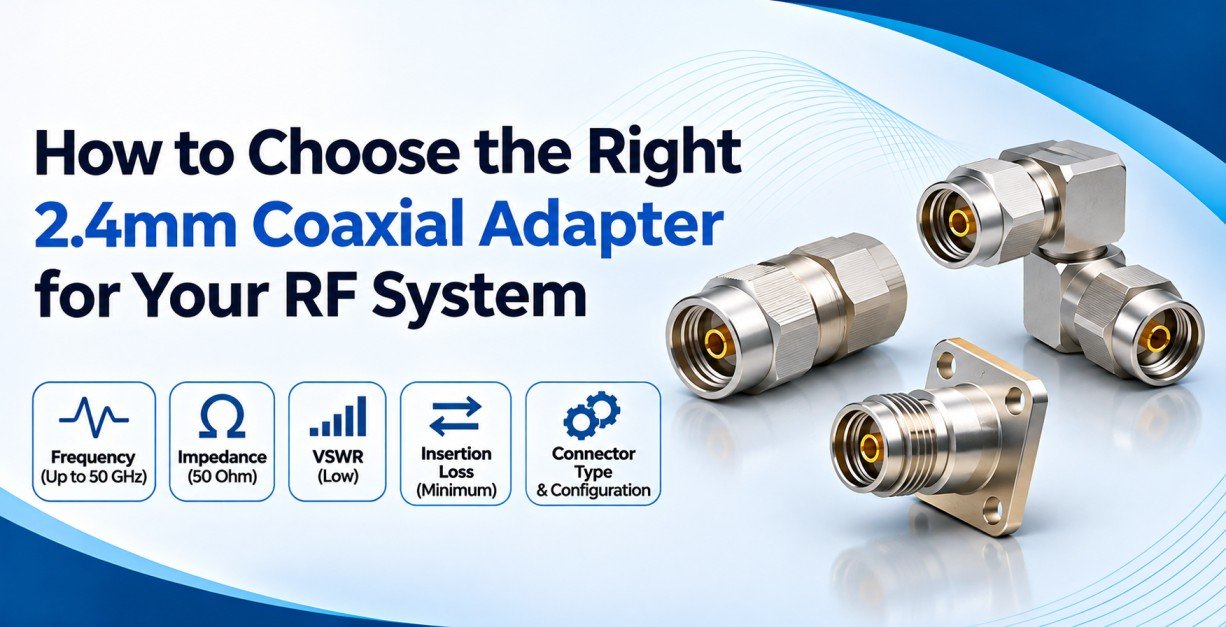
Selecting the right coaxial adapter is essential for maintaining signal integrity, minimizing transmission losses, and achieving reliable performance in high-frequency RF and microwave systems. As modern communication technologies continue to operate at increasingly higher frequencies, precision RF components have become more important than ever. Among these components, the 2.4mm coaxial adapter plays a significant role in connecting high-frequency equipment, test instruments, cables, and microwave assemblies.
A 2.4mm coaxial adapter is a precision RF connector interface commonly used in applications operating up to 50 GHz. It is designed to provide reliable electrical performance, excellent impedance matching, and low signal reflection across a broad frequency range. These characteristics make it suitable for microwave testing, telecommunications, aerospace, defense, research laboratories, and high-frequency measurement systems.
However, choosing the correct 2.4mm RF adapter involves more than simply matching connector sizes. Engineers must consider several technical parameters, including operating frequency, impedance, connector gender, interface configuration, VSWR, insertion loss, power handling capability, and mechanical durability.
An incorrectly selected adapter can introduce impedance mismatches, signal reflections, additional insertion loss, and measurement inaccuracies. Therefore, understanding the specifications and application requirements is essential before selecting a suitable component.
In this guide, we will explain how to choose the right 2.4mm coaxial adapter for your RF system, the important specifications to evaluate, common adapter configurations, applications, and factors that influence long-term performance.
What Is a 2.4mm Coaxial Adapter?
A 2.4mm coaxial adapter is a precision microwave component used to connect two RF interfaces while maintaining a controlled 50-ohm impedance. It provides a mechanical and electrical connection between compatible coaxial connectors, cables, and high-frequency electronic equipment.
The 2.4mm connector interface is designed for high-frequency applications and is commonly specified for operation up to 50 GHz. Its precision mechanical construction helps reduce unwanted reflections and maintain consistent electrical performance.
Unlike conventional RF connectors designed for lower-frequency applications, 2.4mm connectors feature carefully controlled dimensions and precision-machined contact surfaces. These characteristics help maintain signal integrity at microwave frequencies.
A 2.4mm coaxial adapter may be available in several configurations, including:
- 2.4mm Male to 2.4mm Male Adapter
- 2.4mm Female to 2.4mm Female Adapter
- 2.4mm Male to 2.4mm Female Adapter
- 2.4mm Straight Coaxial Adapter
- 2.4mm Right Angle Adapter
- 2.4mm Bulkhead Adapter
- 2.4mm Flange Mount Adapter
- 2.4mm Connector to Other RF Interface Adapters
The appropriate configuration depends on the equipment interfaces, available installation space, and connection requirements of the RF system.
Why Is Choosing the Right 2.4mm Coaxial Adapter Important?
In high-frequency RF systems, even minor variations in connector dimensions, contact quality, or impedance can affect overall system performance.
At frequencies approaching 50 GHz, electrical signals become increasingly sensitive to mechanical discontinuities and transmission-line imperfections. An unsuitable adapter can create unwanted reflections, degrade measurement accuracy, and introduce additional losses.
Selecting the right 2.4mm coaxial adapter offers several advantages.
1. Maintains Signal Integrity
A properly designed 2.4mm adapter maintains a controlled 50-ohm impedance throughout the connection. This helps minimize signal reflections and supports reliable RF transmission.
2. Reduces Insertion Loss
Insertion loss represents the amount of signal power lost when an RF component is introduced into a transmission path. A high-quality precision adapter helps minimize additional signal attenuation.
3. Improves Measurement Accuracy
In RF testing and microwave measurement applications, connector performance directly influences measurement results. Using a suitable adapter helps maintain repeatable connections and reduces measurement uncertainty.
4. Supports High-Frequency Operation
A properly specified 2.4mm adapter supports high-frequency applications up to its rated operating frequency, making it suitable for advanced microwave systems and laboratory instruments.
5. Ensures Mechanical Compatibility
Correct connector gender, interface dimensions, and mounting configurations help ensure secure connections without damaging sensitive connector interfaces.
Key Factors to Consider When Choosing a 2.4mm Coaxial Adapter
Selecting the right 2.4mm RF coaxial adapter requires evaluating electrical, mechanical, and environmental specifications. The following factors should be considered before purchasing or integrating an adapter into your RF system.
1. Operating Frequency Range
Operating frequency is one of the most important specifications when selecting a 2.4mm coaxial adapter.
A standard precision 2.4mm connector interface is commonly designed for applications up to 50 GHz. However, the actual frequency performance of an adapter depends on its construction, materials, manufacturing tolerances, and specified electrical characteristics.
Before selecting an adapter, consider:
- Minimum operating frequency.
- Maximum operating frequency.
- Frequency range of the connected RF equipment.
- Frequency requirements of the complete transmission system.
- Performance specifications across the required frequency band.
For example, if your RF measurement system operates between 18 GHz and 40 GHz, the selected adapter should provide suitable electrical performance throughout this entire range.
Do not select an adapter based only on its maximum frequency rating. Check its VSWR, insertion loss, and other electrical specifications at the frequencies relevant to your application.
2. Impedance Matching
Impedance matching is essential for maintaining efficient RF signal transmission.
Most precision microwave coaxial adapters, including 2.4mm adapters, are designed for a characteristic impedance of 50 ohms.
When two RF components have different impedance characteristics, part of the transmitted signal may be reflected toward the source. This can reduce power transfer efficiency and affect system performance.
A properly matched 50-ohm 2.4mm adapter helps:
- Minimize impedance discontinuities.
- Reduce unwanted signal reflections.
- Maintain consistent transmission characteristics.
- Improve overall RF system efficiency.
- Support accurate microwave measurements.
Always verify that the adapter impedance matches the connected cables, instruments, and other RF components.
3. Connector Gender and Interface Configuration
Connector gender is another important consideration when selecting a 2.4mm coaxial adapter.
The adapter must match the connector interfaces of the equipment or cables being connected.
Common configurations include:
2.4mm Male to 2.4mm Male: Used when connecting two female 2.4mm interfaces.
2.4mm Female to 2.4mm Female: Used when connecting two male 2.4mm interfaces.
2.4mm Male to 2.4mm Female: Commonly used for extending connections or adapting between different equipment interfaces.
2.4mm to Other RF Interface: Used when connecting equipment featuring different coaxial connector families through an appropriately engineered transition adapter.
Before ordering, verify the connector gender on both sides, interface dimensions, coupling mechanism, and mounting requirements.
Never assume that two connectors are compatible simply because they appear physically similar. Precision microwave connectors have specific mechanical interfaces, and incorrect mating can damage their contact structures.
4. VSWR (Voltage Standing Wave Ratio)
VSWR is an important parameter used to evaluate how effectively an RF component maintains impedance matching.
A lower VSWR generally indicates better impedance matching and reduced signal reflections.
For high-frequency applications, selecting an adapter with low VSWR is particularly important because impedance discontinuities can significantly affect system performance.
When evaluating a 2.4mm coaxial adapter, check:
- Maximum specified VSWR.
- Frequency range over which VSWR is measured.
- Measurement conditions.
- Repeatability of the electrical performance.
- Compatibility with the performance requirements of your system.
For example, a precision measurement setup operating at frequencies above 30 GHz may require tighter VSWR performance than a general-purpose microwave connection.
Always compare the manufacturer’s specified VSWR against your system requirements rather than relying on a general performance assumption.
5. Insertion Loss
Insertion loss refers to the reduction in signal power caused by inserting an adapter into an RF transmission path.
It is generally expressed in decibels (dB).
Lower insertion loss is desirable because it helps preserve signal strength and reduces unwanted attenuation.
Several factors influence the insertion loss of a 2.4mm adapter:
- Internal conductor quality.
- Contact resistance.
- Connector geometry.
- Surface finish.
- Manufacturing precision.
- Operating frequency.
- Mechanical connection quality.
For sensitive microwave measurement systems, low insertion loss is especially important.
When comparing different adapters, evaluate their insertion loss specifications across the required frequency range rather than considering a single value without its measurement conditions.
6. Return Loss
Return loss measures the amount of signal power reflected toward the source due to impedance mismatch.
It is expressed in decibels (dB). A higher return loss generally indicates better impedance matching and lower reflected power.
For high-frequency applications, return loss is an important consideration because unwanted reflections can affect signal measurements, system stability, and transmission efficiency.
When selecting a 2.4mm RF adapter, check the specified return loss and its corresponding operating frequency range.
It is also useful to evaluate return loss alongside VSWR because both parameters describe impedance-matching performance from different perspectives.
7. Power Handling Capability
Power handling is another important specification, particularly in RF transmission and testing applications.
The maximum power an adapter can handle depends on its internal construction, contact design, materials, operating frequency, ambient temperature, and cooling conditions.
Before selecting a 2.4mm coaxial adapter, evaluate:
- Maximum continuous RF power.
- Peak power capability.
- Operating frequency.
- Ambient temperature.
- Duty cycle.
- Thermal limitations.
An adapter suitable for low-power laboratory measurements may not be appropriate for higher-power RF transmission applications.
Always consult the manufacturer’s datasheet to verify the power rating under the intended operating conditions.
8. Material and Construction Quality
The material and manufacturing quality of a 2.4mm coaxial adapter directly influence its electrical performance, mechanical reliability, and service life.
Precision microwave adapters are generally manufactured using carefully selected conductive materials and engineered contact structures.
Important construction considerations include:
Body Material: Precision-machined conductive metals help provide mechanical stability and electrical continuity.
Center Contact: The center conductor should maintain accurate dimensions and reliable electrical contact.
Insulation Material: Suitable dielectric materials help maintain the required electrical characteristics.
Surface Plating: Appropriate plating can improve conductivity, corrosion resistance, and contact durability.
Machining Precision: Tight mechanical tolerances are important for maintaining the intended connector interface and minimizing electrical discontinuities.
For demanding applications, always evaluate the material specifications and construction details provided by the manufacturer.
9. Mechanical Design and Mounting Configuration
The physical design of the adapter should match the installation requirements of your RF equipment.
Depending on the application, 2.4mm adapters may be available in different mechanical configurations.
Straight Adapter: Suitable for standard inline RF connections where sufficient installation space is available.
Right Angle Adapter: Useful in applications where cable routing space is limited or a 90-degree connection is required.
Bulkhead Adapter: Designed for mounting through an equipment panel or enclosure.
Flange Mount Adapter: Used in applications requiring a fixed mounting arrangement.
Precision Test Adapter: Designed for laboratory instruments, microwave test fixtures, and measurement setups.
Consider the available space, cable routing, mounting method, connector accessibility, and mechanical loading before selecting the design.
10. Environmental Operating Conditions
The operating environment can significantly influence the reliability of an RF adapter.
For applications involving industrial installations, outdoor equipment, aerospace systems, or defense electronics, environmental requirements should be carefully evaluated.
Consider the following conditions:
- Operating temperature.
- Storage temperature.
- Humidity exposure.
- Vibration.
- Mechanical shock.
- Corrosion exposure.
- Dust and contamination.
- Required environmental sealing.
Not every 2.4mm coaxial adapter is designed for harsh environmental conditions. Verify the manufacturer’s environmental ratings before selecting an adapter for demanding installations.
Different Types of 2.4mm Coaxial Adapters
Understanding the available adapter configurations makes it easier to select the right component for your RF connection requirements.
1. 2.4mm Male to Male Adapter
A 2.4mm male-to-male adapter is designed to connect two female 2.4mm interfaces. It is commonly used in microwave testing, laboratory setups, and RF equipment connections.
2. 2.4mm Female to Female Adapter
A 2.4mm female-to-female adapter connects two male 2.4mm interfaces. It is useful when joining two cables or equipment connections with male connector terminations.
3. 2.4mm Male to Female Adapter
This configuration connects a male 2.4mm interface to a female 2.4mm interface. It is commonly used for extending RF connections and adapting equipment interfaces.
4. 2.4mm Right Angle Adapter
A right-angle 2.4mm adapter provides a 90-degree connection. It is suitable for installations where space is limited or where straight cable routing is not practical.
5. 2.4mm Bulkhead Adapter
Bulkhead adapters are designed for panel mounting and provide a fixed RF connection through an equipment enclosure.
They are useful in microwave test fixtures, instrumentation panels, communication equipment, and RF enclosures.
Applications of 2.4mm Coaxial Adapters
Due to their precision electrical characteristics and high-frequency capabilities, 2.4mm coaxial adapters are used in several advanced RF and microwave applications.
1. RF and Microwave Testing
2.4mm adapters are commonly used in microwave test environments to connect measurement instruments, cables, and test fixtures.
They help establish reliable connections while maintaining controlled impedance characteristics.
2. Telecommunications Infrastructure
High-frequency RF components play an important role in advanced communication infrastructure, laboratory testing, and specialized microwave equipment.
2.4mm adapters can be used wherever the equipment interface and frequency specifications require this precision connector family.
3. Aerospace and Defense Electronics
Aerospace and defense systems frequently require reliable high-frequency connections for testing, measurement, and specialized electronic equipment.
Precision 2.4mm adapters can support these applications when their electrical and environmental specifications meet the system requirements.
4. Research and Development Laboratories
Research laboratories use precision coaxial adapters for microwave experiments, RF characterization, component evaluation, and high-frequency signal measurements.
5. Semiconductor and Electronic Testing
Semiconductor characterization and advanced electronic testing often involve high-frequency signals.
2.4mm adapters can provide suitable interconnections between compatible measurement instruments, RF probes, fixtures, and test assemblies.
6. Radar and Microwave Systems
Radar research, microwave signal analysis, and high-frequency electronic systems may use precision 2.4mm interfaces for testing and measurement applications.
The selected adapter must meet the system’s frequency, power, and electrical performance requirements.
2.4mm vs. 2.92mm vs. 1.85mm Coaxial Adapters
Selecting the correct connector family is important because different precision microwave interfaces have different dimensional and frequency characteristics.
The following table provides a general comparison.
| Parameter | 2.4mm | 2.92mm | 1.85mm |
|---|---|---|---|
| Nominal interface size | 2.4mm | 2.92mm | 1.85mm |
| Common frequency rating | DC to 50 GHz | DC to 40 GHz | DC to 67 GHz |
| Typical impedance | 50 Ohms | 50 Ohms | 50 Ohms |
| Main application | Precision microwave testing | RF and microwave testing | Millimeter-wave testing |
| Construction | Precision interface | Precision interface | High-precision interface |
| Key requirement | Accurate interface dimensions | Accurate interface dimensions | Accurate interface dimensions |
Note: Frequency values are commonly associated with these connector families. Actual adapter performance depends on the manufacturer’s design, specifications, and testing.
Although some precision connector families may have mechanical mating relationships, engineers should never assume direct compatibility between different connector sizes. Use properly specified transition adapters and follow the manufacturer’s mating recommendations to prevent interface damage.
Common Mistakes to Avoid When Selecting a 2.4mm Coaxial Adapter
Even technically experienced buyers can overlook important specifications when selecting precision RF adapters.
Avoid the following mistakes to improve system reliability.
1. Selecting an Adapter Only by Connector Size
Matching the nominal connector size is not enough. Verify gender, interface dimensions, impedance, frequency rating, and mechanical compatibility.
2. Ignoring Frequency Requirements
An adapter that works at lower microwave frequencies may not provide acceptable performance at higher frequencies. Always check the maximum operating frequency and electrical specifications.
3. Overlooking VSWR and Insertion Loss
Choosing an adapter without reviewing its electrical characteristics can introduce unnecessary signal reflections and transmission losses.
4. Using Incorrect Connector Mating Combinations
Incorrect mating can damage precision contact surfaces, threads, and connector interfaces. Always confirm compatibility before connecting components.
5. Ignoring Power Requirements
Operating an adapter beyond its specified power rating can cause excessive heating and component damage.
6. Choosing Low-Quality Components
Poor machining, unsuitable materials, and inconsistent contact dimensions can negatively affect electrical performance and repeatability.
7. Neglecting Connector Maintenance
Dust, oil, and other contaminants can affect contact quality and measurement accuracy. Precision connectors should be inspected and cleaned according to the manufacturer’s instructions.
Best Practices for Installing and Maintaining 2.4mm Coaxial Adapters
Proper installation and maintenance are essential for achieving consistent performance from precision microwave adapters.
Follow these recommendations:
Inspect Before Installation: Check the connector interface for dirt, damage, worn threads, or deformed contact surfaces.
Use Appropriate Mating Procedures: Follow the manufacturer’s recommended connection procedure and use the specified torque wrench where applicable.
Avoid Excessive Tightening: Over-tightening can damage the connector interface and negatively affect mechanical and electrical performance.
Maintain Connector Cleanliness: Use appropriate precision connector cleaning tools and methods recommended by the manufacturer.
Avoid Side Loading: Prevent unnecessary bending, twisting, or mechanical stress on the connected cables and adapters.
Use Protective Caps: Keep unused connector interfaces protected from dust and accidental damage.
Perform Periodic Testing: In critical measurement environments, periodically inspect connector condition and verify performance using suitable RF measurement equipment.
Follow Calibration Procedures: Where adapters are used in measurement systems, account for their electrical characteristics in the calibration and measurement setup.
How to Select the Best 2.4mm Coaxial Adapter for Your Application
The right adapter depends on the specific requirements of your RF system. Different applications may prioritize different electrical and mechanical parameters.
Consider the following selection guidelines.
For RF and Microwave Test Laboratories
Choose precision 2.4mm adapters with well-documented VSWR, insertion loss, return loss, and repeatability specifications.
For High-Frequency Measurement Systems
Prioritize frequency performance, dimensional accuracy, impedance matching, and low reflection characteristics.
For Compact Equipment Installations
Consider right-angle or suitable bulkhead configurations where space limitations affect cable routing and installation.
For Aerospace and Defense Applications
Evaluate mechanical durability, temperature requirements, vibration resistance, and other environmental specifications alongside electrical performance.
For General RF Interconnections
Select a suitable 50-ohm configuration that matches the equipment interfaces and operates within the required frequency and power limits.
Why Choose SRFS Teleinfra for RF Coaxial Adapters?
SRFS Teleinfra provides RF and microwave connectivity solutions designed to support the requirements of modern communication, testing, and electronic systems.
With a focus on RF components, coaxial connectivity, and microwave interconnection solutions, SRFS Teleinfra serves customers looking for reliable components for specialized RF applications.
When selecting 2.4mm coaxial adapters, it is important to consider the complete electrical and mechanical requirements of your system rather than choosing a component based only on its connector configuration.
The right adapter helps establish a dependable connection between compatible RF components while supporting the required frequency range and signal performance.
For product selection, evaluate the available interface configurations, electrical specifications, mechanical construction, and application requirements before finalizing your choice.
Visit SRFS Teleinfra to explore RF and microwave connectivity solutions for your engineering and communication requirements.
Conclusion
Choosing the right 2.4mm coaxial adapter is essential for maintaining signal integrity, reducing unwanted reflections, and achieving reliable performance in high-frequency RF systems.
Important selection factors include operating frequency, 50-ohm impedance, connector gender, VSWR, insertion loss, return loss, power handling capability, construction quality, and mechanical configuration.
Engineers should also consider environmental conditions, installation requirements, and connector maintenance to ensure long-term reliability.
Whether the application involves microwave testing, telecommunications equipment, aerospace electronics, research laboratories, or semiconductor characterization, selecting an appropriately specified 2.4mm RF adapter helps maintain the performance of the complete RF transmission system.
Always refer to the manufacturer’s datasheet and verify that the selected adapter meets the electrical, mechanical, and environmental requirements of your application.
Frequently Asked Questions (FAQs)
1. What is a 2.4mm coaxial adapter?
A 2.4mm coaxial adapter is a precision RF component designed to connect compatible 2.4mm coaxial interfaces while maintaining a controlled 50-ohm impedance. It is commonly used in high-frequency microwave applications and precision testing systems.
2. What is the maximum frequency of a 2.4mm coaxial adapter?
A standard 2.4mm connector interface is commonly rated for operation up to 50 GHz. However, the actual frequency capability depends on the adapter design, manufacturing quality, and manufacturer’s specifications.
3. Is a 2.4mm coaxial adapter 50 ohms?
Yes. Standard 2.4mm precision coaxial interfaces are designed for a characteristic impedance of 50 ohms. This helps maintain impedance matching in RF and microwave transmission systems.
4. What are the different types of 2.4mm coaxial adapters?
Common configurations include 2.4mm male-to-male, female-to-female, male-to-female, straight, right-angle, bulkhead, and flange-mount adapters.
5. What is the difference between 2.4mm and 2.92mm adapters?
The primary difference is their mechanical interface size and commonly specified maximum frequency range. A standard 2.4mm interface is commonly rated up to 50 GHz, while a standard 2.92mm interface is commonly rated up to 40 GHz.
6. What is the difference between a 2.4mm and 1.85mm connector?
The connectors have different interface dimensions and frequency capabilities. Standard 1.85mm interfaces are commonly rated up to 67 GHz, whereas 2.4mm interfaces are commonly rated up to 50 GHz. Always verify mechanical compatibility and manufacturer mating recommendations.
7. Why is VSWR important when selecting a 2.4mm adapter?
VSWR indicates how effectively the adapter maintains impedance matching. Lower VSWR generally means fewer signal reflections, helping improve RF transmission and measurement performance.
8. What causes insertion loss in a 2.4mm coaxial adapter?
Insertion loss can result from conductor resistance, contact quality, impedance discontinuities, internal geometry, surface finish, and operating frequency.
9. Where are 2.4mm coaxial adapters used?
They are commonly used in RF and microwave testing, telecommunications equipment, aerospace and defense electronics, semiconductor testing, research laboratories, and high-frequency measurement systems.
10. How do I maintain a 2.4mm coaxial adapter?
Inspect the connector interface regularly, keep it free from dust and contaminants, use appropriate cleaning tools, avoid excessive tightening, and follow the manufacturer’s recommended mating and maintenance procedures.
11. Can a 2.4mm adapter be used for high-frequency microwave testing?
Yes. Precision 2.4mm adapters are commonly used in microwave testing applications up to their specified frequency rating. Verify VSWR, insertion loss, return loss, and other electrical parameters before use.
12. What should I check before purchasing a 2.4mm RF adapter?
Check the operating frequency, 50-ohm impedance, connector gender, interface configuration, VSWR, insertion loss, return loss, power handling, mounting style, material quality, and environmental requirements.