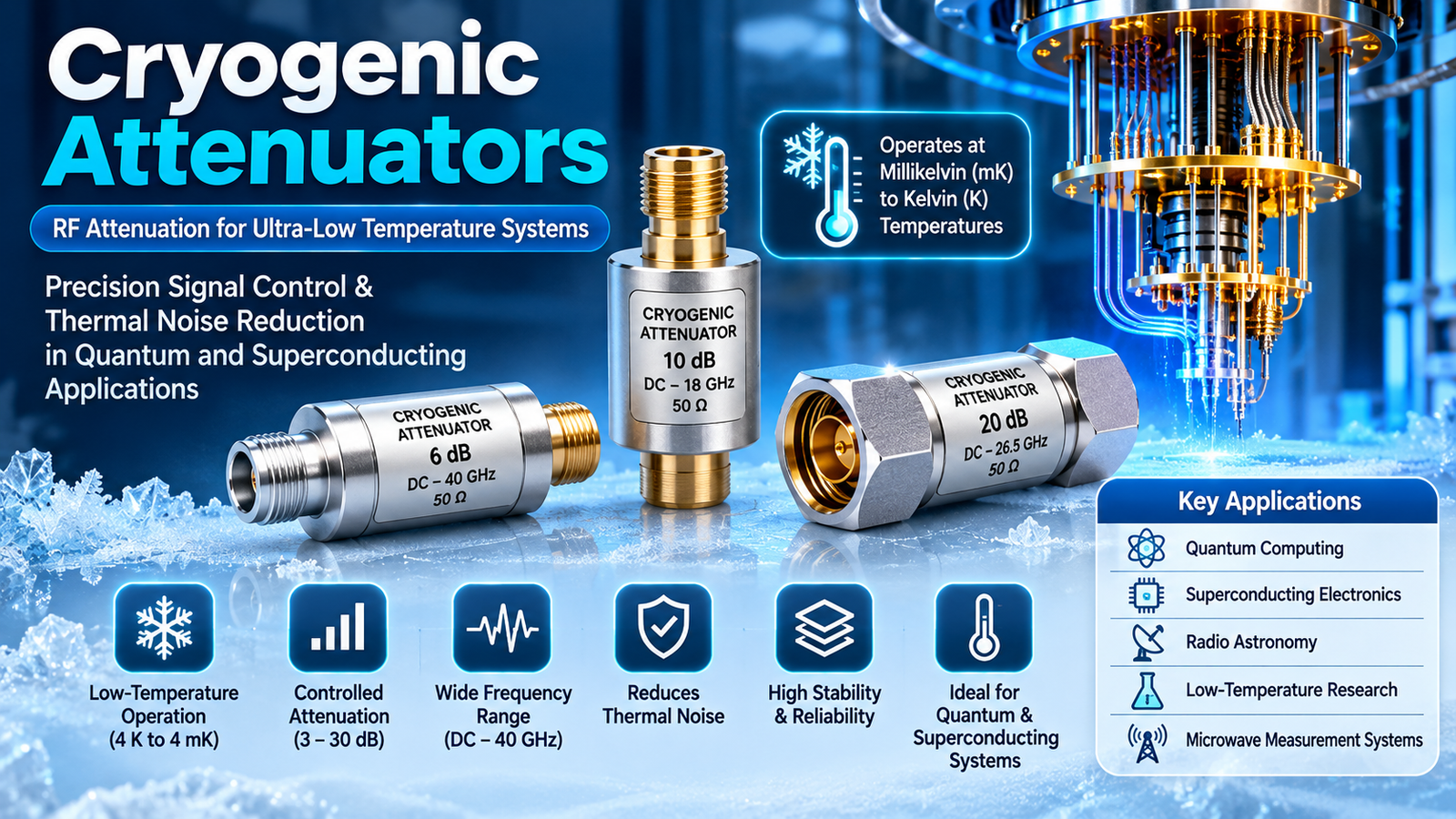
Cryogenic attenuators are specialized passive RF and microwave components designed to reduce signal power while operating at extremely low temperatures. They play an important role in advanced electronic systems where precise signal control, low noise, thermal management, and high-frequency performance are essential.
Unlike conventional RF attenuators that operate at room temperature, cryogenic attenuators are specifically engineered to function inside cryogenic environments, including dilution refrigerators, superconducting systems, quantum computing laboratories, and low-temperature research facilities.
As quantum computing, superconducting electronics, quantum communication, and advanced microwave research continue to develop, the demand for high-performance cryogenic RF components is increasing. These systems require extremely low operating temperatures to maintain quantum coherence and minimize unwanted thermal noise.
Cryogenic attenuators help control microwave signal power between different temperature stages of a cryogenic system. They reduce unwanted thermal noise travelling from warmer stages toward sensitive low-temperature devices while delivering controlled RF signals to components operating near absolute zero.
In this comprehensive guide, we will explore what cryogenic attenuators are, how they work, their construction, types, specifications, applications, advantages, and important factors to consider when selecting the right cryogenic attenuator.
What Is a Cryogenic Attenuator?
A Cryogenic Attenuator is a passive RF and microwave component designed to reduce the power level of an electrical signal while operating at extremely low temperatures, typically inside cryogenic refrigeration systems.
It is primarily used in quantum computing, superconducting circuits, low-temperature physics experiments, and sensitive microwave measurement systems.
Cryogenic attenuators perform two important functions:
- They reduce the amplitude of incoming RF and microwave signals to the required power level.
- They help thermalize incoming signals to the temperature of the refrigerator stage where the attenuator is installed, reducing the amount of thermal noise reaching sensitive low-temperature components.
These devices are generally manufactured using carefully selected resistive materials, low-thermal-conductivity substrates, and specialized connector assemblies to maintain electrical and thermal performance at cryogenic temperatures.
Cryogenic attenuators are commonly available with attenuation values such as 3 dB, 6 dB, 10 dB, 20 dB, and 30 dB, depending on the system requirements.
Why Are Cryogenic Attenuators Important?
Modern quantum and superconducting systems operate at extremely low temperatures, often in the millikelvin range. At these temperatures, even small amounts of unwanted thermal energy can affect the performance of sensitive electronic devices.
For example, superconducting quantum bits (qubits) are highly sensitive to environmental noise. Excess thermal photons entering the quantum circuit can disturb quantum states and negatively affect measurement accuracy.
Cryogenic attenuators help address this problem by reducing signal power and thermal noise as microwave signals travel through different temperature stages.
Their importance includes:
- Reducing unwanted thermal noise.
- Controlling microwave signal power.
- Improving signal-to-noise performance.
- Supporting superconducting quantum circuits.
- Protecting sensitive low-temperature devices.
- Maintaining stable RF transmission.
- Supporting accurate microwave measurements.
- Improving the reliability of cryogenic experiments.
How Does a Cryogenic Attenuator Work?
A cryogenic attenuator works by reducing the power of an RF or microwave signal through a resistive network.
When a signal enters the attenuator, a controlled portion of its power is dissipated as heat within the resistive elements. The remaining signal continues toward the output at a lower power level.
In cryogenic systems, the attenuator is thermally connected to a particular temperature stage of the refrigerator. This allows heat generated by signal attenuation to be transferred to the corresponding stage, subject to the refrigerator’s cooling capacity.
For example, a microwave signal travelling from room temperature toward a quantum processor may pass through multiple cryogenic attenuators installed at different temperature stages.
Each stage reduces signal power and helps establish a lower effective noise temperature for the signal reaching the quantum device.
This arrangement is particularly important in dilution refrigerators, where different stages operate at progressively lower temperatures.
Working Principle of Cryogenic Attenuators in Quantum Computing
Cryogenic attenuators are particularly important in superconducting quantum computers because qubits operate at extremely low temperatures and are sensitive to unwanted microwave photons.
A typical quantum computing system uses a dilution refrigerator with multiple temperature stages. Microwave signals travel from room-temperature electronic equipment through coaxial cables and cryogenic components before reaching the quantum processor.
A simplified temperature arrangement is:
| Refrigerator Stage | Approximate Temperature |
|---|---|
| Room Temperature | 300 K |
| First Cooling Stage | 40–50 K |
| Second Cooling Stage | 4 K |
| Still Stage | 600–800 mK |
| Cold Plate | 100 mK |
| Mixing Chamber | 10–20 mK |
The exact temperatures depend on the refrigerator design.
Cryogenic attenuators are installed at selected temperature stages to progressively reduce the incoming thermal noise and signal power. A typical microwave input line may use 20 dB attenuation at the 4 K stage, additional attenuation at intermediate stages, and further attenuation near the mixing chamber.
The attenuation distribution depends on the qubit architecture, signal requirements, refrigerator cooling capacity, and microwave frequency.
This arrangement helps prevent unwanted thermal photons from reaching superconducting qubits, supporting better quantum coherence and measurement performance. PRX Quantum+2
Types of Cryogenic Attenuators
Cryogenic attenuators are available in different designs depending on operating temperature, frequency range, attenuation requirements, and installation configuration.
1. Cryogenic Fixed Attenuators
Cryogenic fixed attenuators provide a predetermined attenuation value that cannot be adjusted during operation.
They are commonly used in quantum computing systems where stable and repeatable microwave signal reduction is required.
Typical attenuation values include:
- 3 dB
- 6 dB
- 10 dB
- 20 dB
- 30 dB
These attenuators are widely used in dilution refrigerators, superconducting circuits, and cryogenic microwave testing.
2. Cryogenic Coaxial Attenuators
Cryogenic coaxial attenuators are designed with coaxial RF connectors and transmission structures to maintain controlled impedance and reliable microwave signal transmission at low temperatures.
They are commonly available with SMA, 2.92 mm, and SMPM connectors, depending on the frequency and mechanical requirements.
Applications include quantum processors, radio astronomy, microwave research, and superconducting electronics.
3. Cryogenic Chip Attenuators
Cryogenic chip attenuators are miniature components designed for integration into compact electronic assemblies and cryogenic microwave circuits.
They typically use thin-film resistive elements deposited on specialized substrates.
Their compact construction makes them suitable for applications requiring multiple signal channels and limited installation space.
4. Low-Temperature RF Attenuators
Low-temperature RF attenuators are designed to maintain stable electrical characteristics when exposed to extremely low operating temperatures.
They use specially selected materials and mechanical structures to minimize changes in attenuation, impedance, and electrical contact during cooling.
5. Cryogenic High-Frequency Attenuators
These attenuators are designed for microwave and millimeter-wave applications where accurate signal control is required at higher frequencies.
They are used in advanced quantum research, radio astronomy, and specialized microwave measurement systems.
Construction of a Cryogenic Attenuator
The construction of a cryogenic attenuator is more specialized than that of a conventional RF attenuator because it must maintain electrical and mechanical stability during extreme temperature changes.
Its major components include the following.
Resistive Elements
Resistive elements are responsible for reducing the power of the incoming RF signal.
They are manufactured using precision thin-film or other suitable resistive materials selected for stable performance at low temperatures.
The resistance characteristics must remain predictable across the specified operating temperature and frequency range.
Dielectric Substrate
The dielectric substrate supports the resistive network and provides electrical insulation.
Commonly selected materials include:
- Alumina
- Quartz
- Beryllium oxide
- Specialized low-temperature dielectric materials
The choice depends on thermal conductivity, dielectric loss, mechanical stability, and electrical performance.
Outer Housing
The housing protects the internal resistive network and provides mechanical stability.
Common materials include:
- Oxygen-free high-conductivity copper
- Gold-plated copper
- Stainless steel
- Beryllium copper
Non-magnetic materials are often preferred in applications where magnetic interference could affect sensitive superconducting devices.
RF Connectors
Cryogenic attenuators commonly use precision RF connectors to maintain reliable electrical connections.
Common connector options include:
- SMA
- 2.92 mm
- SMPM
- SSMP
- Specialized coaxial interfaces
Thermal Mounting Structure
Thermal mounting is one of the most important aspects of cryogenic attenuator construction.
The attenuator must establish effective thermal contact with the refrigerator’s designated temperature stage. This allows heat generated inside the resistive network to flow toward the cold plate.
Poor thermal mounting can increase the component’s temperature and reduce its effectiveness in suppressing thermal noise.
Key Specifications of Cryogenic Attenuators
Selecting a cryogenic attenuator requires evaluating both its RF performance and low-temperature characteristics.
Attenuation Value
Attenuation determines how much RF signal power is reduced.
Common values include 3 dB, 6 dB, 10 dB, 20 dB, and 30 dB.
Operating Frequency
The operating frequency defines the range over which the attenuator maintains its specified electrical performance.
Depending on the design, cryogenic attenuators may support:
- DC to 6 GHz
- DC to 10 GHz
- DC to 18 GHz
- DC to 26.5 GHz
- DC to 40 GHz
Some specialized designs support higher frequencies.
Operating Temperature
Operating temperature indicates the temperature range in which the attenuator is designed to function.
Cryogenic products are available for applications operating at:
- 4 K
- 1 K
- 100 mK
- 20 mK
- 10 mK
- 4 mK
The actual minimum temperature must always be confirmed from the manufacturer’s datasheet.
Characteristic Impedance
Most cryogenic coaxial attenuators are designed for 50 Ohm systems.
Maintaining impedance matching minimizes signal reflections and improves microwave transmission performance.
Attenuation Accuracy
Attenuation accuracy indicates how closely the actual signal reduction matches the specified attenuation value.
High-precision attenuators are particularly important in quantum computing and laboratory measurements.
Return Loss and VSWR
Return loss and Voltage Standing Wave Ratio (VSWR) describe the impedance matching performance of an attenuator.
Lower VSWR and higher return loss generally indicate better impedance matching.
Power Handling
Power handling defines the maximum RF power the attenuator can safely dissipate under specified operating conditions.
At cryogenic temperatures, power handling must be evaluated carefully because the available cooling capacity can be extremely limited.
Thermal Conductivity
Thermal conductivity determines how effectively heat travels through the component and into the mounting structure.
It is an important parameter for maintaining stable operating temperatures.
Cryogenic Attenuator Specifications Comparison Table
The following table provides an illustrative overview of common cryogenic attenuator requirements. Actual specifications vary by manufacturer and model.
| Parameter | Typical Options |
|---|---|
| Impedance | 50 Ohms |
| Attenuation | 3, 6, 10, 20, 30 dB |
| Frequency Range | DC–18 GHz, DC–40 GHz |
| Operating Temperature | 4 K to 4 mK, depending on model |
| Connector Type | SMA, 2.92 mm, SMPM |
| Housing Material | Copper, Gold-Plated Copper |
| Resistor Technology | Thin-Film Resistor |
| Mounting | Bulkhead or Thermal Plate |
| Main Application | Quantum Computing |
| Performance Requirements | Low VSWR, Stable Attenuation, Low Self-Heating |
For reference, commercial products demonstrate the range of available specifications. Withwave offers a DC–18 GHz cryogenic attenuator design, while Spectrum Control lists cryogenic products supporting frequencies up to 40 GHz and temperatures approaching 4 mK. With-wave+2
Applications of Cryogenic Attenuators
Cryogenic attenuators are used in advanced technologies where low-temperature operation and precise microwave signal management are essential.
1. Quantum Computing
Quantum computing is one of the most important applications of cryogenic attenuators.
Superconducting qubits operate at extremely low temperatures and require carefully controlled microwave signals. Cryogenic attenuators reduce unwanted thermal noise and help maintain suitable signal levels before signals reach the quantum processor.
2. Superconducting Electronics
Superconducting electronic circuits operate at low temperatures to achieve extremely low electrical resistance.
Cryogenic attenuators help manage microwave signal levels and reduce unwanted noise in superconducting devices.
3. Radio Astronomy
Radio astronomy systems detect extremely weak signals originating from distant celestial objects.
Cryogenic microwave components help reduce unwanted noise and improve the sensitivity of radio astronomy receivers.
4. Quantum Communication
Quantum communication systems require highly sensitive electronic components to generate, transmit, and measure quantum signals.
Cryogenic attenuators support microwave signal conditioning in low-temperature quantum communication experiments.
5. Low-Temperature Physics Research
Scientific laboratories use cryogenic attenuators in experiments involving superconductivity, quantum phenomena, microwave spectroscopy, and low-temperature electronic measurements.
6. Space Communication
Specialized cryogenic RF systems are used in certain space communication and radio astronomy applications where low-noise signal reception is important.
7. Microwave Measurement Systems
Cryogenic attenuators are used in advanced laboratory setups to maintain controlled signal levels during low-temperature microwave testing and characterization.
Advantages of Cryogenic Attenuators
Cryogenic attenuators offer several advantages over conventional room-temperature RF attenuators in low-temperature applications.
- Effective reduction of incoming thermal noise.
- Stable RF attenuation at extremely low temperatures.
- Improved microwave signal control.
- Support for superconducting quantum circuits.
- Reduced unwanted thermal photon transmission.
- Precision signal conditioning.
- Compatibility with cryogenic coaxial systems.
- Specialized materials for low-temperature operation.
- Improved reliability in scientific experiments.
- Support for high-frequency microwave applications.
Challenges and Limitations of Cryogenic Attenuators
Although cryogenic attenuators are essential for advanced low-temperature systems, their design and installation involve several challenges.
Heat Dissipation
Attenuation converts RF power into heat. At millikelvin temperatures, refrigerator cooling capacity is extremely limited, so excessive dissipation can raise the temperature of the component and surrounding stage.
Thermal Contraction
Different materials contract at different rates when cooled. This can create mechanical stress, affect connector interfaces, and change electrical characteristics.
Attenuation Stability
Resistance and dielectric properties may change at low temperatures, affecting attenuation accuracy and frequency response.
Installation Complexity
Cryogenic attenuators require careful mechanical mounting and thermal anchoring to ensure proper performance.
Higher Cost
Specialized materials, precision manufacturing, low-temperature testing, and demanding performance requirements make cryogenic attenuators more expensive than standard RF attenuators.
Difference Between Cryogenic Attenuators and Standard RF Attenuators
Although both components reduce RF signal power, their designs and operating requirements are different.
| Feature | Cryogenic Attenuator | Standard RF Attenuator |
|---|---|---|
| Operating Environment | Extremely low temperatures | Normal temperatures |
| Temperature Range | Millikelvin to Kelvin range | Typically -55°C to +125°C, model dependent |
| Primary Purpose | Signal reduction and thermal noise management | Signal power reduction |
| Thermal Management | Critical requirement | Generally less demanding |
| Material Selection | Specialized low-temperature materials | Conventional RF materials |
| Applications | Quantum computing, superconducting systems | Telecom, radar, RF testing |
| Design | Optimized for cryogenic environments | Optimized for standard environments |
Cryogenic Attenuators vs Cryogenic Isolators
Cryogenic attenuators and cryogenic isolators are both important components in quantum computing and low-temperature microwave systems, but they perform different functions.
A cryogenic attenuator reduces the power of an incoming signal by a specified amount.
A cryogenic isolator allows microwave signals to travel primarily in one direction while reducing unwanted reverse signal transmission.
Both components help protect sensitive quantum devices from unwanted microwave interference and improve signal chain performance.
How to Choose the Right Cryogenic Attenuator
Selecting the correct cryogenic attenuator requires careful evaluation of electrical, thermal, and mechanical requirements.
1. Determine the Required Attenuation
Identify the amount of signal reduction required by the system. Common options include 3 dB, 6 dB, 10 dB, and 20 dB.
2. Check the Operating Frequency
Select an attenuator that supports the complete frequency range of your microwave application.
3. Verify the Operating Temperature
Confirm that the component is tested and specified for the required temperature stage, such as 4 K, 100 mK, or 20 mK.
4. Select the Correct Impedance
Most cryogenic microwave systems use 50 Ohm components. Ensure that the attenuator matches the impedance of the connected cables and equipment.
5. Evaluate Power Handling
Consider both the RF power rating and the heat generated at the installation temperature.
6. Check Connector Compatibility
Choose suitable connectors such as SMA, 2.92 mm, SMPM, or SSMP based on frequency, available space, and mechanical requirements.
7. Evaluate Thermal Performance
Check thermal conductivity, mounting arrangements, and thermal anchoring requirements to ensure that the attenuator can transfer dissipated heat to the refrigerator stage.
8. Review Electrical Performance
Evaluate attenuation accuracy, return loss, VSWR, insertion loss, and frequency response at the specified operating temperature.
9. Consider Material Compatibility
Choose components with appropriate non-magnetic materials and mechanical properties when working with sensitive superconducting circuits.
10. Check Manufacturer Testing
Always review datasheets and low-temperature test reports to verify that the component meets your application requirements.
Future Trends in Cryogenic Attenuator Technology
The rapid development of quantum computing and superconducting electronics is creating new opportunities for cryogenic RF component manufacturers.
Future developments are expected to focus on:
- Ultra-low-noise microwave attenuators.
- Higher frequency compatibility.
- Improved thermal conductivity.
- Reduced self-heating.
- Miniaturized cryogenic components.
- Advanced thin-film resistor technologies.
- Non-magnetic materials.
- Multi-channel cryogenic RF assemblies.
- Improved attenuation stability at millikelvin temperatures.
- Components designed for scalable quantum computing systems.
As quantum processors become more complex and support larger numbers of qubits, the demand for compact, reliable, and thermally efficient cryogenic microwave components is expected to increase.
Conclusion
Cryogenic attenuators are essential passive RF components designed to control microwave signal power and reduce unwanted thermal noise in extremely low-temperature environments. Their specialized construction, precision resistive networks, thermal management capabilities, and stable electrical performance make them particularly important in quantum computing, superconducting electronics, radio astronomy, and advanced microwave research.
Selecting the right cryogenic attenuator requires evaluating attenuation value, frequency range, impedance, operating temperature, power handling, thermal conductivity, connector compatibility, and electrical stability.
As quantum technology and low-temperature research continue to advance, cryogenic attenuators will remain important components in building reliable, high-performance microwave systems.
Frequently Asked Questions (FAQs)
1. What is a cryogenic attenuator?
A cryogenic attenuator is a specialized passive RF component designed to reduce signal power while operating at extremely low temperatures. It is commonly used in quantum computing, superconducting circuits, and cryogenic microwave systems.
2. What is the main purpose of a cryogenic attenuator?
Its primary purpose is to reduce microwave signal power and help suppress unwanted thermal noise travelling toward sensitive low-temperature electronic devices.
3. Where are cryogenic attenuators used?
Cryogenic attenuators are commonly used in quantum computers, superconducting electronics, radio astronomy, quantum communication, low-temperature physics laboratories, and advanced microwave measurement systems.
4. What is the operating temperature of a cryogenic attenuator?
Depending on its design, a cryogenic attenuator may operate at 4 K, 1 K, 100 mK, 20 mK, or even 4 mK. The specified temperature range varies by manufacturer and model.
5. What attenuation values are available in cryogenic attenuators?
Common attenuation values include 3 dB, 6 dB, 10 dB, 20 dB, and 30 dB. Custom attenuation values may also be available.
6. What frequency ranges do cryogenic attenuators support?
Commercial cryogenic attenuators are available for frequency ranges such as DC to 18 GHz and DC to 40 GHz. Specialized models may support other frequency ranges depending on their design.
7. Why are cryogenic attenuators important in quantum computing?
They reduce thermal noise and unwanted microwave photons travelling toward superconducting qubits. This helps maintain low-noise operating conditions and supports quantum coherence.
8. What materials are used in cryogenic attenuators?
Cryogenic attenuators may use thin-film resistive materials, alumina, quartz, beryllium oxide, oxygen-free copper, gold-plated copper, and specialized non-magnetic materials.
9. What connectors are commonly used in cryogenic attenuators?
Common connector options include SMA, 2.92 mm, SMPM, and SSMP connectors. The selection depends on the operating frequency and installation requirements.
10. What is the difference between a cryogenic attenuator and a standard RF attenuator?
A standard RF attenuator is designed for conventional operating temperatures, whereas a cryogenic attenuator is specifically engineered to maintain electrical, thermal, and mechanical performance at extremely low temperatures.
11. Do cryogenic attenuators generate heat?
Yes. Conventional resistive cryogenic attenuators dissipate a portion of the incoming RF power as heat. This heat must be managed carefully because cryogenic refrigeration stages have limited cooling capacity.
12. How do I select the right cryogenic attenuator?
Consider attenuation value, frequency range, operating temperature, impedance, power handling, thermal conductivity, connector type, return loss, VSWR, and manufacturer testing specifications.
13. Can cryogenic attenuators be used at millikelvin temperatures?
Yes. Specialized cryogenic attenuators are designed for millikelvin applications, including 20 mK and 4 mK environments, provided their datasheets specify suitability for those temperatures.
14. What is the role of thermalization in cryogenic attenuators?
Thermalization helps bring the signal and attenuator to the temperature of the refrigerator stage. It reduces the thermal noise carried toward sensitive low-temperature devices.
15. Are cryogenic attenuators used in satellite communication?
Specialized cryogenic attenuators can be used in low-noise microwave systems associated with space communication and radio astronomy, particularly where sensitive signal reception is required.