
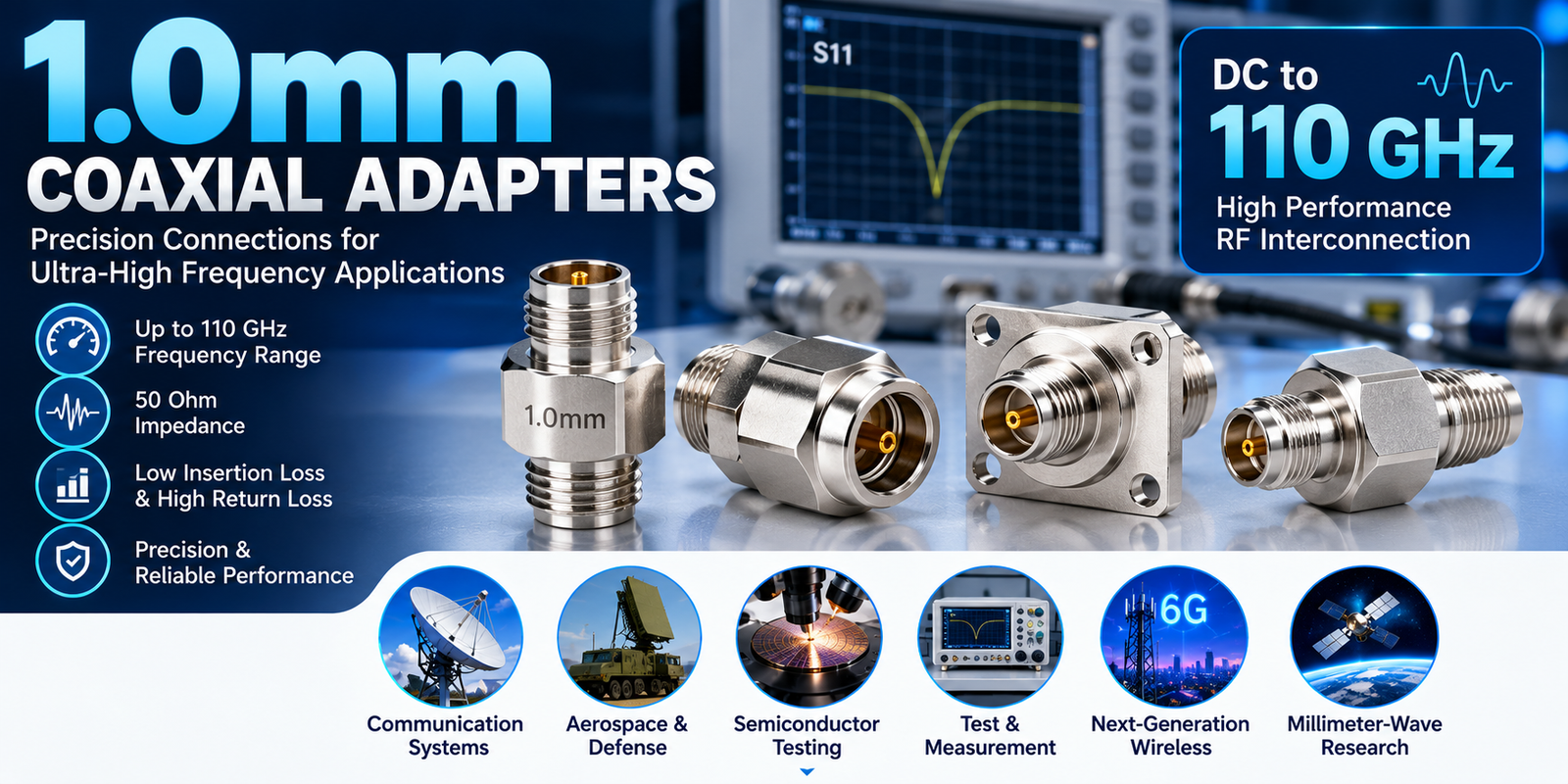
1.0mm Coaxial Adapters are precision RF connectors designed to provide reliable electrical connections in extremely high-frequency radio frequency (RF) and microwave systems. They are used to connect compatible coaxial interfaces in advanced test equipment, measurement instruments, semiconductor testing systems, and millimeter-wave applications.
The 1.0mm interface is engineered for operation at very high frequencies, making it suitable for applications where signal integrity, impedance matching, and measurement accuracy are critical. These adapters are commonly associated with laboratory testing, research and development, telecommunications, aerospace, and defense electronics.
As RF systems move toward higher frequencies and wider bandwidths, 1.0mm Coaxial Adapters help engineers establish controlled signal paths between instruments, test fixtures, cables, and other RF components.
What Are 1.0mm Coaxial Adapters?
A 1.0mm Coaxial Adapter is a precision connector component that joins compatible 1.0mm coaxial interfaces or connects a 1.0mm interface to another specified RF interface. The name refers to the nominal inner-conductor interface dimension associated with this connector family, rather than the overall adapter size.
These adapters are designed for high-frequency applications, with common connector systems specified for operation up to approximately 110 GHz. The actual maximum frequency depends on the specific adapter model, interface configuration, manufacturing tolerances, and test conditions.
Most 1.0mm coaxial systems use a nominal impedance of 50 ohms. Maintaining this impedance through the adapter is important because impedance discontinuities can cause reflections, insertion loss, and measurement errors.
Construction of 1.0mm Coaxial Adapters
The construction of a 1.0mm adapter requires precision engineering because even small dimensional variations can affect performance at millimeter-wave frequencies.
Center Conductor
The center conductor carries the RF signal through the adapter. Its geometry and alignment are carefully controlled to maintain the intended electrical characteristics at high frequencies.
Dielectric Structure
The dielectric separates the center conductor from the outer conductor. Its material properties and dimensions influence impedance, signal propagation, and high-frequency performance.
Outer Conductor
The outer conductor provides the return path for the RF signal and contributes to electromagnetic shielding. Accurate geometry helps reduce unwanted leakage and maintain a consistent coaxial transmission structure.
Precision Connector Interface
The mating interface is manufactured to tight mechanical tolerances. Proper alignment and compatible mating hardware help maintain repeatable electrical contact and reduce the risk of interface damage.
Adapter Body
The body holds the internal components in the correct position and provides mechanical strength. Depending on the design, the adapter may have straight, right-angle, or other specialized configurations.
Key Features of 1.0mm Coaxial Adapters
- Ultra-high-frequency capability: Designed for demanding RF and millimeter-wave applications.
- 50-ohm impedance: Supports common RF measurement and communication systems.
- Precision interface: Helps maintain consistent electrical contact and signal transmission.
- Low-reflection design: Properly specified models can provide low VSWR and good return loss.
- Compact construction: Supports integration into high-frequency instruments and test fixtures.
- Repeatable measurements: Precision manufacturing helps improve connection consistency when adapters are used correctly.
- Multiple configurations: Availability may include 1.0mm male-to-male, female-to-female, male-to-female, and other model-specific arrangements.
- Test-system integration: Can connect compatible cables, instruments, calibration standards, and test accessories.
Exact performance values must be confirmed from the manufacturer’s datasheet.
Technical Specifications of 1.0mm Coaxial Adapters
The following table outlines common characteristics of this adapter family. These are general reference points, not guaranteed specifications for every product.
| Parameter | Typical Description |
| Connector interface | 1.0mm precision coaxial |
| Nominal impedance | 50 Ohms |
| Frequency capability | Up to approximately 110 GHz for suitable models |
| Adapter configurations | Straight and other model-specific designs |
| Connector gender | Male or female, depending on model |
| Primary purpose | High-frequency RF signal connection |
| Performance parameters | VSWR, return loss, insertion loss |
| Applications | Millimeter-wave testing and precision measurements |
When choosing an adapter, check its rated frequency, connector gender, interface dimensions, maximum power, VSWR, insertion loss, and mating compatibility. Do not assume that every 1.0mm adapter supports the same frequency or power level.
Applications of 1.0mm Coaxial Adapters
RF and Microwave Testing
Engineers use 1.0mm adapters to connect high-frequency test cables, instruments, and test fixtures. They are useful when characterizing components that operate in millimeter-wave frequency ranges.
Vector Network Analyzers
Compatible adapters can form part of a vector network analyzer (VNA) test setup. They help establish connections for measuring S-parameters, return loss, insertion loss, and impedance behavior.
Semiconductor Testing
Semiconductor research and testing can require accurate high-frequency signal paths. Precision coaxial adapters help connect test instruments to suitable probes, fixtures, and devices.
Aerospace and Defense
High-frequency radar, electronic warfare research, satellite systems, and advanced communication equipment may require precision RF interfaces for development and testing.
Telecommunications Research
Researchers developing advanced wireless systems use millimeter-wave equipment to evaluate components, transmission paths, and high-frequency circuit performance.
Research and Development
Universities, laboratories, and engineering teams use precision adapters when testing new RF components, antennas, amplifiers, filters, and other microwave devices.
Benefits of Using 1.0mm Coaxial Adapters
The primary benefit of 1.0mm Coaxial Adapters is their suitability for very high-frequency measurement systems. A properly selected adapter can provide a controlled connection between compatible interfaces while helping minimize impedance discontinuities.
Other benefits include reliable instrument connectivity, repeatable test configurations, compact integration, and support for precise RF characterization. These advantages depend on the quality of the adapter, the connected components, and the condition of the mating interfaces.
1.0mm Coaxial Adapters vs. 2.4mm and 2.92mm Adapters
Different precision coaxial connector families support different frequency ranges and mechanical interfaces. A 1.0mm adapter is intended for higher-frequency applications than many commonly used 2.4mm and 2.92mm systems.
| Connector Family | General Frequency Capability | Typical Use |
| 1.0mm | Up to approximately 110 GHz for suitable models | Very high-frequency and millimeter-wave testing |
| 2.4mm | Commonly specified up to 50 GHz | Microwave testing and instrumentation |
| 2.92mm | Commonly specified up to 40 GHz | RF and microwave test systems |
These values are general industry reference points. Individual product ratings can differ. Connector interfaces should not be mated together unless the manufacturer explicitly specifies compatibility or a suitable transition adapter is used.
How to Select the Right 1.0mm Coaxial Adapter
Consider these factors before purchasing:
- Frequency range: Confirm that the adapter supports the complete operating band.
- Connector gender: Match male and female interfaces to the connected equipment.
- Impedance: Select a 50-ohm model for a compatible 50-ohm system.
- VSWR and return loss: Review the specifications across the required frequency range.
- Insertion loss: Check signal loss for sensitive measurement applications.
- Power handling: Verify the rated power under the intended operating conditions.
- Mechanical compatibility: Confirm interface standards, dimensions, and mating requirements.
- Calibration requirements: For precision measurements, consider how the adapter affects calibration and measurement uncertainty.
- Quality and durability: Choose a product manufactured for repeated precision connections where needed.
Installation and Handling Guidelines
- Keep connector interfaces clean and free from dust or debris.
- Inspect the center contact and mating surfaces before use.
- Align the interfaces carefully before connecting them.
- Use the manufacturer’s recommended torque and connection procedure.
- Avoid excessive force, side loading, or repeated unnecessary mating.
- Store adapters with suitable protective caps when not in use.
- Recheck calibration and measurement uncertainty when the adapter is part of a precision test setup.
Because 1.0mm interfaces are extremely small and precision-engineered, careless handling can damage the mating surfaces and affect measurement performance.
Conclusion
1.0mm Coaxial Adapters are specialized RF components designed for precision connections in very high-frequency and millimeter-wave systems. Their controlled geometry, compact construction, and precision interfaces make them useful in network analyzer setups, semiconductor testing, aerospace research, telecommunications development, and advanced RF laboratories.
For dependable performance, select an adapter according to its specified frequency range, impedance, connector configuration, electrical characteristics, and mechanical requirements. Correct handling and compatible interfaces are essential for maintaining signal integrity and obtaining repeatable measurements.
FAQs About 1.0mm Coaxial Adapters
1. What are 1.0mm Coaxial Adapters used for?
They connect compatible precision coaxial interfaces in high-frequency RF systems, laboratory instruments, millimeter-wave testing equipment, and semiconductor measurement setups.
2. What is the frequency range of a 1.0mm Coaxial Adapter?
Suitable models can operate up to approximately 110 GHz. Always verify the maximum rated frequency of the specific product.
3. What is the impedance of a 1.0mm adapter?
The 1.0mm precision coaxial interface is commonly designed for a nominal impedance of 50 ohms.
4. Can 1.0mm adapters be used with a vector network analyzer?
Yes, if the adapter’s interface, frequency rating, and electrical specifications are compatible with the VNA and the rest of the test setup.
5. What is the difference between 1.0mm and 2.4mm adapters?
The 1.0mm connector family supports higher frequencies, with suitable models reaching approximately 110 GHz, while many 2.4mm systems are rated up to 50 GHz.
6. Are 1.0mm adapters compatible with 2.92mm connectors?
They are different connector interfaces and should not be directly mated unless an explicitly compatible transition is specified. Use a suitable adapter designed for the required connection.
7. What specifications should I check before buying?
Check frequency range, impedance, connector gender, VSWR, return loss, insertion loss, power rating, mechanical dimensions, and manufacturer compatibility information.
8. Why is precision important for 1.0mm adapters?
At very high frequencies, small dimensional variations or interface imperfections can affect reflections, losses, and measurement accuracy.
9. How should 1.0mm Coaxial Adapters be maintained?
Keep the interfaces clean, inspect them regularly, follow recommended connection procedures, and protect the precision mating surfaces during storage.
10. Where are 1.0mm Coaxial Adapters commonly used?
They are used in millimeter-wave research, RF testing, vector network analyzer systems, semiconductor characterization, aerospace and defense development, and advanced telecommunications laboratories.