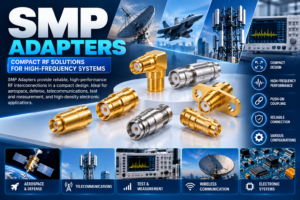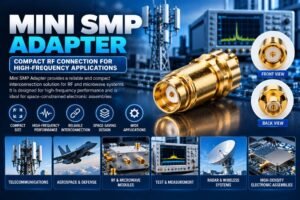
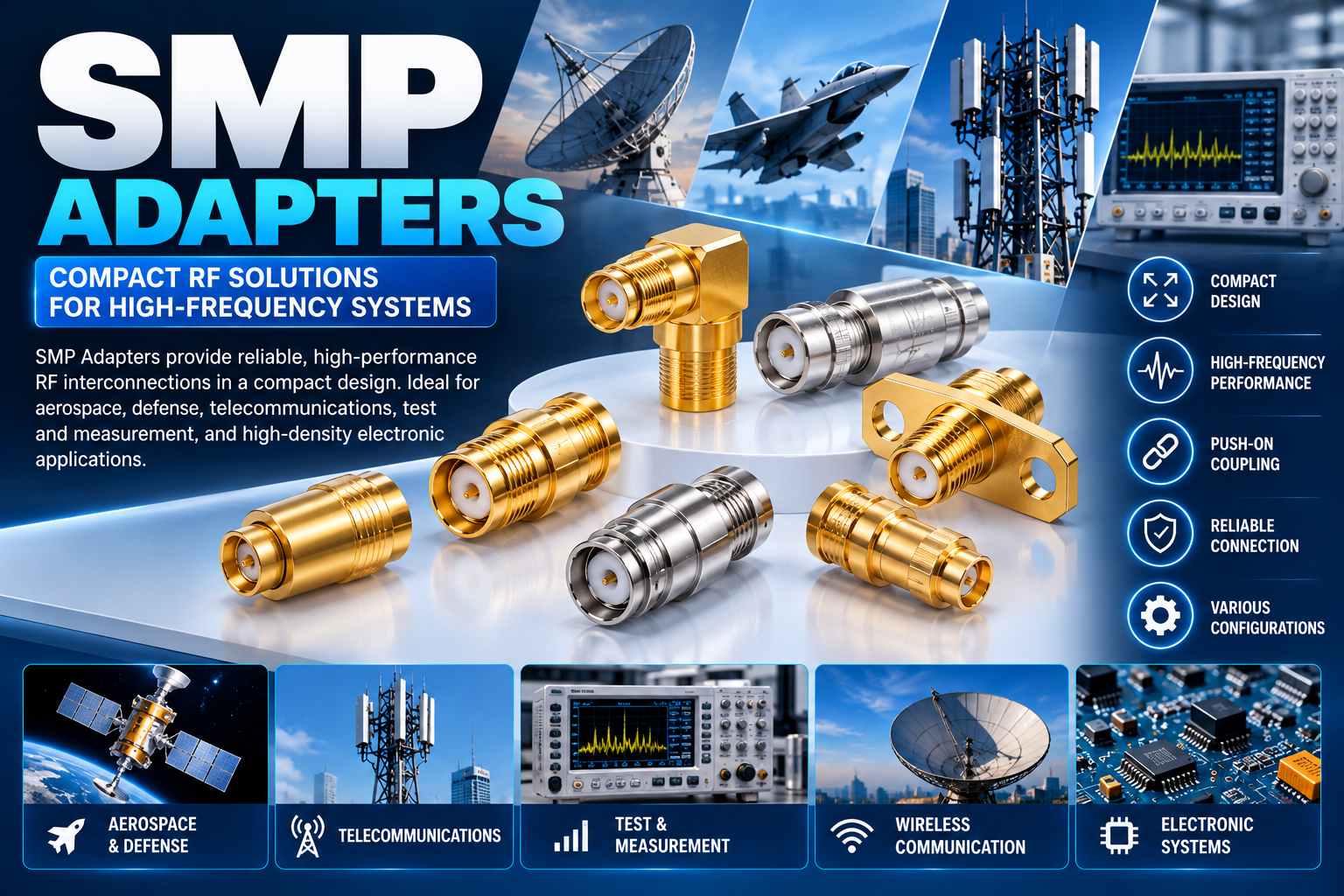
SMP Adapters are compact radio frequency (RF) connectors designed to provide reliable electrical connections between RF components, cables, circuit boards, and microwave modules. Their small size, push-on or snap-on coupling mechanism, and high-frequency capabilities make them suitable for applications where space is limited and signal integrity is essential.
SMP Adapters are widely used in aerospace, defense, telecommunications, wireless communication, RF testing, instrumentation, and high-speed electronic systems. They help engineers establish connections between compatible RF interfaces while supporting compact equipment designs and convenient installation.
Unlike larger threaded RF connectors, SMP interfaces can be connected and disconnected quickly, depending on their coupling style. This makes them useful in modular RF assemblies, test fixtures, and systems requiring frequent component replacement or maintenance.
What Are SMP Adapters?
SMP Adapters are RF interconnection components that connect two compatible SMP interfaces or provide an interface between SMP connectors and other specified RF connector types. SMP stands for SubMiniature Push-on and refers to a compact connector family designed for high-frequency applications.
These adapters are commonly designed for 50-ohm RF systems. Their small footprint allows multiple RF connections to be installed within a limited space, making them suitable for densely packed electronic assemblies.
Depending on the model, SMP Adapters may feature straight or right-angle configurations, different gender combinations, and various mounting arrangements. Their actual frequency range, mechanical retention, and electrical performance depend on the specific design and manufacturer’s specifications.
Construction of SMP Adapters
SMP Adapters consist of several components that work together to provide mechanical stability and electrical continuity.
1. Center Contact
The center contact carries the RF signal through the adapter. Its dimensions, material, and plating influence contact resistance and signal performance.
2. Outer Conductor
The outer conductor provides the return-current path and contributes to electromagnetic shielding. Proper contact between the mating interfaces helps maintain the intended RF characteristics.
3. Dielectric Insulator
The dielectric separates the center contact from the outer conductor. Its electrical properties and geometry affect impedance matching and high-frequency performance.
4. Coupling Mechanism
SMP connectors generally use a push-on or snap-on connection. Different retention styles provide different levels of engagement and mechanical security.
5. Adapter Body
The body holds the internal components in alignment and provides the mechanical structure needed to connect the mating interfaces.
Types of SMP Adapters
SMP Adapters are available in several configurations to suit different RF system requirements.
SMP Male-to-Male Adapter
This configuration connects compatible female SMP interfaces. It is useful when two components require a male-to-male interconnection arrangement.
SMP Female-to-Female Adapter
An SMP female-to-female adapter connects compatible male SMP interfaces. It can be used to extend or join RF connections within compact assemblies.
SMP Male-to-Female Adapter
This adapter connects a male SMP interface to a female SMP interface. It is selected according to the connector gender required by the equipment or cable assembly.
Straight SMP Adapter
Straight adapters maintain a direct connection along a common axis. They are suitable for installations with sufficient clearance and straightforward cable routing.
Right-Angle SMP Adapter
Right-angle adapters change the direction of the RF connection, helping accommodate restricted spaces and improve routing in compact equipment.
Important: Connector gender, interface dimensions, and coupling style must be verified before selecting an adapter. Product naming and configurations can vary by manufacturer.
Key Specifications of SMP Adapters
Understanding technical specifications is essential when selecting SMP Adapters for an RF application.
| Specification | Description |
|---|---|
| Impedance | Typically 50 ohms |
| Connector Family | SMP RF interface |
| Coupling Mechanism | Push-on or snap-on, depending on design |
| Frequency Range | Model-dependent |
| Configuration | Straight or right-angle |
| Connector Gender | Male, female, or mixed interface |
| Mounting Style | Cable, board, or other supported arrangements |
| VSWR | Depends on design and operating frequency |
| Insertion Loss | Depends on construction and frequency |
| Material and Plating | Manufacturer-specific |
| Application | RF and microwave interconnection |
The table provides general selection guidance rather than guaranteed specifications. Always consult the product datasheet for the exact frequency range, interface dimensions, mating requirements, and electrical limits.
Key Features of SMP Adapters
Compact Design
SMP Adapters support high-density RF assemblies where traditional, larger connectors may require excessive installation space.
Quick Connection
Their push-on or snap-on coupling mechanism allows fast mating and removal when the interface design permits it.
High-Frequency Capability
SMP interfaces are used in RF and microwave systems. The maximum usable frequency depends on the particular adapter, connector geometry, and assembly.
Flexible Integration
Different configurations allow engineers to connect compatible components, boards, modules, and cable assemblies.
Reliable Electrical Contact
Properly manufactured and mated adapters provide electrical continuity and help maintain signal integrity.
Support for Modular Systems
SMP connections are useful in modular equipment where components may need to be assembled, replaced, or tested independently.
Applications of SMP Adapters
Aerospace and Defense
SMP Adapters are used in compact RF modules, radar equipment, communication systems, and electronic assemblies where space and weight are important design considerations.
Telecommunications
They can connect RF modules and components used in wireless infrastructure, radio equipment, and communication systems.
RF and Microwave Testing
Test laboratories use SMP interfaces in fixtures, evaluation boards, and measurement setups. Correct adapter selection is important for repeatable measurements and reduced mismatch.
Wireless Communication
SMP Adapters support interconnections in radio modules, transceiver assemblies, antenna systems, and other RF devices.
Electronic and Semiconductor Testing
Their compact format is useful in high-density test fixtures and electronic assemblies where multiple RF paths must be routed within limited space.
Modular RF Equipment
SMP adapters can connect compatible modules and assemblies where convenient access and repeatable mating are required.
Advantages of SMP Adapters
SMP Adapters offer several benefits for modern RF engineering:
- Save space in compact electronic equipment.
- Allow fast connection and disconnection.
- Support high-density RF interconnections.
- Offer multiple connector and mounting configurations.
- Enable modular equipment design.
- Provide an alternative to larger connector interfaces where compatible.
- Support RF and microwave testing and communication applications.
Their benefits depend on correct mating, suitable operating conditions, and adherence to manufacturer specifications.
SMP Adapters vs. SMA Adapters
SMP and SMA are different RF connector families with different mechanical interfaces.
| Feature | SMP Adapters | SMA Adapters |
|---|---|---|
| Coupling | Push-on or snap-on | Threaded |
| Connection Speed | Generally faster mating | Requires threaded engagement |
| Mechanical Retention | Depends on SMP retention style | Threaded coupling |
| Size and Packaging | Compact, suitable for high-density layouts | Compact but generally requires thread access |
| Typical Uses | Modular RF modules and dense assemblies | RF cables, instruments, antennas, and equipment |
| Compatibility | SMP-specific interfaces | SMA-specific interfaces |
SMP and SMA adapters are not directly interchangeable. A suitable transition adapter is required when connecting different connector families, and its frequency and electrical performance must be verified.
How to Select the Right SMP Adapter
Choosing the correct SMP Adapter requires evaluating the electrical, mechanical, and environmental needs of the application.
- Check connector compatibility: Confirm that both mating interfaces use the correct SMP configuration.
- Verify impedance: Most SMP RF systems use 50-ohm interfaces.
- Confirm frequency range: Select an adapter rated for the complete operating frequency range.
- Choose the configuration: Determine whether straight, right-angle, male, female, or mixed interfaces are required.
- Review retention style: Check whether the application needs a particular push-on or snap-on engagement.
- Evaluate RF performance: Review VSWR, insertion loss, and return loss over the required frequency range.
- Check physical dimensions: Ensure the adapter fits the available space and does not interfere with adjacent components.
- Consider the operating environment: Review temperature, vibration, mating-cycle, and other applicable requirements.
Installation and Maintenance Best Practices
Inspect the mating interfaces for contamination, damage, or deformation before installation. Align the connector correctly and mate it according to the manufacturer’s instructions. Avoid applying excessive force or twisting the assembly in a way that may damage the interface.
For frequently mated connections, inspect the retention mechanism and contact surfaces regularly. Use approved cleaning methods and avoid introducing debris into the connector. In precision RF test setups, use suitable adapters and avoid unnecessary connection transitions that may affect measurement accuracy.
Conclusion
SMP Adapters are compact RF interconnection components designed for high-density electronic assemblies and RF and microwave applications. Their push-on or snap-on coupling, small footprint, and range of interface configurations make them useful in aerospace, defense, telecommunications, wireless communication, test equipment, and modular RF systems.
Selecting the right SMP Adapter requires checking connector compatibility, impedance, frequency range, coupling style, electrical performance, and installation dimensions. By matching the adapter to the application’s technical requirements, engineers can build reliable RF connections and support consistent system performance.
FAQs About SMP Adapters
1. What does SMP stand for?
SMP stands for SubMiniature Push-on, a compact RF connector family used in high-frequency electronic systems.
2. What are SMP Adapters used for?
They connect compatible SMP interfaces in RF modules, microwave equipment, telecommunications systems, test fixtures, and compact electronic assemblies.
3. What is the impedance of SMP Adapters?
SMP Adapters are commonly designed for 50-ohm RF systems. Always confirm the impedance from the specific product datasheet.
4. What is the frequency range of SMP Adapters?
The supported frequency range varies by model, interface design, and manufacturer. Check the rated operating range before use.
5. Are SMP Adapters push-on connectors?
SMP interfaces generally use push-on or snap-on coupling. The exact engagement and retention characteristics depend on the connector design.
6. What is the difference between SMP and SMA adapters?
SMP adapters generally use push-on or snap-on coupling, while SMA adapters use a threaded coupling mechanism. They have different mating interfaces and are not directly interchangeable.
7. Are SMP Adapters suitable for microwave applications?
Yes. SMP interfaces are used in RF and microwave applications, provided the selected adapter meets the required frequency and electrical performance specifications.
8. Can SMP Adapters be used in test equipment?
Yes. They are used in RF test fixtures, evaluation boards, measurement systems, and modular test assemblies where compatible interfaces are provided.
9. What is the difference between straight and right-angle SMP Adapters?
Straight adapters provide an in-line connection, while right-angle adapters change the connection direction to accommodate space and routing constraints.
10. How do I choose the correct SMP Adapter?
Check the interface type, gender, impedance, frequency range, coupling style, VSWR, insertion loss, physical dimensions, and environmental requirements before purchasing.