
Introduction to TNC Adapters
TNC adapters are radio frequency (RF) components designed to connect, adapt, or convert compatible coaxial interfaces in wireless communication, telecommunications, test and measurement equipment, and RF systems. TNC stands for Threaded Neill–Concelman, a connector interface developed from the BNC connector design. Unlike the bayonet coupling mechanism used by BNC connectors, TNC connectors use a threaded coupling system that provides a secure mechanical connection.
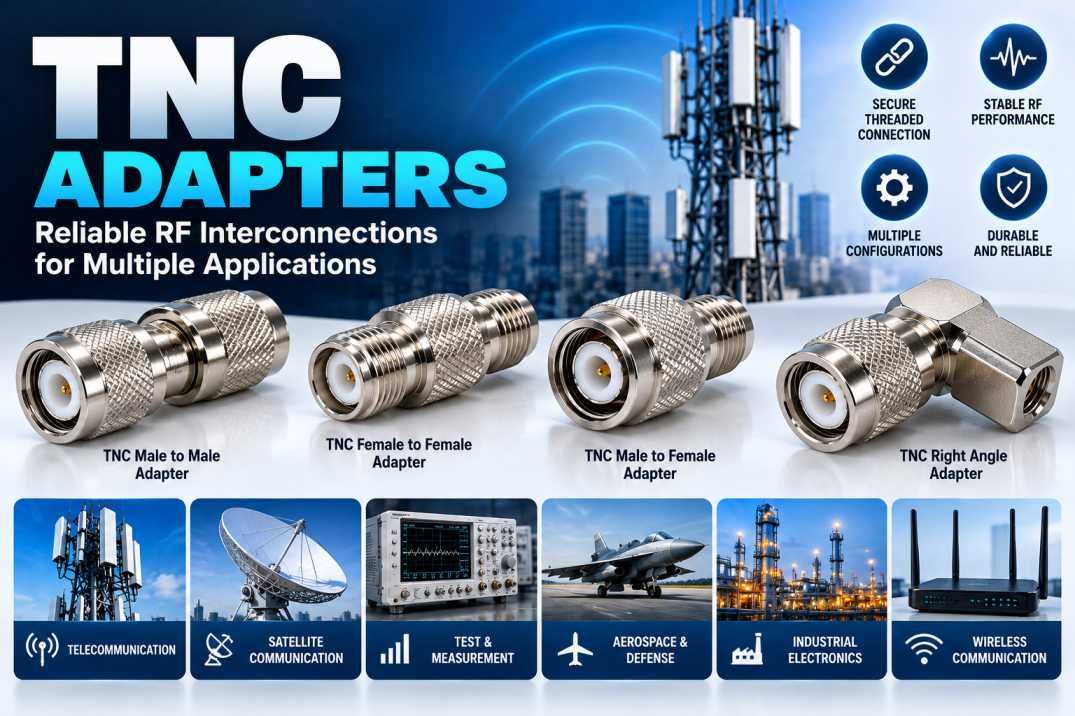
TNC adapters are commonly used to connect RF cables, antennas, communication devices, transmitters, receivers, and electronic instruments. They are available in different configurations, including male-to-male, female-to-female, male-to-female, and right-angle designs. Selecting the correct TNC adapter helps maintain mechanical compatibility and reliable signal transmission.
What Are TNC Adapters?
TNC adapters are RF interconnection components that connect two compatible coaxial interfaces or provide a transition between different connector configurations. Depending on the design, an adapter may connect two TNC connectors, change the gender of an interface, or provide a connection between TNC and another connector type.
Most standard TNC interfaces are designed for 50-ohm RF systems. However, impedance, frequency range, power handling, and other electrical specifications depend on the specific adapter model.
The threaded coupling mechanism helps secure the connection and reduces the likelihood of accidental disconnection caused by movement or vibration. This makes TNC adapters suitable for many communication and instrumentation environments.
Construction of TNC Adapters
TNC adapters typically consist of several components that work together to support electrical performance and mechanical reliability.
1. Center Contact
The center contact carries the RF signal between connected devices. Its dimensions, material, and plating influence contact resistance and signal performance.
2. Dielectric Insulator
The dielectric material separates the center contact from the outer conductor. Its design helps maintain the required characteristic impedance and electrical properties.
3. Outer Conductor
The outer conductor provides the return path for the RF signal and contributes to electromagnetic shielding. Proper construction helps limit unwanted signal leakage.
4. Threaded Coupling Mechanism
The threaded coupling system secures the mating connectors. Correct mating and tightening help maintain a stable connection during operation.
5. Connector Body
The connector body provides structural support and protection for internal components. Materials and finishes vary according to the intended operating environment and product specifications.
Types of TNC Adapters
TNC adapters are available in several configurations to support different RF connection requirements.
| TNC Adapter Type | Description | Common Application |
|---|---|---|
| TNC Male-to-Male | Connects two compatible female TNC interfaces | RF cable interconnection |
| TNC Female-to-Female | Connects two compatible male TNC interfaces | Equipment and cable connections |
| TNC Male-to-Female | Provides a gender transition between interfaces | RF system integration |
| TNC Right-Angle Adapter | Changes the connection direction by approximately 90 degrees | Space-constrained installations |
| TNC Bulkhead Adapter | Provides a panel-mounted connection through an enclosure | Communication equipment |
| TNC-to-SMA Adapter | Connects compatible TNC and SMA interfaces | RF equipment integration |
| TNC-to-BNC Adapter | Provides a transition between TNC and BNC interfaces | Test equipment and legacy systems |
| TNC-to-N-Type Adapter | Connects compatible TNC and N-type interfaces | RF cables and communication systems |
The exact gender, impedance, mounting style, and frequency capability should be verified before selecting an adapter.
Key Features of TNC Adapters
Secure Threaded Connection
The threaded coupling mechanism helps maintain a firm connection between mating interfaces. It is useful in equipment exposed to movement or moderate vibration.
Reliable RF Signal Transmission
Properly designed TNC adapters support RF signal transmission while maintaining the specified impedance and electrical performance.
Multiple Interface Configurations
Different connector genders, mounting styles, and interface combinations allow TNC adapters to support a wide range of RF installations.
Compact Design
Many TNC adapters have a compact form factor, making them suitable for communication devices, instrument panels, and RF assemblies.
Mechanical Durability
The threaded design provides secure mating when connectors are correctly installed and used within their specified mechanical limits.
Compatibility with RF Systems
TNC adapters are used in coaxial systems that require compatible RF interfaces, including selected antenna, radio, and measurement applications.
Electrical Specifications of TNC Adapters
The electrical specifications of a TNC adapter determine whether it is suitable for a particular RF system.
| Specification | What to Check |
|---|---|
| Impedance | Commonly 50 ohms; verify the specific model |
| Frequency Range | Confirm the manufacturer’s rated operating range |
| VSWR | Indicates impedance matching performance |
| Insertion Loss | Indicates signal loss through the adapter |
| Return Loss | Indicates the amount of reflected signal |
| Power Handling | Confirm the allowable power at the operating frequency |
| Contact Material | Check conductor material and plating |
| Operating Temperature | Verify the specified temperature range |
| Interface Type | Confirm TNC gender and mating compatibility |
| Mounting Style | Choose inline, right-angle, or bulkhead as required |
These parameters are model-dependent. Actual performance should be confirmed using the manufacturer’s datasheet, especially for high-frequency or high-power applications.
Applications of TNC Adapters
1. Wireless Communication
TNC adapters can connect antennas, coaxial cables, and radio equipment in compatible wireless communication systems. Their threaded connection helps maintain a secure interface.
2. Telecommunications
In telecommunications equipment, TNC adapters can support RF signal routing between cables, antennas, and communication modules.
3. Test and Measurement
RF test benches may use TNC adapters to connect compatible instruments, cables, signal sources, and measurement fixtures. Low insertion loss and suitable impedance performance are important when measurement accuracy matters.
4. Antenna Systems
TNC adapters can provide connections between compatible antennas and coaxial feed lines. The correct interface and frequency rating should be selected for the antenna system.
5. Aerospace and Defense Electronics
Selected TNC adapters are used in RF communication and electronic systems where a threaded connection is suitable. Applications with demanding environmental requirements may require specialized qualified versions.
6. Industrial RF Equipment
Industrial communication devices, monitoring equipment, and electronic systems may use TNC adapters to establish reliable coaxial connections.
Advantages of Using TNC Adapters
TNC adapters provide several practical benefits when correctly matched to the application:
- Secure threaded coupling
- Multiple connector and gender configurations
- Support for compatible 50-ohm RF systems
- Convenient interconnection between coaxial interfaces
- Availability in straight, right-angle, and bulkhead designs
- Potential for stable performance when properly specified and installed
- Integration with antennas, cables, instruments, and communication equipment
Adapter performance still depends on manufacturing quality, connector condition, mating compatibility, and correct installation.
TNC Adapters vs. BNC Adapters
TNC and BNC adapters serve similar RF interconnection purposes, but their coupling mechanisms differ.
| Feature | TNC Adapter | BNC Adapter |
|---|---|---|
| Coupling Mechanism | Threaded | Bayonet |
| Connection Method | Screw-on coupling | Quarter-turn coupling |
| Connection Security | Threaded mechanical engagement | Bayonet locking engagement |
| Typical Use | RF systems needing threaded coupling | Applications requiring quick connection and disconnection |
| Electrical Performance | Depends on model and frequency rating | Depends on model and frequency rating |
Neither connector type is universally suitable for every application. Selection should be based on interface compatibility, operating frequency, environmental conditions, and equipment requirements.
How to Choose the Right TNC Adapter
Selecting the correct TNC adapter helps avoid connection problems and unwanted signal loss.
- Identify the connector interfaces: Confirm the gender and type of both ports.
- Check impedance: Match the adapter impedance to the RF system, commonly 50 ohms.
- Verify frequency range: Ensure the adapter supports the intended operating frequency.
- Review RF performance: Check insertion loss, VSWR, and return loss where specified.
- Choose the correct configuration: Select straight, right-angle, bulkhead, or interface-conversion options as needed.
- Check environmental requirements: Consider temperature, moisture exposure, vibration, and corrosion resistance.
- Confirm power handling: Ensure the adapter is rated for the system’s RF power.
- Inspect the datasheet: Verify dimensions, materials, plating, and mating requirements before purchase.
Installation and Maintenance Tips
Always inspect the connector interfaces for contamination, damaged threads, bent contacts, or worn plating before installation. Align the mating connectors carefully and tighten them according to the manufacturer’s recommended procedure. Avoid overtightening, which can damage the interface.
Keep unused adapters protected with suitable dust caps and store them in a clean, dry environment. For precision RF systems, periodically inspect the connections and measure RF performance when required by the maintenance procedure.
Conclusion
TNC adapters are useful RF interconnection components that provide secure threaded connections between compatible coaxial interfaces. Available in multiple genders, mounting styles, and connector transitions, they support applications in wireless communication, telecommunications, antenna systems, test and measurement, aerospace, defense, and industrial electronics.
Choosing the right TNC adapter requires checking impedance, frequency range, connector compatibility, RF performance, power handling, and environmental requirements. By matching the adapter to the system and following proper installation practices, engineers can build dependable RF interconnections for their equipment.
Frequently Asked Questions (FAQs) About TNC Adapters
1. What does TNC stand for?
TNC stands for Threaded Neill–Concelman, referring to an RF connector interface that uses threaded coupling.
2. What are TNC adapters used for?
They connect compatible RF cables, antennas, instruments, and electronic equipment, or provide transitions between connector interfaces.
3. Are TNC adapters 50 ohms?
Many standard TNC adapters are designed for 50-ohm RF systems. Always confirm the impedance of the specific model.
4. What is the difference between TNC and BNC adapters?
TNC adapters use a threaded coupling mechanism, while BNC adapters use a bayonet-style locking mechanism.
5. What types of TNC adapters are available?
Common types include male-to-male, female-to-female, male-to-female, right-angle, bulkhead, and TNC-to-SMA or TNC-to-BNC adapters.
6. Can TNC adapters be used for high-frequency applications?
Some models support high-frequency RF applications, but the maximum frequency varies by design. Check the manufacturer’s specifications before use.
7. Do TNC adapters affect signal quality?
They can introduce insertion loss and impedance discontinuities. Selecting a suitable adapter with appropriate RF specifications helps manage these effects.
8. What is a TNC bulkhead adapter?
A TNC bulkhead adapter is designed to mount through a panel or enclosure, providing an accessible RF connection on the equipment surface.
9. Are TNC adapters suitable for outdoor applications?
Certain models are suitable for outdoor use, but environmental sealing, corrosion resistance, and temperature ratings must be verified.
10. How do I choose a TNC adapter?
Check connector gender, interface type, impedance, frequency range, insertion loss, VSWR, power handling, mounting requirements, and environmental conditions.
11. Can TNC adapters connect different connector types?
Yes. Adapter models such as TNC-to-SMA, TNC-to-BNC, and TNC-to-N-type are available. Both interfaces and electrical specifications must be compatible.