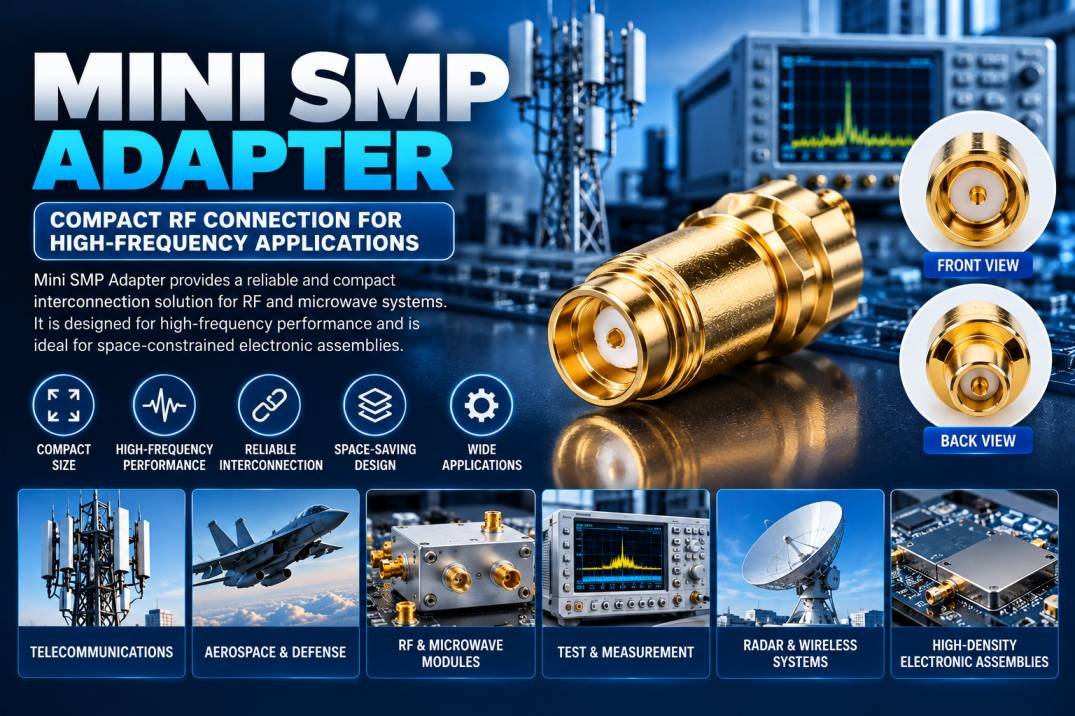
A Mini SMP Adapter is a compact RF coaxial adapter designed to connect compatible Mini-SMP interfaces in radio frequency (RF) and microwave systems. It is used in applications where limited installation space, reliable electrical connectivity, and high-frequency signal transmission are important. Mini-SMP connectors are smaller than conventional SMP connectors, making them suitable for compact electronic assemblies and high-density RF modules.
Mini-SMP adapters are commonly considered for telecommunications equipment, aerospace and defense electronics, test and measurement systems, radar assemblies, and advanced wireless communication platforms. Their suitability depends on the adapter configuration, frequency range, impedance, mechanical design, and the interfaces being connected.
What Is a Mini SMP Adapter?
A Mini SMP Adapter is an RF interconnection component that connects two compatible Mini-SMP interfaces or provides a transition between specified RF connector configurations. Depending on its design, it may feature male-to-male, female-to-female, or male-to-female interfaces, as well as straight or other specialized configurations.
The adapter maintains the RF signal path between connected components while providing mechanical alignment and electrical contact. In compact systems, this helps engineers connect RF modules, cable assemblies, circuit boards, and test equipment without using bulky interconnection hardware.
Mini-SMP adapters are not universal connectors. The interface type, contact arrangement, mating mechanism, and electrical ratings must match the intended equipment.
Construction of a Mini SMP Adapter
The construction of a Mini SMP Adapter typically includes several important components.
1. Center Contact
The center contact carries the RF signal between the connected interfaces. Its geometry, contact material, and plating influence electrical continuity, insertion loss, and overall signal integrity.
2. Outer Conductive Body
The outer body forms the external conductive path and contributes to shielding. It also supports the connector interface and provides mechanical strength.
3. Dielectric Insulator
A dielectric material separates the center contact from the outer conductor. Its dimensions and electrical properties help maintain the required characteristic impedance.
4. Precision Interface
The mating interface is designed to connect with a compatible Mini-SMP connector. Precise dimensions and contact alignment are important for reliable connections and repeatable RF performance.
5. Mechanical Retention
Depending on the design, the adapter may use a specific push-on or snap-on mating arrangement. The exact retention method depends on the connector series and product specification.
Key Features of Mini SMP Adapter
Mini-SMP adapters offer several advantages for compact RF systems:
- Compact size: Helps reduce the space required for RF interconnections.
- High-density integration: Suitable for equipment with closely spaced RF ports.
- Reliable electrical contact: Supports signal continuity when properly mated.
- High-frequency capability: Available in designs intended for RF and microwave applications.
- Multiple configurations: Options may include different gender combinations and mounting arrangements.
- Lightweight construction: Useful in space-sensitive electronic assemblies.
- Module connectivity: Helps connect RF modules, cable assemblies, and compatible components.
- Flexible system integration: Can support different interconnection requirements when the interfaces are correctly matched.
Actual performance varies by model and manufacturer. These features should not be interpreted as guaranteed specifications for every Mini-SMP adapter.
Mini SMP Adapter Specifications
Before selecting a Mini SMP Adapter, engineers should review the manufacturer’s datasheet. Common specification categories include:
| Parameter | Description |
|---|---|
| Connector series | Mini-SMP |
| Interface configuration | Male-to-male, female-to-female, or other specified combination |
| Impedance | Often 50 Ohms in RF systems; verify the specific model |
| Frequency range | Depends on adapter design and manufacturer |
| Insertion loss | Indicates signal power lost through the adapter |
| VSWR | Indicates impedance-matching performance |
| Return loss | Indicates the amount of reflected RF energy |
| Contact material | Specified conductive material and plating |
| Body material | Specified housing material and finish |
| Mating mechanism | Depends on the Mini-SMP interface design |
| Operating temperature | Defined by the product datasheet |
There is no single frequency range, insertion-loss value, or temperature rating that applies to all Mini-SMP adapters. Always use the exact model’s published specifications for design and procurement decisions.
How Does a Mini SMP Adapter Work?
A Mini-SMP Adapter creates a continuous electrical path between compatible RF interfaces. When the two connectors are correctly aligned and mated, the center contacts carry the signal while the outer conductive surfaces provide the return path and shielding.
For high-frequency signals, even small dimensional differences, poor contact, contamination, or an unsuitable transition can affect impedance matching. These issues may increase reflections and insertion loss or reduce repeatability.
Using a correctly specified adapter and following the manufacturer’s mating instructions helps maintain the intended performance of the RF system.
Applications of Mini SMP Adapter
1. Telecommunications Equipment
Mini-SMP adapters can support compact RF connections in wireless communication hardware, radio modules, and high-density telecommunications assemblies.
2. Aerospace and Defense
Space-constrained avionics, radar equipment, and defense electronics may require small and lightweight RF interconnections. Adapter suitability depends on environmental, vibration, and performance requirements.
3. RF and Microwave Modules
Engineers can use compatible Mini-SMP interfaces to connect RF modules, amplifiers, filters, and other components within compact electronic systems.
4. Test and Measurement
Mini-SMP adapters can provide interconnections in RF test fixtures, specialized measurement setups, and module-level testing systems when the adapter’s electrical ratings are appropriate.
5. Radar and Wireless Systems
Compact RF architectures may use Mini-SMP interfaces to connect signal paths within radar, antenna, and wireless equipment.
6. High-Density Electronic Assemblies
Where several RF ports must fit into a limited area, the Mini-SMP form factor can help engineers optimize packaging and routing.
Advantages of Using a Mini SMP Adapter
The primary advantage of a Mini-SMP Adapter is its suitability for compact, high-density RF interconnections. Its small form factor can help reduce connector footprint and support modular equipment design.
Other potential benefits include simplified component interconnection, flexible system configuration, and reliable signal transmission when the correct adapter is selected and properly installed. In demanding applications, however, performance must be evaluated against the actual frequency, power, environmental, and mechanical requirements.
Mini SMP Adapter vs. Standard SMP Adapter
Mini-SMP and standard SMP adapters belong to related but distinct connector families. Mini-SMP is designed for a smaller interface footprint, while standard SMP uses its own defined interface dimensions and mating specifications.
| Feature | Mini-SMP Adapter | Standard SMP Adapter |
|---|---|---|
| Interface size | Smaller form factor | Larger relative form factor |
| Space requirements | Suited to compact assemblies | Depends on equipment layout |
| Mating compatibility | Requires compatible Mini-SMP interfaces | Requires compatible SMP interfaces |
| RF performance | Model-dependent | Model-dependent |
| Selection priority | Space and interface requirements | Interface and system requirements |
Important: Do not assume that Mini-SMP and standard SMP adapters are directly interchangeable. Confirm the exact interface series and mating compatibility before connecting components.
How to Choose the Right Mini SMP Adapter
Follow these steps when selecting a Mini SMP Adapter:
- Identify the interfaces: Confirm the connector series and gender on both sides.
- Verify impedance: Match the adapter to the RF system, commonly 50 Ohms.
- Check frequency range: Ensure the specified operating range covers the application’s requirements.
- Review electrical performance: Compare insertion loss, VSWR, and return loss where specified.
- Confirm mechanical compatibility: Check dimensions, retention method, and installation clearances.
- Evaluate environmental requirements: Review temperature, vibration, and durability ratings.
- Use the correct mating procedure: Follow manufacturer guidance to avoid damaging precision contacts.
- Verify the datasheet: Confirm the exact part number and performance limits before ordering.
Installation and Maintenance Tips
Keep mating surfaces clean and inspect the contacts for damage before installation. Align the connectors correctly and follow the manufacturer’s instructions for mating and unmating. Avoid excessive force, twisting, or side loading, as these may damage the interface.
For critical RF systems, inspect the adapter periodically and test the connection using suitable RF measurement equipment when required. Replace adapters that show physical damage or fail the application’s electrical performance requirements.
Conclusion
A Mini SMP Adapter is a compact RF interconnection solution for compatible Mini-SMP interfaces in telecommunications, aerospace, defense, radar, microwave, and test equipment. Its small footprint makes it useful in high-density electronic assemblies where space and reliable signal connectivity are important.
Choosing the right adapter requires careful attention to interface compatibility, impedance, frequency range, insertion loss, VSWR, mechanical retention, and environmental ratings. By checking the manufacturer’s datasheet and following proper installation practices, engineers can integrate Mini-SMP adapters into RF systems with greater confidence.
FAQs About Mini SMP Adapter
1. What is a Mini SMP Adapter used for?
It connects compatible Mini-SMP RF interfaces in compact electronic equipment, RF modules, communication systems, and microwave assemblies.
2. Is a Mini SMP Adapter suitable for high-frequency applications?
Some models are designed for high-frequency RF and microwave use. The supported frequency range must be verified in the specific product datasheet.
3. What is the impedance of a Mini SMP Adapter?
Many RF Mini-SMP adapters are designed for 50-ohm systems, but the impedance should always be confirmed for the selected model.
4. Are Mini-SMP and SMP adapters interchangeable?
Not necessarily. They are distinct connector interfaces, so compatibility must be confirmed before mating them.
5. What configurations are available?
Depending on the product range, adapters may be offered with different interface genders, mounting styles, and connector arrangements.
6. What specifications matter when buying a Mini SMP Adapter?
Key parameters include interface type, impedance, frequency range, insertion loss, VSWR, return loss, materials, temperature rating, and mating mechanism.
7. Can Mini SMP adapters be used in aerospace and defense?
They may be used in these applications when the specific adapter meets the required electrical, mechanical, and environmental standards.
8. How can RF signal loss be minimized?
Select a suitable adapter, maintain clean contacts, ensure proper mating, avoid damaged interfaces, and verify the RF performance of the assembled connection.
9. Does every Mini SMP Adapter have the same frequency rating?
No. Frequency capability and other electrical specifications vary by design and manufacturer.
10. What should be checked before installation?
Confirm interface compatibility, inspect contacts, review the manufacturer’s mating instructions, and ensure the adapter meets the system’s electrical and environmental requirements.