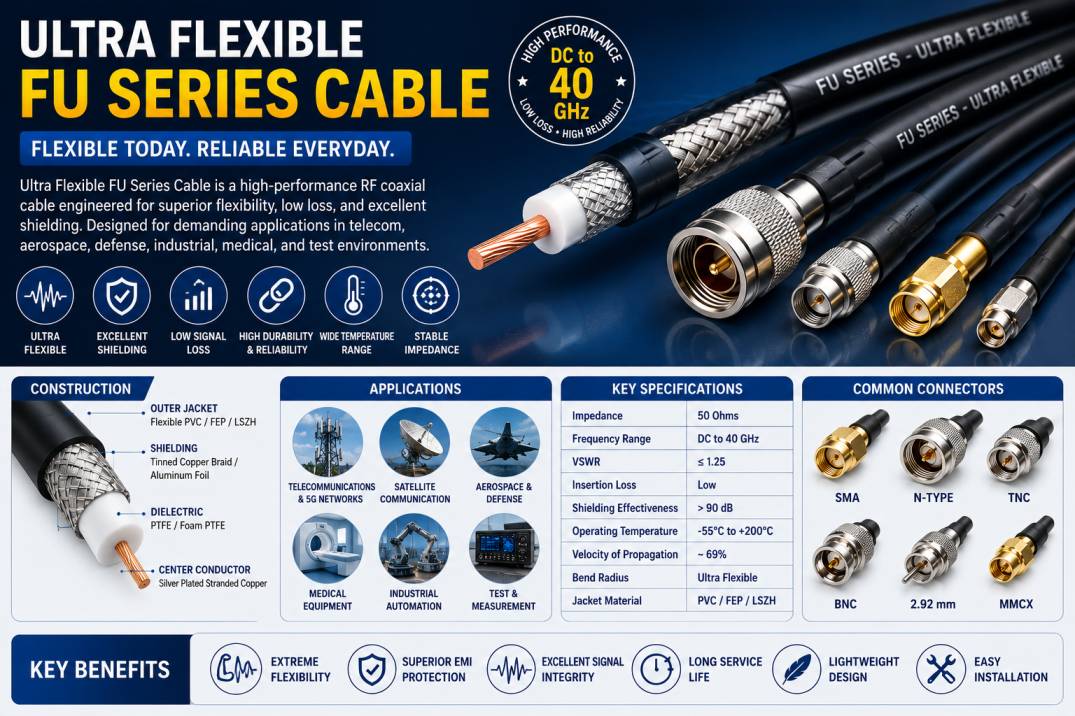
Ultra Flexible FU Series Cable is a premium-grade RF coaxial cable specifically designed for applications requiring exceptional flexibility, low signal loss, superior shielding, and long-lasting mechanical durability. Unlike conventional coaxial cables, the Ultra Flexible FU Series is engineered with advanced materials and precision construction to withstand repeated bending, twisting, and movement while maintaining consistent electrical performance.
These cables are widely used in telecommunications, 4G and 5G infrastructure, aerospace, military communication, satellite systems, medical equipment, laboratory testing, industrial automation, and wireless networking. Their outstanding flexibility makes them ideal for installations where tight routing, continuous cable movement, or limited installation space is a concern.
As modern RF systems continue to operate at higher frequencies with stricter performance requirements, Ultra Flexible FU Series Cables have become a preferred solution for engineers seeking dependable signal transmission, reduced attenuation, and excellent mechanical reliability.
This comprehensive guide explains everything about Ultra Flexible FU Series Cable, including its construction, working principle, features, specifications, applications, advantages, and selection criteria.
What Is Ultra Flexible FU Series Cable?
Ultra Flexible FU Series Cable is a high-performance flexible RF coaxial cable designed for transmitting radio frequency and microwave signals with minimal attenuation and excellent shielding. It combines a stranded center conductor, high-quality dielectric insulation, multiple shielding layers, and a highly flexible outer jacket to deliver reliable electrical performance even in dynamic environments.
Unlike semi-rigid cables, Ultra Flexible FU Series Cables are specifically manufactured to withstand repeated bending without affecting impedance, insertion loss, or signal quality. This makes them suitable for portable equipment, robotics, test systems, and applications where cables are frequently moved or repositioned.
How Does Ultra Flexible FU Series Cable Work?
Ultra Flexible FU Series Cable transfers RF energy through its precision stranded center conductor while the dielectric insulation maintains constant spacing between the conductor and shield. Multiple shielding layers protect the signal from electromagnetic interference (EMI) and radio frequency interference (RFI), ensuring stable signal transmission.
The highly flexible outer jacket protects the cable against abrasion, moisture, chemicals, and mechanical stress while allowing easy installation in compact spaces.
The carefully engineered cable structure maintains constant impedance, minimizes signal reflections, and provides excellent electrical stability over a wide frequency range.
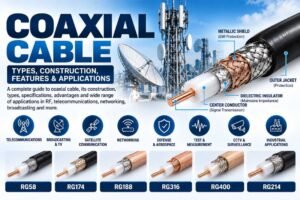
Construction of Ultra Flexible FU Series Cable
Center Conductor
The center conductor carries the RF signal.
Common conductor materials include:
- Silver-Plated Copper
- Bare Copper
- Stranded Copper
- Oxygen-Free Copper
A stranded conductor provides superior flexibility while maintaining excellent conductivity.
Dielectric Insulation
The dielectric ensures precise impedance and minimizes signal loss.
Common dielectric materials include:
- PTFE (Teflon)
- Foam PTFE
- Expanded PTFE
- Low-Density PTFE
These materials offer excellent electrical insulation and thermal stability.
Shielding
The shielding protects against EMI and RFI.
Common shielding designs include:
- Tinned Copper Braid
- Silver-Plated Copper Braid
- Aluminum Foil Shield
- Double Shield
- Triple Shield
Multiple shielding layers improve signal integrity in high-frequency environments.
Outer Jacket
The jacket protects the cable from environmental damage.
Common jacket materials include:
- PVC
- FEP
- Polyurethane
- LSZH (Low Smoke Zero Halogen)
- TPE
These materials provide flexibility, chemical resistance, and long service life.
Key Features of Ultra Flexible FU Series Cable
- Exceptional flexibility
- Low insertion loss
- Excellent shielding effectiveness
- Superior mechanical durability
- Stable impedance
- Low VSWR
- High-frequency compatibility
- Outstanding bend performance
- Lightweight construction
- Long operational life
- Excellent phase stability
- Easy installation
Technical Specifications
| Specification | Typical Value |
| Characteristic Impedance | 50 Ohms |
| Frequency Range | DC to 40 GHz (depending on model) |
| Center Conductor | Silver-Plated Stranded Copper |
| Dielectric | PTFE |
| Shielding | Double or Triple Shield |
| VSWR | Less than 1.25 |
| Shielding Effectiveness | Greater than 90 dB |
| Operating Temperature | -55°C to +200°C |
| Jacket Material | FEP / PVC / LSZH |
| Bend Radius | Ultra Flexible Design |
Common Cable Sizes
| Cable Series | Outside Diameter | Typical Applications |
| FU-086 | 2.18 mm | Compact RF Assemblies |
| FU-141 | 3.58 mm | Microwave Systems |
| FU-195 | 4.95 mm | Wireless Equipment |
| FU-240 | 6.10 mm | Telecom Networks |
| FU-400 | 10.30 mm | Base Stations |
Frequency Range
Ultra Flexible FU Series Cables support a broad frequency spectrum.
Typical operating frequencies include:
- DC to 6 GHz
- DC to 12 GHz
- DC to 18 GHz
- DC to 26.5 GHz
- DC to 40 GHz
Higher-frequency versions are available for specialized microwave applications.
Compatible RF Connectors
Ultra Flexible FU Series Cables are compatible with a wide range of RF connectors.
Popular connector options include:
- SMA
- N-Type
- TNC
- BNC
- 2.92 mm
- 2.4 mm
- SMP
- SMPM
- MMCX
- MCX
Applications of Ultra Flexible FU Series Cable
Telecommunications
- Cellular base stations
- Distributed antenna systems
- RF repeaters
- Telecom infrastructure
5G Networks
- Massive MIMO antennas
- Small cells
- RF front-end modules
- Base station interconnections
Aerospace
- Aircraft communication systems
- Navigation equipment
- Avionics
- Satellite payloads
Defense
- Radar systems
- Military communication
- Electronic warfare
- Secure RF systems
Medical Equipment
- MRI systems
- Medical imaging
- Diagnostic instruments
- Patient monitoring
Laboratory Testing
- Spectrum analyzers
- Network analyzers
- Oscilloscopes
- Signal generators
Industrial Automation
- Robotics
- Wireless monitoring
- Factory automation
- Process control systems
Advantages of Ultra Flexible FU Series Cable
- Outstanding flexibility
- Excellent signal integrity
- Low attenuation
- Superior EMI shielding
- High mechanical strength
- Long service life
- Easy routing in confined spaces
- Excellent temperature resistance
- Stable RF performance
- Reduced maintenance
- Reliable operation
- Suitable for dynamic applications
Limitations of Ultra Flexible FU Series Cable
- Higher cost than standard coaxial cables
- Requires high-quality RF connectors
- Maximum frequency depends on cable size
- Improper installation can reduce performance
How to Choose the Right Ultra Flexible FU Series Cable
Before selecting an Ultra Flexible FU Series Cable, consider the following:
- Operating frequency
- Cable diameter
- Connector compatibility
- Installation environment
- Cable flexibility requirements
- Shielding effectiveness
- Power handling capability
- Attenuation specifications
- Temperature range
- Application requirements
Ultra Flexible FU Series Cable vs Standard Flexible Cable
| Feature | Ultra Flexible FU Series | Standard Flexible Cable |
| Flexibility | Excellent | Moderate |
| Signal Loss | Very Low | Moderate |
| Shielding | Superior | Standard |
| VSWR | Lower | Higher |
| Mechanical Life | Longer | Moderate |
| EMI Protection | Excellent | Good |
| High Frequency | Better | Limited |
| Installation | Easy | Standard |
Industries Using Ultra Flexible FU Series Cable
Ultra Flexible FU Series Cables are widely used in:
- Telecommunications
- Aerospace
- Defense
- Medical Electronics
- Satellite Communication
- Industrial Automation
- Broadcasting
- RF Laboratories
- Semiconductor Manufacturing
- Scientific Research
Maintenance Tips
To maximize cable life and performance:
- Avoid excessive pulling force.
- Use proper bend radius during installation.
- Keep RF connectors clean and dry.
- Inspect the cable regularly for damage.
- Avoid crushing or sharp bends.
- Store in a clean and dry environment.
- Use compatible connectors and accessories.
Future Trends of Ultra Flexible FU Series Cable
The demand for Ultra Flexible FU Series Cables continues to grow with the expansion of 5G networks, satellite communication, autonomous vehicles, aerospace technology, industrial automation, and advanced medical electronics. Manufacturers are developing cables with lower attenuation, improved shielding, higher frequency capabilities, lighter materials, and greater flexibility to support next-generation RF and microwave systems. As communication technologies move toward higher bandwidth and millimeter-wave frequencies, Ultra Flexible FU Series Cables will remain an essential component for reliable and efficient signal transmission.
Conclusion
Ultra Flexible FU Series Cable is a high-performance RF coaxial cable engineered to deliver exceptional flexibility, low signal loss, superior shielding, and long-term durability. Its advanced construction makes it suitable for demanding applications in telecommunications, aerospace, defense, medical devices, industrial automation, laboratory testing, and 5G infrastructure. By selecting the appropriate cable size, connector type, frequency range, and shielding configuration, users can achieve reliable signal transmission, improved system performance, and extended operational life in modern RF communication systems.
Frequently Asked Questions (FAQs)
1. What is an Ultra Flexible FU Series Cable?
Ultra Flexible FU Series Cable is a high-performance RF coaxial cable designed for applications requiring excellent flexibility, low signal loss, and reliable high-frequency signal transmission.
2. What are Ultra Flexible FU Series Cables used for?
These cables are commonly used in telecommunications, 5G networks, aerospace, defense, satellite communication, medical equipment, RF testing, and industrial automation.
3. What is the impedance of Ultra Flexible FU Series Cable?
Most Ultra Flexible FU Series Cables are manufactured with a 50 Ohm characteristic impedance for RF and microwave applications.
4. What frequency range does Ultra Flexible FU Series Cable support?
Depending on the model, these cables support frequencies from DC up to 40 GHz or higher.
5. Why is Ultra Flexible FU Series Cable better than standard flexible cable?
It offers superior flexibility, lower insertion loss, better shielding, improved phase stability, and longer service life in demanding RF applications.
6. Which RF connectors are compatible with Ultra Flexible FU Series Cable?
Common connector options include SMA, N-Type, TNC, BNC, 2.92 mm, 2.4 mm, SMP, SMPM, MCX, and MMCX.
7. Can Ultra Flexible FU Series Cable be used outdoors?
Yes. When paired with weather-resistant jackets and properly sealed connectors, it performs reliably in outdoor environments.
8. What industries use Ultra Flexible FU Series Cable?
Telecommunications, aerospace, defense, satellite communication, medical electronics, industrial automation, broadcasting, and RF laboratories are among the major industries using these cables.
9. What are the main benefits of Ultra Flexible FU Series Cable?
The main benefits include exceptional flexibility, low attenuation, excellent EMI shielding, stable impedance, high mechanical durability, and reliable high-frequency performance.
10. How do I choose the right Ultra Flexible FU Series Cable?
Choose the cable based on operating frequency, impedance, cable diameter, connector compatibility, shielding performance, flexibility requirements, installation conditions, and environmental factors.