What Is Coaxial Cable?
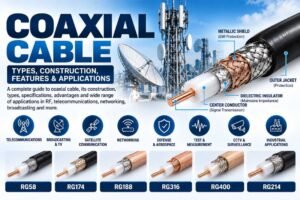
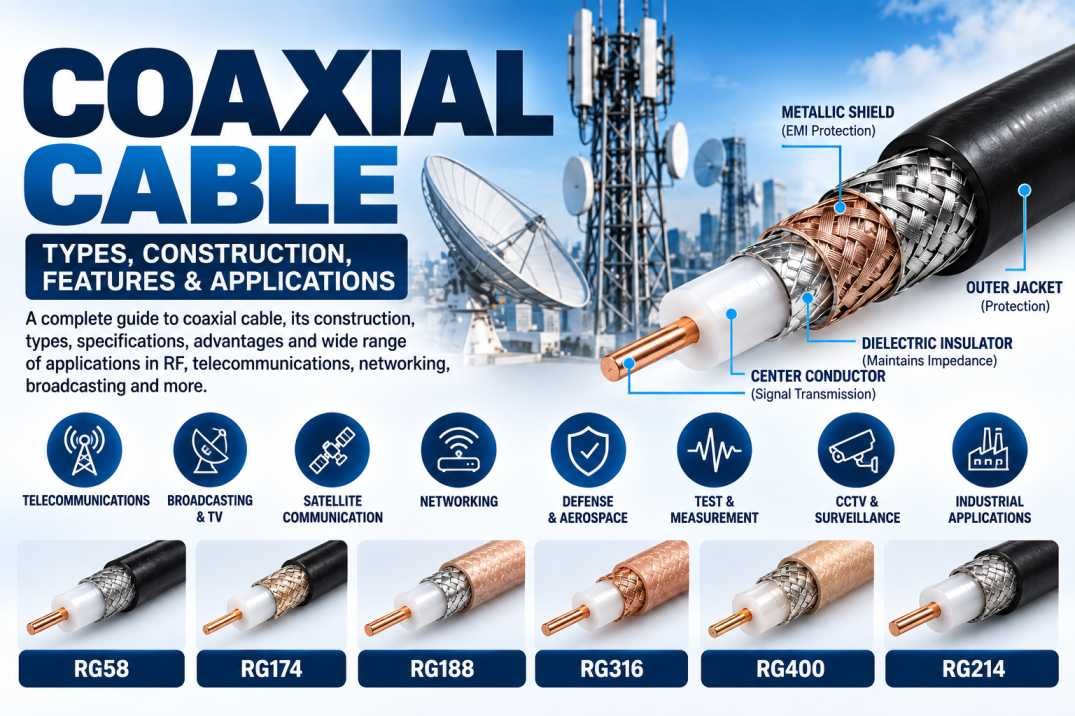
A coaxial cable is an electrical transmission cable designed to carry high-frequency signals with minimal interference. It consists of a central conductor surrounded by an insulating dielectric, a metallic shielding layer, and an outer protective jacket. These layers share a common axis, which gives the cable its name.
Coaxial cables are widely used in radio frequency (RF) systems, telecommunications, television broadcasting, satellite communication, wireless networks, CCTV systems, and electronic test equipment. Their construction helps maintain signal integrity by reducing electromagnetic interference (EMI) and unwanted signal radiation.
Different coaxial cable designs support different frequency ranges, impedance values, power levels, and environmental conditions. Selecting the right cable is essential for achieving reliable performance in any RF or communication system.
Construction of Coaxial Cable
A coaxial cable typically consists of four main layers that work together to provide electrical performance and mechanical protection.
1. Center Conductor
The center conductor carries the electrical signal through the cable. It may be made from solid or stranded copper, silver-plated copper, or other conductive materials depending on the cable type and application.
The conductor material and dimensions influence signal loss, flexibility, and operating frequency.
2. Dielectric Insulator
The dielectric surrounds the center conductor and maintains a consistent distance between the conductor and the outer shield. Common dielectric materials include polyethylene, foam polyethylene, and polytetrafluoroethylene (PTFE).
The dielectric affects impedance, signal propagation, capacitance, and the cable’s temperature capability.
3. Metallic Shielding
The shielding layer protects the transmitted signal from external electromagnetic interference and helps reduce signal leakage. Depending on the design, shielding may consist of braided metal, metallic foil, or multiple shielding layers.
Double-shielded and multi-shielded coaxial cables are used when improved shielding effectiveness is required.
4. Outer Jacket
The outer jacket protects the internal cable structure from abrasion, moisture, chemicals, and environmental exposure. Jacket materials vary according to the intended installation, including indoor, outdoor, industrial, and specialized applications.
Key Features of Coaxial Cable
Coaxial cables offer several important features for modern electronic and communication systems:
- Controlled characteristic impedance, commonly 50 ohms or 75 ohms
- Shielding against electromagnetic interference
- Reliable high-frequency signal transmission
- Different levels of flexibility and mechanical durability
- Availability in various diameters and constructions
- Compatibility with a wide range of RF connectors
- Options for high-temperature and outdoor environments
- Suitability for analog and digital signals
Actual performance depends on cable construction, material selection, operating frequency, and installation conditions.
Types of Coaxial Cable
Several types of coaxial cable are available to meet different electrical and mechanical requirements.
RG58 Coaxial Cable
RG58 is a flexible 50-ohm coaxial cable commonly used in RF communication, radio equipment, and general-purpose signal connections. It is suitable for applications where flexibility and ease of installation are important.
RG174 Coaxial Cable
RG174 is a small-diameter coaxial cable designed for compact electronic equipment, antennas, and short RF connections. Its narrow construction makes routing easier in space-constrained installations.
RG188 Coaxial Cable
RG188 is a compact RF coaxial cable commonly associated with PTFE dielectric construction. It is used in applications requiring a small cable diameter and suitable temperature performance, subject to the manufacturer’s specifications.
RG316 Coaxial Cable
RG316 is a flexible, small-diameter 50-ohm cable frequently used in RF assemblies, wireless devices, instrumentation, and compact electronic systems. Its PTFE dielectric and shielding configuration make it suitable for many demanding applications.
RG400 Coaxial Cable
RG400 is a flexible, typically double-shielded 50-ohm coaxial cable used in aerospace, defense, telecommunications, and RF instrumentation. Its construction is designed to provide shielding and temperature performance appropriate to the specified cable grade.
RG214 Coaxial Cable
RG214 is a double-shielded 50-ohm coaxial cable commonly used in RF communication, military electronics, and test systems. Its larger construction can provide robust shielding and power-handling capabilities, depending on the operating conditions.
Coaxial Cable Specifications
Before selecting a coaxial cable, evaluate the following technical parameters.
| Specification | Description |
|---|---|
| Impedance | Commonly 50 ohms or 75 ohms |
| Frequency Range | Maximum usable frequency depends on cable design |
| Attenuation | Signal loss over a specified cable length |
| Shielding | Determines resistance to external interference |
| Conductor Material | Affects conductivity and flexibility |
| Dielectric Material | Influences impedance and signal propagation |
| Outer Diameter | Determines routing and installation requirements |
| Temperature Range | Defines permitted operating temperatures |
| Power Rating | Depends on frequency, cooling, and installation |
| Minimum Bend Radius | Defines safe cable bending limits |
Always check the manufacturer’s datasheet for exact specifications instead of relying on generic values.
Applications of Coaxial Cable
Telecommunications
Coaxial cables are used in communication infrastructure, RF signal distribution, radio equipment, and selected broadband networks. Their shielding supports reliable transmission in environments with electrical interference.
Wireless Communication
Wireless systems use coaxial cables to connect antennas with radios, transmitters, receivers, and RF modules. Low-loss cables are particularly useful when signal attenuation must be minimized.
Television and Broadcasting
In television and video distribution, 75-ohm coaxial cables are commonly used to carry signals between antennas, distribution equipment, receivers, and compatible video devices.
Satellite Communication
Coaxial cables connect satellite antennas, low-noise block converters, receivers, and other compatible equipment. Cable loss and frequency suitability are important considerations in these systems.
Test and Measurement
RF laboratories use coaxial cables and precision cable assemblies to connect signal generators, spectrum analyzers, network analyzers, and other test instruments.
Aerospace and Defense
Specialized coaxial cables are used in radar systems, avionics, navigation equipment, and secure communication systems where electrical performance and environmental suitability are critical.
CCTV and Industrial Electronics
Coaxial cable can carry compatible video signals in surveillance systems and support signal connections in industrial electronics, depending on the cable type and equipment interface.
Advantages of Coaxial Cable
The primary advantage of coaxial cable is its shielded structure, which helps protect signals from external interference. Its controlled impedance supports predictable high-frequency transmission, while its availability in different constructions makes it suitable for many applications.
Additional advantages include reliable connector compatibility, durable protective jackets, and options for flexible, low-loss, high-temperature, and high-shielding designs.
How to Choose the Right Coaxial Cable
Selecting the correct cable requires more than matching its physical dimensions. Consider these factors before purchasing:
- Impedance: Use 50-ohm cable for many RF systems and 75-ohm cable for many video and television applications, according to equipment requirements.
- Frequency range: Confirm that the cable supports the complete operating frequency band.
- Cable length and attenuation: Calculate expected signal loss at the intended frequency and length.
- Shielding effectiveness: Choose appropriate shielding for the electromagnetic environment.
- Operating temperature: Verify the cable’s rated temperature range.
- Flexibility and routing: Check the minimum bend radius and installation space.
- Connector compatibility: Match the cable to the required SMA, N-Type, TNC, BNC, or other connector.
- Environmental conditions: Consider moisture, UV exposure, chemicals, vibration, and mechanical stress.
Coaxial Cable vs. Other Transmission Cables
Coaxial cable uses a central conductor and surrounding shield to transmit signals. Twisted-pair cable uses paired conductors and is widely used in Ethernet and telephone systems. Fiber-optic cable transmits data as light and is suitable for high-bandwidth, long-distance communication.
The best option depends on bandwidth, distance, interference, cost, installation conditions, and equipment compatibility.
Conclusion
Coaxial cable is an important component in RF, microwave, telecommunications, broadcasting, and electronic systems. Its central conductor, dielectric insulation, metallic shielding, and protective jacket work together to support controlled signal transmission and reduce interference.
From compact RG188 and RG316 cables to larger RG214 and RG400 designs, different cable types serve different electrical and mechanical requirements. Reviewing impedance, attenuation, frequency range, shielding, temperature rating, and connector compatibility helps ensure dependable system performance.
FAQs About Coaxial Cable
1. What is coaxial cable used for?
Coaxial cable is used for RF signal transmission, telecommunications, television, satellite communication, CCTV, wireless systems, and electronic test equipment.
2. What are the main parts of a coaxial cable?
The four main parts are the center conductor, dielectric insulator, metallic shielding, and outer protective jacket.
3. What is the difference between 50-ohm and 75-ohm coaxial cable?
50-ohm cable is common in RF communication and test systems, while 75-ohm cable is widely used for television, video, and related signal distribution. Always follow equipment requirements.
4. Which coaxial cable is best for high-frequency applications?
The right cable depends on frequency, attenuation, impedance, power, and mechanical requirements. Specialized low-loss or precision coaxial cables may be appropriate for demanding applications.
5. What is RG316 coaxial cable?
RG316 is a compact, flexible RF coaxial cable commonly used in wireless devices, instrumentation, and cable assemblies.
6. Is coaxial cable resistant to interference?
Its metallic shielding helps reduce electromagnetic interference, but performance depends on shield construction, connector quality, installation, and the surrounding environment.
7. How do I select the correct coaxial cable?
Check impedance, frequency range, attenuation, shielding, temperature rating, cable dimensions, bend radius, and connector compatibility.
8. Can coaxial cable be used outdoors?
Yes. Outdoor-rated coaxial cables are available. Select a cable with a jacket and construction suitable for moisture, sunlight, temperature, and other environmental conditions.
9. What is coaxial cable impedance?
Impedance is the characteristic electrical property of a transmission line, expressed in ohms. Common coaxial cable impedances are 50 ohms and 75 ohms.
10. Why is shielding important in coaxial cable?
Shielding helps protect the signal from external interference and reduces unwanted electromagnetic radiation, supporting reliable transmission.