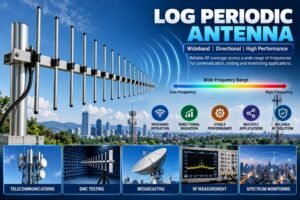
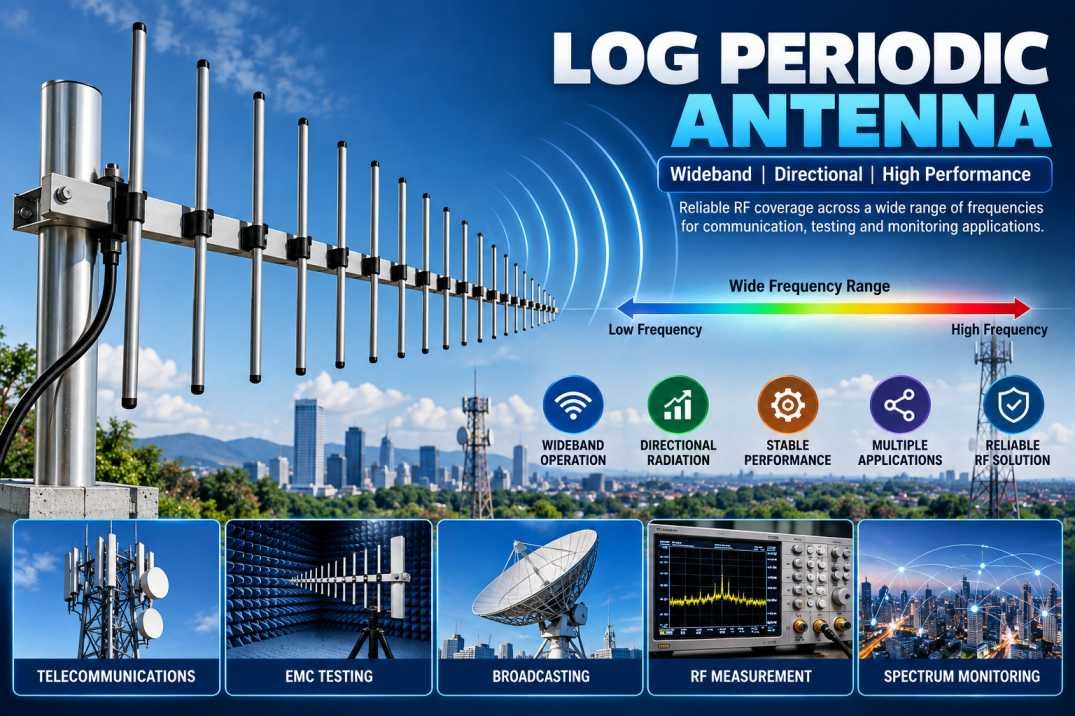
A Log Periodic Antenna is a directional antenna designed to operate across a wide range of frequencies while maintaining relatively consistent radiation characteristics. It is widely used in RF communication, telecommunications, broadcasting, electromagnetic compatibility (EMC) testing, signal monitoring, and wireless measurement systems.
Unlike narrowband antennas that are optimized for a limited frequency range, a log periodic antenna can support multiple frequencies within its specified operating bandwidth. Its distinctive structure consists of multiple conductive elements arranged in a progressively changing pattern, typically mounted along a supporting boom.
Log periodic antennas are valued for their wide bandwidth, directional radiation pattern, stable impedance characteristics, and suitability for applications that require reliable signal transmission or reception across different frequencies.
What Is a Log Periodic Antenna?
A log periodic antenna, commonly called a log periodic dipole array (LPDA), is a broadband directional antenna that uses multiple elements of different lengths and spacing. These elements are arranged according to a geometric progression, allowing the antenna to operate over a broad frequency range.
The term “log periodic” refers to the antenna’s electrical characteristics, which repeat approximately with the logarithm of frequency. As the operating frequency changes, different elements become the primary contributors to radiation and reception.
Log periodic antennas are commonly designed for VHF and UHF applications, although specialized models are available for other frequency ranges. The actual operating bandwidth, gain, polarization, and dimensions depend on the antenna design.
How Does a Log Periodic Antenna Work?
A log periodic antenna works by using different-sized elements to support different operating frequencies. Longer elements generally contribute more effectively at lower frequencies, while shorter elements are more effective at higher frequencies.
As the frequency changes, the active region of the antenna shifts along the array. This design enables broadband operation without requiring a separate antenna for every frequency band.
The antenna is generally directional, meaning it provides greater sensitivity or radiation in a preferred direction than in other directions. This characteristic makes it useful for applications that require targeted signal transmission, reception, or measurement.
The key operating principles include:
- Broadband performance: Multiple elements support operation across a wide frequency range.
- Frequency-dependent active region: Different elements become active as the operating frequency changes.
- Directional radiation: The antenna focuses energy toward a preferred direction.
- Impedance stability: A suitable design can maintain relatively consistent impedance across its operating bandwidth.
- Wide frequency coverage: One antenna can support multiple frequencies within its rated range.
Construction of a Log Periodic Antenna
A typical log periodic dipole array consists of several important components.
1. Dipole Elements
The conductive elements have progressively varying lengths. Longer elements are associated with lower operating frequencies, while shorter elements support higher frequencies.
2. Supporting Boom
The boom provides mechanical support and maintains the position and spacing of the elements. Depending on the design, it may also form part of the antenna’s feeding structure.
3. Feed Network
The feed network supplies RF energy to the antenna elements. In many LPDA designs, the elements are connected alternately to a balanced transmission-line structure to achieve the required phase relationships.
4. Mounting Structure
The mounting bracket allows the antenna to be installed on a mast, tower, tripod, or other suitable support. The mounting arrangement depends on the antenna’s size and intended application.
5. Protective Materials
Some log periodic antennas include protective coatings, weather-resistant components, or radomes to support outdoor operation. These features vary by manufacturer and model.
Key Features of Log Periodic Antenna
Log periodic antennas offer several useful characteristics for RF and communication systems.
- Wide operating bandwidth: Supports multiple frequencies within a specified range.
- Directional performance: Helps focus transmission or reception in a preferred direction.
- Broadband impedance characteristics: Designed to maintain usable matching across its operating band.
- Consistent radiation behavior: Can provide relatively stable characteristics across a wide frequency range.
- Multiple frequency applications: Suitable for systems that require coverage of several communication bands.
- Flexible installation: Available in different sizes and mounting configurations.
- RF measurement compatibility: Commonly used for testing and signal monitoring.
- Single-antenna convenience: May reduce the need for multiple narrowband antennas.
Technical Specifications of Log Periodic Antenna
When selecting a log periodic antenna, it is important to review its technical specifications. These determine whether the antenna is suitable for the intended RF application.
| Specification | Description |
|---|---|
| Frequency Range | The minimum and maximum supported frequencies |
| Antenna Type | Commonly a log periodic dipole array |
| Gain | Indicates directional signal performance, usually in dBi |
| Polarization | May be horizontal, vertical, or specified by the design |
| Impedance | Commonly 50 ohms for RF communication systems |
| VSWR | Indicates impedance matching over the operating band |
| Radiation Pattern | Describes directional transmission and reception |
| Connector Type | May include N-type, SMA, or other RF interfaces, depending on the model |
| Mounting Type | Mast, pole, tripod, or other specified mounting arrangement |
| Environmental Rating | Defines suitability for indoor or outdoor use |
Exact specifications vary between products. Always consult the manufacturer’s datasheet before selecting an antenna for a particular frequency band or installation.
Types of Log Periodic Antennas
1. Log Periodic Dipole Array (LPDA)
The LPDA is the most widely recognized form of log periodic antenna. It uses multiple dipole elements with varying lengths and spacing to achieve broadband directional performance. It is commonly used in EMC testing, spectrum monitoring, telecommunications, and RF measurements.
2. Wideband Log Periodic Antenna
Wideband models are designed to cover broad frequency ranges. They are useful when equipment must operate across several bands without frequent antenna changes.
3. Log Periodic Antennas for EMC Testing
These antennas are designed for electromagnetic compatibility testing and measurement. They can be used to measure radiated emissions or support immunity testing, subject to the applicable test setup and frequency requirements.
4. Outdoor Log Periodic Antenna
Outdoor models are designed for installations where weather resistance and mechanical durability are important. Their suitability depends on the environmental protection, mounting system, and operating conditions specified by the manufacturer.
Applications of Log Periodic Antenna
1. Telecommunications
Log periodic antennas are used in communication testing, signal monitoring, and applications requiring coverage across multiple RF bands. Their broadband characteristics make them useful in technical environments where frequency flexibility is important.
2. RF Testing and Measurement
Engineers use log periodic antennas with spectrum analyzers, receivers, and RF measurement equipment to investigate signals across specified frequency ranges.
3. EMC and EMI Testing
Log periodic antennas are widely used in electromagnetic compatibility laboratories to measure radiated emissions and perform certain electromagnetic immunity tests. The antenna must be selected according to the required frequency range and test standard.
4. Broadcasting
Depending on its frequency range and design, a log periodic antenna can be used for receiving or transmitting broadcast signals. Suitability depends on the required band, gain, polarization, and regulatory conditions.
5. Research and Development
RF engineers and researchers use log periodic antennas for laboratory experiments, antenna characterization, propagation studies, and broadband signal analysis.
6. Wireless Communication
Log periodic antennas can support wireless signal testing and monitoring across different frequency bands. The selected model must cover the specific frequencies used by the communication system.
7. Spectrum Monitoring
Monitoring systems use broadband directional antennas to detect, receive, or investigate RF signals within the antenna’s specified operating range.
Advantages of Log Periodic Antenna
One of the main advantages of a log periodic antenna is its ability to operate over a broad frequency range. This reduces the need to install several separate antennas when multiple bands must be covered.
Its directional characteristics can improve reception from a desired direction and help reduce unwanted signals arriving from other directions. The relatively consistent broadband behavior also makes it useful for measurement systems and applications where the operating frequency may change.
Additional benefits include versatile applications, practical directional coverage, and availability in different sizes and frequency configurations.
Log Periodic Antenna vs. Yagi Antenna
| Feature | Log Periodic Antenna | Yagi Antenna |
|---|---|---|
| Bandwidth | Generally wideband | Generally narrower |
| Frequency Coverage | Multiple frequencies across a designed band | Often optimized for a specific band |
| Elements | Progressively varying lengths and spacing | Driven element with directors and reflector |
| Directionality | Directional | Directional |
| Typical Uses | EMC testing, broadband monitoring, RF measurements | TV reception, amateur radio, point-to-point links |
The best option depends on the frequency range, gain requirements, available installation space, and application.
How to Choose the Right Log Periodic Antenna
Selecting the right antenna requires evaluating several technical and installation factors.
- Frequency range: Ensure the antenna covers every frequency required by the application.
- Gain: Choose an appropriate gain level based on coverage and signal-strength requirements.
- Polarization: Match the antenna polarization to the transmitting or receiving system.
- Impedance and VSWR: Verify compatibility with the RF equipment and feed cable.
- Connector type: Confirm the required RF interface and cable assembly compatibility.
- Installation environment: Check whether the antenna is suitable for indoor or outdoor use.
- Dimensions and mounting: Ensure the antenna fits the available installation space and support structure.
- Application requirements: For EMC testing, confirm that the antenna meets the required test frequency range and applicable standards.
Conclusion
A Log Periodic Antenna is a broadband directional antenna designed to provide useful RF performance across a wide range of frequencies. Its progressively arranged elements allow different parts of the antenna to operate effectively at different frequencies, making it suitable for telecommunications, EMC testing, broadcasting, spectrum monitoring, wireless communication, and research applications.
When selecting a log periodic antenna, evaluate frequency coverage, gain, polarization, impedance, VSWR, mounting requirements, and environmental conditions. Choosing a model that matches the intended application helps support reliable signal transmission, reception, and RF measurement performance.
FAQs About Log Periodic Antenna
1. What is a log periodic antenna?
A log periodic antenna is a broadband directional antenna with elements of progressively varying lengths and spacing, designed to operate across a wide frequency range.
2. What is a log periodic antenna used for?
It is used in RF testing, EMC measurements, telecommunications, broadcasting, spectrum monitoring, wireless communication, and research.
3. How does a log periodic antenna work?
Different elements become active at different frequencies, allowing the antenna to maintain useful performance across its designed operating bandwidth.
4. Is a log periodic antenna directional?
Yes. A typical log periodic dipole array has a directional radiation pattern, providing greater sensitivity or radiation in a preferred direction.
5. What is the difference between a log periodic and a Yagi antenna?
A log periodic antenna generally offers wider bandwidth, while a Yagi antenna is typically optimized for a narrower frequency band.
6. What frequency range does a log periodic antenna support?
The operating range depends on the model. Some antennas cover selected VHF and UHF bands, while specialized designs support other frequency ranges.
7. What is the typical impedance of a log periodic antenna?
Many RF log periodic antennas are designed for 50-ohm systems, but the specified impedance should always be confirmed from the product datasheet.
8. Can a log periodic antenna be used outdoors?
Yes, if the model is designed for outdoor operation and has suitable weather protection, mounting provisions, and environmental ratings.
9. What factors affect log periodic antenna performance?
Frequency range, gain, polarization, impedance matching, installation height, orientation, surrounding objects, and environmental conditions can all affect performance.
10. How do I select the best log periodic antenna?
Choose an antenna based on the required frequency range, gain, polarization, impedance, connector, installation conditions, and intended application.