RG400 Cable Double Shield is a high-performance coaxial RF cable designed for reliable transmission of radio frequency signals in demanding communication, aerospace, defense, instrumentation, and industrial applications. Its double-shield construction provides excellent protection against electromagnetic interference (EMI), radio frequency interference (RFI), and unwanted signal leakage.
RG400 is particularly valued in applications where signal integrity, mechanical durability, temperature resistance, and stable electrical performance are important. Compared with many standard single-shield coaxial cables, a double-shield RG400 construction can provide improved shielding effectiveness and better protection in electrically noisy environments.
The cable is commonly used with RF connectors such as SMA, BNC, TNC, N-Type, and other connector configurations to create customized RF cable assemblies. Depending on the exact construction and manufacturer, RG400 cables can be supplied in different lengths, connector combinations, and termination styles.
This guide explains what RG400 Double Shield Cable is, how it is constructed, how it works, its technical characteristics, applications, advantages, limitations, and how to select the right cable for an RF system.
What Is RG400 Double Shield Cable?
RG400 is a 50-ohm coaxial RF cable designed for high-frequency signal transmission. The term double shield refers to a construction that uses two shielding layers around the dielectric, typically combining a metallic foil with a braided shield.
The center conductor carries the RF signal, while the dielectric maintains the required spacing between the center conductor and shield. The double-shield structure helps reduce electromagnetic interference and prevents RF energy from escaping the cable.
RG400 is commonly associated with PTFE insulation and a high-temperature construction, making it suitable for applications where conventional PVC-insulated RF cables may not provide sufficient thermal or mechanical performance.
What Does Double Shield Mean in RG400 Cable?
The shielding system is one of the most important features of RG400 cable.
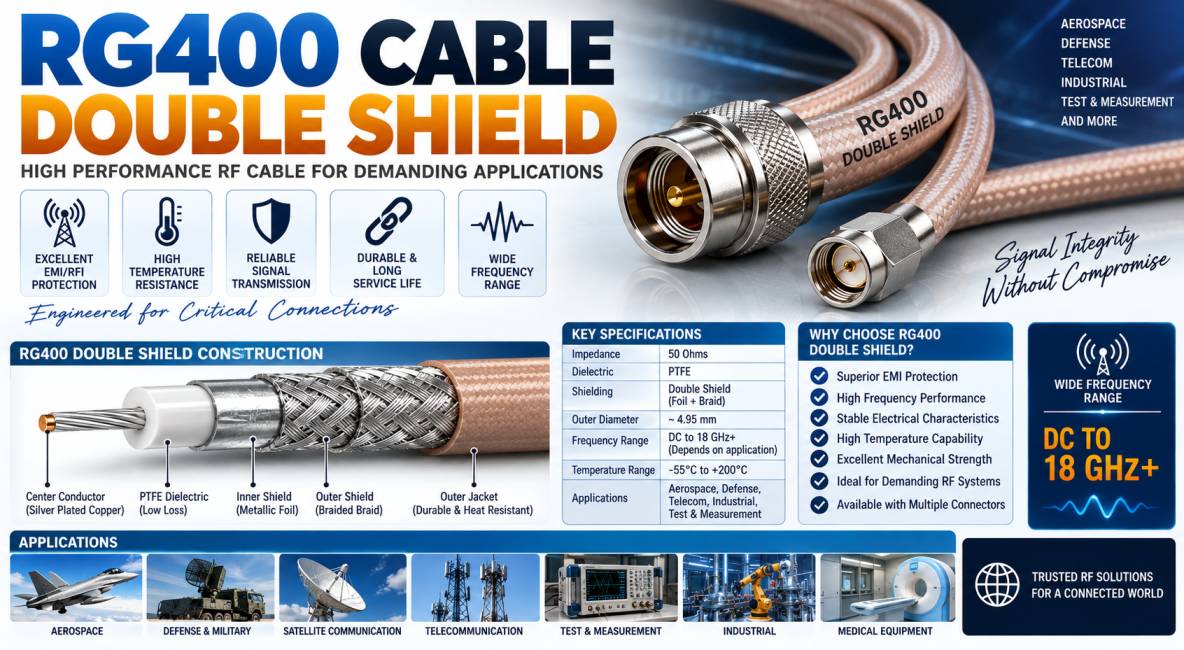
A typical double-shield construction includes:
- Center conductor
- PTFE dielectric
- Inner metallic shield
- Outer braided shield
- Protective outer jacket
The foil layer provides continuous coverage around the dielectric, while the braid provides mechanical strength and additional shielding.
This combination offers better protection against external electromagnetic fields than a basic single-braid construction.
Construction of RG400 Double Shield Cable
Center Conductor
The center conductor is responsible for carrying the RF signal. RG400 is commonly manufactured with stranded conductors to provide a useful combination of electrical performance and flexibility.
Depending on the manufacturer, conductor materials and plating can vary. Silver-plated copper is commonly associated with high-performance RF cable constructions because silver offers excellent conductivity, particularly at high frequencies.
PTFE Dielectric
The dielectric surrounds the center conductor and maintains consistent separation between the conductor and shielding system.
RG400 commonly uses PTFE insulation, which provides:
- Excellent temperature resistance
- Low dielectric loss
- Good chemical resistance
- Stable electrical characteristics
- High insulation performance
PTFE is one reason RG400 is suitable for demanding aerospace, military, and instrumentation environments.
Inner Shield
The first shielding layer is typically a metallic foil or similar conductive layer.
Its primary purpose is to provide continuous electromagnetic coverage around the dielectric. This helps reduce RF leakage and improves protection against external interference.
Outer Braid
The second shield is generally a braided metallic conductor.
The braid provides:
- Additional EMI protection
- Mechanical strength
- Improved durability
- Better resistance to handling stress
The combination of foil and braid produces the double-shield structure.
Outer Jacket
The external jacket protects the cable from abrasion, moisture, chemicals, and mechanical damage.
The exact jacket material can vary by manufacturer and application requirements.
How Does RG400 Double Shield Cable Work?
RF signals travel through the center conductor of the coaxial cable. The surrounding dielectric maintains the geometry required for controlled impedance, while the metallic shielding system acts as the return path and electromagnetic barrier.
The coaxial construction confines most of the electromagnetic energy within the cable. The double shield further reduces the possibility of interference entering or leaving the transmission path.
This is especially useful in systems containing sensitive receivers, high-power transmitters, switching equipment, motors, computers, and other sources of electromagnetic noise.
Key Features of RG400 Double Shield Cable
RG400 Double Shield Cable offers several characteristics that make it useful for demanding RF applications.
- 50-ohm characteristic impedance
- Double-shield construction
- Excellent EMI and RFI protection
- PTFE dielectric
- Good high-frequency performance
- High-temperature capability
- Good mechanical durability
- Reliable signal transmission
- Low signal leakage
- Suitable for RF cable assemblies
- Compatible with numerous RF connectors
- Suitable for aerospace and defense applications
RG400 Cable Technical Specifications
Exact specifications vary between manufacturers, so the manufacturer’s datasheet should always be used for final engineering selection.
| Specification | Typical RG400 Characteristic |
|---|---|
| Cable Type | Coaxial RF Cable |
| Characteristic Impedance | 50 Ohms |
| Shielding | Double Shield |
| Dielectric | PTFE |
| Conductor | Typically stranded, plated copper construction |
| Outer Diameter | Approximately 4.95 mm |
| Operating Frequency | Commonly used into the GHz range |
| Temperature Capability | High-temperature construction |
| Applications | RF, microwave, aerospace, defense, instrumentation |
| Connector Options | SMA, BNC, TNC, N-Type and others |
What Is the Frequency Range of RG400 Cable?
RG400 is designed for high-frequency RF applications and is commonly used across the MHz and GHz ranges.
The practical operating frequency depends on:
- Cable manufacturer
- Cable length
- Connector type
- Assembly quality
- Required insertion loss
- VSWR requirement
- Application environment
For precision RF applications, engineers should always verify attenuation and VSWR at the actual operating frequency rather than relying only on the cable designation.
RG400 Cable Attenuation
Attenuation is the amount of RF signal power lost as the signal travels through the cable.
Cable attenuation generally increases with frequency and cable length. Therefore, a longer RG400 cable will normally have greater signal loss than a shorter assembly operating at the same frequency.
When designing an RF system, engineers should calculate the complete transmission-line loss, including:
- Cable loss
- Connector loss
- Adapter loss
- Transition loss
- Bending effects
- Temperature effects
Choosing a lower-loss cable may be beneficial when the RF system has a limited signal budget.
RG400 Cable Impedance
RG400 is normally used as a 50-ohm RF cable.
Maintaining 50-ohm impedance from the transmitter to the receiver is important because impedance discontinuities can produce signal reflections.
Incorrect impedance matching can increase:
- VSWR
- Return loss
- Reflected power
- Signal distortion
- Transmission loss
For this reason, RG400 should normally be paired with compatible 50-ohm RF connectors and components.
RG400 Cable Shielding Performance
The double-shield construction is one of the major reasons engineers select RG400 for demanding applications.
A single braid can provide good shielding, but a foil-and-braid configuration can provide more continuous coverage and improved isolation.
This makes double-shield RG400 particularly useful around:
- RF transmitters
- Radar equipment
- Switching power supplies
- Motors
- Industrial machinery
- Digital electronics
- Wireless communication equipment
Actual shielding effectiveness varies with cable construction, frequency, connectors, assembly methods, and installation.
Applications of RG400 Double Shield Cable
Aerospace Applications
RG400 cable is suitable for many aerospace applications because of its high-temperature insulation and robust construction.
Typical uses include:
- Avionics
- Aircraft communication
- Navigation equipment
- Antenna systems
- Flight instrumentation
- RF test systems
Defense and Military
Defense electronics often require reliable signal transmission in electrically challenging environments.
RG400 cable assemblies may be used in:
- Radar systems
- Military communication
- Electronic warfare equipment
- RF instrumentation
- Tactical communication systems
- Antenna connections
RF Test and Measurement
RG400 is frequently used to manufacture test cables and interconnections.
Applications include:
- Spectrum analyzers
- Signal generators
- Network analyzers
- RF power meters
- Oscilloscopes with RF interfaces
- Laboratory test fixtures
Telecommunications
RG400 can be used for RF interconnections in communication equipment, particularly where compact, durable, shielded cable assemblies are required.
Wireless Communication
Applications can include:
- Antenna connections
- Radio equipment
- RF modules
- Repeaters
- Wireless test systems
- Communication transceivers
Industrial Electronics
Industrial environments can contain significant electrical noise. Double-shield RF cables help protect sensitive RF signals from interference.
Applications include:
- Industrial control systems
- RF sensors
- Automation equipment
- Monitoring systems
- Instrumentation
Medical Electronics
Specialized medical equipment may require carefully controlled RF signal paths. RG400 cable assemblies can be used where their electrical and environmental specifications meet the equipment requirements.
RG400 Cable Connector Options
RG400 cable can be terminated with various RF connectors depending on system requirements.
Common options include:
- SMA Male
- SMA Female
- BNC Male
- BNC Female
- TNC Male
- TNC Female
- N-Type Male
- N-Type Female
- SMB
- SMC
- MCX
- MMCX
Custom assemblies can also combine different connector types, such as:
SMA Male to SMA Male
SMA Male to BNC Male
SMA Male to N-Type Male
TNC Male to TNC Male
BNC Male to BNC Male
The connector should be selected according to impedance, frequency, power, mounting configuration, and environmental requirements.
Advantages of RG400 Double Shield Cable
Excellent EMI Protection
The double-shield design provides effective protection against electromagnetic interference and helps maintain signal integrity.
High-Temperature Performance
The PTFE dielectric makes RG400 suitable for applications exposed to elevated temperatures.
Reliable RF Performance
Controlled impedance and coaxial construction support consistent RF signal transmission.
Durable Construction
The combination of shielding and protective jacket provides good mechanical durability.
Wide Application Range
RG400 can be used across aerospace, defense, telecommunications, instrumentation, industrial, and laboratory applications.
Customizable
RG400 can be manufactured into custom cable assemblies with different lengths and connector combinations.
RG400 vs RG58 Cable
| Feature | RG400 | RG58 |
|---|---|---|
| Impedance | 50 Ohms | 50 Ohms |
| Shielding | Double Shield | Typically Single/Standard Shield |
| Dielectric | PTFE | Commonly Polyethylene |
| Temperature Performance | Higher | Lower |
| RF Applications | Demanding RF Systems | General RF Applications |
| Mechanical Construction | Robust | Flexible |
| Typical Use | Aerospace, Defense, Test | General Communication |
RG400 is generally selected when higher temperature capability, better shielding, and more demanding RF performance are required.
RG400 vs RG316 Cable
| Feature | RG400 | RG316 |
|---|---|---|
| Cable Size | Larger | Smaller |
| Power Capability | Generally Higher | Generally Lower |
| Flexibility | Moderate | High |
| Shielding | Double Shield | Commonly Double Shield |
| Temperature Performance | High | High |
| Applications | Aerospace, Defense, RF Systems | Compact RF Assemblies |
| Installation Space | Moderate | Limited/Compact |
RG316 is often preferred when small diameter and flexibility are more important, while RG400 is useful when a larger cable with higher power capability and robust construction is required.
How to Choose the Right RG400 Cable
Before purchasing an RG400 Double Shield Cable, consider the following factors.
Operating Frequency
Confirm that the cable provides acceptable attenuation and VSWR at your required frequency.
Cable Length
Longer cable assemblies produce greater signal loss.
Connector Type
Choose connectors that match the equipment interface.
Connector Gender
Confirm whether the application requires male, female, or reverse-polarity interfaces.
Temperature
Verify that the cable and connector assembly can withstand the application’s temperature range.
Shielding
Double shielding is particularly useful in high-EMI environments.
Power Handling
Confirm that the cable can safely handle the expected RF power at the operating frequency and temperature.
Flexibility
RG400 is more robust than many miniature flexible RF cables, but installation should still avoid excessive bending or repeated flexing.
RG400 Cable Installation Best Practices
Proper installation is essential for achieving the expected RF performance.
Avoid excessively sharp bends.
Do not crush the cable.
Prevent unnecessary twisting.
Use the correct connector termination method.
Keep connectors clean.
Use appropriate torque when installing threaded RF connectors.
Avoid pulling the cable by the connector.
Maintain the recommended bend radius.
Inspect the cable assembly before installation.
Why Choose Double-Shield RG400 for RF Cable Assemblies?
Double-shield RG400 is particularly valuable when signal integrity and electromagnetic isolation are important.
The combination of a PTFE dielectric, controlled impedance, metallic foil, and braided outer shield creates a robust RF transmission path.
For customized RF cable assemblies, the cable can be terminated with precision connectors and manufactured to specific lengths. This makes RG400 suitable for equipment interconnection where off-the-shelf cables may not provide the required connector configuration or cable length.
Conclusion
RG400 Cable Double Shield is a robust 50-ohm coaxial RF cable designed for demanding high-frequency applications. Its double-shield construction provides strong protection against electromagnetic interference, while the PTFE dielectric offers excellent thermal and electrical stability. These characteristics make RG400 a valuable choice for aerospace, defense, telecommunications, RF test equipment, instrumentation, industrial electronics, and other applications requiring dependable RF signal transmission.
When selecting an RG400 cable assembly, engineers should evaluate frequency, attenuation, impedance, shielding, power handling, temperature rating, cable length, connector type, and installation requirements. Using the correct cable and properly matched RF connectors can help minimize signal loss, reduce reflections, and achieve reliable system performance.
Frequently Asked Questions (FAQs)
1. What is RG400 Double Shield Cable?
RG400 Double Shield Cable is a 50-ohm coaxial RF cable that typically uses a PTFE dielectric and two shielding layers to provide reliable high-frequency signal transmission and improved EMI protection.
2. What does double shield mean in RG400 cable?
Double shield generally refers to two conductive shielding layers, commonly a metallic foil and braided shield, surrounding the dielectric.
3. Is RG400 a 50-ohm cable?
Yes. RG400 is commonly specified as a 50-ohm coaxial RF cable for RF and microwave applications.
4. What dielectric does RG400 use?
RG400 commonly uses PTFE dielectric, which provides good electrical performance and high-temperature resistance.
5. What are the applications of RG400 cable?
RG400 is commonly used in aerospace, defense, telecommunications, radar, RF testing, instrumentation, wireless communication, and industrial electronics.
6. Is RG400 better than RG58?
RG400 can be a better choice than RG58 when higher temperature capability, stronger shielding, and more demanding RF performance are required. The best choice depends on the application.
7. What connectors can be used with RG400?
RG400 cable assemblies can be terminated with SMA, BNC, TNC, N-Type, SMB, SMC, MCX, MMCX, and other compatible RF connectors.
8. Can RG400 be used at high temperatures?
Yes. RG400’s PTFE-based construction provides high-temperature capability, although the exact temperature rating should always be confirmed from the manufacturer’s datasheet.
9. Is RG400 suitable for aerospace applications?
Yes. RG400 is commonly selected for aerospace and avionics applications where robust construction, thermal performance, and reliable RF transmission are required.
10. What is the difference between RG400 and RG316?
RG400 is generally larger and more robust, while RG316 has a smaller diameter and is useful where compact size and flexibility are important.
11. Does RG400 cable reduce electromagnetic interference?
Its double-shield construction is designed to provide strong protection against electromagnetic interference and reduce RF signal leakage.
12. Can RG400 be made into custom RF cable assemblies?
Yes. RG400 can be terminated with different connector types and manufactured to specified lengths for customized RF cable assemblies.