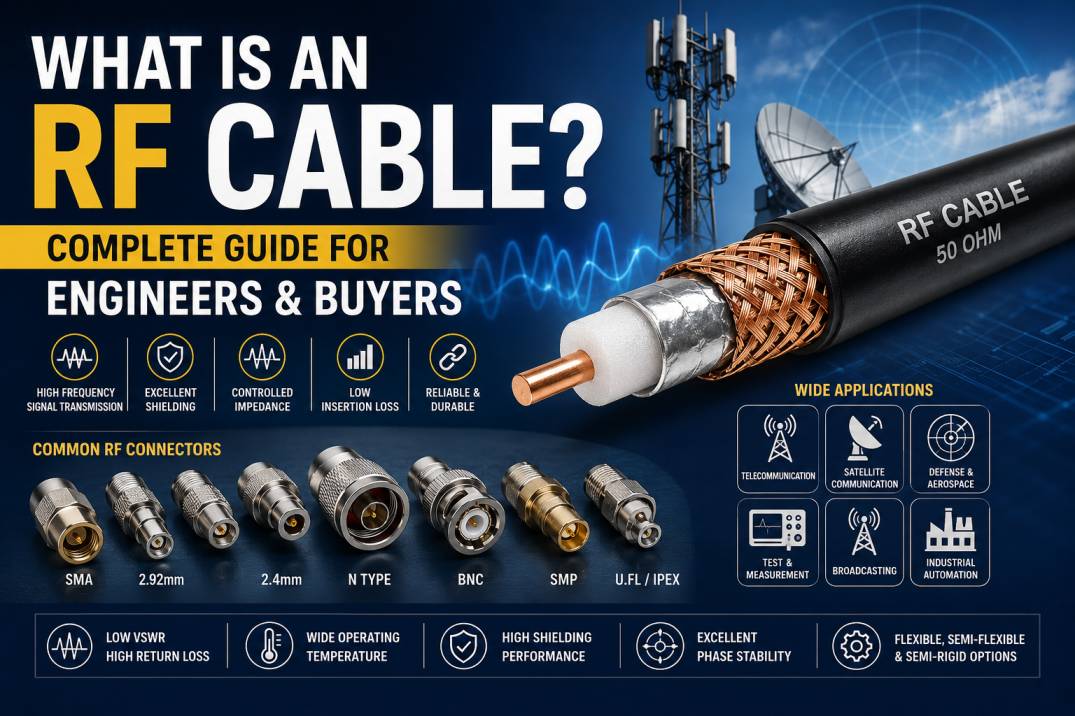
Radio Frequency (RF) cables are the backbone of modern communication systems. Whether you are designing a 5G network, building a satellite communication system, testing microwave equipment, or installing a Wi-Fi infrastructure, RF cables play a critical role in transmitting high-frequency signals with minimal loss.
Unlike ordinary electrical cables, RF cables are specifically engineered to carry radio frequency and microwave signals while maintaining signal integrity, reducing electromagnetic interference, and ensuring consistent impedance.
This comprehensive guide explains everything engineers, system integrators, procurement teams, and buyers need to know about RF cables, including their construction, working principle, types, specifications, applications, and selection criteria.
What Is an RF Cable?
An RF cable is a specially designed coaxial or multi-layer cable that transmits radio frequency signals from one device to another with minimal attenuation and excellent shielding.
RF cables are widely used in communication systems operating from a few megahertz (MHz) to several gigahertz (GHz), depending on the cable type and construction.
These cables are commonly used to connect:
- RF antennas
- Base stations
- Test equipment
- RF amplifiers
- Power splitters
- Directional couplers
- Filters
- RF modules
- Satellite equipment
- Radar systems
The primary objective of an RF cable is to preserve signal quality while minimizing insertion loss, reflection, and interference.
How Does an RF Cable Work?
An RF cable carries electromagnetic signals through a central conductor while a surrounding shield prevents external electromagnetic interference from affecting signal quality.
The signal travels along the center conductor, while the outer conductor serves as the return path and acts as a protective shield.
A dielectric material separates these conductors, maintaining a consistent impedance throughout the cable.
This unique construction enables RF cables to transport high-frequency signals with low loss over varying distances.
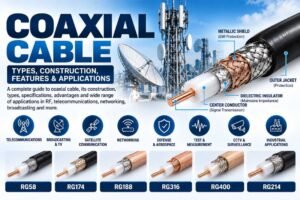
Construction of an RF Cable
Understanding the cable structure helps engineers choose the correct cable for different applications.
Center Conductor
The center conductor carries the RF signal.
Common materials include:
- Copper
- Silver-plated copper
- Copper-clad aluminum
Silver-plated conductors provide lower resistance at microwave frequencies.
Dielectric Insulation
The dielectric separates the center conductor from the outer shield.
Popular dielectric materials include:
- PTFE (Teflon)
- FEP
- Polyethylene
- Foam PE
The dielectric directly affects signal velocity, impedance, and attenuation.
Outer Shield
The shield prevents electromagnetic interference from entering or leaving the cable.
Shield options include:
- Braided copper
- Aluminum foil
- Double shield
- Triple shield
- Corrugated copper
Better shielding results in lower signal leakage.
Outer Jacket
The jacket protects the cable against:
- Moisture
- UV radiation
- Chemicals
- Mechanical damage
- Temperature extremes
Common jacket materials include:
- PVC
- Polyurethane
- LSZH
- TPE
- FEP
Key Characteristics of RF Cables
High-frequency signal transmission
Excellent shielding effectiveness
Controlled impedance
Low insertion loss
Low VSWR
High return loss
Excellent phase stability
Flexible or semi-rigid construction
Wide operating temperature range
Long service life
Types of RF Cables
Flexible RF Cable
Flexible RF cables are easy to bend and install.
Applications include:
- Wireless systems
- Indoor installations
- Instrumentation
- Telecom equipment
Advantages:
- Easy routing
- Lightweight
- Cost-effective
Semi-Flexible RF Cable
Semi-flexible cables provide better electrical performance while maintaining moderate flexibility.
Applications include:
- Aerospace
- Defense
- Microwave assemblies
- RF modules
Advantages:
- Lower attenuation
- Better shielding
- Stable electrical characteristics
Semi-Rigid RF Cable
Semi-rigid cables feature a solid outer conductor for maximum performance.
Applications include:
- Radar
- Satellites
- Military systems
- Test equipment
Advantages:
- Excellent phase stability
- Very low signal loss
- High shielding effectiveness
Corrugated RF Cable
These cables are used in long-distance telecom installations.
Applications include:
- Cellular towers
- Outdoor antenna systems
- DAS installations
Advantages:
- Low attenuation
- Weather resistance
- Long lifespan
Low Loss RF Cable
Designed to reduce attenuation over long cable runs.
Applications include:
- Wi-Fi networks
- RF repeaters
- Base stations
- Broadcast systems
Common RF Cable Impedance
Choosing the correct impedance is essential.
50 Ohm RF Cable
Used for:
- Wireless communication
- Military equipment
- RF testing
- Microwave systems
- Radar
75 Ohm RF Cable
Used for:
- Television
- Video transmission
- CCTV
- Broadcasting
RF Cable Frequency Range
Different cable constructions support different frequencies.
Typical operating ranges include:
- DC to 1 GHz
- DC to 6 GHz
- DC to 18 GHz
- DC to 26.5 GHz
- DC to 40 GHz
- DC to 50 GHz
- DC to 67 GHz
- DC to 110 GHz
Higher frequencies require precision-manufactured cables with tighter tolerances.
Popular RF Cable Types
Several industry-standard RF cables are commonly used.
- RG58
- RG174
- RG316
- RG400
- LMR195
- LMR240
- LMR400
- LMR600
- Low Loss LP Series
- Temperature Phase Stable Cables
- Semi-Rigid GS Series
- Semi-Flexible FS Series
- Ultra Flexible FU Series
- Thermal Vacuum RF Cables
Common RF Connectors Used with RF Cables
RF cables are terminated using precision RF connectors.
Popular connector types include:
- SMA
- 2.92mm
- 2.4mm
- 1.85mm
- N Type
- BNC
- TNC
- SMP
- SMPM
- MMCX
- MCX
- QMA
- QN
- 4.3-10
- 7/16 DIN
- U.FL
- IPEX
Connector selection depends on frequency, power, mating cycles, and environmental conditions.
Advantages of RF Cables
Superior signal integrity
Excellent shielding against EMI and RFI
Low insertion loss
Stable impedance
High-frequency capability
Reliable long-term performance
Wide connector compatibility
Suitable for indoor and outdoor environments
Available in flexible and rigid constructions
High mechanical durability
Applications of RF Cables
RF cables are essential across many industries.
Telecommunications
- 4G networks
- 5G infrastructure
- Small cells
- DAS systems
- Base stations
Aerospace
- Aircraft communication
- Navigation systems
- Flight testing
Defense
- Radar
- Electronic warfare
- Missile guidance
- Tactical communication
Satellite Communication
- Ground stations
- Satellite terminals
- VSAT systems
Broadcasting
- Radio stations
- Television transmitters
- Studio equipment
Medical Equipment
- MRI systems
- Diagnostic equipment
- Imaging systems
Industrial Automation
- Wireless monitoring
- Remote sensing
- Factory communication
Test and Measurement
- Spectrum analyzers
- Signal generators
- Vector network analyzers
- Oscilloscopes
Important RF Cable Specifications
Before purchasing an RF cable, engineers should evaluate several critical parameters.
Frequency Range
Ensure the cable supports the intended operating frequency.
Impedance
Most RF systems require either 50 Ohm or 75 Ohm impedance.
Insertion Loss
Lower insertion loss results in stronger signal transmission.
VSWR
Lower VSWR indicates better impedance matching and fewer reflections.
Shielding Effectiveness
High shielding reduces electromagnetic interference.
Power Handling
Verify that the cable can safely handle the required RF power.
Phase Stability
Critical for precision measurement systems and phased-array applications.
Bend Radius
Smaller bend radius simplifies installation in compact spaces.
Operating Temperature
Choose cables rated for the expected environmental conditions.
How to Choose the Right RF Cable
Selecting the appropriate RF cable depends on multiple factors.
Determine the operating frequency.
Choose the correct impedance.
Calculate acceptable signal loss.
Identify indoor or outdoor installation requirements.
Consider flexibility needs.
Verify connector compatibility.
Review power handling capability.
Evaluate shielding performance.
Check environmental resistance.
Ensure compliance with industry standards.
Common Problems with RF Cables
Improper cable selection or installation can result in poor system performance.
Common issues include:
- Excessive attenuation
- High VSWR
- Connector damage
- Signal reflections
- Water ingress
- Cable kinking
- Poor shielding
- Impedance mismatch
Routine inspection and proper installation significantly improve cable lifespan.
Maintenance Tips
Inspect connectors regularly.
Avoid excessive bending.
Protect cables from moisture.
Use the recommended torque for connectors.
Replace damaged cable assemblies immediately.
Store cables properly when not in use.
Test insertion loss and VSWR periodically.
Why Engineers Choose High-Quality RF Cables
Professional RF systems require stable electrical performance over many years.
Premium RF cables provide:
- Lower signal loss
- Better impedance control
- Higher reliability
- Improved shielding
- Longer operating life
- Superior mechanical strength
- Better high-frequency performance
These benefits reduce maintenance costs while improving overall system efficiency.
Conclusion
RF cables are one of the most important components in any high-frequency communication system. From 5G infrastructure and satellite communication to aerospace, defense, medical equipment, and laboratory testing, the right RF cable ensures reliable signal transmission with minimal loss and maximum performance.
Selecting the proper cable involves evaluating frequency range, impedance, insertion loss, shielding, flexibility, connector compatibility, and environmental requirements. Investing in high-quality RF cables helps engineers achieve better signal integrity, lower maintenance, and long-term reliability in even the most demanding RF and microwave applications.
Frequently Asked Questions
What is an RF cable?
An RF cable is a specially designed cable used to transmit radio frequency and microwave signals while maintaining low loss, controlled impedance, and high shielding.
What is the difference between an RF cable and a normal cable?
RF cables are engineered for high-frequency signal transmission with precise impedance and shielding, while standard electrical cables are designed primarily for power distribution.
What impedance is most common for RF cables?
The two most common impedance values are 50 Ohm for RF communication systems and 75 Ohm for video and broadcasting applications.
Where are RF cables used?
RF cables are widely used in telecommunications, 5G networks, aerospace, defense, satellite communication, radar, broadcasting, industrial automation, and RF test laboratories.
How long do RF cables last?
A high-quality RF cable can last 10–20 years or more, depending on operating conditions, installation quality, environmental exposure, and maintenance.