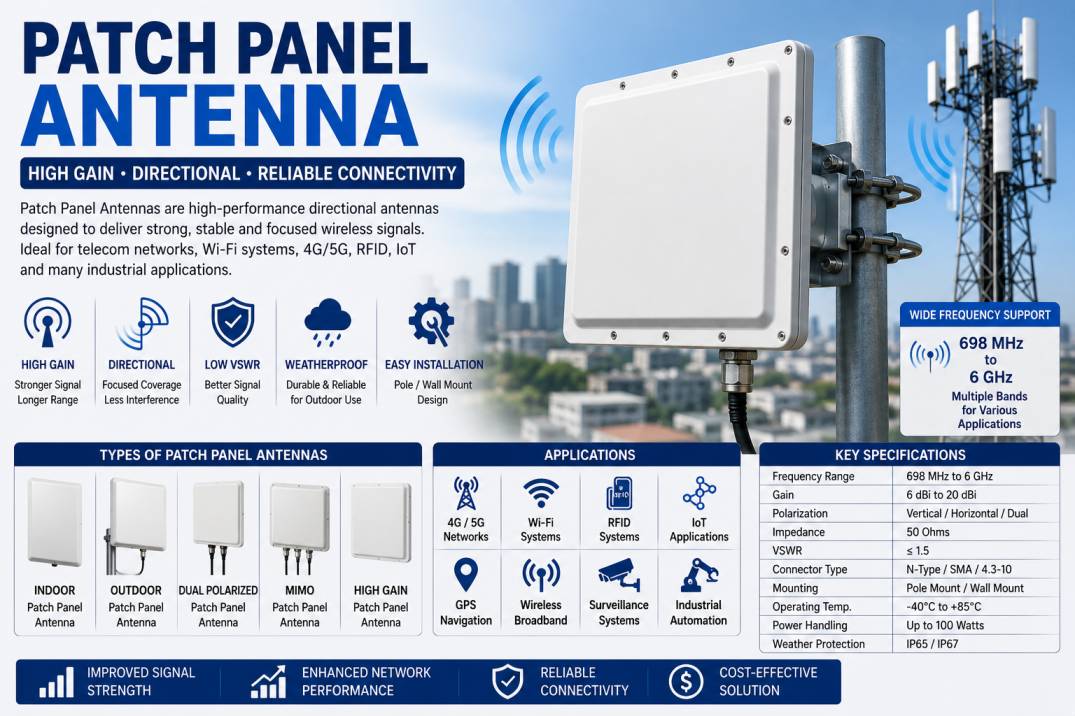
A Patch Panel Antenna is a high-performance directional antenna designed to transmit and receive radio frequency (RF) signals efficiently within a specific coverage area. Built using microstrip patch technology, these antennas offer excellent gain, stable performance, and compact construction, making them an ideal choice for modern wireless communication systems.
Patch Panel Antennas are widely used in cellular networks, Wi-Fi systems, GPS devices, RFID applications, IoT infrastructure, wireless broadband, surveillance systems, public safety communication, and 4G/5G telecom networks. Their directional radiation pattern allows them to focus RF energy in a specific direction, providing stronger signal strength, improved coverage, and reduced interference compared to omnidirectional antennas.
As wireless communication technologies continue to evolve, Patch Panel Antennas have become increasingly important for delivering reliable connectivity in indoor and outdoor environments. Their lightweight design, weather-resistant construction, and high-frequency compatibility make them suitable for commercial, industrial, and telecommunications applications.
This comprehensive guide explains everything about Patch Panel Antennas, including their construction, working principle, types, specifications, applications, advantages, and selection criteria.
What Is a Patch Panel Antenna?
A Patch Panel Antenna is a flat directional antenna that uses one or more conductive metal patches mounted on a dielectric substrate above a ground plane to radiate RF energy. The antenna is enclosed in a protective panel housing that provides durability and weather resistance while maintaining consistent signal performance.
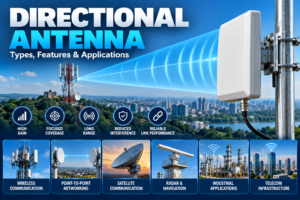
Unlike omnidirectional antennas that transmit signals in all directions, a Patch Panel Antenna concentrates RF energy into a focused beam, resulting in higher gain, longer communication distance, and better signal quality.
These antennas operate across various frequency bands and are commonly used in wireless communication systems where controlled signal coverage is required.
How Does a Patch Panel Antenna Work?
A Patch Panel Antenna converts electrical RF signals into electromagnetic waves using a metallic patch element positioned above a ground plane.
When RF energy reaches the antenna through the feed network, the patch radiates electromagnetic waves toward the desired direction. The ground plane minimizes backward radiation while directing maximum energy toward the target coverage area.
Because of their directional radiation pattern, Patch Panel Antennas provide:
Higher signal strength
Improved communication range
Reduced interference
Better signal-to-noise ratio
Higher data throughput
Stable wireless connectivity
Construction of a Patch Panel Antenna
Radiating Patch
The radiating element is a conductive metal patch responsible for transmitting RF energy.
Common materials include:
- Copper
- Aluminum
- Silver-plated copper
Dielectric Substrate
The substrate supports the patch while maintaining electrical isolation.
Common materials include:
- FR4
- PTFE
- Rogers Laminate
- Ceramic-filled PTFE
Ground Plane
The metallic ground plane improves antenna efficiency by reflecting RF energy in the forward direction.
Feed Network
The feed network delivers RF power from the cable to the patch element.
Common feed methods include:
- Microstrip Feed
- Coaxial Probe Feed
- Aperture Coupled Feed
- Proximity Coupled Feed
Protective Radome
The radome protects the antenna against environmental conditions such as rain, dust, UV radiation, and temperature variations.
Key Features of Patch Panel Antenna
- High directional gain
- Compact design
- Lightweight construction
- Excellent front-to-back ratio
- Low VSWR
- Wide frequency compatibility
- Stable signal transmission
- Low wind loading
- Weather-resistant housing
- Easy installation
- Low maintenance
- High radiation efficiency
Technical Specifications
| Specification | Typical Value |
| Frequency Range | 698 MHz to 6 GHz |
| Gain | 6 dBi to 20 dBi |
| Polarization | Vertical, Horizontal, Dual |
| VSWR | Less than 1.5 |
| Impedance | 50 Ohms |
| Connector Type | N-Type, SMA, 4.3-10 |
| Operating Temperature | -40°C to +85°C |
| Mounting Type | Pole or Wall Mount |
| Beamwidth | 20°–120° |
| Power Handling | Up to 100 Watts |
Types of Patch Panel Antennas
Indoor Patch Panel Antenna
Designed for offices, shopping malls, hospitals, airports, hotels, and indoor wireless coverage.
Outdoor Patch Panel Antenna
Engineered with weatherproof enclosures for telecom towers, industrial sites, and outdoor wireless communication.
Dual Polarized Patch Panel Antenna
Supports both vertical and horizontal polarization for improved data throughput and MIMO applications.
MIMO Patch Panel Antenna
Designed specifically for modern LTE and 5G communication systems requiring multiple data streams.
High Gain Patch Panel Antenna
Provides long-distance directional communication for wireless broadband and point-to-point links.
Operating Frequency Bands
Patch Panel Antennas support multiple communication bands including:
- 700 MHz
- 800 MHz
- 900 MHz
- 1.8 GHz
- 2.1 GHz
- 2.4 GHz
- 2.6 GHz
- 3.5 GHz
- 5 GHz
- 5.8 GHz
Applications of Patch Panel Antenna
Cellular Networks
4G LTE
5G NR
Small Cells
Base Stations
Wi-Fi Networks
Enterprise Wi-Fi
Campus Networks
Wireless Hotspots
Industrial WLAN
RFID Systems
Inventory tracking
Warehouse management
Asset monitoring
Access control
IoT Infrastructure
Smart factories
Smart cities
Industrial sensors
Connected devices
GPS Systems
Navigation
Vehicle tracking
Fleet management
Survey equipment
Public Safety Communication
Police networks
Emergency communication
Fire services
Disaster management
Wireless Broadband
Point-to-point communication
Fixed wireless access
Internet service providers
Security Systems
CCTV transmission
Wireless surveillance
Remote monitoring
Advantages of Patch Panel Antenna
- High gain
- Directional coverage
- Low interference
- Excellent signal quality
- Compact design
- Lightweight
- Easy installation
- High efficiency
- Low maintenance
- Long operational life
- Supports MIMO technology
- Weather-resistant construction
Limitations of Patch Panel Antenna
- Limited coverage angle
- Requires proper alignment
- Lower coverage than omnidirectional antennas
- Performance depends on installation position
- Directional beam may require adjustment
How to Choose the Right Patch Panel Antenna
Before selecting a Patch Panel Antenna, consider:
- Operating frequency
- Gain requirement
- Beamwidth
- Polarization
- Connector type
- Mounting method
- Cable compatibility
- Environmental conditions
- Power handling
- Weather protection
Patch Panel Antenna vs Omnidirectional Antenna
| Feature | Patch Panel Antenna | Omnidirectional Antenna |
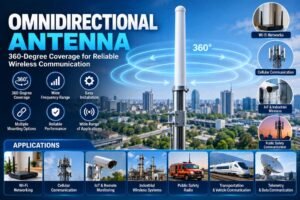
| Radiation Pattern | Directional | 360° |
| Gain | High | Moderate |
| Coverage Distance | Longer | Shorter |
| Interference | Lower | Higher |
| Installation | Direction Sensitive | Easy |
| Best Application | Point-to-Point & Sector Coverage | General Coverage |
Industries Using Patch Panel Antennas
Patch Panel Antennas are widely used in:
- Telecommunications
- Industrial Automation
- Transportation
- Defense
- Aerospace
- Smart Cities
- Warehousing
- Healthcare
- Education
- Broadcasting
- Public Safety
- Manufacturing
Installation Tips
For optimal performance:
- Mount the antenna at the recommended height.
- Aim the antenna toward the target coverage area.
- Use high-quality low-loss RF cables.
- Minimize cable length to reduce attenuation.
- Ensure proper grounding for outdoor installations.
- Avoid nearby metal obstructions.
- Use weatherproof connectors in outdoor environments.
Future Trends of Patch Panel Antennas
As wireless technologies continue to evolve toward 5G Advanced and future 6G networks, Patch Panel Antennas are becoming more sophisticated with higher gain, wider bandwidth, integrated MIMO capabilities, beamforming support, and improved weather resistance. Manufacturers are developing lightweight, compact antennas capable of operating across multiple frequency bands while supporting smart cities, IoT infrastructure, autonomous vehicles, industrial automation, and high-capacity wireless broadband networks.
Conclusion
Patch Panel Antennas have become an essential component of modern wireless communication systems due to their high directional gain, excellent signal quality, compact design, and reliable performance. They are widely deployed in telecommunications, Wi-Fi, RFID, GPS, industrial automation, public safety, and 5G infrastructure. By selecting the appropriate gain, frequency range, beamwidth, polarization, and connector type, users can achieve optimal wireless coverage and long-term communication reliability.
Frequently Asked Questions (FAQs)
1. What is a Patch Panel Antenna?
A Patch Panel Antenna is a directional RF antenna that uses a flat microstrip patch element to transmit and receive wireless signals with high gain and focused coverage.
2. What are Patch Panel Antennas used for?
They are used in 4G LTE, 5G, Wi-Fi, RFID, GPS, wireless broadband, IoT, surveillance systems, and industrial communication.
3. What is the advantage of a Patch Panel Antenna?
The main advantages include high gain, directional coverage, reduced interference, improved signal strength, and better communication range.
4. What frequency bands do Patch Panel Antennas support?
Most Patch Panel Antennas support frequencies from 698 MHz to 6 GHz, depending on the design and application.
5. Are Patch Panel Antennas suitable for outdoor use?
Yes. Outdoor Patch Panel Antennas feature weatherproof radomes and rugged construction for reliable operation in harsh environments.
6. What connector types are available for Patch Panel Antennas?
Common connector options include N-Type, SMA, and 4.3-10 connectors.
7. Can Patch Panel Antennas support 5G networks?
Yes. Modern Patch Panel Antennas are designed to support LTE, 5G NR, MIMO, and advanced wireless communication technologies.
8. What gain values are available for Patch Panel Antennas?
Typical gain values range from 6 dBi to 20 dBi, depending on the antenna size and intended application.
9. How do I choose the right Patch Panel Antenna?
Select the antenna based on frequency band, gain, beamwidth, polarization, connector type, mounting method, and installation environment.
10. What industries use Patch Panel Antennas?
Patch Panel Antennas are widely used in telecommunications, industrial automation, transportation, healthcare, defense, aerospace, public safety, broadcasting, warehousing, and smart city infrastructure.