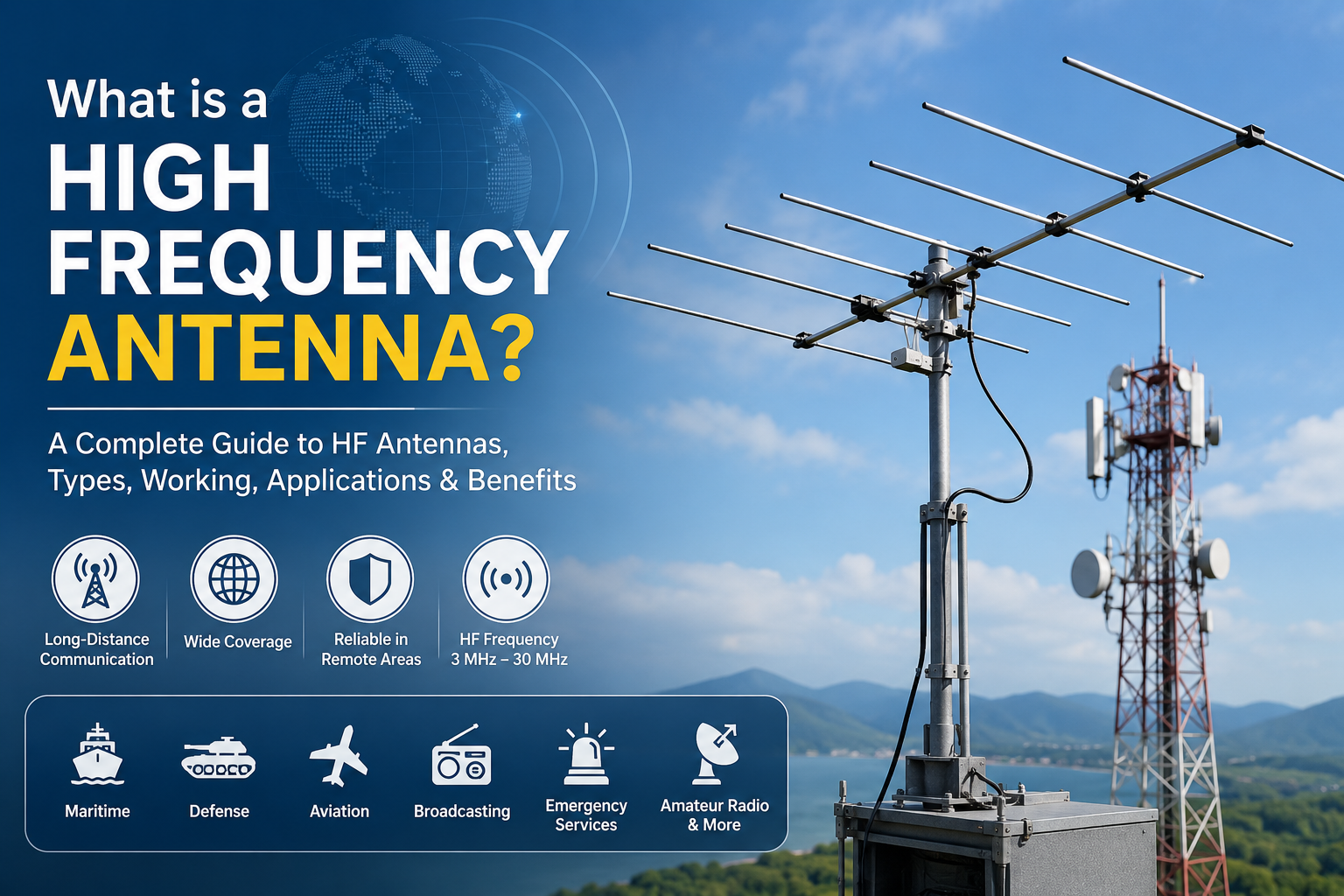
A High Frequency (HF) antenna is a specially designed antenna used to transmit and receive radio signals in the High Frequency (HF) band, which ranges from 3 MHz to 30 MHz. Unlike antennas operating at higher frequencies, HF antennas can communicate over hundreds or even thousands of kilometers by reflecting radio waves off the Earth’s ionosphere. This unique capability makes them essential for long-distance communication, military operations, broadcasting, maritime communication, aviation, emergency response, and amateur radio applications.
At SRFS Teleinfra, we manufacture and supply high-performance RF and telecom solutions designed to support reliable communication systems across various industries.
How Does a High Frequency Antenna Work?
A High Frequency antenna converts electrical RF signals into electromagnetic waves and radiates them into the atmosphere. When transmitted within the HF frequency range (3–30 MHz), these signals can travel beyond the horizon by bouncing off the ionosphere, enabling long-distance communication without relying on satellites or cellular infrastructure.
This propagation method, known as Skywave Propagation, allows HF antennas to provide dependable communication even in remote locations where conventional communication networks are unavailable.
High Frequency Antenna Frequency Range
| Frequency Band | Frequency Range | Typical Applications |
|---|---|---|
| Low HF | 3–10 MHz | Maritime, Military Communication |
| Mid HF | 10–20 MHz | Amateur Radio, Aviation |
| High HF | 20–30 MHz | International Broadcasting, Emergency Networks |
Types of High Frequency Antennas
1. Dipole HF Antenna
The Dipole antenna is one of the most commonly used HF antennas due to its simple construction, excellent radiation efficiency, and cost-effectiveness. It is widely used in amateur radio, military communication, and fixed communication stations.
Features
- Easy installation
- Broad frequency coverage
- High radiation efficiency
- Low maintenance
2. Vertical HF Antenna
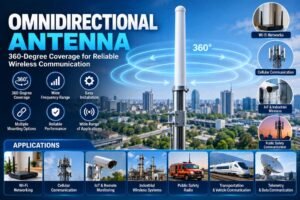
Vertical HF antennas provide omnidirectional signal coverage, making them ideal for marine vessels, emergency communication systems, and mobile applications.
Features
- 360° coverage
- Compact design
- Excellent ground-wave performance
- Suitable for limited installation space
3. Yagi HF Antenna
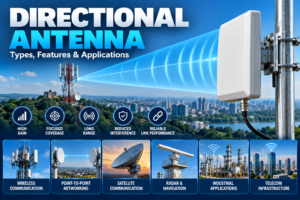
Yagi antennas are directional antennas designed to provide higher gain and longer communication distances.
Features
- High gain
- Directional radiation pattern
- Reduced interference
- Long-distance communication
4. Log Periodic HF Antenna
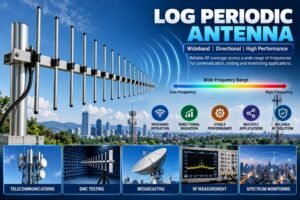
Log Periodic antennas support multiple frequencies without changing antenna dimensions, making them suitable for military, broadcasting, and monitoring applications.
Features
- Wide bandwidth
- Stable performance
- Multiple frequency operation
- Excellent signal consistency
5. Loop HF Antenna
Loop antennas are compact and highly resistant to electrical noise, making them suitable for receiving weak signals.
Features
- Low noise
- Compact installation
- High receiving sensitivity
- Indoor and outdoor applications
Key Features of High Frequency Antennas
- Wide frequency coverage (3–30 MHz)
- Long-distance communication capability
- Excellent signal stability
- Low transmission loss
- Durable weather-resistant construction
- High radiation efficiency
- Easy installation and maintenance
- Reliable performance in harsh environments
Applications of High Frequency Antennas
High Frequency antennas are widely used across multiple industries due to their ability to provide reliable long-range communication.
Telecommunications
Support long-distance wireless communication networks and backup communication systems.
Military & Defense
Enable secure battlefield communication and tactical operations.
Maritime Communication
Provide reliable ship-to-shore and ship-to-ship communication.
Aviation
Support aircraft communication over long distances.
Emergency Services
Maintain communication during natural disasters and network failures.
Broadcasting
Transmit radio programs to national and international audiences.
Amateur Radio
Used by HAM radio operators for worldwide communication.
Scientific Research
Support ionospheric studies and radio propagation research.
Advantages of High Frequency Antennas
- Reliable long-range communication
- No dependency on satellite networks
- Cost-effective communication solution
- Excellent performance in remote locations
- Wide coverage area
- Strong signal propagation
- Suitable for harsh environmental conditions
- Low operating cost
Factors to Consider When Choosing a High Frequency Antenna
Before selecting an HF antenna, consider the following factors:
- Operating frequency range
- Antenna gain
- Radiation pattern
- Polarization
- Installation location
- Power handling capacity
- Environmental conditions
- VSWR performance
- Bandwidth requirements
Choosing the right antenna ensures maximum signal efficiency, reduced losses, and reliable communication performance.
Why Choose SRFS Teleinfra for High Frequency Antennas?
SRFS Teleinfra is a trusted manufacturer and supplier of premium RF and telecom solutions. We provide high-quality High Frequency antennas designed for superior signal performance, durability, and reliable communication across diverse applications. Our products are manufactured using premium materials, advanced engineering practices, and strict quality control standards to meet the evolving needs of telecom, defense, industrial, and communication industries.
Frequently Asked Questions
What is the frequency range of a High Frequency antenna?
High Frequency antennas operate between 3 MHz and 30 MHz, enabling long-distance radio communication through ionospheric propagation.
Where are High Frequency antennas used?
They are commonly used in telecommunications, military, maritime, aviation, emergency services, broadcasting, scientific research, and amateur radio applications.
What are the advantages of High Frequency antennas?
HF antennas provide long-range communication, reliable signal transmission, low operating costs, wide coverage, and dependable performance in remote areas.
Which type of HF antenna is best?
The ideal HF antenna depends on the application. Dipole antennas are excellent for general communication, while Yagi antennas are preferred for high-gain directional communication.
How do High Frequency antennas achieve long-distance communication?
HF antennas use skywave propagation, where radio waves reflect off the Earth’s ionosphere, allowing communication over hundreds or thousands of kilometers without satellite infrastructure.
Conclusion
High Frequency antennas remain one of the most reliable solutions for long-distance wireless communication. Their ability to operate over vast distances, combined with excellent durability and versatile applications, makes them indispensable in modern telecommunications, defense, broadcasting, maritime, and emergency communication systems. By selecting a high-quality HF antenna designed for your specific requirements, organizations can ensure stable connectivity, enhanced signal performance, and dependable communication in even the most challenging environments