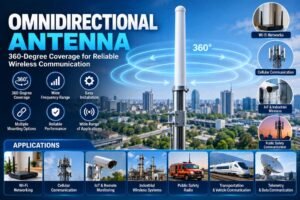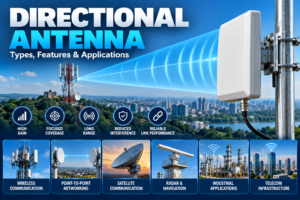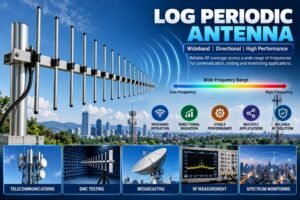
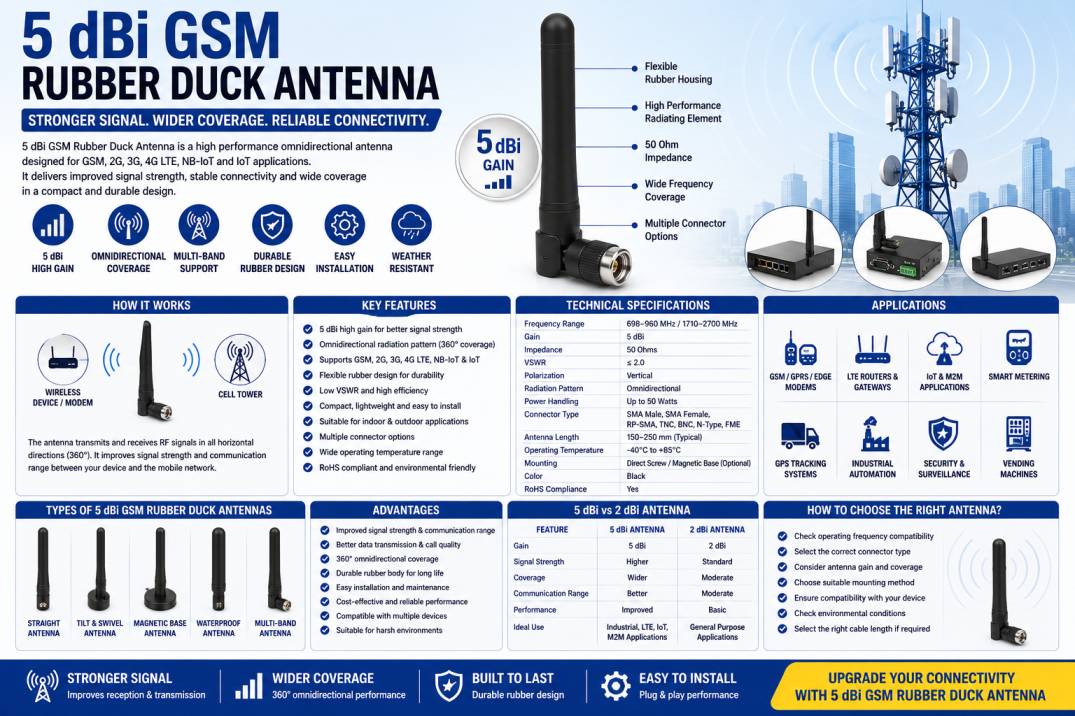
A 5 dBi GSM Rubber Duck Antenna is a compact omnidirectional antenna designed to improve the transmission and reception of GSM, GPRS, EDGE, 2G, 3G, 4G LTE, NB-IoT, and various wireless communication signals. It is one of the most commonly used antennas in industrial communication equipment, IoT devices, wireless terminals, telemetry systems, GSM modems, routers, M2M (Machine-to-Machine) applications, and embedded communication systems.
The name “Rubber Duck” comes from its flexible rubber-coated exterior, which protects the internal antenna element from physical damage while providing durability in demanding environments. With a gain of 5 dBi, this antenna offers improved signal strength and wider coverage compared to standard 2 dBi antennas, making it an excellent choice for both indoor and outdoor wireless applications.
Designed for ease of installation and reliable performance, the 5 dBi GSM Rubber Duck Antenna supports multiple frequency bands and is available with connectors such as SMA, RP-SMA, TNC, BNC, N-Type, and FME. It provides stable wireless communication while maintaining a compact, lightweight design suitable for modern communication devices.
This comprehensive guide explains everything you need to know about the 5 dBi GSM Rubber Duck Antenna, including its construction, working principle, technical specifications, applications, advantages, and selection criteria.
What Is a 5 dBi GSM Rubber Duck Antenna?
A 5 dBi GSM Rubber Duck Antenna is an omnidirectional whip antenna enclosed in a flexible rubber housing that enhances GSM and cellular communication by transmitting and receiving radio frequency signals efficiently across multiple frequency bands.
The antenna is specifically designed to improve signal coverage without requiring a large installation space. Its 5 dBi gain provides stronger signal reception than standard low-gain antennas while maintaining nearly 360-degree coverage.
Because of its compact size and rugged construction, it is widely used in GSM modems, LTE routers, industrial gateways, remote monitoring systems, wireless terminals, GPS trackers, vending machines, smart meters, and IoT communication devices.
How Does a 5 dBi GSM Rubber Duck Antenna Work?
The antenna converts electrical RF signals into electromagnetic waves during transmission and converts incoming electromagnetic waves back into electrical signals during reception.
The communication process includes:
- RF signal is generated by the modem or wireless device.
- The signal travels through the RF connector.
- The antenna radiates electromagnetic waves in all horizontal directions.
- Remote cellular towers receive the transmitted signal.
- Incoming RF signals are captured by the antenna.
- The signals are delivered back to the communication device.
Its omnidirectional radiation pattern ensures reliable communication regardless of the device’s orientation.
Construction of a 5 dBi GSM Rubber Duck Antenna
Radiating Element
The internal radiating element is designed to operate efficiently across GSM frequency bands.
It is commonly manufactured using:
- Copper
- Brass
- Phosphor Bronze
Flexible Rubber Housing
The outer rubber covering protects the antenna from:
- Physical impact
- Dust
- Moisture
- UV exposure
- Mechanical stress
The flexible design also prevents damage during transportation and installation.
Connector
Various RF connector options are available, including:
- SMA Male
- SMA Female
- RP-SMA
- TNC
- BNC
- N-Type
- FME
The connector selection depends on the communication equipment.
Internal Matching Network
The antenna includes an impedance matching circuit to maintain:
- 50 Ohm impedance
- Low VSWR
- Efficient power transfer
Base Assembly
The base provides mechanical stability and secure attachment to wireless devices.
Working Principle of a 5 dBi GSM Rubber Duck Antenna
The antenna radiates RF energy in a nearly horizontal omnidirectional pattern.
Its operation includes:
- RF power enters through the connector.
- Current flows through the internal antenna element.
- Electromagnetic waves are generated.
- The antenna broadcasts signals uniformly around the device.
- Incoming RF signals are captured and transferred to the modem.
- Stable wireless communication is established.
The optimized antenna length and matching network improve signal efficiency across supported frequency bands.
Technical Specifications
| Specification | Typical Value |
| Frequency Range | 698–960 MHz / 1710–2700 MHz |
| Gain | 5 dBi |
| Polarization | Vertical |
| Radiation Pattern | Omnidirectional |
| Impedance | 50 Ohms |
| VSWR | ≤ 2.0 |
| Connector Type | SMA, RP-SMA, TNC, BNC, N-Type |
| Power Handling | Up to 50 Watts |
| Operating Temperature | -40°C to +85°C |
| Antenna Length | 150–250 mm (Typical) |
Key Features of a 5 dBi GSM Rubber Duck Antenna
- 5 dBi signal gain
- Omnidirectional coverage
- Flexible rubber coating
- Compact and lightweight design
- Multi-band GSM compatibility
- Low VSWR
- High durability
- Easy installation
- Excellent signal stability
- Weather-resistant construction
- Long operational life
- Wide connector compatibility
Types of 5 dBi GSM Rubber Duck Antennas
Straight Rubber Duck Antenna
Designed for direct vertical installation on communication devices.
Tilt and Swivel Antenna
Allows adjustable positioning for improved signal optimization.
Magnetic Base Rubber Duck Antenna
Mounted using a magnetic base for temporary installations.
Waterproof Rubber Duck Antenna
Designed for outdoor communication equipment with enhanced environmental protection.
Multi-Band GSM Rubber Duck Antenna
Supports GSM, 3G, 4G LTE, NB-IoT, and LTE-M communication in a single antenna.
Applications of 5 dBi GSM Rubber Duck Antennas
GSM Modems
Improves signal strength for industrial GSM communication.
LTE Routers
Provides stable cellular internet connectivity.
IoT Devices
Supports wireless communication in smart sensors and IoT gateways.
M2M Communication
Used in machine-to-machine communication systems.
Smart Metering
Enables remote data collection in utility networks.
Industrial Automation
Supports wireless monitoring and industrial control systems.
GPS Tracking Systems
Enhances communication between tracking devices and cellular networks.
Security Systems
Provides reliable connectivity for alarm panels and surveillance equipment.
Vending Machines
Maintains uninterrupted cellular communication for payment processing and monitoring.
Remote Monitoring Systems
Used in environmental monitoring, agriculture, and infrastructure management.
Advantages of a 5 dBi GSM Rubber Duck Antenna
- Improved GSM signal reception
- Better communication range
- Omnidirectional coverage
- Durable rubber housing
- Lightweight construction
- Easy installation
- Cost-effective solution
- Multi-band compatibility
- Reliable indoor and outdoor performance
- Low maintenance
- Long service life
- Suitable for industrial environments
Limitations of a 5 dBi GSM Rubber Duck Antenna
- Lower gain than large directional antennas
- Limited long-distance communication
- Performance depends on installation height
- Signal quality can be affected by nearby metal objects
- Requires compatible RF connectors
How to Choose the Right 5 dBi GSM Rubber Duck Antenna
When selecting a GSM Rubber Duck Antenna, consider:
- Operating frequency
- Connector type
- Antenna gain
- Polarization
- Mounting method
- Cable requirements
- Indoor or outdoor use
- Environmental conditions
- Device compatibility
- Network technology support
5 dBi GSM Rubber Duck Antenna vs 2 dBi GSM Antenna
| Feature | 5 dBi GSM Rubber Duck Antenna | 2 dBi GSM Antenna |
| Gain | Higher | Lower |
| Signal Coverage | Wider | Standard |
| Communication Range | Better | Moderate |
| Antenna Length | Longer | Shorter |
| Performance | Improved | Basic |
| Typical Applications | Industrial, LTE, IoT | Consumer Devices |
Industries Using 5 dBi GSM Rubber Duck Antennas
These antennas are widely used in:
- Telecommunications
- Industrial Automation
- Smart Cities
- IoT
- Transportation
- Agriculture
- Healthcare
- Energy Utilities
- Security Systems
- Remote Monitoring
- Retail
- Manufacturing
Maintenance Tips
To maximize antenna performance:
- Keep the connector clean.
- Tighten the antenna securely.
- Avoid excessive bending.
- Protect outdoor installations from physical damage.
- Inspect connectors periodically.
- Maintain proper antenna orientation.
- Replace damaged antennas immediately.
Future Trends of 5 dBi GSM Rubber Duck Antennas
As IoT, Industry 4.0, LTE-M, NB-IoT, private LTE, and 5G machine communication continue expanding, demand for compact high-performance antennas is increasing. Future 5 dBi GSM Rubber Duck Antennas will feature wider frequency coverage, improved efficiency, enhanced weather resistance, reduced signal loss, and compatibility with next-generation cellular technologies. Manufacturers are also focusing on lightweight materials, environmentally resistant coatings, and advanced internal matching networks to deliver better performance across industrial and commercial wireless applications.
Conclusion
The 5 dBi GSM Rubber Duck Antenna is a reliable and cost-effective solution for improving wireless communication in GSM, LTE, IoT, and industrial applications. Its omnidirectional radiation pattern, durable rubber-coated design, multi-band compatibility, and enhanced signal gain make it ideal for routers, modems, gateways, smart meters, tracking systems, and machine-to-machine communication devices. Selecting the correct frequency range, connector type, and installation method ensures consistent signal quality, reliable connectivity, and long-term performance in demanding wireless environments.
Frequently Asked Q@uestions (FAQs)
1. What is a 5 dBi GSM Rubber Duck Antenna?
A 5 dBi GSM Rubber Duck Antenna is a flexible omnidirectional antenna designed to improve GSM, 3G, 4G LTE, and IoT wireless communication by increasing signal strength and coverage.
2. What does 5 dBi mean in an antenna?
A 5 dBi gain indicates the antenna provides higher signal concentration than a standard isotropic radiator, resulting in improved communication range and signal quality.
3. What frequency bands does a 5 dBi GSM Rubber Duck Antenna support?
Most models support 698–960 MHz and 1710–2700 MHz, making them suitable for GSM, UMTS, LTE, and many IoT applications.
4. What is a GSM Rubber Duck Antenna used for?
It is commonly used with GSM modems, LTE routers, IoT gateways, M2M devices, GPS trackers, smart meters, industrial controllers, and wireless communication equipment.
5. What connector types are available?
Common connector options include SMA, RP-SMA, TNC, BNC, N-Type, and FME.
6. Is a 5 dBi GSM Rubber Duck Antenna suitable for outdoor use?
Yes. Many models are designed with weather-resistant rubber housings suitable for both indoor and outdoor environments.
7. What are the advantages of a 5 dBi GSM Rubber Duck Antenna?
It offers improved signal gain, omnidirectional coverage, durable construction, easy installation, multi-band compatibility, and reliable wireless performance.
8. What is the difference between a 5 dBi and a 2 dBi GSM antenna?
A 5 dBi antenna provides greater signal gain, wider coverage, and better communication range than a standard 2 dBi antenna.
9. Which industries use 5 dBi GSM Rubber Duck Antennas?
These antennas are widely used in telecommunications, industrial automation, IoT, transportation, healthcare, agriculture, smart cities, security systems, and energy utilities.
10. How do I choose the right 5 dBi GSM Rubber Duck Antenna?
Choose the antenna based on operating frequency, connector type, gain, polarization, mounting method, environmental conditions, and compatibility with your wireless communication device.