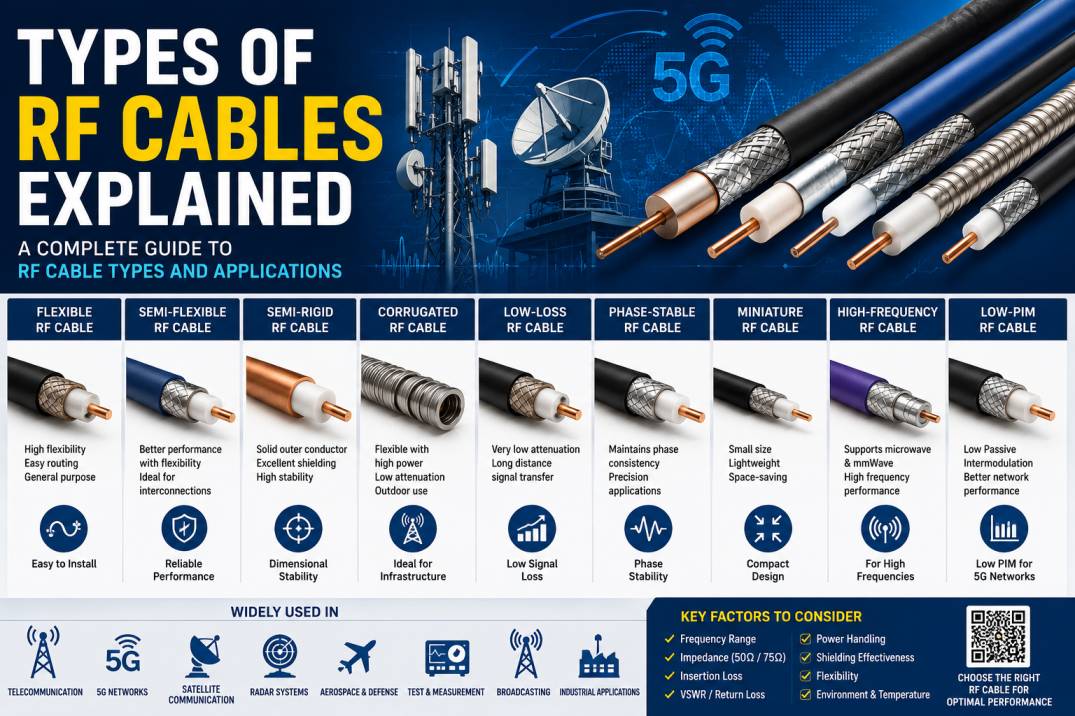
RF cables, or Radio Frequency cables, are essential components in wireless communication, telecom infrastructure, RF testing, radar, satellite communication, aerospace, defense, broadcasting, and 4G and 5G networks. They are designed to transfer high-frequency electrical signals between antennas, transmitters, receivers, amplifiers, filters, test equipment, and other RF components while maintaining signal integrity.
Choosing the correct RF cable is more complicated than simply selecting a cable based on its physical size. Frequency range, characteristic impedance, insertion loss, shielding effectiveness, flexibility, power handling, phase stability, operating temperature, cable length, and connector type all influence the suitability of an RF cable for a particular application.
There are several types of RF cables, including flexible coaxial cables, semi-rigid cables, semi-flexible cables, low-loss cables, corrugated cables, phase-stable cables, miniature coaxial cables, and specialized high-frequency cables.
This guide explains the major types of RF cables, their construction, advantages, limitations, applications, and the factors engineers should consider when selecting an RF cable.
What Is an RF Cable?
An RF cable is a transmission cable designed to carry radio frequency signals from one point to another with controlled electrical characteristics.
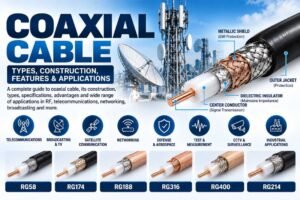
Most RF cables use a coaxial construction consisting of a center conductor, dielectric insulator, outer conductor or shield, and protective jacket.
The center conductor carries the RF signal, while the outer conductor normally provides the return path and shielding. The dielectric maintains the spacing between the conductors and contributes to the cable’s characteristic impedance.
The basic RF cable structure can be represented as:
Center Conductor → Dielectric → Shield/Outer Conductor → Protective Jacket
The exact construction varies depending on the cable type and intended application.
Why Are There Different Types of RF Cables?
No single RF cable can provide the ideal combination of flexibility, attenuation, shielding, power handling, frequency capability, mechanical strength, and phase stability for every application.
For example, a cable used inside an RF laboratory may prioritize phase stability and measurement accuracy, while a cable connecting a cellular antenna to a base station may prioritize low attenuation, weather resistance, and high power handling.
Similarly, a microwave test system may require a precision 2.92mm or 2.4mm cable assembly, while a telecom installation may use a larger corrugated coaxial feeder cable.
RF cable types are therefore developed for specific electrical, mechanical, environmental, and installation requirements.
Major Types of RF Cables
1. Flexible RF Cables
Flexible RF cables are designed to provide easy routing and bending without significantly compromising RF performance.
They generally use a stranded center conductor and a flexible braided or multilayer shield.
Flexible RF cables are commonly used where cables must be routed around equipment or connected to components that may move during operation.
Key Features of Flexible RF Cables
Flexible construction
Easy installation
Stranded center conductor
Braided shielding
Good mechanical flexibility
Available across many frequency ranges
Available with numerous RF connector configurations
Applications
Flexible RF cables are commonly used in:
RF test equipment
Wireless communication systems
Antenna connections
Laboratory instruments
Telecom equipment
Radio systems
Broadcasting equipment
Instrumentation
Advantages
The primary advantage is flexibility. They can be routed through relatively tight spaces and are easier to install than rigid transmission lines.
Limitations
Flexible cables can generally have higher attenuation than larger low-loss or semi-rigid cables. Repeated bending can also eventually affect cable performance if the cable is not designed for dynamic applications.
2. Semi-Flexible RF Cables
Semi-flexible RF cables provide a balance between electrical performance and mechanical flexibility.
They are more flexible than traditional semi-rigid cables but generally more mechanically stable than conventional flexible coaxial cables.
These cables are useful when a cable must be routed around equipment but does not require continuous repeated movement.
Applications
Semi-flexible RF cables are used in:
RF modules
Wireless equipment
Microwave systems
Test equipment
Aerospace electronics
Defense electronics
Communication systems
Instrumentation
Benefits
Good RF performance
Controlled impedance
Moderate flexibility
Good shielding
Suitable for compact equipment
Semi-flexible cables are particularly useful for equipment interconnections where installation geometry is important.
3. Semi-Rigid RF Cables
Semi-rigid RF cables are among the most widely used cable types in precision microwave and high-frequency applications.
They normally use a solid metallic outer conductor rather than a braided shield.
The solid outer conductor provides excellent shielding, dimensional stability, and predictable RF performance.
Construction
A typical semi-rigid RF cable consists of:
Solid center conductor
PTFE or specialized dielectric
Solid metallic outer conductor
Optional protective jacket
The outer conductor may be made from copper or another suitable conductive material.
Advantages
Excellent shielding
High mechanical stability
Low signal leakage
Good impedance control
Excellent repeatability
Suitable for high-frequency applications
Applications
Semi-rigid cables are commonly used in:
Microwave circuits
RF laboratories
Aerospace
Defense
Radar
Satellite systems
Test equipment
RF modules
High-frequency instrumentation
Limitations
Semi-rigid cables are not designed for repeated bending. They are usually formed into the required routing shape during installation.
4. Corrugated RF Cables
Corrugated RF cables are widely used in telecommunications and wireless infrastructure.
Their outer conductor contains corrugations that provide mechanical flexibility while maintaining strong electromagnetic shielding.
Corrugated cables are particularly common in antenna feeder systems.
Key Features
Low attenuation
High power handling
Strong shielding
Outdoor durability
Mechanical flexibility
Long-distance RF transmission capability
Applications
Corrugated RF cables are commonly installed in:
Cellular base stations
4G networks
5G networks
Tower sites
Distributed antenna systems
Wireless infrastructure
Antenna feeder systems
RF transmission systems
Why Corrugated Cables Are Used in Telecom
Telecom towers require cables that can run considerable distances while handling high RF power and outdoor environmental conditions.
Corrugated construction provides a practical combination of flexibility, shielding, low loss, and mechanical strength.
5. Low-Loss RF Cables
Low-loss RF cables are designed specifically to minimize signal attenuation.
They are often constructed using larger conductors, low-loss dielectric materials, optimized shielding, and carefully controlled cable geometry.
Why Low Loss Matters
Every RF cable introduces some amount of signal attenuation.
When the cable is long or the operating frequency is high, the loss can become significant.
For example, excessive cable loss between a transmitter and antenna can reduce the amount of RF power reaching the antenna.
Similarly, excessive loss between an antenna and receiver can reduce the signal level available to the receiver.
Applications
Low-loss RF cables are widely used in:
Cellular networks
5G infrastructure
Antenna systems
Satellite communication
Broadcasting
Wireless communication
RF distribution systems
Long cable runs
6. Ultra-Low-Loss RF Cables
Ultra-low-loss RF cables are specialized versions of low-loss cables designed for applications where minimizing attenuation is extremely important.
They may use advanced dielectric materials, larger conductors, optimized shielding, and specialized cable structures.
Applications
Ultra-low-loss cables can be used in:
High-performance telecom networks
Base station systems
Long RF transmission paths
Broadcast infrastructure
Satellite systems
High-power RF systems
Antenna feeder systems
Their main purpose is to preserve as much RF signal power as possible across the transmission path.
7. Phase-Stable RF Cables
Phase-stable RF cables are designed to maintain predictable electrical phase when subjected to mechanical movement or temperature variations.
Phase stability is especially important in systems where the exact timing or phase relationship between signals matters.
Applications
Phase-stable cables are commonly used in:
Vector network analyzers
Phased-array antennas
Radar
Satellite communication
Aerospace systems
Defense electronics
RF measurement equipment
5G test systems
Why Phase Stability Matters
In a conventional cable, bending, stretching, compression, or temperature changes can alter the electrical length of the cable.
This can introduce phase changes that affect measurement accuracy and system synchronization.
Phase-stable cable designs use specialized dielectric materials and mechanical structures to reduce these variations.
8. Low-PIM RF Cables
PIM stands for Passive Intermodulation.
Passive intermodulation occurs when unwanted mixing products are generated by passive components exposed to multiple RF signals.
Low-PIM RF cables and assemblies are designed to minimize sources of passive intermodulation.
Applications
Low-PIM cable assemblies are particularly important in:
Cellular networks
5G networks
Distributed antenna systems
Indoor wireless systems
Base stations
Multi-carrier communication systems
Why Low PIM Is Important
High PIM can create interference within sensitive cellular systems.
A cable assembly with poor materials, inadequate connector construction, contamination, loose connections, or mechanical defects can contribute to PIM.
Low-PIM designs therefore focus on material quality, connector design, mechanical integrity, and manufacturing precision.
9. High-Frequency RF Cables
High-frequency RF cables are engineered for microwave and millimeter-wave applications.
At higher frequencies, small dimensional changes can have a significant effect on electrical performance.
These cables require precise control over:
Conductor dimensions
Dielectric geometry
Shielding
Connector interface
Impedance
Concentricity
Mechanical construction
Applications
High-frequency RF cables are used in:
Microwave laboratories
Radar
Aerospace
Defense
5G testing
Satellite communication
Millimeter-wave research
Semiconductor testing
Network analyzers
High-frequency instrumentation
10. Microwave RF Cables
Microwave cables are designed for higher-frequency applications where low loss, controlled impedance, low VSWR, and mechanical stability are important.
Many microwave cable assemblies use precision connectors such as:
SMA
2.92mm
2.4mm
1.85mm
SMP
SMPM
These cables are frequently used with laboratory and test equipment.
11. Miniature RF Cables
Miniature RF cables are designed for applications where space and weight are limited.
They have smaller diameters and can be terminated with miniature RF connectors.
Examples include cable assemblies using:
U.FL/IPEX
MMCX
MCX
SMP
SMPM
Miniature coaxial interfaces
Applications
Miniature RF cables are commonly found in:
Wireless modules
IoT equipment
GPS devices
Compact antennas
Mobile equipment
Embedded RF systems
Test equipment
Small communication devices
Their primary advantage is compact size.
12. Micro-Coaxial RF Cables
Micro-coaxial cables are very small coaxial cables designed for compact electronic systems.
They are commonly used when PCB space is limited and a conventional RF cable would be too large.
Applications
Micro-coaxial cables are used in:
Wireless modules
GPS systems
Laptop equipment
Embedded antennas
Medical electronics
Compact communication devices
IoT devices
Small RF modules
Their construction requires precision because the small physical dimensions can make termination and handling more challenging.
13. Thermal Vacuum RF Cables
Thermal vacuum cables are designed for demanding environments where standard cable materials may not provide adequate performance.
They may be used in thermal vacuum chambers, aerospace systems, satellite testing, and specialized laboratory environments.
Key Requirements
Low outgassing
Temperature stability
High-frequency performance
Reliable connector construction
Mechanical durability
Stable electrical characteristics
Applications
Thermal vacuum RF cables are commonly used for:
Satellite testing
Space electronics
Aerospace testing
Thermal vacuum chambers
Space qualification systems
Scientific instrumentation
14. Flexible Low-Loss RF Cables
Flexible low-loss cables combine the mechanical flexibility of conventional flexible cables with improved attenuation performance.
They are useful where both cable routing flexibility and signal preservation are important.
Applications
Flexible low-loss RF cables are often used in:
Telecom systems
Wireless infrastructure
RF test systems
Antenna assemblies
Laboratory equipment
Communication equipment
15. High-Power RF Cables
High-power RF cables are designed to carry relatively high RF power without excessive heating, dielectric breakdown, or electrical degradation.
Power-handling capability depends on cable diameter, conductor construction, dielectric material, frequency, VSWR, cooling, and environmental conditions.
Applications
High-power RF cables are used in:
Broadcast transmitters
RF amplifiers
Radar systems
Industrial RF equipment
Telecommunication systems
High-power transmitters
The cable must always be selected according to the manufacturer’s specified power rating and operating conditions.
16. Coaxial RF Cables
Coaxial cables are the most common general category of RF transmission cables.
A coaxial cable contains a center conductor surrounded by a dielectric and an outer conductive shield.
Coaxial construction provides controlled impedance and good electromagnetic shielding.
Common coaxial RF cable families include:
Flexible coaxial cables
Semi-rigid coaxial cables
Semi-flexible coaxial cables
Corrugated coaxial cables
Low-loss coaxial cables
Miniature coaxial cables
High-frequency coaxial cables
17. Twinaxial and Specialized RF Cables
Some specialized systems use cable structures that differ from conventional single-coaxial construction.
Twinaxial cables contain two internal conductors and are generally used for specialized differential or high-speed signal applications rather than conventional single-ended RF transmission.
Other specialized RF cable constructions may be designed for specific instrumentation, aerospace, defense, or high-frequency systems.
RF Cable Types Based on Impedance
RF cables are also classified according to characteristic impedance.
50 Ohm RF Cables
50 Ohm cables are extremely common in RF and microwave systems.
Applications include:
5G
4G
Wireless communication
Radar
Satellite communication
RF testing
Aerospace
Defense
Microwave systems
75 Ohm RF Cables
75 Ohm cables are widely used in:
Television
Video distribution
Broadcasting
Cable television
Certain broadband systems
The correct impedance must match the connected RF equipment.
RF Cable Types Based on Frequency
RF cables can also be classified according to their maximum operating frequency.
Low-Frequency RF Cables
These cables are suitable for relatively lower RF frequencies where extreme microwave performance is not required.
Microwave RF Cables
Microwave cables are designed for higher-frequency applications where cable geometry and connector performance become increasingly important.
Millimeter-Wave RF Cables
Millimeter-wave cables are designed for very high frequencies and require highly precise manufacturing.
Typical applications include:
5G research
Radar
Automotive radar
Aerospace
Defense
High-frequency measurement
Semiconductor testing
RF Cable Types Based on Construction
Another useful way to classify RF cables is by construction.
Solid-Conductor RF Cable
Uses a solid center conductor and provides stable electrical characteristics.
Stranded-Conductor RF Cable
Uses multiple strands to provide improved flexibility.
Braided-Shield RF Cable
Uses a woven conductive shield to combine flexibility and electromagnetic protection.
Foil-Shield RF Cable
Uses conductive foil for high coverage and electromagnetic shielding.
Double-Shield RF Cable
Uses multiple shielding layers to improve isolation and reduce signal leakage.
Solid-Shield RF Cable
Uses a continuous metallic outer conductor and provides excellent shielding performance.
RF Cable Types Based on Application
Different industries require different RF cable designs.
RF Test Cable
RF test cables are designed for repeated connections, precision measurements, and stable electrical performance.
Antenna Cable
Antenna cables connect RF equipment to antennas and are generally selected for low attenuation and suitable power handling.
Telecom Feeder Cable
Feeder cables are used in cellular base stations and tower infrastructure.
Microwave Test Cable
Microwave test cables are designed for precision measurement at high frequencies.
Aerospace RF Cable
Aerospace cables are designed for demanding temperature, vibration, weight, and reliability requirements.
Defense RF Cable
Defense systems may require high shielding effectiveness, rugged construction, phase stability, and reliable performance.
How to Select the Right RF Cable
Selecting the correct RF cable requires evaluation of several parameters.
1. Frequency Range
Determine the minimum and maximum operating frequency.
A cable should have a suitable frequency rating for the complete application range.
2. Impedance
Confirm whether the system uses 50 Ohm or 75 Ohm impedance.
3. Insertion Loss
For long cable runs or high-frequency systems, choose a cable with appropriately low insertion loss.
4. VSWR
Low VSWR helps reduce signal reflections.
5. Cable Length
Minimize unnecessary cable length when signal loss is a concern.
6. Flexibility
Choose flexible, semi-flexible, or semi-rigid construction according to installation requirements.
7. Power Handling
Check the maximum permissible RF power at the operating frequency.
8. Shielding Effectiveness
High-shielding cables should be considered for environments with strong electromagnetic interference.
9. Phase Stability
Choose phase-stable cables when phase accuracy is important.
10. Temperature Range
Confirm that the cable can withstand the operating and storage temperature conditions.
11. Environmental Conditions
For outdoor installations, consider:
UV exposure
Moisture
Rain
Humidity
Corrosion
Mechanical stress
Temperature cycling
12. Connector Type
The connector must match the equipment and cable requirements.
Common RF connector options include SMA, N-Type, TNC, BNC, QMA, 7/16 DIN, 4.3/10, 2.92mm, 2.4mm, 1.85mm, SMP, SMPM, MCX, MMCX, and U.FL/IPEX.
Difference Between Flexible, Semi-Flexible, and Semi-Rigid RF Cables
The main difference is mechanical construction.
Flexible cables are designed for easy routing and bending.
Semi-flexible cables provide a middle ground between flexibility and mechanical stability.
Semi-rigid cables use a solid outer conductor and provide excellent shielding and dimensional stability but are not intended for repeated bending.
The best option depends on the installation environment and electrical requirements.
Difference Between Low-Loss and Standard RF Cables
Standard RF cables are suitable for many general-purpose applications.
Low-loss cables are optimized to reduce attenuation and are particularly useful for longer transmission paths or applications where signal power must be preserved.
Low-loss construction may involve larger conductors, improved dielectric materials, optimized shielding, and specialized geometry.
Difference Between RF Cable and RF Cable Assembly
An RF cable is the transmission cable itself.
An RF cable assembly is a complete finished cable with connectors installed on one or both ends.
For example, an SMA-to-SMA cable assembly consists of an RF cable terminated with an SMA connector at each end.
Cable assemblies must be evaluated based on the performance of the complete assembly, not only the cable.
Common RF Cable Connectors
The connector is a critical part of an RF cable assembly.
Common connector types include:
SMA Connector
N-Type Connector
TNC Connector
BNC Connector
SMB Connector
MCX Connector
MMCX Connector
QMA Connector
7/16 DIN Connector
4.3/10 Connector
2.92mm Connector
2.4mm Connector
1.85mm Connector
SMP Connector
SMPM Connector
U.FL/IPEX Connector
Connector selection depends on frequency, interface type, mechanical requirements, impedance, and application.
RF Cable Performance Parameters
Important RF cable specifications include:
Characteristic impedance
Frequency range
Insertion loss
Return loss
VSWR
Power handling
Shielding effectiveness
Phase stability
Velocity of propagation
Capacitance
Bend radius
Operating temperature
Jacket material
Cable diameter
Connector type
These parameters should be reviewed together rather than selecting a cable based on a single specification.
Common RF Cable Applications
RF cables are used in a wide variety of industries.
Telecommunications
RF cables connect antennas, radios, filters, amplifiers, and other network components.
5G Networks
Low-loss and high-frequency RF cables are used in 5G base stations, antennas, small cells, test systems, and distributed antenna systems.
Aerospace
Specialized lightweight, phase-stable, low-loss, and high-temperature cable assemblies can be used in aerospace electronics.
Defense
RF cables are used in radar, electronic warfare systems, communication equipment, surveillance systems, and other defense electronics.
Satellite Communication
Satellite systems use specialized RF cable assemblies for signal transmission, testing, and ground-support equipment.
Radar
Radar systems require cables with controlled impedance, low loss, phase stability, and reliable high-frequency performance.
RF Testing
Precision RF cable assemblies are used with VNAs, spectrum analyzers, signal generators, power meters, and other RF test instruments.
Broadcasting
RF cables connect transmitters, antennas, amplifiers, filters, and broadcast equipment.
RF Cable Installation Best Practices
Correct installation is important for maintaining RF cable performance.
Avoid sharp bends.
Follow the manufacturer’s minimum bend radius.
Avoid crushing or flattening the cable.
Use appropriate cable supports.
Protect outdoor cables against moisture.
Use compatible connectors.
Apply the correct connector torque.
Avoid unnecessary cable length.
Keep RF cables away from strong sources of interference when possible.
Inspect connectors before installation.
Avoid excessive mechanical stress at connector interfaces.
Common RF Cable Problems
Poor cable selection or installation can result in:
High insertion loss
High VSWR
Signal reflections
Poor shielding
Intermittent connections
Connector damage
Phase instability
Moisture ingress
Cable deformation
Reduced power handling
Increased passive intermodulation
Regular inspection and appropriate RF testing can help identify these issues.
Why RF Cable Quality Matters
The quality of an RF cable can directly influence the performance of an entire communication or measurement system.
A cable with poor impedance control can produce reflections.
A cable with excessive attenuation can reduce received signal strength.
Poor shielding can allow electromagnetic interference to affect the signal.
Poor connector termination can increase VSWR and return loss.
A mechanically unstable cable can introduce phase variation.
For this reason, RF cable selection should consider the complete electrical and mechanical requirements of the application.
SRFS Teleinfra RF Cable Solutions
SRFS Teleinfra provides RF and telecom infrastructure solutions for wireless communication, RF systems, telecom networks, testing, and related applications.
Its RF product range can include RF cables, RF cable assemblies, connectors, adapters, telecom accessories, weatherproofing products, clamps, and other RF infrastructure components.
RF cable assemblies can be configured according to requirements such as cable type, frequency range, impedance, cable length, connector combination, shielding, and application environment.
For telecom, 4G, 5G, RF testing, aerospace, defense, industrial, and communication applications, selecting the appropriate RF cable type is essential for maintaining reliable signal transmission.
Future Trends in RF Cable Technology
The development of higher-frequency wireless technologies is increasing demand for advanced RF cable designs.
5G networks, millimeter-wave communication, satellite systems, radar, aerospace electronics, and advanced RF test equipment require cables capable of operating at higher frequencies while maintaining low loss and stable impedance.
Future RF cable development is expected to focus on:
Higher frequency capability
Lower attenuation
Improved phase stability
Higher shielding effectiveness
Smaller cable diameters
Lower weight
Higher power handling
Improved thermal stability
Low-PIM performance
More compact high-frequency connectors
These developments will become increasingly important as RF systems move toward higher frequencies and more compact architectures.
Conclusion
There are many types of RF cables, and each type is designed to solve a specific electrical or mechanical requirement.
Flexible RF cables provide easy routing and bending. Semi-flexible cables provide a balance between flexibility and stability. Semi-rigid cables provide excellent shielding and dimensional consistency. Corrugated cables are widely used for telecom feeder applications. Low-loss cables minimize attenuation, while phase-stable cables maintain predictable electrical phase during mechanical and temperature changes.
Specialized cable types such as low-PIM, miniature, micro-coaxial, thermal vacuum, high-frequency, microwave, and high-power RF cables address more demanding applications.
The correct RF cable should always be selected according to frequency, impedance, insertion loss, VSWR, power handling, shielding, flexibility, phase stability, environmental conditions, cable length, and connector requirements.
Understanding the different types of RF cables allows engineers, network designers, system integrators, and procurement teams to choose the appropriate cable for reliable and efficient RF signal transmission.
Frequently Asked Questions About RF Cable Types
What are the main types of RF cables?
The main types include flexible RF cables, semi-flexible RF cables, semi-rigid RF cables, corrugated RF cables, low-loss RF cables, ultra-low-loss cables, phase-stable cables, low-PIM cables, high-frequency cables, miniature coaxial cables, micro-coaxial cables, and specialized RF cables.
Which RF cable is best for 5G applications?
The appropriate cable depends on the 5G frequency, installation distance, power level, connector interface, and environmental conditions. Low-loss, high-frequency, and low-PIM cable assemblies are commonly considered for demanding 5G applications.
What is the difference between flexible and semi-rigid RF cables?
Flexible RF cables are designed for easier bending and routing, while semi-rigid RF cables use a solid outer conductor that provides excellent shielding and dimensional stability.
What is a semi-flexible RF cable?
A semi-flexible RF cable is designed to provide a balance between flexibility and electrical stability. It is useful where a cable must be routed into position but does not require continuous movement.
What is a low-loss RF cable?
A low-loss RF cable is designed to minimize signal attenuation. It is particularly useful for long transmission paths, high-frequency applications, and antenna feeder systems.
What is a phase-stable RF cable?
A phase-stable RF cable is designed to minimize changes in electrical phase caused by bending, movement, temperature variation, or other mechanical conditions.
What is a corrugated RF cable?
A corrugated RF cable uses a corrugated outer conductor that provides mechanical flexibility while maintaining effective shielding. It is widely used in telecom tower and antenna feeder installations.
Are all RF cables 50 Ohm?
No. 50 Ohm is very common in RF and microwave systems, but 75 Ohm RF cables are also widely used in video, broadcasting, and related applications.
What RF cable is used for RF testing?
Precision flexible, semi-rigid, phase-stable, and high-frequency RF cable assemblies are commonly used for RF testing. The appropriate type depends on frequency, connector interface, measurement accuracy, and mechanical requirements.
What is a low-PIM RF cable?
A low-PIM RF cable or cable assembly is designed to minimize passive intermodulation products that can interfere with multi-carrier wireless communication systems.
What is a high-frequency RF cable?
A high-frequency RF cable is engineered to maintain controlled impedance, low loss, low VSWR, and reliable signal transmission at microwave and millimeter-wave frequencies.
Which RF cable is best for long-distance transmission?
Low-loss or ultra-low-loss RF cables are generally preferred when signal attenuation must be minimized over longer transmission distances. The final selection depends on frequency, power, cable diameter, and installation conditions.
What connectors can be used with RF cables?
RF cables can be terminated with many connector types, including SMA, N-Type, TNC, BNC, QMA, 7/16 DIN, 4.3/10, 2.92mm, 2.4mm, 1.85mm, SMP, SMPM, MCX, MMCX, and U.FL/IPEX.
Does RF cable diameter affect performance?
Yes. Cable diameter can influence attenuation, power handling, flexibility, mechanical strength, and frequency performance. Larger cables often provide lower attenuation and higher power handling but are less flexible.
How do I choose the right RF cable?
Consider the operating frequency, impedance, insertion loss, VSWR, power level, shielding effectiveness, cable length, flexibility, phase stability, temperature range, environmental conditions, and connector type before selecting an RF cable.
SEO Meta Title
Types of RF Cables Explained: Complete Guide
SEO Meta Description
Explore RF cable types, including flexible, semi-rigid, low-loss, corrugated, phase-stable, high-frequency and coaxial cables for 5G and telecom.