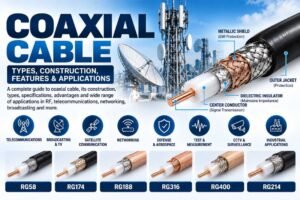
Twinaxial cable, commonly known as Twinax cable, is a specialized high-speed electrical cable designed to transmit balanced differential signals with low electromagnetic interference and excellent signal integrity. Unlike conventional coaxial cable, which uses a single central conductor surrounded by a dielectric and shield, twinaxial cable contains two insulated inner conductors enclosed within a common outer shield.
The two conductors carry differential signals, meaning the receiver detects the voltage difference between them rather than relying on a single conductor referenced to ground. This configuration provides excellent immunity to external electromagnetic interference and makes twinaxial cable suitable for high-speed digital communication, data centers, storage systems, telecommunications, networking equipment, instrumentation, and other demanding applications.
As data rates continue to increase, conventional copper interconnects face challenges such as insertion loss, crosstalk, electromagnetic interference, and signal distortion. Twinaxial cable addresses many of these challenges through its balanced transmission architecture and controlled impedance design.
For applications where high-speed data transmission, signal integrity, flexibility, and electromagnetic shielding are important, twinaxial cable can provide an efficient alternative to conventional coaxial or unshielded twisted-pair solutions.
What Is Twinaxial Cable?
Twinaxial cable is a type of shielded balanced transmission cable containing two signal-carrying conductors inside a common dielectric and conductive shield.
The basic construction generally consists of:
Two inner conductors
Individual insulation around each conductor
A common dielectric structure
An overall metallic shield
An outer protective jacket
The two internal conductors typically carry complementary signals. One conductor carries the positive side of the differential signal while the other carries the negative side. The receiving device measures the voltage difference between these conductors.
This differential signaling approach reduces the effect of external noise because interference that couples similarly into both conductors can be rejected by the receiving circuit.
Twinaxial cable is particularly useful in high-speed applications where maintaining signal integrity is critical.
How Does Twinaxial Cable Work?
The operating principle of twinaxial cable is based on differential signaling.
Instead of transmitting information using one signal conductor and a separate ground reference, a transmitter sends two complementary electrical signals through the two internal conductors.
For example, if one conductor carries a positive voltage variation, the other carries a corresponding negative variation. The receiver compares the two signals and determines the intended data from their voltage difference.
This arrangement provides several advantages.
First, external electromagnetic interference tends to affect both conductors in a similar manner. Because the receiver responds primarily to the difference between the conductors, much of this common-mode noise can be rejected.
Second, the shield surrounding the conductors provides an additional barrier against electromagnetic interference entering or leaving the cable.
Third, controlled impedance construction helps reduce signal reflections and maintain predictable high-frequency performance.
These characteristics make twinaxial cable highly suitable for high-speed digital communication systems.
Twinaxial Cable Construction
The construction of twinaxial cable is carefully engineered to achieve electrical balance, mechanical reliability, and controlled impedance.
Inner Conductors
A twinaxial cable contains two electrical conductors. These conductors are normally made from copper or copper-based materials because copper provides excellent electrical conductivity.
Depending on the application, conductors may be solid, stranded, bare copper, tinned copper, silver-plated copper, or another specialized construction.
The conductor diameter influences resistance, current capacity, flexibility, attenuation, and high-frequency performance.
Individual Insulation
Each conductor is surrounded by an insulating material. Common insulation materials include polyethylene, fluoropolymers, PTFE, FEP, and other low-loss dielectric materials.
The insulation prevents electrical contact between the two conductors and helps maintain the required electrical spacing.
Dielectric
The dielectric determines the electrical characteristics of the transmission structure.
For high-speed twinaxial cables, low-loss dielectric materials are often preferred because they help reduce signal attenuation and dielectric losses.
The dielectric geometry also contributes significantly to the characteristic impedance of the cable.
Shield
A major feature of twinaxial cable is its common outer shield.
The shield can be constructed using braided copper, aluminum foil, copper foil, served shields, or combinations of foil and braid.
Some high-performance designs use multiple shielding layers to achieve improved electromagnetic compatibility and shielding effectiveness.
Outer Jacket
The outer jacket protects the internal cable structure against mechanical damage, moisture, chemicals, abrasion, temperature variations, and environmental conditions.
Depending on the application, jackets may be manufactured from PVC, LSZH, polyurethane, fluoropolymers, or other specialized materials.
Twinaxial Cable vs Coaxial Cable
Twinaxial and coaxial cables are both shielded transmission cables, but their internal structures and signaling methods are different.
A coaxial cable normally contains one central conductor surrounded by a dielectric and an outer conductive shield. The shield generally functions as the return path or reference conductor.
A twinaxial cable contains two signal conductors within a common shield. These conductors normally carry differential signals.
The primary difference can therefore be summarized as:
Coaxial cable: one central signal conductor plus shield/return path.
Twinaxial cable: two balanced signal conductors plus a common shield.
Twinaxial cable is particularly advantageous for differential high-speed digital signals, while coaxial cable remains widely used for RF, microwave, broadband, antenna, instrumentation, and other single-ended transmission applications.
Twinaxial Cable vs Twisted Pair Cable
Twinaxial cable and twisted-pair cable both support differential signaling, but their physical construction is different.
Twisted-pair cable consists of two insulated conductors twisted around each other. Shielded twisted pair may include an additional foil or braid shield.
Twinaxial cable places two conductors inside a controlled common shield structure.
Twinaxial cable can provide stronger electromagnetic shielding and more controlled electrical characteristics than many conventional twisted-pair constructions.
However, twisted-pair cables can be less expensive, easier to terminate, and more widely available for standard Ethernet and general networking applications.
The correct choice depends on data rate, transmission distance, impedance requirements, EMI environment, connector system, mechanical requirements, and cost.
Types of Twinaxial Cable
Twinaxial cables can be classified according to construction, impedance, application, shielding, data rate, and mechanical design.
Standard Twinaxial Cable
Standard twinaxial cable is designed for general balanced high-speed signal transmission. It is used in networking, instrumentation, computing, and industrial applications.
High-Speed Twinaxial Cable
High-speed twinaxial cables are optimized for demanding digital applications where low insertion loss, controlled impedance, and excellent signal integrity are required.
These cables are commonly used in data centers, high-performance computing, networking equipment, and storage systems.
Flexible Twinaxial Cable
Flexible twinaxial cable uses specialized materials and construction techniques to provide improved flexibility.
It is suitable for applications where cables must repeatedly move, bend, or fit into compact equipment.
Semi-Rigid Twinaxial Cable
Semi-rigid twinaxial cable provides a more mechanically stable structure. It can be useful in applications where precise routing and dimensional stability are important.
Low-Loss Twinaxial Cable
Low-loss twinaxial cable is engineered to minimize attenuation at high frequencies. It is useful for longer transmission paths and high-speed systems where signal degradation must be controlled.
Shielded Twinaxial Cable
Shielded twinaxial cable incorporates one or more conductive shielding layers to reduce electromagnetic interference and improve electromagnetic compatibility.
Important Twinaxial Cable Specifications
When selecting twinaxial cable, several electrical and mechanical specifications should be evaluated.
Characteristic Impedance
Characteristic impedance is one of the most important specifications for a high-speed transmission cable.
Common impedance values depend on the application and system architecture. The cable impedance should match the associated transmitter, receiver, PCB traces, and connectors as closely as practical.
Impedance mismatch can cause reflections, signal distortion, ringing, and data errors.
Frequency Range
The operating frequency or effective bandwidth determines how well the cable can transmit high-speed signals.
A cable designed for low-frequency applications may not provide sufficient performance at high data rates.
Insertion Loss
Insertion loss represents the reduction in signal power as the signal travels through the cable.
Lower insertion loss is generally desirable for high-speed applications because it helps maintain sufficient signal amplitude at the receiver.
Return Loss
Return loss indicates the amount of signal reflected back toward the source due to impedance discontinuities.
Higher return loss generally indicates better impedance matching and lower reflection.
Crosstalk
Crosstalk occurs when signals from one transmission path interfere with another.
Twinaxial cable construction and shielding can help control unwanted coupling and maintain signal integrity.
Shielding Effectiveness
Shielding effectiveness measures the cable’s ability to prevent electromagnetic energy from entering or escaping the cable.
High shielding effectiveness is particularly important in environments containing strong RF sources or sensitive electronic equipment.
Propagation Delay
Propagation delay is the time required for an electrical signal to travel through the cable.
In high-speed systems, propagation delay and delay variation can influence system timing and synchronization.
Temperature Range
The operating temperature range depends on conductor materials, dielectric materials, shielding, and jacket construction.
Industrial, aerospace, automotive, and outdoor applications may require specialized temperature-resistant cable designs.
Twinaxial Cable Connectors
Twinaxial cable assemblies can be terminated using specialized connectors designed for balanced high-speed transmission.
The connector selection depends on the equipment, impedance, frequency, mechanical interface, and application requirements.
Common considerations include:
Twinax connectors
High-speed differential connectors
High-density data connectors
Board-to-cable connectors
Custom RF and microwave interfaces
Specialized data-center cable connectors
Connector quality is extremely important because a high-performance cable can lose its electrical advantages if the connector introduces excessive impedance discontinuity, insertion loss, or crosstalk.
Twinaxial Cable Applications
Twinaxial cable is used across a wide range of industries.
Data Centers
Data centers require high-speed and reliable connections between servers, switches, storage systems, and networking equipment.
Twinaxial cable assemblies can be used for short-distance high-speed connections where low latency and signal integrity are important.
Telecommunications
Telecommunications equipment often requires high-speed internal connections between processing boards, radio units, networking modules, and transmission equipment.
Twinaxial cable can provide controlled impedance and EMI-resistant differential transmission.
Networking Equipment
Switches, routers, network interface modules, and high-performance computing equipment can use twinaxial cable assemblies for high-speed interconnections.
Storage Systems
Storage networks require high-speed data transfer between storage devices, controllers, servers, and switching equipment.
Twinaxial interconnects can support high-bandwidth data transmission over short cable distances.
Aerospace and Defense
Aerospace and defense systems often operate in environments with strict requirements for electromagnetic compatibility, reliability, weight, and mechanical durability.
Specialized twinaxial cables can be designed to meet demanding environmental and electrical requirements.
Industrial Automation
Industrial equipment may generate significant electromagnetic noise through motors, drives, switching devices, and power electronics.
Shielded twinaxial cables can help maintain reliable differential signal transmission in electrically noisy environments.
Test and Measurement
High-speed instrumentation and electronic test equipment require predictable signal behavior.
Twinaxial cables can be used for differential measurement, high-speed digital signals, instrumentation systems, and specialized laboratory equipment.
Medical Electronics
Certain medical electronic systems require reliable, low-noise signal transmission.
Specialized shielded twinaxial cable constructions can be used where electrical performance and electromagnetic compatibility are important.
Advantages of Twinaxial Cable
Twinaxial cable provides several important advantages for high-speed electronic systems.
Excellent Noise Rejection
Differential signaling helps reject common-mode electromagnetic interference.
Strong EMI Shielding
The surrounding shield helps reduce electromagnetic coupling between the cable and its environment.
High-Speed Data Transmission
Twinaxial construction can support high-speed digital communication when properly engineered with suitable conductors, dielectric materials, connectors, and impedance control.
Controlled Impedance
Precision cable construction helps maintain predictable impedance along the transmission path.
Low Signal Distortion
High-quality twinaxial cables can minimize attenuation, reflections, and other forms of signal degradation.
Compact Interconnect Design
Twinaxial assemblies can provide two differential signal paths within a relatively compact shielded structure.
Reliable Performance
Properly designed twinaxial cables can provide consistent electrical performance over their intended operating range.
Limitations of Twinaxial Cable
Despite its advantages, twinaxial cable is not ideal for every application.
One limitation is cost. Specialized twinaxial cable and connectors can be more expensive than standard unshielded cables.
Termination can also be more complex because the two internal conductors and shield must be properly connected while maintaining the required impedance.
Twinaxial cables may also have limitations in transmission distance compared with optical fiber for extremely high-speed or long-distance applications.
Mechanical flexibility can vary significantly depending on the cable construction.
Therefore, cable selection should always consider the complete system rather than focusing only on the maximum data rate.
Factors to Consider When Selecting Twinaxial Cable
Before purchasing or designing a twinaxial cable assembly, engineers should evaluate several factors.
Data Rate
Determine the required data rate and ensure that the cable supports the required signaling bandwidth.
Impedance
Select the impedance required by the system and ensure compatibility with connectors and equipment.
Cable Length
Transmission distance directly affects attenuation and signal integrity.
Operating Frequency
Check the frequency range and high-frequency electrical performance.
Shielding Requirement
Consider the electromagnetic environment and required shielding effectiveness.
Flexibility
For applications involving repeated movement, select a cable designed for the required bend radius and flex cycles.
Temperature
Ensure that the cable materials can withstand the expected operating and storage temperatures.
Connector Compatibility
Verify that the selected cable can be terminated with connectors compatible with the equipment.
Environmental Conditions
For outdoor, industrial, aerospace, or harsh environments, consider moisture resistance, chemical resistance, vibration, abrasion, and flame performance.
Twinaxial Cable for High-Speed Data Applications
As modern electronics move toward higher data rates, maintaining signal integrity becomes increasingly challenging.
At high speeds, a cable cannot be treated simply as a piece of wire. Electrical characteristics such as impedance, attenuation, propagation delay, insertion loss, return loss, crosstalk, and electromagnetic coupling become increasingly important.
Twinaxial cable is well suited to this environment because its differential transmission structure helps reduce common-mode noise while the surrounding shield provides additional electromagnetic protection.
The overall system performance, however, depends on the complete signal path, including PCB traces, connectors, cable assemblies, vias, packages, and receiver equalization.
Twinaxial Cable and Signal Integrity
Signal integrity refers to the quality of an electrical signal as it travels from transmitter to receiver.
Several factors can degrade signal integrity:
Impedance mismatch
Insertion loss
Dielectric loss
Conductor loss
Connector discontinuities
Crosstalk
Electromagnetic interference
Reflections
Poor termination
Excessive cable length
Twinaxial cable helps address several of these issues through balanced transmission and controlled geometry.
For demanding applications, cable assemblies should be tested and characterized using suitable high-frequency measurement equipment.
Twinaxial Cable Manufacturing
Manufacturing high-quality twinaxial cable requires precise control over conductor dimensions, insulation thickness, dielectric geometry, shielding, and jacket construction.
The two internal conductors must maintain controlled spacing and consistent electrical characteristics.
Shielding must be applied uniformly to achieve predictable electromagnetic performance.
During cable assembly manufacturing, connector termination must also be performed carefully to minimize impedance discontinuities.
Depending on the application, manufacturers may perform electrical continuity tests, impedance testing, insertion-loss measurements, return-loss measurements, shielding tests, dimensional inspection, and environmental testing.
Twinaxial Cable Testing
Testing is essential for high-performance twinaxial cable assemblies.
Typical tests may include:
Continuity testing
Insulation resistance testing
Characteristic impedance testing
Insertion loss testing
Return loss testing
Crosstalk testing
Time-domain reflectometry
High-frequency network analysis
Shielding effectiveness testing
Mechanical inspection
Temperature testing
Vector Network Analyzers can be used to characterize high-frequency transmission performance, while Time-Domain Reflectometry can help identify impedance discontinuities along the cable assembly.
Twinaxial Cable in RF and Telecom Systems
Although twinaxial cable is primarily associated with differential digital transmission, its shielded balanced structure can also be valuable in specialized RF and telecom equipment.
Modern telecom systems increasingly combine RF circuitry, digital processing, high-speed serial links, power electronics, and control interfaces inside compact equipment.
This creates challenging electromagnetic environments.
Twinaxial cable can help separate sensitive differential signals from external interference while maintaining compact interconnect architecture.
Twinaxial Cable vs Fiber Optic Cable
Fiber optic cable transmits information using light, while twinaxial cable transmits electrical signals.
Fiber offers major advantages for long-distance communication, extremely high bandwidth, electrical isolation, and immunity to electromagnetic interference.
Twinaxial cable, however, can provide advantages for short-distance equipment interconnections because it can be cost-effective, easy to deploy, and compatible with electrical interfaces.
For short high-speed links inside data centers and electronic systems, twinaxial cable can be an attractive solution.
For long-distance backbone communication, fiber optic technology is generally more suitable.
Future of Twinaxial Cable Technology
The demand for higher data rates continues to drive improvements in copper interconnect technology.
Data centers, artificial intelligence infrastructure, high-performance computing, cloud systems, networking equipment, and advanced telecommunications are pushing electrical interfaces toward increasingly higher speeds.
Future twinaxial cable designs are expected to focus on:
Higher bandwidth
Lower insertion loss
Improved shielding
Reduced crosstalk
Lower power consumption
Smaller cable diameters
Higher connector density
Improved thermal performance
Better mechanical flexibility
Higher manufacturing precision
Advanced materials and improved cable geometries will continue to play an important role in maintaining electrical performance as data rates increase.
How to Choose the Right Twinaxial Cable
Choosing the correct twinaxial cable starts with identifying the requirements of the complete application.
First, determine the required data rate and operating bandwidth.
Next, identify the required characteristic impedance and connector interface.
Then evaluate the required cable length, insertion loss, return loss, shielding performance, flexibility, temperature range, and environmental requirements.
For high-speed applications, it is important to consider the complete cable assembly rather than selecting the cable alone.
A cable with excellent specifications may still perform poorly if the connector or termination introduces a significant impedance discontinuity.
Why Twinaxial Cable Is Important for Modern Electronics
Modern electronic systems increasingly depend on fast and reliable data movement.
Servers, switches, storage systems, telecommunications equipment, industrial controllers, test instruments, and advanced computing platforms all require high-speed electrical interconnections.
Twinaxial cable provides a practical solution for many of these applications by combining differential signaling, shielding, controlled impedance, and compact construction.
Its ability to maintain signal integrity while reducing susceptibility to electromagnetic interference makes it an important interconnect technology for modern high-speed electronics.
Twinaxial Cable for Custom Cable Assemblies
Standard twinaxial cables may not always meet the requirements of specialized equipment.
Custom cable assemblies can be developed with application-specific cable lengths, connector configurations, shielding structures, conductor materials, jacket materials, and electrical specifications.
Custom twinaxial cable assemblies are particularly useful for:
Telecom equipment
Data-center infrastructure
RF systems
Test and measurement equipment
Industrial electronics
Aerospace systems
Defense electronics
High-speed computing
Networking equipment
Research instrumentation
A properly engineered custom assembly can provide better integration and more predictable system performance.
Conclusion
Twinaxial cable is a high-performance shielded cable technology designed primarily for balanced differential signal transmission. Its two internal conductors, controlled dielectric structure, and common electromagnetic shield provide excellent noise rejection, signal integrity, and high-speed transmission performance.
Compared with conventional coaxial cable, twinaxial cable is specifically optimized for differential signaling. Compared with many twisted-pair solutions, its controlled shielded structure can provide improved electromagnetic protection and predictable high-frequency performance.
Twinaxial cable is widely relevant to data centers, telecommunications, networking, storage systems, industrial automation, aerospace, defense, instrumentation, and other high-speed electronic applications.
As data rates continue to increase, the importance of cable design, impedance control, connector performance, shielding, insertion loss, and signal integrity will become even greater. For applications requiring reliable high-speed electrical communication over short and medium interconnect distances, twinaxial cable remains an important and versatile interconnect solution.
Frequently Asked Questions About Twinaxial Cable
What is a twinaxial cable?
A twinaxial cable is a shielded cable containing two insulated inner conductors inside a common conductive shield. It is primarily used for differential signal transmission and high-speed data communication.
What is the difference between twinaxial and coaxial cable?
Coaxial cable normally contains one central conductor and an outer shield, while twinaxial cable contains two signal conductors inside a common shield. Twinaxial cable is generally designed for balanced differential signaling.
Is twinaxial cable suitable for high-speed data?
Yes. Twinaxial cable is widely used for high-speed electrical interconnections because its differential structure, controlled impedance, and shielding can help maintain signal integrity.
Does twinaxial cable reduce electromagnetic interference?
Yes. Differential signaling helps reject common-mode noise, while the conductive outer shield provides additional protection against electromagnetic interference.
Where is twinaxial cable commonly used?
Twinaxial cable is used in data centers, servers, networking equipment, storage systems, telecommunications, industrial electronics, aerospace, defense, instrumentation, and high-performance computing systems.
Is twinaxial cable better than coaxial cable?
Neither cable is universally better. Twinaxial cable is advantageous for balanced differential high-speed signals, while coaxial cable is commonly preferred for single-ended RF, microwave, antenna, broadband, and instrumentation applications.
Yes. Twinaxial cable assemblies can be customized according to cable length, impedance, connector type, shielding requirements, jacket material, temperature range, flexibility, and electrical performance.
Can twinaxial cable be customized?
What factors affect twinaxial cable performance?
Important factors include characteristic impedance, conductor size, dielectric material, insertion loss, return loss, cable length, shielding, connector design, crosstalk, operating frequency, and temperature.
Can twinaxial cable be used in data centers?
Yes. Twinaxial cable is particularly useful for short-distance high-speed connections between servers, switches, storage equipment, and other data-center hardware.
What connectors are used with twinaxial cable?
Connector selection depends on the application. Specialized twinax connectors, high-speed differential connectors, high-density connectors, and custom cable interfaces can be used depending on system requirements.
What is controlled impedance in twinaxial cable?
Controlled impedance means the cable geometry and materials are designed to maintain a predictable electrical impedance along the transmission path. This helps reduce reflections and signal distortion.
Is twinaxial cable shielded?
Yes. Twinaxial cable normally includes a common conductive shield around the two internal conductors. Depending on the design, the shield may use foil, braid, or multiple shielding layers.
What is the advantage of differential signaling in twinaxial cable?
Differential signaling allows the receiver to detect the voltage difference between two conductors. This helps reject common-mode interference and improves signal reliability in electrically noisy environments.
Is twinaxial cable suitable for long-distance communication?
Twinaxial cable is generally most attractive for short- to medium-distance high-speed electrical links. For very long distances, fiber optic cable is often preferred because of its lower transmission loss and much greater immunity to electromagnetic interference.
How is twinaxial cable tested?
Twinaxial cable assemblies can be tested for continuity, impedance, insertion loss, return loss, crosstalk, shielding effectiveness, insulation resistance, and high-frequency performance using equipment such as Vector Network Analyzers and Time-Domain Reflectometers.