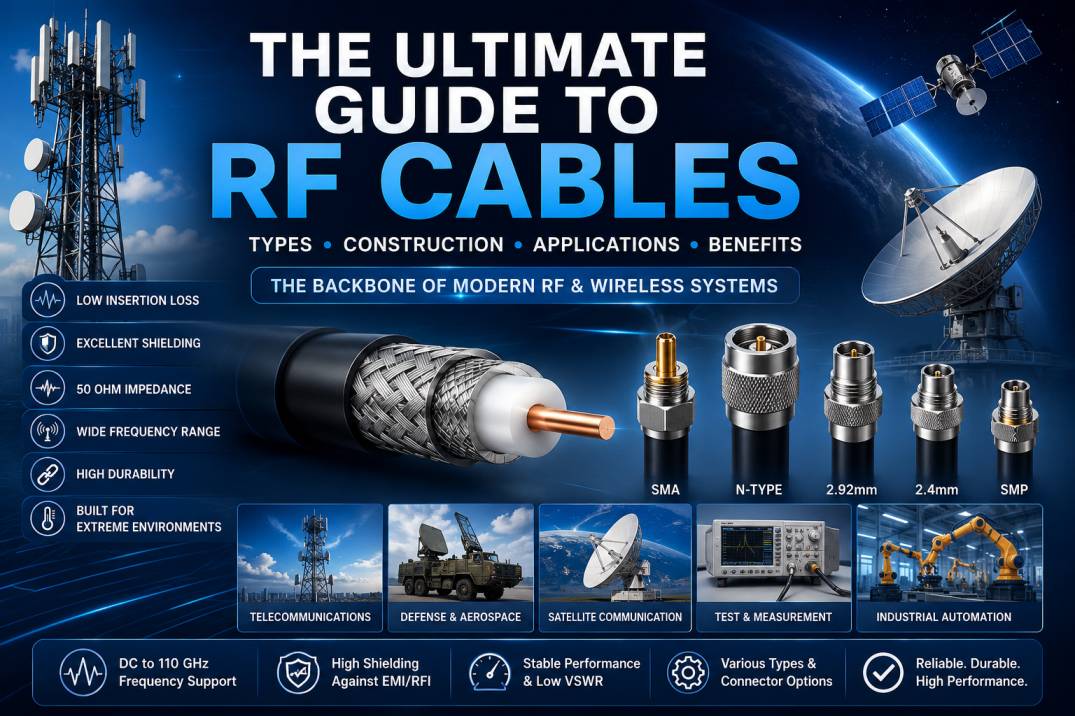
RF Cables are one of the most important components in radio frequency and microwave communication systems. They are specifically designed to carry high-frequency electrical signals with minimal loss while maintaining signal integrity over varying distances. Whether it is a mobile communication network, satellite system, radar installation, aerospace platform, medical equipment, or laboratory test setup, RF cables play a critical role in ensuring reliable signal transmission.
Unlike standard electrical cables, RF cables are engineered with controlled impedance, superior shielding, and specialized dielectric materials that reduce signal attenuation and electromagnetic interference. Modern RF systems operating at frequencies from a few megahertz to more than 110 GHz require cables capable of delivering consistent electrical performance even in harsh operating environments.
This guide explains everything you need to know about RF Cables, including their construction, working principles, types, applications, advantages, selection criteria, maintenance, and future trends.
What Are RF Cables?
RF Cables, also known as Radio Frequency Cables or RF Coaxial Cables, are specially designed transmission lines that transport high-frequency signals from one electronic device to another while minimizing power loss and external interference.
They are widely used in wireless communication systems where maintaining signal quality is essential. RF cables are available in numerous sizes, impedance ratings, shielding configurations, and connector interfaces to suit different industries and applications.
How RF Cables Work
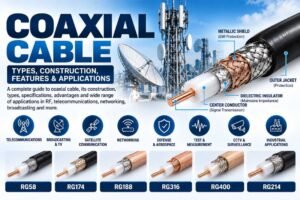
RF Cables transmit electromagnetic energy through a center conductor surrounded by an insulating dielectric. The outer conductor acts as both a return path for current and a shield against external electromagnetic interference.
This construction helps maintain a constant impedance, reduces signal reflection, and protects transmitted signals from outside electrical noise.
The controlled impedance allows efficient power transfer between connected RF components such as antennas, amplifiers, filters, attenuators, couplers, splitters, oscilloscopes, and vector network analyzers.
Construction of RF Cables
Center Conductor
The center conductor carries the RF signal. It is commonly manufactured from copper, silver-plated copper, or copper-clad steel depending on the application.
Dielectric Insulator
The dielectric separates the center conductor from the outer conductor while maintaining impedance. Common dielectric materials include:
PTFE
Foam Polyethylene
Solid Polyethylene
Air Dielectric
Expanded PTFE
Outer Conductor
The outer conductor provides electrical shielding and acts as the ground reference. It may consist of:
Copper braid
Aluminum foil
Double braid
Triple shield
Corrugated copper tube
Outer Jacket
The protective jacket safeguards the cable from environmental damage such as moisture, chemicals, abrasion, UV exposure, and mechanical stress.
Typical materials include:
PVC
LSZH
Polyurethane
FEP
PE
Why RF Cables Are Different from Standard Electrical Cables
RF Cables are specifically designed for high-frequency signal transmission. Unlike ordinary electrical cables, they maintain controlled impedance, minimize insertion loss, reduce reflections, and offer excellent shielding against EMI and RFI.
Their precision construction ensures stable electrical performance across a broad frequency range.
Types of RF Cables
Flexible RF Cables
Flexible RF cables are easy to install and ideal for systems requiring repeated bending or movement.
Applications include:
Laboratory testing
Communication equipment
Wireless devices
Medical equipment
Military electronics
Semi-Rigid RF Cables
Semi-rigid cables provide exceptional shielding, phase stability, and low insertion loss.
Applications include:
Radar
Satellite communication
Defense systems
Aerospace
Microwave assemblies
Semi-Flexible RF Cables
These cables combine the benefits of flexibility and excellent electrical performance.
Applications include:
Base stations
Wireless infrastructure
RF modules
Instrumentation
Low Loss RF Cables
Designed to minimize attenuation over long cable runs.
Applications include:
Cellular networks
Outdoor antenna systems
Broadcasting
Telecommunication infrastructure
High Frequency RF Cables
These cables support frequencies exceeding 40 GHz and are used in advanced microwave applications.
Applications include:
5G
Millimeter-wave communication
Satellite
Research laboratories
Automotive radar
Common RF Cable Impedance
50 Ohm RF Cable
Used for RF communication systems
Wireless equipment
Microwave systems
Military electronics
Satellite communication
Test and measurement
75 Ohm RF Cable
Used for:
Television broadcasting
Video transmission
Cable television
Digital broadcasting
Common RF Cable Connector Types
Several connector interfaces are available depending on system frequency and power requirements.
SMA Connector
N Type Connector
BNC Connector
TNC Connector
SMP Connector
SMPM Connector
MCX Connector
MMCX Connector
2.92mm Connector
2.4mm Connector
1.85mm Connector
4.3-10 Connector
DIN Connector
UHF Connector
F Connector
RF Cable Frequency Ranges
Different RF cables support different operating frequencies depending on construction and connector type.
Low Frequency
DC to 1 GHz
Medium Frequency
1 GHz to 18 GHz
High Frequency
18 GHz to 40 GHz
Very High Frequency
40 GHz to 67 GHz
Ultra High Frequency
67 GHz to 110 GHz
Advantages of RF Cables
Excellent signal integrity
Low insertion loss
High shielding effectiveness
Stable impedance
Wide frequency coverage
Long service life
High mechanical durability
Resistance to electromagnetic interference
Resistance to radio frequency interference
Suitable for indoor and outdoor environments
Excellent phase stability
Available in numerous connector configurations
Applications of RF Cables
RF Cables are used across numerous industries.
Telecommunications
Mobile base stations
5G infrastructure
Cellular towers
Signal repeaters
Distributed antenna systems
Aerospace
Aircraft communication
Avionics
Navigation systems
Electronic warfare
Defense
Military radios
Radar systems
Missile guidance
Communication shelters
Electronic intelligence systems
Satellite Communication
Ground stations
Satellite payloads
Earth observation systems
VSAT terminals
Medical Equipment
MRI systems
CT scanners
Medical imaging
Diagnostic equipment
Automotive
ADAS systems
Vehicle radar
Autonomous driving
GPS modules
Industrial Automation
Wireless control systems
Remote monitoring
Factory automation
Industrial IoT
Broadcasting
TV transmission
FM radio
Digital broadcasting
Studio equipment
Research Laboratories
RF testing
Microwave measurements
Calibration laboratories
Electromagnetic compatibility testing
Factors to Consider When Selecting RF Cables
Frequency Range
Select a cable capable of operating above your maximum system frequency.
Insertion Loss
Lower attenuation improves system efficiency.
Power Handling
Choose a cable that safely handles the required RF power.
Cable Flexibility
Flexible cables are suitable for moving assemblies, while semi-rigid cables provide maximum performance.
Shielding Effectiveness
High shielding minimizes interference from nearby electronic equipment.
Connector Compatibility
Ensure compatibility with existing RF connectors and equipment.
Operating Environment
Consider temperature, humidity, UV exposure, vibration, and chemical resistance.
Cable Length
Longer cables increase signal attenuation, making low-loss cable selection important.
Common Problems in RF Cables
Signal attenuation
Connector damage
Improper impedance matching
Water ingress
Cable bending damage
Poor shielding
Mechanical stress
Corrosion
Loose connectors
Improper installation
Best Practices for RF Cable Installation
Avoid excessive bending.
Maintain the recommended bend radius.
Use proper torque values for RF connectors.
Protect outdoor cables from moisture.
Inspect connectors regularly.
Keep cable lengths as short as possible.
Avoid sharp bends and crushing.
Store cables properly when not in use.
Maintenance Tips
Inspect cables periodically.
Clean RF connectors carefully.
Replace damaged connectors immediately.
Measure insertion loss during maintenance.
Check VSWR regularly.
Protect connectors using dust caps.
Avoid unnecessary cable movement.
Follow manufacturer installation guidelines.
Future of RF Cables
The rapid expansion of 5G, 6G, satellite internet, autonomous vehicles, aerospace systems, and defense technologies continues to drive demand for advanced RF cable solutions. Modern RF cables are becoming lighter, more flexible, and capable of supporting frequencies above 110 GHz while maintaining exceptional signal integrity.
Innovations in dielectric materials, shielding technologies, and connector designs are enabling next-generation communication systems with lower losses, higher power handling, and improved reliability.
Why Choose SRFS Teleinfra RF Cables
SRFS Teleinfra manufactures high-quality RF Cables engineered for reliable performance across demanding RF and microwave applications. The company offers flexible, semi-rigid, semi-flexible, low-loss, and high-frequency cable assemblies with precision RF connectors suitable for telecommunications, defense, aerospace, satellite communication, industrial automation, research laboratories, and test equipment. Every cable is designed to deliver excellent electrical performance, low VSWR, high shielding effectiveness, and long operational life.
Frequently Asked Questions
What is an RF Cable?
An RF Cable is a specially designed coaxial cable used to transmit high-frequency radio frequency signals with minimal loss and excellent shielding.
What impedance is most commonly used for RF Cables?
The most common impedance values are 50 Ohm for RF communication systems and 75 Ohm for video and broadcasting applications.
Which industries use RF Cables?
Telecommunications, aerospace, defense, medical, broadcasting, automotive, industrial automation, satellite communication, and research laboratories all rely on RF cables.
How do I choose the right RF Cable?
Consider frequency range, insertion loss, power handling, shielding, connector compatibility, flexibility, operating environment, and cable length.
What is the difference between flexible and semi-rigid RF Cables?
Flexible cables are easier to install and bend, while semi-rigid cables provide lower loss, better shielding, and superior phase stability for high-performance microwave systems.
Can RF Cables be used outdoors?
Yes. Outdoor-rated RF cables are manufactured with weather-resistant jackets that protect against UV radiation, moisture, and harsh environmental conditions.
Why is shielding important in RF Cables?
Shielding prevents electromagnetic interference and radio frequency interference, ensuring clean and reliable signal transmission.
What connectors are commonly used with RF Cables?
Popular connectors include SMA, N Type, BNC, TNC, SMP, SMPM, MCX, MMCX, 2.92mm, 2.4mm, and 1.85mm connectors.
How long do RF Cables last?
High-quality RF cables can provide many years of reliable operation when installed correctly and maintained properly.
Why are low-loss RF Cables important?
Low-loss RF cables reduce signal attenuation, improve transmission efficiency, and enhance overall system performance, especially in high-frequency and long-distance applications.