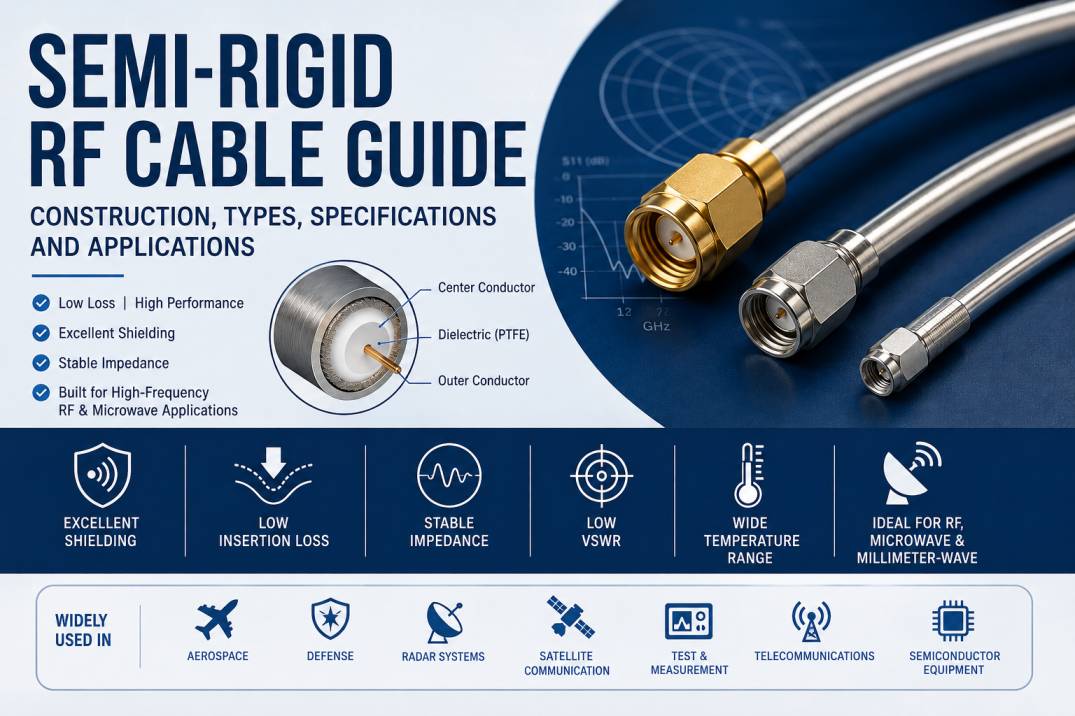
Semi-rigid RF cable is a specialized coaxial cable designed for high-frequency applications where excellent electrical performance, strong shielding, dimensional stability, and reliable signal transmission are required. Unlike conventional flexible RF cables, semi-rigid cables use a solid metallic outer conductor that provides superior electromagnetic shielding and maintains a controlled cable geometry.
Semi-rigid RF cables are widely used in aerospace, defense, telecommunications, radar, satellite communication, test and measurement equipment, medical electronics, microwave systems, semiconductor equipment, and high-frequency research applications.
The rigid metallic construction helps maintain consistent impedance and minimizes signal leakage, making semi-rigid RF cables particularly suitable for applications where low insertion loss, low VSWR, high isolation, and excellent phase stability are important.
With the increasing adoption of 5G, high-frequency test systems, satellite communications, advanced radar, and millimeter-wave electronics, the demand for high-performance RF cables continues to grow. Semi-rigid cable assemblies are especially valuable in applications operating from low RF frequencies into microwave and millimeter-wave frequency ranges.
What Is a Semi-Rigid RF Cable?
A semi-rigid RF cable is a coaxial transmission line consisting of a center conductor, dielectric material, and solid metallic outer conductor. The outer conductor is normally made from copper, tin-plated copper, silver-plated copper, or another conductive metal and is formed into a mechanically stable tube.
The term “semi-rigid” describes the cable’s mechanical characteristics. It is rigid enough to maintain its shape after installation but can be bent during assembly using suitable tooling. Once formed, the cable generally retains its configured shape.
This construction provides excellent shielding effectiveness and consistent electrical characteristics because the outer conductor forms a continuous metallic enclosure around the dielectric and center conductor.
Semi-rigid RF cable is different from flexible coaxial cable because flexible cable normally uses a braided outer conductor, while semi-rigid cable generally uses a solid tubular outer conductor.
Basic Construction of Semi-Rigid RF Cable
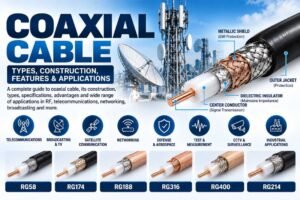
A semi-rigid RF cable typically consists of three primary components: the center conductor, dielectric, and outer conductor. Additional protective layers may be added depending on the application.
Center Conductor
The center conductor carries the RF signal through the cable. Copper is commonly used because of its excellent electrical conductivity and mechanical properties.
Depending on the cable design, the conductor may be bare copper, silver-plated copper, or another high-conductivity material. Silver plating can improve surface conductivity at high frequencies because RF current tends to concentrate near the conductor surface due to the skin effect.
Dielectric
The dielectric separates the center conductor from the outer conductor and determines several important electrical characteristics, including impedance, propagation velocity, capacitance, and dielectric loss.
PTFE is one of the most commonly used dielectric materials in semi-rigid RF cables because it offers low dielectric loss, good temperature stability, and reliable electrical insulation.
Other dielectric materials may be used for specialized high-frequency, low-loss, cryogenic, or high-temperature applications.
Outer Conductor
The outer conductor provides the return path for the RF signal and protects the transmitted signal from external electromagnetic interference.
In semi-rigid cables, the outer conductor is normally a continuous metallic tube rather than a braided shield. This provides excellent shielding effectiveness and helps maintain stable cable impedance.
Protective Jacket
Some semi-rigid RF cables are supplied without an additional jacket because the metallic outer conductor itself provides mechanical protection. Other versions may include a protective jacket when additional environmental protection is required.
How Does a Semi-Rigid RF Cable Work?
Semi-rigid RF cable operates using the same basic transmission-line principle as other coaxial cables.
The RF signal travels along the center conductor while the outer conductor provides the return path. The dielectric maintains the spacing between the two conductors and controls the electromagnetic field.
Because the conductors are arranged concentrically, the RF electromagnetic field is largely contained within the dielectric region. The continuous metallic outer conductor significantly reduces electromagnetic radiation and external interference.
Maintaining a consistent relationship between the center conductor and outer conductor is critical for impedance control. Any significant deformation, discontinuity, or dimensional variation can introduce reflections and increase VSWR.
This is one reason semi-rigid cable requires controlled bending and proper installation techniques.
Semi-Rigid vs Flexible RF Cable
The major difference between semi-rigid and flexible RF cables is their mechanical construction.
Semi-rigid RF cables use a solid metallic outer conductor, whereas flexible cables generally use a braided shield. The solid outer conductor provides better shielding and dimensional stability, while the braided structure provides greater flexibility.
Semi-rigid cables are therefore preferred when electrical performance and shielding are more important than repeated movement.
Flexible RF cables are generally better suited to applications where the cable must be repeatedly moved, routed, connected, or disconnected.
Semi-rigid cable is commonly used inside equipment where the cable can be permanently routed and formed into a defined configuration.
Key Advantages of Semi-Rigid RF Cables
Excellent Shielding Effectiveness
The continuous metallic outer conductor provides very high shielding effectiveness. This helps prevent RF energy from escaping the cable and reduces susceptibility to external electromagnetic interference.
This feature is particularly important in sensitive test equipment, radar systems, aerospace electronics, and high-density RF assemblies.
Low Insertion Loss
High-quality semi-rigid cables can provide low insertion loss across their specified frequency range. Low attenuation helps preserve signal power, particularly in microwave and high-frequency systems.
Excellent Impedance Stability
Semi-rigid construction maintains a consistent relationship between the center conductor, dielectric, and outer conductor.
Common RF cable impedance values include 50 ohms and, in some specialized systems, 75 ohms.
Low VSWR
A properly designed and installed semi-rigid RF cable can provide excellent voltage standing wave ratio performance.
Low VSWR indicates that less RF energy is reflected toward the source, improving overall system efficiency.
High Phase Stability
Cable dimensions and dielectric characteristics influence RF phase. Semi-rigid construction can provide excellent phase stability when the cable is properly designed and installed.
This is important in phased-array antennas, radar, test systems, instrumentation, and coherent RF systems.
Excellent Mechanical Stability
Once formed, semi-rigid cable maintains its installed shape. This makes it useful for internal equipment connections where cable routing needs to remain stable.
High Frequency Capability
Specialized semi-rigid cables can support microwave and millimeter-wave frequencies. Cable performance depends on conductor dimensions, dielectric material, connector design, manufacturing tolerances, and operating environment.
Types of Semi-Rigid RF Cables
Standard Semi-Rigid RF Cable
Standard semi-rigid cable is commonly used for internal RF connections and general microwave applications. It provides a balance of electrical performance, mechanical stability, and cost.
PTFE Semi-Rigid Cable
PTFE dielectric semi-rigid cables are widely used because of their low dielectric loss, temperature capability, and excellent insulation characteristics.
They are frequently used in aerospace, defense, laboratory instrumentation, telecommunications, and RF test equipment.
High-Frequency Semi-Rigid Cable
High-frequency semi-rigid cables are designed for demanding microwave and millimeter-wave applications.
They typically use carefully controlled conductor dimensions and high-performance dielectric materials to achieve stable impedance and low loss at elevated frequencies.
Silver-Plated Semi-Rigid Cable
Silver-plated conductors can provide excellent surface conductivity and are commonly used in high-frequency applications.
Because high-frequency current tends to flow primarily near conductor surfaces, conductor surface quality can have an important effect on RF performance.
Formable Semi-Rigid Cable
Formable cable provides a compromise between traditional semi-rigid and flexible cable.
It can be shaped more easily while still offering strong shielding and good RF performance.
Formable cables are useful when installation requires more routing flexibility than conventional semi-rigid cable can provide.
Low-Loss Semi-Rigid Cable
Low-loss designs use optimized conductor dimensions and low-loss dielectric materials to reduce attenuation.
They are useful in applications where signal integrity is critical, especially at higher frequencies.
Important Semi-Rigid RF Cable Specifications
When selecting a semi-rigid RF cable, engineers should evaluate several electrical and mechanical parameters.
Impedance
Impedance is one of the most important specifications for an RF cable.
50-ohm semi-rigid cables are extensively used in RF, microwave, telecommunications, aerospace, defense, and test equipment.
The cable impedance must match the system and connected components to minimize signal reflections.
Frequency Range
Frequency range defines the operating frequencies over which the cable meets specified electrical performance requirements.
The appropriate cable should be selected according to the application’s highest operating frequency rather than only its nominal system frequency.
Insertion Loss
Insertion loss indicates the amount of signal power lost as the RF signal travels through the cable.
Lower insertion loss is generally desirable, particularly in high-frequency and low-power systems.
Return Loss
Return loss indicates how effectively the cable and its interfaces prevent RF energy from being reflected back toward the source.
Higher return loss generally represents better impedance matching.
VSWR
Voltage Standing Wave Ratio is another measurement of impedance matching.
A lower VSWR indicates fewer reflections and better transmission-line performance.
Shielding Effectiveness
Shielding effectiveness indicates how well the cable prevents electromagnetic energy from entering or escaping the cable.
Semi-rigid cable generally provides excellent shielding because of its continuous metallic outer conductor.
Phase Stability
Phase stability describes how consistently the cable maintains RF phase under changes in temperature, mechanical movement, and other operating conditions.
This specification is particularly important for phase-sensitive applications.
Minimum Bend Radius
The minimum bend radius defines how tightly the cable can be formed without damaging the cable or significantly affecting its electrical performance.
Excessive bending can deform the outer conductor, change the dielectric geometry, and create impedance discontinuities.
Operating Temperature
The operating temperature specification defines the temperature range in which the cable can maintain its specified mechanical and electrical performance.
For demanding aerospace, defense, industrial, and laboratory applications, temperature capability should be carefully evaluated.
Semi-Rigid RF Cable Connector Options
Semi-rigid cables can be terminated with many RF connector types depending on frequency, interface requirements, and available space.
Common connector options include SMA, 2.92 mm, 2.4 mm, 1.85 mm, SMP, SMPM, N-Type, TNC, BNC, and other specialized microwave connectors.
SMA Connectors
SMA connectors are widely used for RF and microwave cable assemblies and are available in male and female configurations.
They are commonly used in test equipment, wireless systems, antennas, and RF modules.
2.92 mm Connectors
2.92 mm connectors are commonly known as K connectors and are designed for high-frequency microwave applications.
They are frequently used in high-frequency test systems and precision RF instrumentation.
2.4 mm Connectors
2.4 mm connectors are designed for higher-frequency applications and are commonly found in precision microwave test and measurement systems.
1.85 mm Connectors
1.85 mm connectors are used for very high-frequency microwave and millimeter-wave applications where higher-frequency performance is required.
SMP and SMPM Connectors
SMP and SMPM connectors provide compact interfaces for high-density RF applications.
They are particularly useful where space is limited and multiple RF connections must be installed within a small area.
Semi-Rigid Cable Assembly
A semi-rigid RF cable assembly consists of the cable, connectors, and termination process required to create a complete RF interconnect.
The assembly process requires careful control of cable length, stripping, connector attachment, soldering or other termination techniques, cable forming, and electrical testing.
The final assembly should be inspected for mechanical quality and tested for electrical characteristics appropriate to the application.
Typical tests can include insertion loss, return loss, VSWR, continuity, insulation resistance, and shielding performance.
Semi-Rigid RF Cable Bending
Cable forming is one of the most important aspects of semi-rigid RF cable installation.
The cable should be formed using appropriate tooling and according to the manufacturer’s recommended bending limits.
Improper bending can cause:
Cable diameter deformation
Impedance variation
Increased insertion loss
Higher VSWR
Connector stress
Mechanical damage
Reduced reliability
For precision RF systems, cable routing should be planned before forming to reduce unnecessary bends and mechanical stress.
Why Cable Geometry Matters
RF performance depends strongly on cable geometry.
The distance between the center conductor and outer conductor affects characteristic impedance. If the cable is crushed, excessively bent, or otherwise deformed, the geometry changes.
This can create an impedance discontinuity.
The resulting mismatch can produce signal reflections and degrade VSWR and return loss.
Therefore, mechanical handling is directly connected to RF performance in semi-rigid cable assemblies.
Applications of Semi-Rigid RF Cables
Aerospace
Semi-rigid RF cables are widely used in aerospace electronics because of their shielding, mechanical stability, and high-frequency performance.
They can be found in avionics, communication systems, navigation equipment, satellite payloads, and aircraft electronic systems.
Defense
Defense electronics require reliable RF interconnects for radar, electronic warfare, communication, surveillance, and high-frequency instrumentation.
Semi-rigid cable provides strong shielding and stable RF performance for these environments.
Radar Systems
Radar systems require controlled RF transmission between antennas, receivers, transmitters, filters, amplifiers, and other components.
Semi-rigid cable assemblies can provide the required electrical stability and shielding.
Satellite Communication
Satellite systems often require compact, low-loss, and mechanically stable RF interconnections.
Semi-rigid cables can be used inside RF modules, payload systems, transceiver assemblies, and ground-based satellite communication equipment.
RF Test and Measurement
Test and measurement equipment requires high-quality RF interconnects to prevent cable-related errors.
Semi-rigid cables are commonly used in RF fixtures, calibration systems, test benches, VNAs, spectrum analyzers, signal generators, and microwave measurement equipment.
Telecommunications
Telecommunication equipment uses RF cables for connections between RF modules, filters, amplifiers, antennas, and other components.
Semi-rigid cable is particularly useful for internal equipment connections where stable routing is required.
5G and Advanced Wireless Systems
High-frequency wireless systems require low-loss, well-shielded RF interconnections.
Semi-rigid cable assemblies can be used in RF modules, test systems, antenna systems, base-station equipment, and laboratory development platforms.
Semiconductor Equipment
Semiconductor manufacturing and testing equipment often contains high-frequency RF systems that require compact, controlled-impedance interconnects.
Semi-rigid cables can provide stable RF performance in these systems.
Medical Electronics
Specialized medical equipment can use high-frequency RF systems where controlled signal transmission and electromagnetic isolation are important.
Cable selection depends on the specific equipment, frequency, environmental requirements, and regulatory considerations.
Semi-Rigid RF Cable for High-Frequency Applications
At higher frequencies, cable losses, connector performance, impedance discontinuities, surface conductivity, and manufacturing tolerances become increasingly important.
The skin effect causes RF current to concentrate near the surfaces of conductors. Consequently, conductor material, surface finish, plating quality, and dimensional accuracy can influence high-frequency performance.
The connector-to-cable transition is also critical. Even a high-quality cable can exhibit poor system performance if the connector interface introduces a significant impedance discontinuity.
For millimeter-wave applications, engineers should evaluate the complete cable assembly rather than considering the cable alone.
Semi-Rigid Cable and Phase Matching
Phase matching is important when multiple RF paths must maintain a defined phase relationship.
Applications such as phased-array antennas, radar systems, beamforming networks, and coherent measurement systems may require matched cable assemblies.
Cable length, dielectric properties, temperature, mechanical configuration, and manufacturing tolerances can all influence phase.
For such applications, cable assemblies may need to be manufactured to controlled lengths and tested for phase characteristics.
Temperature Effects on Semi-Rigid RF Cable
Temperature can influence both the mechanical and electrical characteristics of an RF cable.
Changes in temperature can affect conductor dimensions, dielectric properties, cable length, and phase.
For high-precision applications, temperature-stable cable designs may be preferred.
A cable intended for outdoor, aerospace, industrial, or high-temperature environments should be selected according to the complete operating temperature range rather than room-temperature performance alone.
Semi-Rigid RF Cable Installation Best Practices
Select the cable according to system impedance and frequency requirements.
Plan the cable route before forming the cable.
Use appropriate bending tools.
Avoid excessive mechanical stress near connectors.
Maintain the recommended bend radius.
Avoid repeated bending of conventional semi-rigid cable.
Do not crush or flatten the outer conductor.
Ensure connectors are installed according to the manufacturer’s termination requirements.
Use the correct torque for threaded RF connectors.
Inspect the cable after forming.
Test the completed assembly whenever system performance is critical.
How to Select the Right Semi-Rigid RF Cable
Selecting the correct cable requires evaluating the electrical, mechanical, environmental, and application requirements.
First, determine the system impedance, typically 50 ohms for many RF and microwave systems.
Next, identify the maximum operating frequency.
Then evaluate acceptable insertion loss, VSWR, return loss, shielding effectiveness, phase stability, and power requirements.
Mechanical requirements should also be considered, including cable diameter, bend radius, cable length, connector type, available installation space, and required cable configuration.
Environmental requirements such as temperature, vibration, humidity, pressure, and chemical exposure may also influence cable selection.
Finally, select the connector and termination technology based on the frequency and mechanical interface.
Common Mistakes When Using Semi-Rigid RF Cables
One common mistake is selecting a cable only according to frequency while ignoring insertion loss and connector performance.
Another mistake is excessive bending. Mechanical deformation can negatively affect impedance and RF performance.
Using incompatible connectors is another frequent problem. A cable designed for high-frequency operation cannot automatically deliver the same performance when terminated with a lower-performance connector.
Improper connector installation can also cause high VSWR and poor return loss.
Engineers should therefore evaluate the complete cable assembly, including cable, connectors, transitions, termination method, and installation geometry.
Semi-Rigid RF Cable vs Semi-Flexible RF Cable
Semi-rigid and semi-flexible cables are sometimes used interchangeably, but they are not mechanically identical.
Semi-rigid cable generally uses a solid metallic outer conductor and is designed to retain a formed configuration.
Semi-flexible cable is designed to allow greater manual forming and may use a different outer-conductor construction or material.
The appropriate choice depends on the application’s mechanical requirements.
If maximum shielding and dimensional stability are priorities, semi-rigid construction may be preferred.
If installation requires more frequent forming or adjustment, a semi-flexible or formable cable may be more appropriate.
Why Choose a High-Quality Semi-Rigid RF Cable Manufacturer?
The performance of a semi-rigid RF cable depends heavily on dimensional accuracy, material quality, connector termination, manufacturing consistency, and testing.
A reliable manufacturer should be able to provide controlled cable dimensions, suitable dielectric materials, high-quality conductors, appropriate connectors, precision termination, and electrical testing.
For critical applications, customers should also consider traceability, inspection procedures, test reports, customization capability, and experience with high-frequency RF assemblies.
SRFS Teleinfra provides RF cable and RF cable assembly solutions for telecommunications, RF testing, microwave systems, defense, aerospace, and other demanding applications. Semi-rigid cable assemblies can be configured according to required cable type, length, connector interface, frequency range, and application requirements.
Semi-Rigid RF Cable Customization
Many RF applications require customized cable assemblies rather than standard cable lengths.
Customization can include cable length, cable diameter, connector type, connector orientation, bend configuration, phase matching, impedance, and environmental requirements.
Custom semi-rigid assemblies are particularly useful for equipment manufacturers where the cable must fit a specific internal mechanical layout.
The cable can be formed according to the required routing geometry before final testing.
Testing of Semi-Rigid RF Cable Assemblies
Testing is essential for high-performance RF cable assemblies.
Depending on the application, manufacturers may perform:
Insertion loss testing
Return loss testing
VSWR testing
Continuity testing
Insulation resistance testing
Phase testing
Cable length verification
Connector inspection
Dimensional inspection
Environmental testing
High-frequency network analyzer testing
Testing helps identify manufacturing defects, connector problems, impedance discontinuities, and cable damage before the assembly is installed in the final system.
Future of Semi-Rigid RF Cables
The demand for high-performance RF interconnects is expected to continue as wireless communication, satellite systems, radar, aerospace electronics, semiconductor technology, and advanced test equipment move toward higher frequencies.
5G and emerging wireless technologies are increasing the need for precise RF measurement and compact high-frequency interconnects.
At the same time, satellite communication, phased-array radar, electronic warfare systems, and millimeter-wave research are creating demand for cables with lower loss, better phase stability, improved shielding, and higher frequency capability.
Semi-rigid RF cable remains an important technology because its solid metallic construction provides an effective combination of electrical stability, shielding, mechanical strength, and high-frequency performance.
Frequently Asked Questions About Semi-Rigid RF Cable
What is a semi-rigid RF cable?
A semi-rigid RF cable is a coaxial cable with a solid metallic outer conductor that provides excellent shielding, stable impedance, and mechanical rigidity while allowing controlled forming during installation.
What is the difference between semi-rigid and flexible RF cable?
Semi-rigid RF cable normally uses a solid metallic outer conductor, while flexible RF cable generally uses a braided shield. Semi-rigid cable provides better shielding and dimensional stability, whereas flexible cable provides greater flexibility.
What impedance is commonly used for semi-rigid RF cables?
50 ohms is the most common impedance for RF and microwave semi-rigid cables. The impedance should always match the system and connected RF components.
Can semi-rigid RF cable be bent?
Yes. Semi-rigid cable can be formed using appropriate tools, but it should not be repeatedly bent or bent beyond the manufacturer’s recommended limits.
Why is PTFE commonly used in semi-rigid RF cable?
PTFE offers excellent electrical insulation, low dielectric loss, good temperature performance, and stable characteristics, making it suitable for many RF and microwave applications.
What frequencies can semi-rigid RF cables support?
The frequency capability depends on the cable construction, diameter, dielectric, conductor materials, connectors, and manufacturing tolerances. Specialized semi-rigid assemblies can support microwave and millimeter-wave frequencies.
Are semi-rigid RF cables suitable for 5G applications?
Yes. Semi-rigid cables can be used in 5G development equipment, RF test systems, antenna systems, RF modules, and high-frequency laboratory applications when the selected cable and connectors meet the required frequency and performance specifications.
Which connectors can be used with semi-rigid RF cables?
Common connector options include SMA, 2.92 mm, 2.4 mm, 1.85 mm, SMP, SMPM, N-Type, and other RF and microwave connector interfaces.
What causes high VSWR in a semi-rigid cable assembly?
High VSWR can result from impedance mismatch, poor connector termination, cable deformation, damaged dielectric, incorrect connector selection, poor cable-to-connector transitions, or excessive bending.
How should semi-rigid RF cables be installed?
The cable should be routed carefully, formed using suitable tools, kept within the recommended bend radius, protected from crushing and excessive mechanical stress, and terminated using the appropriate connector installation procedure.
What industries use semi-rigid RF cables?
Semi-rigid RF cables are used in aerospace, defense, telecommunications, satellite communications, radar, RF test and measurement, semiconductor equipment, wireless communications, industrial electronics, and research laboratories.
Can SRFS Teleinfra supply customized semi-rigid RF cable assemblies?
Yes. Customized RF cable assemblies can be developed according to requirements such as cable type, impedance, length, connector type, frequency range, configuration, and application requirements.
Conclusion
Semi-rigid RF cable is an important high-performance interconnection solution for RF, microwave, and millimeter-wave systems. Its solid metallic outer conductor provides excellent shielding, mechanical stability, controlled impedance, and reliable signal transmission.
The correct cable selection requires more than simply checking the frequency range. Engineers should evaluate impedance, insertion loss, VSWR, return loss, shielding effectiveness, phase stability, temperature range, bend radius, connector compatibility, and environmental requirements.
For demanding applications such as aerospace, defense, radar, satellite communication, 5G, RF test equipment, and high-frequency instrumentation, a properly designed semi-rigid RF cable assembly can provide reliable and repeatable performance.
Choosing a qualified RF cable manufacturer and testing the complete cable assembly can further improve system reliability and minimize RF performance issues.