RG59 cable is a widely used 75-ohm coaxial cable designed primarily for transmitting video, RF, and other high-frequency signals. It has been used extensively in CCTV surveillance systems, analog security cameras, television distribution, video equipment, and certain low-frequency RF applications.
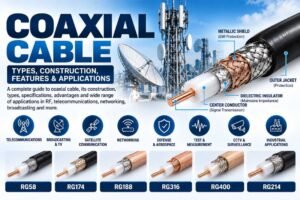
The cable consists of a central conductor, dielectric insulation, metallic shielding, and an outer protective jacket. Its coaxial construction keeps the signal conductor electrically isolated while providing shielding against electromagnetic interference.
Although newer digital technologies have increased the use of other cable types, RG59 remains an important solution where moderate-distance video transmission, flexibility, cost efficiency, and compatibility with existing infrastructure are required.
What Is RG59 Cable?
RG59 is a type of coaxial cable with a nominal characteristic impedance of 75 ohms. The “RG” designation historically refers to Radio Guide terminology, although modern RG59 cables are manufactured according to different commercial and application-specific constructions.
RG59 generally features a relatively small conductor compared with larger 75-ohm coaxial cables such as RG6. This makes it more flexible and easier to route through tight spaces, but it also results in greater attenuation over long distances.
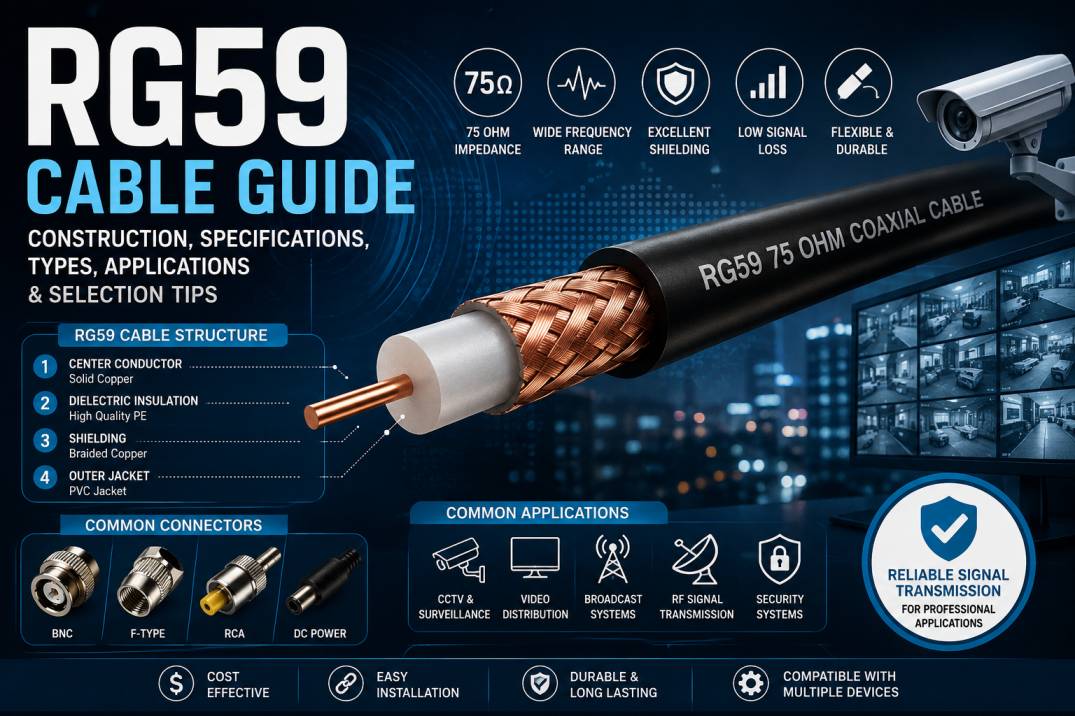
Typical RG59 cable construction includes:
Central Conductor: Usually bare copper, copper-clad steel, or other conductive material.
Dielectric: Commonly polyethylene or foam polyethylene insulation surrounding the center conductor.
Shield: Usually braided copper, tinned copper, aluminum, or a combination of foil and braid.
Outer Jacket: PVC or another protective material designed to provide mechanical and environmental protection.
Connectors: BNC, F-type, RCA, and other compatible connector configurations may be used depending on the application.
RG59 Cable Construction
The performance of RG59 depends heavily on the materials and geometry used in its construction.
1. Center Conductor
The center conductor carries the primary electrical signal. RG59 cables may use solid copper or copper-clad steel conductors.
Solid copper generally provides excellent conductivity and is often preferred for applications requiring reliable signal transmission and power delivery.
Copper-clad steel can reduce cost and provide mechanical strength, but its electrical characteristics differ from those of solid copper.
2. Dielectric Insulation
The dielectric surrounds the center conductor and maintains the required spacing between the conductor and shield.
Common dielectric materials include polyethylene and foam polyethylene. The dielectric affects the cable’s characteristic impedance, velocity of propagation, capacitance, attenuation, and overall electrical performance.
3. Shielding
The shield protects the signal from external electromagnetic and radio-frequency interference.
Depending on the design, RG59 can use:
Braided copper shielding
Tinned copper braid
Aluminum foil shielding
Foil and braid combinations
Higher shielding coverage generally improves resistance to interference, particularly in electrically noisy environments.
4. Outer Jacket
The outer jacket protects the cable from mechanical damage, moisture, abrasion, chemicals, and environmental exposure.
PVC is common for general-purpose installations. Specialized RG59 cables may use materials designed for plenum, outdoor, direct-burial, or other demanding environments.
RG59 Cable Specifications
Exact specifications vary between manufacturers and constructions, but typical RG59 characteristics include:
Characteristic Impedance: 75 ohms
Cable Type: Coaxial
Conductor: Solid copper or copper-clad steel
Dielectric: Polyethylene or foam polyethylene
Shield: Copper, tinned copper, aluminum foil, or combination shield
Outer Diameter: Typically around 6 mm, depending on construction
Operating Frequency: Application and manufacturer dependent
Typical Applications: CCTV, video distribution, television, monitoring systems, and RF signal transmission
Connector Options: BNC, F-type, RCA, and other coaxial connectors
The manufacturer’s datasheet should always be checked before selecting RG59 for a specific frequency, distance, temperature, or installation environment.
RG59 75 Ohm Impedance
One of the most important characteristics of RG59 is its 75-ohm impedance.
A 75-ohm coaxial system is commonly used for video and broadcast applications. Matching the cable impedance with the connected equipment helps minimize signal reflections and maintain signal integrity.
For example, if a video system uses 75-ohm outputs and inputs, a properly selected 75-ohm coaxial cable provides the correct transmission environment.
Impedance mismatch can result in signal reflections, distortion, standing waves, and degraded transmission performance.
RG59 Cable Frequency Performance
RG59 is suitable for many video and moderate-frequency applications, but its attenuation increases as frequency and cable length increase.
This means RG59 is generally more suitable for relatively short or moderate cable runs than very long high-frequency transmission paths.
The actual usable frequency range depends on:
Conductor material
Dielectric construction
Shield design
Cable diameter
Connector quality
Cable length
Installation environment
Signal type
When selecting RG59 for RF applications, engineers should examine attenuation and return-loss specifications at the actual operating frequency rather than relying only on the cable name.
RG59 Cable Types
RG59 is available in several constructions designed for different applications.
Standard RG59 Cable
Standard RG59 is intended for general indoor applications such as CCTV, video distribution, and equipment interconnection.
RG59 CCTV Cable
RG59 CCTV cable is commonly used with surveillance cameras and video monitoring systems. Some versions combine coaxial video transmission with additional conductors for power.
RG59 Siamese Cable
RG59 Siamese cable combines a coaxial video cable with additional power conductors under one outer jacket.
This design can simplify CCTV installations because video and power can be routed together.
Typical applications include analog security cameras and surveillance installations.
Outdoor RG59 Cable
Outdoor RG59 uses a jacket and construction designed to withstand environmental conditions such as sunlight, moisture, temperature variations, and mechanical exposure.
Plenum RG59 Cable
Plenum-rated RG59 is designed for installation in air-handling spaces where building codes require cables with specific fire and smoke characteristics.
The exact rating should always be verified against the applicable building code and manufacturer certification.
Direct Burial RG59 Cable
Direct-burial RG59 is designed for underground installation. It generally incorporates additional protection against moisture and environmental exposure.
RG59 vs RG6 Cable
RG59 and RG6 are both 75-ohm coaxial cables, but they are designed with different physical and electrical characteristics.
RG59 is generally thinner and more flexible, making it convenient for short-distance installations and areas with tight bends.
RG6 typically has a larger conductor and greater shielding options, making it more suitable for many higher-frequency and longer-distance applications.
RG59 is commonly associated with analog CCTV and short video connections, while RG6 is widely used for cable television, satellite television, broadband, and longer high-frequency signal paths.
The best choice depends on frequency, distance, attenuation, installation conditions, flexibility requirements, and system specifications.
RG59 vs RG58 Cable
RG59 and RG58 are often confused because both are coaxial cables, but their impedance is different.
RG59 is typically 75 ohms.
RG58 is typically 50 ohms.
RG59 is therefore commonly used for video and television-related applications, while RG58 is frequently used for RF, radio, instrumentation, and communication systems designed around 50-ohm impedance.
They should not be considered interchangeable simply because their physical appearance can be similar.
RG59 Cable for CCTV
One of the most common applications of RG59 is CCTV surveillance.
Traditional analog CCTV cameras commonly transmit video through 75-ohm coaxial cable. RG59 provides a practical combination of flexibility, availability, and cost for many short and medium-length surveillance installations.
A CCTV RG59 installation may include:
Security camera
RG59 coaxial cable
BNC connectors
Power conductors
Digital video recorder
Power supply
Monitor or networked video equipment
For installations requiring long cable distances or higher-resolution systems, the designer should verify attenuation, signal format, transmission distance, and the requirements of the camera and recorder.
RG59 Siamese Cable for CCTV
RG59 Siamese cable is particularly useful when both power and video need to be delivered to a surveillance camera.
The coaxial section carries the video signal, while the additional conductors supply electrical power.
Advantages include:
Simplified installation
Reduced cable clutter
Faster cable routing
Cleaner CCTV infrastructure
Convenient termination
However, the power conductor size must be selected according to the camera’s voltage, current requirements, cable length, and allowable voltage drop.
RG59 Cable Connectors
The connector is an important part of any coaxial cable assembly.
Common connector types used with RG59 include:
BNC Connector
BNC connectors are widely used in CCTV and professional video equipment. Their bayonet locking mechanism allows quick and secure connections.
F-Type Connector
F-type connectors are common in television and broadband systems and are designed for 75-ohm coaxial applications.
RCA Connector
RCA connectors may be used for certain consumer video and audio applications.
Compression Connectors
Compression-style connectors provide a secure termination and are commonly used in professional coaxial installations.
The connector should match the cable diameter, conductor construction, shielding design, impedance, and equipment interface.
RG59 Cable Attenuation
Attenuation represents the reduction in signal power as the signal travels through the cable.
RG59 attenuation increases with:
Higher frequency
Longer cable length
Higher conductor resistance
Dielectric losses
Poor-quality construction
Temperature
Connector losses
This is why cable datasheets should be consulted when designing a transmission system.
A cable that performs well at one frequency and distance may not provide equivalent performance at another frequency or over a longer installation.
RG59 Cable Shielding
Shielding effectiveness is especially important when RG59 is installed near electrical equipment, motors, power cables, transmitters, or other sources of electromagnetic interference.
Common shielding structures include:
Single braid
Foil shield
Foil plus braid
Multiple shielding layers
A higher-quality shield can reduce unwanted electromagnetic coupling and improve signal integrity.
For demanding environments, engineers should examine the manufacturer’s shielding coverage and transfer impedance specifications rather than assuming all RG59 cables provide the same protection.
RG59 Cable Temperature Range
The operating temperature of RG59 depends on its jacket and insulation materials.
General-purpose PVC RG59 may be suitable for normal indoor environments, while specialized cables can be designed for outdoor, industrial, high-temperature, low-temperature, or other demanding conditions.
Before installation, verify:
Operating temperature
Storage temperature
Minimum bending temperature
Jacket material
UV resistance
Moisture resistance
Fire rating
Environmental certification
RG59 Cable Bending Radius
Because RG59 is relatively flexible, it can be routed through many confined installation areas.
However, excessive bending can damage the dielectric, deform the shield, alter impedance, and negatively affect signal performance.
Installers should maintain the manufacturer’s recommended minimum bend radius and avoid sharp bends, crushing, twisting, or excessive pulling force.
RG59 Cable Installation Guidelines
Proper installation is essential for reliable coaxial performance.
Avoid Sharp Bends
Maintain an appropriate bend radius throughout the cable route.
Avoid Excessive Pulling Force
High pulling tension can deform the cable structure and affect impedance.
Keep Distance from High-Voltage Cables
Where practical, route coaxial cable away from strong sources of electrical interference.
Use Correct Connectors
Select connectors specifically designed for the cable construction.
Make Proper Terminations
Poor connector installation can create impedance discontinuities and signal losses.
Protect Outdoor Installations
Outdoor installations should use suitable UV-resistant, weather-resistant, or direct-burial cable constructions.
Avoid Crushing
Staples, cable ties, and clamps should not compress the cable excessively.
Advantages of RG59 Cable
RG59 offers several benefits for suitable applications.
Flexible construction makes it easier to route than larger coaxial cables.
75-ohm impedance makes it suitable for many video and broadcast systems.
It is widely available in different jacket and shielding configurations.
It can be terminated using commonly available coaxial connectors.
RG59 is cost-effective for many short and medium-distance video installations.
Siamese versions simplify CCTV installations by combining video and power conductors.
Limitations of RG59 Cable
RG59 is not ideal for every application.
Its smaller conductor can result in higher attenuation than larger coaxial cables.
Long cable runs can experience significant signal loss.
Higher-frequency applications may require a different coaxial cable.
Cable quality varies considerably between manufacturers.
Copper-clad steel versions may not be appropriate for applications requiring excellent DC conductivity.
Incorrect impedance matching can degrade signal quality.
Therefore, cable selection should always be based on actual electrical requirements rather than simply choosing RG59 because it is commonly used.
Applications of RG59 Cable
RG59 cable is used across several industries and systems.
CCTV surveillance
Analog security cameras
Video monitoring
Television distribution
Broadcast video
Video equipment interconnection
Closed-circuit television systems
RF signal transmission
Test and measurement applications
Security systems
Residential video installations
Commercial surveillance networks
Industrial monitoring
How to Select the Right RG59 Cable
Selecting the correct RG59 cable requires evaluating several parameters.
1. Determine the Application
Identify whether the cable will be used for CCTV, video, television, RF, instrumentation, or another application.
2. Determine Cable Length
Longer cable runs generally require lower-attenuation cable or an alternative cable type.
3. Check Impedance
For standard RG59 systems, verify that the cable and connected equipment are designed for 75 ohms.
4. Select the Conductor
Choose between solid copper, copper-clad steel, or other conductor constructions according to electrical and mechanical requirements.
5. Evaluate Shielding
Consider the installation environment and potential electromagnetic interference.
6. Select the Jacket
Indoor, outdoor, plenum, direct-burial, and industrial applications may require different jacket constructions.
7. Verify Connector Compatibility
Make sure the selected connectors match the cable’s dimensions and construction.
8. Review Manufacturer Specifications
Always verify attenuation, velocity of propagation, capacitance, operating temperature, shielding, bend radius, and other relevant specifications.
RG59 Cable in RF and Telecom Applications
Although RG59 is primarily associated with 75-ohm video systems, it can be used in selected RF and telecommunications applications where its electrical characteristics meet the system requirements.
However, many telecom RF systems use 50-ohm transmission lines. In such systems, cables such as RG58, RG213, LMR-series cables, or specialized RF cable assemblies may be more appropriate.
The correct cable should therefore be selected based on impedance, frequency, attenuation, power handling, VSWR, shielding, and environmental requirements.
Importance of RG59 Cable Quality
Not all RG59 cables provide identical performance.
Two cables carrying the same RG59 designation can differ significantly in:
Conductor material
Shield coverage
Dielectric material
Jacket quality
Attenuation
Return loss
Temperature rating
Mechanical strength
Connector compatibility
For professional installations, it is important to source cable from a reliable manufacturer or supplier and review the technical datasheet before purchasing.
RG59 Cable Maintenance
Coaxial cables generally require limited maintenance when installed correctly.
Regular inspection should look for:
Damaged jackets
Loose connectors
Corrosion
Water ingress
Sharp bends
Crushed sections
Improper cable support
Signal degradation
Outdoor cable exposed to sunlight or moisture should be inspected periodically for jacket deterioration.
Future of RG59 Cable
RG59 remains relevant because many surveillance, video, and legacy infrastructure systems continue to use 75-ohm coaxial transmission.
Although IP cameras and Ethernet-based systems have expanded significantly, coaxial infrastructure remains valuable in applications where existing cabling can be reused.
Modern technologies can also use coaxial infrastructure with suitable transmission equipment, allowing organizations to upgrade certain systems without completely replacing existing cable routes.
Why Choose a Professional RG59 Cable Supplier?
A reliable supplier can help customers select the appropriate cable construction based on application, distance, frequency, environment, and connector requirements.
Professional cable suppliers can provide:
Technical datasheets
Custom cable lengths
Different conductor materials
Multiple shielding configurations
Indoor and outdoor jackets
Compatible connectors
Pre-terminated cable assemblies
Application-specific recommendations
Quality inspection
For demanding RF, telecom, CCTV, and communication applications, selecting the correct cable construction is just as important as selecting the connector.
Conclusion
RG59 cable remains a practical 75-ohm coaxial cable solution for CCTV, video distribution, television, monitoring, and selected RF applications. Its flexible construction, widespread availability, and compatibility with common 75-ohm interfaces make it particularly useful for short and medium-distance installations.
However, RG59 should not be selected solely based on its name. Important parameters such as conductor material, shielding, attenuation, frequency, cable length, environmental rating, connector compatibility, and impedance must be evaluated before installation.
For professional RF and telecom systems, engineers should compare RG59 with alternatives such as RG6, RG58, RG213, and specialized low-loss coaxial cables to determine the most appropriate solution.
Frequently Asked Questions About RG59 Cable
What is RG59 cable used for?
RG59 cable is primarily used for 75-ohm video transmission, CCTV surveillance, analog security cameras, television distribution, video equipment, and selected RF applications.
Is RG59 cable 50 ohm or 75 ohm?
RG59 is generally a 75-ohm coaxial cable. This makes it suitable for many video, CCTV, television, and broadcast applications.
What is the difference between RG59 and RG6 cable?
Both are generally 75-ohm coaxial cables, but RG6 typically provides better performance for many higher-frequency and longer-distance applications, while RG59 is thinner and more flexible.
Is RG59 good for CCTV?
Yes. RG59 is widely used for CCTV, particularly for analog surveillance systems and short-to-medium cable runs. The required cable type depends on distance, video format, and installation conditions.
Can RG59 carry power?
Standard RG59 is designed primarily for signal transmission. RG59 Siamese cable includes additional conductors specifically for carrying power to CCTV cameras.
Can RG59 be used outdoors?
Yes, provided the selected RG59 cable has an appropriate outdoor-rated, UV-resistant, moisture-resistant, or direct-burial construction.
Is RG59 suitable for high-frequency RF applications?
RG59 can be used when its electrical specifications meet the application’s requirements, but many high-frequency RF systems require specialized 50-ohm or low-loss coaxial cables.
What connector is commonly used with RG59?
BNC connectors are very common for CCTV and video applications. F-type, RCA, and other connectors can also be used depending on the equipment.
Does RG59 have low signal loss?
RG59 provides acceptable loss for many short and medium-distance applications, but attenuation increases with frequency and cable length. Larger or low-loss coaxial cables may be preferable for longer runs.
Can RG59 replace RG6?
Sometimes, but they should not automatically be considered interchangeable. The correct choice depends on frequency, distance, attenuation, shielding, flexibility, and equipment requirements.
Is solid copper RG59 better than copper-clad steel RG59?
Solid copper generally provides better electrical conductivity and is preferable for applications requiring strong DC conductivity. Copper-clad steel can be useful where cost and mechanical properties are more important.
How long can an RG59 cable run?
There is no single maximum distance because practical transmission distance depends on frequency, signal format, attenuation, cable quality, connectors, and receiving equipment. The manufacturer’s attenuation specifications should be used to determine the appropriate distance.
What impedance should RG59 connectors have?
For standard RG59 video systems, connectors should normally be designed for 75-ohm operation to maintain proper impedance matching.