RG58 cable is a widely used 50-ohm coaxial cable designed for RF signal transmission, radio communication, test equipment, networking, wireless systems, and electronic applications. Its compact construction, flexibility, reasonable attenuation, and compatibility with numerous RF connectors make it a popular choice for low- and medium-frequency RF applications.
The term RG58 generally refers to a family of coaxial cable constructions rather than one single cable specification. Different RG58 variants can use different conductors, dielectric materials, shielding configurations, and jacket materials. Therefore, selecting the correct RG58 cable requires understanding its electrical and mechanical characteristics rather than relying only on the RG58 designation.
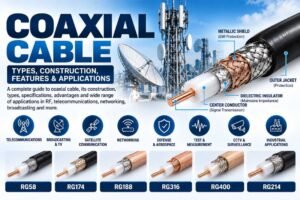
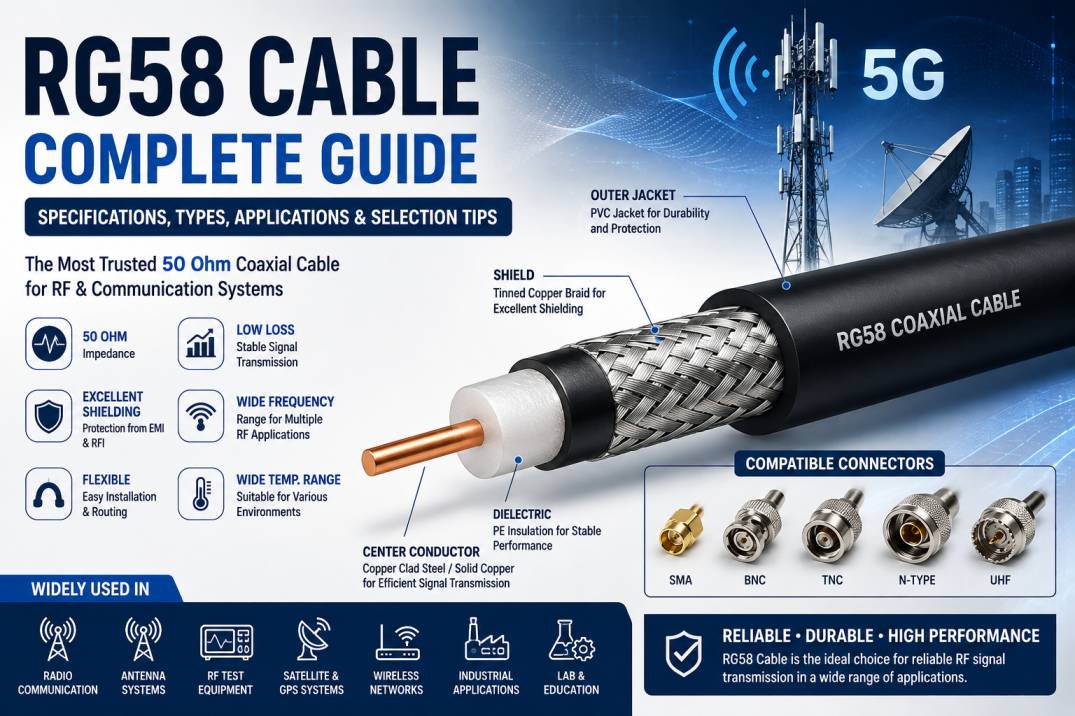
RG58 cable typically consists of a center conductor, dielectric insulation, conductive shielding, and an outer protective jacket. The shielding surrounds the dielectric and center conductor to control electromagnetic interference and maintain the cable’s characteristic impedance.
For RF and telecom applications, RG58 is commonly supplied as bulk cable, jumper cable, RF cable assembly, and terminated cable assembly with connectors such as SMA, BNC, TNC, N-Type, UHF, and other compatible interfaces.
What Is RG58 Cable?
RG58 is a 50-ohm coaxial RF cable commonly used for transmitting radio-frequency signals. It has a relatively small outer diameter compared with larger RF cables such as RG213 and RG214, which makes it easier to route through compact equipment and confined spaces.
The 50-ohm impedance of RG58 makes it suitable for many RF systems where impedance matching is important. Maintaining a consistent 50-ohm transmission path helps reduce signal reflections and improves overall system performance.
RG58 cable is frequently used in radio communication equipment, antenna connections, RF test systems, industrial electronics, wireless communication equipment, GPS systems, and legacy Ethernet applications.
However, RG58 should not automatically be selected for every RF application. Cable length, operating frequency, insertion loss, power handling, environmental conditions, flexibility, shielding requirements, and connector type should all be considered before selecting a cable.
RG58 Cable Construction
A standard RG58 coaxial cable has four primary construction layers.
Center Conductor
The center conductor carries the RF signal through the cable. RG58 variants may use solid or stranded conductors.
Solid conductors generally provide consistent electrical characteristics and can offer good attenuation performance. Stranded conductors provide greater flexibility and are particularly useful for cable assemblies that are repeatedly moved or connected.
Copper is commonly used because of its good electrical conductivity. Some cable designs may use tinned copper or other conductor treatments to improve corrosion resistance, solderability, or manufacturing performance.
Dielectric
The dielectric surrounds the center conductor and maintains the physical spacing between the conductor and shield.
Traditional RG58 designs commonly use polyethylene-based dielectric materials, although modern cable variants may use alternative low-loss or low-density dielectric materials to improve electrical performance.
The dielectric material affects velocity of propagation, capacitance, attenuation, flexibility, and maximum operating temperature.
Shield
The shield surrounds the dielectric and provides the return path for the RF transmission system while also helping protect the signal from external electromagnetic interference.
Depending on the specific RG58 construction, the shield may consist of a braided copper layer, tinned copper braid, or a combination of foil and braid.
Shield coverage is important when RG58 is used in environments containing strong electromagnetic interference. Higher shielding effectiveness can help reduce unwanted signal coupling and improve system reliability.
Outer Jacket
The outer jacket protects the internal cable construction from mechanical damage, moisture, abrasion, chemicals, and environmental exposure.
PVC is commonly used for general-purpose RG58 cables, while specialized versions may use materials designed for higher temperature, outdoor, UV-resistant, low-smoke, or demanding industrial applications.
Key RG58 Cable Specifications
The exact specifications vary according to the manufacturer and RG58 variant. Typical characteristics include:
| Parameter | Typical RG58 Characteristic |
|---|---|
| Characteristic Impedance | 50 Ohm |
| Cable Type | Coaxial RF Cable |
| Center Conductor | Copper or copper-based conductor |
| Dielectric | Polyethylene or similar RF dielectric |
| Shield | Braided copper/tinned copper or foil-braid construction |
| Outer Diameter | Approximately 5 mm |
| Frequency Capability | Application-dependent |
| Connector Options | SMA, BNC, TNC, N-Type, UHF and others |
| Applications | RF, radio, wireless, test equipment, telecom |
| Construction | Flexible coaxial cable |
| Shielding | Dependent on construction |
| Temperature Rating | Manufacturer dependent |
These values are general reference characteristics. The manufacturer’s datasheet should always be consulted when precise attenuation, power, temperature, shielding, and frequency specifications are required.
RG58 Cable Frequency Range
RG58 cable is generally used in relatively low- to moderate-frequency RF applications. Its usable frequency range depends on the exact cable construction, length, connector quality, and performance requirements of the system.
RG58 can be found in applications involving HF, VHF, and UHF signals. Some specialized RG58 variants can support higher frequencies, but attenuation generally increases as frequency increases.
For high-frequency microwave systems, smaller low-loss cables or precision microwave cable assemblies may be more appropriate.
When selecting RG58 for an RF system, the required operating frequency should therefore be evaluated together with cable length and allowable insertion loss.
RG58 Cable Attenuation
Attenuation represents the amount of signal power lost as the RF signal travels through the cable.
RG58 attenuation increases with frequency and cable length. This means a short RG58 jumper may perform very well in a system while a long RG58 cable operating at a higher frequency may introduce significant insertion loss.
For example, if an RF system has a very low allowable link loss, a low-loss coaxial cable may be preferable to conventional RG58.
The correct selection should consider:
Cable length
Operating frequency
Required signal level
Maximum acceptable insertion loss
Connector losses
System impedance
Environmental conditions
RG58 Impedance
One of the most important characteristics of RG58 is its nominal 50-ohm characteristic impedance.
RF equipment, antennas, connectors, attenuators, splitters, amplifiers, and transmission lines are frequently designed around a 50-ohm impedance environment.
Maintaining impedance continuity across the complete RF signal path helps minimize reflections.
An RF system can contain several components:
Transmitter → Connector → Cable → Adapter → Antenna
If all components are designed for 50 ohms, impedance matching can be maintained throughout the transmission path.
Using a 75-ohm component in an otherwise 50-ohm RF system can introduce an impedance mismatch and increase signal reflections.
RG58 Cable VSWR and Return Loss
Voltage Standing Wave Ratio, commonly called VSWR, is an important RF parameter associated with impedance matching.
A properly manufactured RG58 cable with high-quality connectors can provide good impedance continuity. However, the cable itself is only one part of the transmission system.
Poor connector termination, damaged cable, incorrect crimping, excessive bending, or an improperly matched load can increase VSWR.
Return loss is another parameter used to evaluate reflected RF power. Higher return loss generally indicates better impedance matching and lower reflected power.
For precision RF applications, cable assemblies should be tested using appropriate RF measurement equipment such as a Vector Network Analyzer.
Types of RG58 Cable
RG58 is available in multiple construction variations.
RG58 Solid Conductor Cable
Solid-conductor RG58 uses a single conductor through the center of the cable. It can provide stable electrical characteristics and is suitable for applications where the cable does not require extensive movement.
RG58 Stranded Conductor Cable
Stranded RG58 uses multiple small conductor strands. This design improves flexibility and is useful for test cables, equipment jumpers, laboratory applications, and frequently handled assemblies.
RG58/U Cable
RG58/U is one of the commonly recognized RG58 designations. The exact construction and performance can vary depending on the manufacturer and applicable specification.
RG58A/U Cable
RG58A/U is another common variant, generally associated with a flexible construction. It has been widely used in radio and communication applications.
Low-Loss RG58 Variants
Modern manufacturers also produce enhanced RG58-type cables designed to provide lower attenuation than conventional constructions.
These variants may use improved dielectric materials, optimized conductor dimensions, advanced shielding, or other construction techniques.
RG58 vs RG174
RG58 and RG174 are both 50-ohm coaxial cables, but their physical and electrical characteristics differ.
RG58 is thicker and generally provides lower attenuation and better power-handling capability than RG174.
RG174 is smaller and lighter, making it useful when space and weight are important considerations.
RG58 is generally preferred when mechanical durability, lower attenuation, and higher power capability are more important.
RG174 may be preferred for compact electronic equipment, GPS devices, wireless modules, and internal interconnections where very small cable dimensions are required.
RG58 vs RG213
RG213 is significantly larger than RG58 and is commonly used where lower attenuation and higher power-handling capability are required.
RG58 is easier to route and install because of its smaller size and greater flexibility.
RG213 is typically selected for longer RF transmission paths, higher-power radio systems, and applications where lower loss is more important than compact cable size.
RG58 vs LMR-400
LMR-400 is a much larger low-loss coaxial cable designed for applications where transmission efficiency over longer distances is important.
RG58 is compact, flexible, and economical, making it useful for short RF connections.
LMR-400 generally provides substantially lower attenuation than conventional RG58 but requires more installation space and has a larger bend radius.
For short equipment jumpers, RG58 can be a practical choice. For long antenna feeder runs, a low-loss cable such as LMR-400 may be more appropriate.
RG58 Cable Connector Options
RG58 cable assemblies can be terminated with a wide range of RF connectors.
SMA Connector
SMA connectors are compact threaded RF connectors widely used in wireless communication, antennas, RF modules, test equipment, and instrumentation.
BNC Connector
BNC connectors use a bayonet coupling mechanism and are widely used in test equipment, radio systems, instrumentation, video equipment, and laboratory applications.
TNC Connector
TNC connectors use a threaded coupling mechanism and provide improved mechanical stability compared with bayonet-style connectors.
N-Type Connector
N-Type connectors are larger RF connectors designed for robust applications and are frequently used with antennas, base stations, telecom equipment, and outdoor RF systems.
UHF Connector
UHF connectors are commonly used in radio communication applications, although their RF performance is generally less precise than many modern precision RF connectors.
RG58 Cable Assemblies
An RG58 cable assembly consists of RG58 coaxial cable terminated with RF connectors at one or both ends.
Examples include:
SMA Male to SMA Male RG58 Cable Assembly
SMA Male to BNC Female RG58 Cable Assembly
SMA Male to BNC Male RG58 Cable Assembly
BNC Male to BNC Male RG58 Cable Assembly
N-Type Male to N-Type Male RG58 Cable Assembly
TNC Male to SMA Male RG58 Cable Assembly
Custom connector combinations can also be manufactured according to equipment requirements.
Cable length, connector orientation, stripping dimensions, contact plating, jacket material, and electrical testing can be customized for specific applications.
Applications of RG58 Cable
RG58 is used across many RF and electronic applications.
Radio Communication
RG58 is commonly used for connecting radio equipment to antennas and other RF components.
RF Test Equipment
Test laboratories frequently use RG58 cable assemblies for connecting signal generators, oscilloscopes, spectrum analyzers, VNAs, attenuators, and other RF equipment.
Wireless Communication
RG58 can be used for short RF interconnections inside wireless communication systems.
GPS and Navigation Systems
Certain GPS and navigation systems use RG58-type cables for antenna connections, depending on frequency and required cable loss.
Telecom Equipment
RG58 can be used for internal RF connections, equipment jumpers, and selected telecom applications.
Industrial Electronics
Industrial RF systems may use RG58 where flexible signal transmission and moderate environmental resistance are required.
Antenna Systems
RG58 is widely used for short antenna feeder connections, especially in amateur radio and communication equipment.
Laboratory and Educational Systems
Because RG58 is readily available and compatible with many RF connectors, it is also commonly used in electronics laboratories and educational RF setups.
Advantages of RG58 Cable
RG58 provides several practical benefits.
Compact Construction
Its relatively small diameter allows it to be installed in areas where larger coaxial cables may be difficult to route.
Flexible Design
Flexible RG58 variants are easy to install and suitable for equipment connections and cable assemblies.
50-Ohm RF Compatibility
The 50-ohm impedance makes RG58 suitable for a broad range of RF systems.
Wide Connector Compatibility
RG58 can be terminated with many commonly used RF connector types.
Cost-Effective
Compared with many specialized low-loss RF cables, standard RG58 can be an economical solution for short-distance RF connections.
Easy Availability
RG58 is a widely recognized coaxial cable family and is available from many cable and RF component manufacturers.
Limitations of RG58 Cable
Despite its versatility, RG58 has limitations.
Its attenuation is higher than many modern low-loss RF cables, particularly at higher frequencies.
For long cable runs, the accumulated insertion loss can become significant.
RG58 also has lower power-handling capability than many larger coaxial cables.
Therefore, it may not be the best choice for high-power transmitters, long antenna feeder systems, or demanding microwave applications.
How to Select the Right RG58 Cable
Choosing the correct RG58 cable requires evaluating several parameters.
Operating Frequency
Determine the highest frequency that the cable must support.
Cable Length
Longer cable lengths produce greater insertion loss. Always calculate the expected cable loss at the operating frequency.
Flexibility
For moving equipment or frequently connected test assemblies, select a flexible stranded-conductor construction where appropriate.
Shielding
For electrically noisy environments, choose a cable with suitable shielding effectiveness.
Temperature
Verify the cable’s operating temperature range if it will be installed near high-temperature equipment.
Jacket Material
Select the jacket according to indoor, outdoor, UV, chemical, mechanical, or industrial requirements.
Connector Type
Confirm that the connector interface matches the equipment and that the connector is compatible with the cable diameter and construction.
Power Handling
Ensure that the cable can safely handle the required RF power at the operating frequency.
Environmental Conditions
For outdoor applications, consider moisture resistance, UV resistance, temperature cycling, and mechanical protection.
RG58 Cable Installation Guidelines
Proper installation is important for maintaining RF performance.
Avoid excessive bending because sharp bends can deform the dielectric and change the cable’s impedance.
Do not crush the cable with cable ties or mechanical clamps.
Maintain the recommended minimum bend radius specified by the cable manufacturer.
Use correct stripping and crimping tools when installing connectors.
Ensure that connectors are properly tightened according to the connector manufacturer’s requirements.
Protect outdoor cable connections against moisture ingress.
Inspect cable assemblies for damaged jackets, loose connectors, kinks, or excessive mechanical stress before installation.
RG58 Cable Testing
Professional RF cable assemblies can be tested for several parameters.
Continuity Test
A continuity test verifies that the center conductor and shield are electrically connected as intended.
Insulation Resistance
This test checks electrical isolation between the center conductor and shield.
VSWR Test
VSWR testing helps identify impedance discontinuities and connector termination problems.
Return Loss Test
Return loss provides information about reflected RF power caused by impedance mismatch.
Insertion Loss Test
Insertion loss measures the signal power lost through the cable assembly.
Time Domain Reflectometry
TDR can help locate impedance discontinuities, cable damage, connector faults, and other problems along the transmission line.
RG58 Cable for RF and Telecom Applications
In RF and telecom systems, cable selection has a direct effect on overall system performance.
RG58 is particularly useful for short RF connections where compact size, flexibility, and cost are important.
For applications involving long cable routes, high transmit power, or high-frequency microwave signals, engineers should compare RG58 against lower-loss alternatives.
SRFS Teleinfra can provide RF cable assemblies and related RF interconnection solutions based on cable type, connector interface, frequency range, impedance, length, and application requirements.
RG58 Cable Maintenance
Proper maintenance can extend the service life of RG58 cable assemblies.
Inspect cable jackets periodically for cracking, cuts, or abrasion.
Check connectors for corrosion or mechanical damage.
Avoid repeatedly bending the same section of cable.
Keep RF connectors clean and protected from contamination.
For critical systems, periodically test insertion loss and VSWR to identify performance degradation.
Replace cables that show significant physical damage or abnormal RF test results.
RG58 Cable Selection Checklist
Before purchasing RG58 cable, verify:
50-ohm impedance
Required frequency range
Cable length
Attenuation
Power-handling capability
Conductor construction
Dielectric material
Shielding configuration
Outer jacket material
Operating temperature
Minimum bend radius
Connector type
Connector gender
Cable assembly length
Environmental requirements
Required RF testing
Why Choose a Quality RG58 Cable Manufacturer?
The quality of an RG58 cable assembly depends not only on the cable itself but also on connector selection, termination quality, dimensional accuracy, materials, assembly processes, and testing.
A professional RF cable manufacturer should be able to provide consistent cable dimensions, reliable connector termination, appropriate materials, controlled assembly processes, and electrical testing.
For critical RF applications, customers should request technical datasheets and relevant test results before approving a cable assembly.
Conclusion
RG58 cable remains a practical and versatile 50-ohm coaxial cable for RF communication, radio systems, laboratory equipment, wireless devices, antenna connections, and short-distance RF interconnections.
Its compact size, flexibility, wide connector compatibility, and relatively low cost make it an attractive choice for many applications. However, RG58 is not universally suitable for every RF system. Frequency, cable length, attenuation, power level, shielding, environmental conditions, and connector configuration must be considered before selecting the appropriate cable.
For high-frequency, long-distance, or low-loss applications, engineers should compare RG58 with alternatives such as RG213, RG214, LMR-series cables, and specialized low-loss RF cable assemblies.
Frequently Asked Questions About RG58 Cable
What is RG58 cable?
RG58 is a 50-ohm coaxial RF cable commonly used for radio communication, antennas, wireless equipment, RF testing, instrumentation, and electronic applications.
Is RG58 a 50-ohm cable?
Yes. RG58 is generally a 50-ohm coaxial cable, making it suitable for many RF and radio-frequency systems designed around 50-ohm impedance.
What is RG58 cable used for?
RG58 is used for radio communication, antenna connections, RF test equipment, wireless systems, instrumentation, telecom equipment, GPS-related applications, and short RF interconnections.
What is the difference between RG58 and RG174?
Both are generally 50-ohm coaxial cables. RG58 is larger and typically offers better attenuation and power handling, while RG174 is smaller and better suited to compact applications where space and flexibility are important.
Is RG58 suitable for high-frequency applications?
RG58 can be used at various RF frequencies, but attenuation increases as frequency increases. For demanding microwave or low-loss applications, a specialized low-loss cable may be a better choice.
Is RG58 suitable for antenna connections?
Yes. RG58 is commonly used for antenna connections, particularly for relatively short cable runs where its attenuation is acceptable for the operating frequency.
What connectors can be used with RG58 cable?
RG58 can be terminated with connectors such as SMA, BNC, TNC, N-Type, UHF, and other compatible RF connectors depending on the cable construction and application.
Is RG58 better than LMR-400?
Neither is universally better. RG58 is smaller, lighter, and more flexible, while LMR-400 generally provides much lower attenuation and is better suited for longer RF transmission paths.
Can RG58 be used outdoors?
Certain RG58 constructions are suitable for outdoor applications, but the specific jacket, UV resistance, moisture resistance, temperature rating, and environmental specifications must be verified before outdoor installation.
How do you test an RG58 cable?
RG58 cable assemblies can be tested for continuity, insulation resistance, VSWR, return loss, insertion loss, and, when required, time-domain characteristics using appropriate RF test equipment.