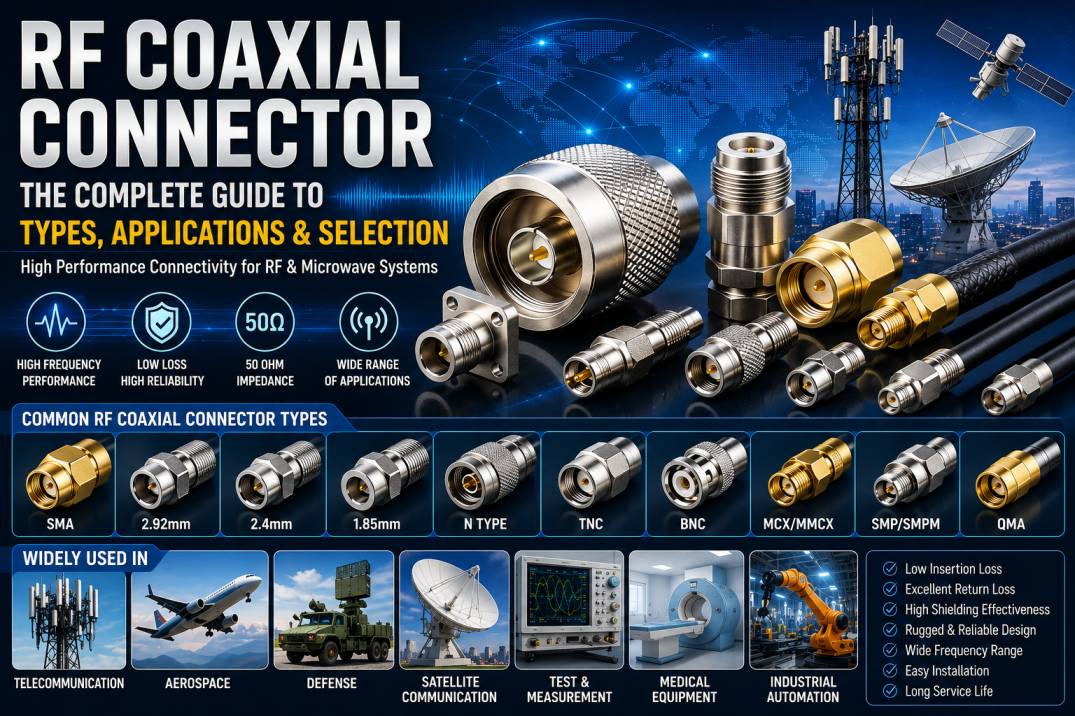
An RF Coaxial Connector is one of the most important components in radio frequency (RF) and microwave communication systems. It provides a secure mechanical and electrical connection between coaxial cables, antennas, RF equipment, and electronic devices while maintaining the characteristic impedance of the transmission line.
Whether you are designing a 5G communication network, testing microwave equipment, building a satellite communication system, or manufacturing defense electronics, selecting the right RF coaxial connector directly impacts signal integrity, insertion loss, return loss, and overall system performance.
Modern RF connectors are engineered to operate from DC frequencies to over 110 GHz while ensuring low VSWR, excellent shielding, and reliable performance in demanding environments.
This comprehensive guide explains everything you need to know about RF coaxial connectors, including their construction, working principle, major types, applications, specifications, and selection criteria.
What is an RF Coaxial Connector?
An RF Coaxial Connector is a precision-engineered connector designed to transmit high-frequency electrical signals with minimal signal degradation. It connects coaxial cables to RF devices while preserving the cable’s impedance, typically 50 Ohm or 75 Ohm.
Unlike conventional electrical connectors, RF connectors are specially designed to reduce signal reflections, electromagnetic interference (EMI), insertion loss, and impedance mismatch.
These connectors are widely used in:
- Wireless communication
- Cellular infrastructure
- Satellite communication
- Radar systems
- Aerospace
- Military electronics
- Medical equipment
- Laboratory testing
- Broadcasting
- Industrial automation
How Does an RF Coaxial Connector Work?
A coaxial connector extends the coaxial cable structure without interrupting signal flow.
The connector consists of:
- Center Contact
- Dielectric Insulator
- Outer Conductor
- Shield
- Coupling Mechanism
- Connector Housing
The center conductor carries the RF signal while the outer conductor provides grounding and shielding. The dielectric maintains spacing and impedance, ensuring efficient signal transmission across the connection.
When properly connected, the connector minimizes:
- Signal Reflection
- Power Loss
- Signal Distortion
- Electromagnetic Interference
- Voltage Standing Wave Ratio (VSWR)
Main Components of an RF Coaxial Connector
Center Pin
Carries the RF signal from one device to another.
Dielectric Insulator
Separates the center conductor from the outer conductor while maintaining impedance.
Outer Conductor
Provides shielding and serves as the ground path.
Coupling Nut
Locks the connector securely to prevent accidental disconnection.
Connector Body
Protects internal components and provides mechanical strength.
Plating
Gold, silver, nickel, or stainless steel plating improves conductivity and corrosion resistance.
Types of RF Coaxial Connectors
Numerous RF connector types are available depending on frequency range, power handling, cable type, and application.
SMA Connector
One of the most popular RF connectors.
Frequency Range:
DC to 18 GHz (up to 26.5 GHz for precision versions)
Applications:
- Test equipment
- GPS
- Wi-Fi
- RF modules
- Microwave systems
2.92mm Connector (K Connector)
Designed for high-frequency microwave applications.
Frequency Range:
DC to 40 GHz
Applications:
- High-speed testing
- Aerospace
- Defense
- Microwave communication
2.4mm Connector
Supports extremely high frequencies.
Frequency Range:
DC to 50 GHz
Applications:
- Precision measurement
- Millimeter wave systems
1.85mm Connector
Supports frequencies up to 67 GHz.
Applications:
- 5G
- Microwave research
- RF laboratories
N Type Connector
A rugged connector suitable for outdoor installations.
Frequency Range:
DC to 11 GHz
Applications:
- Base stations
- Antennas
- Cellular towers
TNC Connector
Threaded version of the BNC connector with better vibration resistance.
Applications:
- Military
- Avionics
- Industrial equipment
BNC Connector
Quick-connect RF connector.
Applications:
- Oscilloscopes
- Video systems
- Laboratory instruments
MCX and MMCX Connectors
Miniature RF connectors for compact electronics.
Applications:
- GPS
- IoT devices
- Medical electronics
SMP and SMPM Connectors
Ultra-compact connectors designed for high-density interconnections.
Applications:
- Aerospace
- Radar
- High-frequency modules
QMA Connector
Quick-lock RF connector offering fast installation.
Applications:
- Wireless communication
- Telecom infrastructure
Common RF Coaxial Connector Interfaces
Manufacturers provide RF connectors in numerous interface combinations.
Examples include:
- SMA Male to SMA Female
- N Male to SMA Female
- 2.92mm Male to SMA Female
- 2.4mm Male to 2.92mm Female
- SMP to SMPM
- BNC to SMA
- TNC to N Type
Key Electrical Specifications
Before selecting an RF connector, engineers evaluate several electrical parameters.
Frequency Range
Maximum operating frequency supported by the connector.
Characteristic Impedance
Most RF connectors use:
50 Ohm
or
75 Ohm
VSWR
Lower VSWR indicates better impedance matching.
Typical values:
1.10:1
1.15:1
1.20:1
Return Loss
Higher return loss indicates lower signal reflection.
Insertion Loss
Represents signal loss through the connector.
Lower insertion loss improves overall system efficiency.
Power Handling
Depends on connector size, frequency, and cooling conditions.
Mechanical Specifications
Important mechanical characteristics include:
- Connector Type
- Gender
- Mounting Style
- Thread Type
- Coupling Mechanism
- Torque Rating
- Mating Cycles
- Material
- Plating
Materials Used
Premium RF connectors are manufactured using:
- Stainless Steel
- Brass
- Beryllium Copper
- Gold Plating
- Silver Plating
- PTFE Insulators
- Nickel Plating
These materials improve durability and electrical performance.
Applications of RF Coaxial Connectors
RF connectors are found across almost every high-frequency industry.
Telecommunications
Used in:
- 4G Networks
- 5G Infrastructure
- Distributed Antenna Systems
- Small Cells
- Repeaters
Aerospace
Essential for:
- Aircraft communication
- Navigation
- Satellite payloads
- Flight testing
Defense
Used in:
- Electronic warfare
- Radar
- Missile guidance
- Tactical communication
Satellite Communication
Supports:
- Ground stations
- VSAT systems
- Satellite antennas
- Tracking systems
Test and Measurement
Widely used in:
- Vector Network Analyzers
- Spectrum Analyzers
- Signal Generators
- Oscilloscopes
Medical Equipment
Applications include:
- MRI
- Imaging systems
- Diagnostic equipment
Industrial Automation
Used in:
- RF sensors
- Wireless monitoring
- Robotics
Advantages of RF Coaxial Connectors
High-frequency performance
Low insertion loss
Excellent return loss
Reliable impedance matching
High shielding effectiveness
Long service life
Easy installation
Excellent corrosion resistance
Suitable for harsh environments
Supports precision microwave applications
How to Select the Right RF Coaxial Connector
Choosing the correct connector depends on multiple technical factors.
Operating Frequency
Always select a connector rated above your operating frequency.
Cable Compatibility
Ensure compatibility with the cable diameter and construction.
Impedance
Maintain consistent impedance throughout the RF system.
Power Rating
Choose connectors capable of handling the required RF power.
Environmental Conditions
Consider:
- Temperature
- Humidity
- Vibration
- Corrosion
- Outdoor exposure
Connector Size
Compact connectors are ideal for space-constrained equipment.
Mating Cycles
For laboratory applications, choose connectors with high mating durability.
Common Installation Mistakes
Improper cable stripping
Incorrect crimping
Over-tightening
Insufficient torque
Damaged center pin
Contaminated connector surfaces
Impedance mismatch
Poor cable preparation
Avoiding these issues significantly improves connector life and RF performance.
Maintenance Tips
Inspect connectors regularly.
Keep mating surfaces clean.
Use protective dust caps.
Avoid excessive bending of cables.
Apply recommended torque values.
Replace worn connectors promptly.
Store unused connectors in dry environments.
Future Trends in RF Coaxial Connectors
As communication technology advances, RF connectors continue to evolve.
Key trends include:
Higher frequency capability beyond 110 GHz
Miniaturized connector designs
Low PIM connectors for 5G networks
High-density board-level connectors
Improved corrosion-resistant materials
Enhanced precision manufacturing
Connectors optimized for satellite internet and autonomous systems
Why Choose SRFS Teleinfra RF Coaxial Connectors?
SRFS Teleinfra offers a comprehensive range of precision RF coaxial connectors designed for demanding RF and microwave applications. Manufactured using high-quality materials and advanced machining processes, our connectors deliver low insertion loss, excellent VSWR, superior durability, and reliable performance across a wide frequency range. Whether you need SMA, N Type, 2.92mm, 2.4mm, 1.85mm, SMP, SMPM, MCX, MMCX, or custom RF connector solutions, SRFS Teleinfra provides products that meet the requirements of telecommunications, defense, aerospace, satellite communication, industrial automation, and RF testing industries.
Conclusion
RF Coaxial Connectors are fundamental components in modern RF and microwave systems, ensuring efficient signal transmission with minimal loss and maximum reliability. Understanding connector types, electrical specifications, mechanical characteristics, and application requirements helps engineers select the most suitable solution for their systems. As wireless communication, aerospace, satellite technology, and high-frequency electronics continue to advance, precision RF connectors will remain essential for achieving reliable and high-performance connectivity. By choosing quality RF coaxial connectors and following proper installation and maintenance practices, users can maximize system efficiency, reduce downtime, and ensure long-term operational performance.