RF Coaxial Cable is one of the most important components in modern radio frequency (RF) and microwave communication systems. Whether it is used in telecommunications, aerospace, defense, broadcasting, satellite communication, medical equipment, or wireless networking, an RF Coaxial Cable ensures efficient transmission of high-frequency electrical signals with minimal signal loss and excellent shielding.
Selecting the right RF Coaxial Cable is critical for achieving reliable system performance. Factors such as frequency range, insertion loss, shielding effectiveness, power handling capability, flexibility, and environmental conditions all influence cable performance.
This guide explains everything you need to know about RF Coaxial Cable, including its construction, working principle, types, selection criteria, applications, advantages, and maintenance tips.
What is an RF Coaxial Cable?
An RF Coaxial Cable is a specially designed transmission cable that carries radio frequency signals from one device to another while protecting the signal from electromagnetic interference (EMI) and radio frequency interference (RFI).
Unlike ordinary electrical cables, RF Coaxial Cables are engineered to maintain a constant impedance, usually 50 Ohms or 75 Ohms, ensuring minimal reflections and maximum signal integrity.
These cables are widely used in RF communication systems where high-frequency signals must travel over long distances without significant attenuation.
Construction of an RF Coaxial Cable
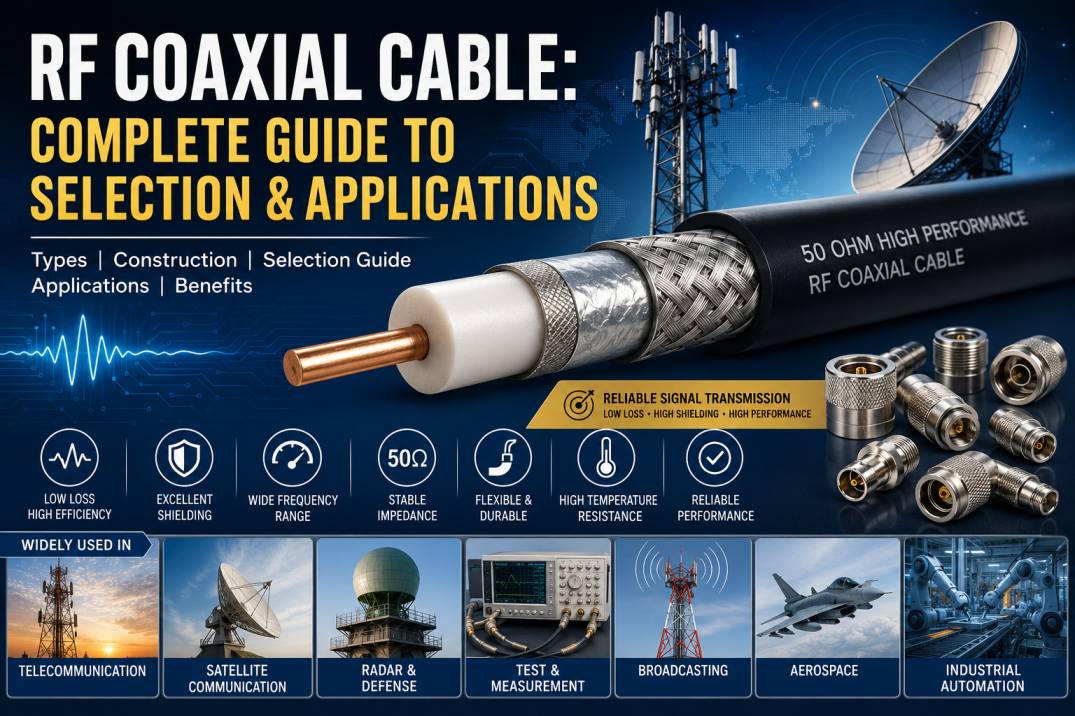
A typical RF Coaxial Cable consists of four major layers that work together to ensure reliable signal transmission.
Center Conductor
The center conductor carries the RF signal. It is typically made from copper, silver-plated copper, or copper-clad steel depending on the application.
Dielectric Insulator
The dielectric surrounds the center conductor and maintains the spacing between the conductor and the shield. Common materials include:
- PTFE (Teflon)
- Foam Polyethylene
- Solid Polyethylene
- Air-Spaced Dielectrics
The dielectric directly affects impedance, signal velocity, and cable loss.
Outer Shield
The shielding layer protects the signal from external electromagnetic interference and prevents signal leakage.
Shielding options include:
- Copper Braid
- Aluminum Foil
- Double Shield
- Triple Shield
- Quad Shield
Outer Jacket
The outer jacket provides mechanical protection against abrasion, chemicals, moisture, UV exposure, and harsh environments.
Common jacket materials include:
- PVC
- PE
- FEP
- LSZH
- Polyurethane
How Does an RF Coaxial Cable Work?
RF Coaxial Cable works by guiding electromagnetic energy through the center conductor while the surrounding shield acts as the return path and protects the signal from external interference.
The coaxial design confines the electromagnetic field within the cable, resulting in:
- Lower insertion loss
- Better impedance stability
- Reduced radiation
- Excellent noise immunity
- Improved signal quality
This unique design makes RF Coaxial Cable suitable for frequencies ranging from DC to more than 110 GHz, depending on the cable type.
Types of RF Coaxial Cable
Flexible RF Coaxial Cable
Flexible cables are easy to install and suitable for systems requiring frequent movement or routing through tight spaces.
Applications include:
- Test equipment
- Wireless communication
- Laboratory use
- Indoor installations
Semi-Flexible RF Cable
Semi-flexible cables provide lower loss than flexible cables while maintaining moderate bendability.
Applications include:
- Base stations
- Radar
- Satellite systems
Semi-Rigid RF Cable
Semi-rigid cables use a solid metal outer conductor, providing excellent electrical performance.
Applications include:
- Military systems
- Aerospace
- High-frequency microwave systems
- Precision RF testing
Corrugated RF Cable
Corrugated cables are commonly used for long-distance installations where low loss is critical.
Applications include:
- Cellular towers
- Outdoor communication systems
- DAS networks
Low Loss RF Cable
Low-loss RF cables are specifically designed to minimize attenuation over long cable runs.
Applications include:
- GPS
- Wi-Fi
- LTE
- 5G
- RF distribution networks
Common RF Coaxial Cable Impedance
50 Ohm Cable
Most RF communication systems use 50 Ohm cables because they provide the best balance between power handling and signal loss.
Common applications include:
- RF equipment
- Wireless communication
- Military communication
- Microwave systems
- Test instruments
75 Ohm Cable
75 Ohm cables offer lower attenuation and are commonly used for video transmission.
Applications include:
- CCTV
- Television
- Video broadcasting
Important Parameters for Selecting an RF Coaxial Cable
Choosing the right RF Coaxial Cable requires evaluating several technical parameters.
Frequency Range
Higher frequencies require cables with lower dielectric loss and better shielding.
Insertion Loss
Lower insertion loss means more signal reaches the destination.
VSWR
A low Voltage Standing Wave Ratio indicates better impedance matching and lower signal reflection.
Return Loss
Higher return loss means improved signal quality and lower reflections.
Shielding Effectiveness
Better shielding protects against EMI and RFI.
Power Handling
The cable should safely handle the maximum RF power without overheating.
Bend Radius
Flexible applications require cables with smaller bend radii.
Operating Temperature
Industrial, aerospace, and military systems require cables capable of operating under extreme temperatures.
Environmental Protection
Outdoor applications may require UV-resistant, waterproof, or flame-retardant jackets.
Popular RF Coaxial Cable Types
Several cable families are commonly used across RF industries.
- RG58
- RG174
- RG213
- RG316
- LMR195
- LMR240
- LMR400
- LMR600
- Semi-Rigid Cable
- Low Loss Cable
- Phase Stable Cable
- High Performance Test Cable
Each cable type is designed for specific frequency ranges, power levels, and installation environments.
Advantages of RF Coaxial Cable
RF Coaxial Cable offers several advantages over conventional transmission cables.
- Excellent signal integrity
- Low insertion loss
- High shielding effectiveness
- Stable impedance
- Wide frequency coverage
- High reliability
- Long service life
- Easy connector compatibility
- Suitable for indoor and outdoor installations
- Supports high-power RF applications
Applications of RF Coaxial Cable
RF Coaxial Cable is used in nearly every industry that relies on high-frequency communication.
Telecommunications
RF Coaxial Cable connects antennas, base stations, repeaters, and distributed antenna systems.
Aerospace
Aircraft communication and navigation systems require lightweight, high-performance RF cables.
Defense
Military radar, electronic warfare, missile guidance, and secure communication systems rely on precision RF Coaxial Cables.
Satellite Communication
Satellite uplink and downlink equipment require low-loss RF transmission.
Broadcasting
Television and radio broadcasting stations use RF cables to connect transmitters and antennas.
Medical Equipment
MRI systems, RF imaging equipment, and diagnostic instruments depend on high-quality coaxial cables.
Test and Measurement
Vector Network Analyzers, Spectrum Analyzers, Signal Generators, and Oscilloscopes require precision RF cables.
Industrial Automation
Factories use RF Coaxial Cables in wireless control systems, sensors, and monitoring equipment.
Automotive
Connected vehicles, autonomous driving systems, and advanced driver assistance systems use RF communication extensively.
Research Laboratories
Universities and research organizations use RF cables for microwave experiments and advanced communication research.
How to Choose the Right RF Coaxial Cable
Selecting the best RF Coaxial Cable depends on your application requirements.
Consider:
- Operating frequency
- Cable length
- Signal attenuation
- Connector compatibility
- Environmental conditions
- Power handling requirements
- Flexibility requirements
- Installation location
- Budget
- Industry standards
Always choose a cable that provides low loss while meeting the required electrical and mechanical specifications.
Maintenance Tips
Proper maintenance increases cable life and improves system reliability.
- Avoid excessive bending.
- Protect connectors from contamination.
- Inspect the cable regularly for damage.
- Maintain proper torque during connector installation.
- Keep moisture away from connector interfaces.
- Replace damaged cables immediately.
- Store cables using proper bend radius guidelines.
Why Choose High-Quality RF Coaxial Cable?
High-quality RF Coaxial Cables provide superior signal transmission, improved durability, and lower maintenance costs. Precision manufacturing, high-grade materials, and strict quality control ensure consistent electrical performance across demanding RF and microwave applications.
Choosing a trusted manufacturer also ensures compliance with international quality standards, reliable impedance control, excellent shielding performance, and long operational life.
Frequently Asked Questions
What is an RF Coaxial Cable used for?
RF Coaxial Cable is used to transmit radio frequency signals between antennas, transmitters, receivers, test equipment, and communication devices.
What impedance is commonly used in RF Coaxial Cable?
Most RF communication systems use 50 Ohm RF Coaxial Cable, while 75 Ohm cables are commonly used for video transmission.
What is the difference between flexible and semi-rigid RF Coaxial Cable?
Flexible cables are easier to route and install, whereas semi-rigid cables provide lower loss, better shielding, and higher frequency performance.
Can RF Coaxial Cable be used outdoors?
Yes. Outdoor-rated RF Coaxial Cables feature UV-resistant and weatherproof jackets for reliable operation in harsh environments.
Which industries use RF Coaxial Cable?
Telecommunications, aerospace, defense, broadcasting, satellite communication, medical equipment, automotive, industrial automation, and RF testing all rely on RF Coaxial Cables.
Conclusion
RF Coaxial Cable is the backbone of modern RF and microwave communication systems. Its ability to deliver stable impedance, low signal loss, superior shielding, and reliable high-frequency performance makes it indispensable across industries. Understanding cable construction, electrical characteristics, and application requirements allows engineers and system designers to select the most suitable cable for their projects. Investing in a high-quality RF Coaxial Cable ensures long-term reliability, improved signal integrity, and optimal performance in even the most demanding communication environments.