Radio Frequency (RF) cables are the backbone of modern communication systems. From 5G networks and satellite communications to defense, aerospace, broadcasting, and industrial automation, RF cables ensure reliable transmission of high-frequency signals with minimal loss. Selecting the right RF cable is essential for maintaining signal integrity, reducing interference, and achieving optimal system performance.
If you are looking for a reliable RF Cable Manufacturer in India, understanding the different cable types, technical specifications, applications, and selection criteria is the first step. This comprehensive guide explains everything you need to know about RF cables, helping engineers, OEMs, telecom operators, and system integrators make informed purchasing decisions.
What is an RF Cable?
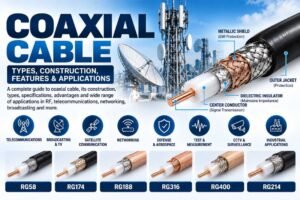
An RF cable, also known as a coaxial cable, is a specially designed cable that transmits radio frequency signals from one device to another while protecting the signal from electromagnetic interference. Unlike conventional electrical cables, RF cables maintain a consistent impedance throughout their length, ensuring efficient signal transmission.
An RF cable consists of four primary components:
Center Conductor
The center conductor carries the RF signal. It is typically made from copper, silver-plated copper, or copper-clad steel.
Dielectric Insulator
The dielectric surrounds the center conductor and maintains the spacing between the conductor and the outer shield. PTFE and Foam PE are common dielectric materials.
Outer Shield
The shield prevents signal leakage and protects the cable from external electromagnetic interference. It may consist of braided copper, aluminum foil, or a combination of both.
Outer Jacket
The outer jacket protects the cable against moisture, chemicals, abrasion, UV exposure, and mechanical damage.
How Does an RF Cable Work?
RF cables transmit high-frequency electrical signals by confining the electromagnetic field between the inner conductor and the outer shield. This design minimizes radiation losses while preventing external noise from entering the cable.
A properly designed RF cable offers:
Low insertion loss
Excellent shielding effectiveness
Stable impedance
High return loss
Minimal VSWR
Reliable long-distance signal transmission
Types of RF Cables
Flexible RF Cable
Flexible RF cables are easy to bend and install, making them suitable for laboratory testing, telecommunications, wireless infrastructure, and production environments.
Applications include:
Portable test equipment
5G infrastructure
Indoor communication systems
Medical equipment
Military communication systems
Semi-Rigid RF Cable
Semi-rigid cables provide exceptional shielding and low signal loss. They are widely used in aerospace, satellite communication, and microwave systems.
Advantages include:
Excellent phase stability
Superior shielding
Very low insertion loss
High-frequency operation
Semi-Flexible RF Cable
Semi-flexible cables provide a balance between flexibility and electrical performance. They can be bent during installation without significantly affecting performance.
Typical applications include:
Radar systems
Defense electronics
Laboratory equipment
Microwave assemblies
Low Loss RF Cable
Low-loss RF cables reduce attenuation over long distances and are commonly used in cellular base stations and wireless communication systems.
Benefits include:
Reduced signal attenuation
Improved communication range
Better overall system efficiency
Lower maintenance costs
Phase Stable RF Cable
Phase stable RF cables maintain consistent electrical characteristics despite temperature changes or repeated movement.
Applications include:
Vector Network Analyzer testing
Calibration laboratories
Military systems
High-frequency instrumentation
Common RF Cable Specifications
When purchasing RF cables, consider the following technical specifications.
Frequency Range
The cable should support the required operating frequency, ranging from DC to several tens of GHz.
Characteristic Impedance
Most RF systems use:
50 Ohm for RF communication, defense, aerospace, microwave, and testing
75 Ohm for broadcasting, CATV, and video transmission
VSWR
A lower Voltage Standing Wave Ratio indicates better impedance matching and reduced reflected power.
Insertion Loss
Lower insertion loss ensures more efficient signal transmission over longer distances.
Shielding Effectiveness
High-quality RF cables provide excellent protection against EMI and RFI.
Operating Temperature
Industrial-grade RF cables typically operate between -55°C and +200°C, depending on materials.
Power Handling
Power handling depends on cable diameter, operating frequency, and cooling conditions.
Popular RF Cable Types
Some of the most commonly used RF cables include:
RG Series Cables
LMR Series Cables
Semi-Rigid Cables
Semi-Flexible Cables
Ultra Flexible Cables
Low Loss Cables
Phase Stable Test Cables
Thermal Vacuum Cables
High Frequency Microwave Cables
Custom RF Cable Assemblies
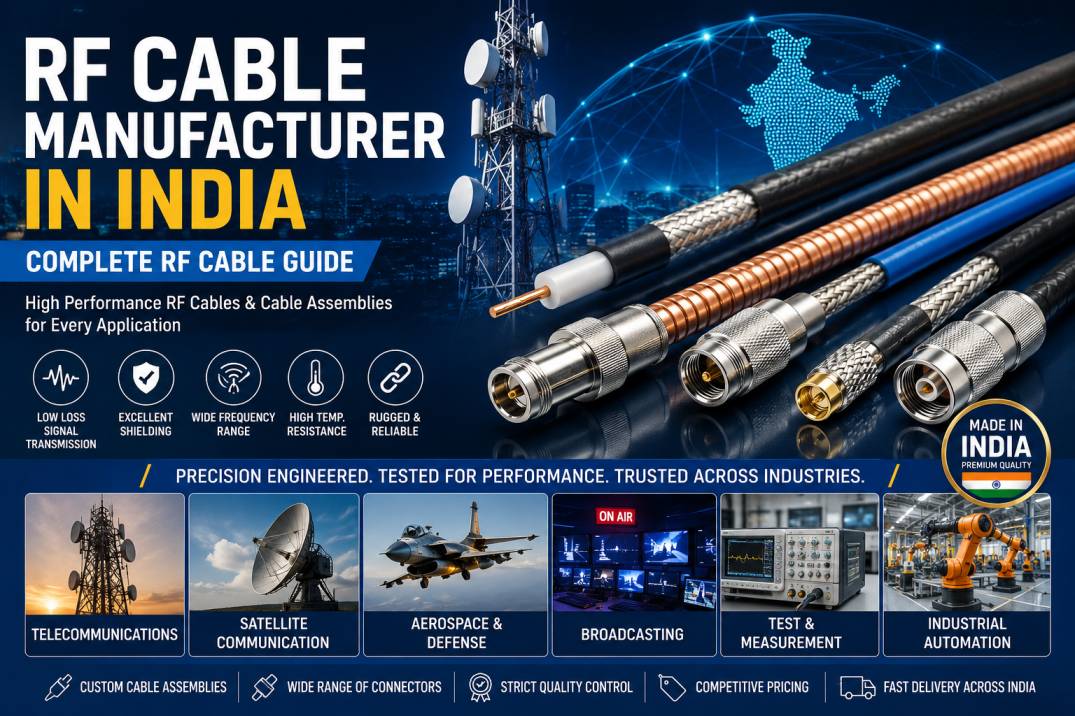
Applications of RF Cables
RF cables are used across numerous industries.
Telecommunications
RF cables connect antennas, repeaters, base stations, and network infrastructure for 4G, 5G, and future wireless technologies.
Aerospace
Aircraft communication systems, navigation equipment, radar systems, and satellite payloads rely on precision RF cables.
Defense
Military communication systems demand rugged RF cables capable of operating in harsh environments with superior shielding performance.
Satellite Communication
Satellite uplinks and downlinks require extremely low-loss RF cable assemblies for consistent signal quality.
Medical Equipment
MRI systems, imaging equipment, and diagnostic instruments use precision RF cables for accurate signal transmission.
Test and Measurement
Network analyzers, spectrum analyzers, oscilloscopes, and signal generators require phase-stable RF cables for accurate measurements.
Broadcasting
Television and radio broadcasting stations utilize RF cables to deliver high-quality signal transmission.
Industrial Automation
Wireless sensors, industrial IoT systems, and factory automation depend on RF cable connectivity.
Benefits of Choosing a Professional RF Cable Manufacturer in India
Partnering with an experienced manufacturer offers several advantages.
High Manufacturing Standards
Precision manufacturing ensures consistent electrical performance and mechanical reliability.
Custom Cable Assemblies
Manufacturers can provide customized cable lengths, connector combinations, and electrical specifications.
Superior Quality Materials
Premium conductors, PTFE dielectrics, and corrosion-resistant connectors improve cable lifespan.
Cost-Effective Solutions
Local manufacturing reduces procurement costs while maintaining international quality standards.
Faster Delivery
Indian manufacturers provide shorter lead times compared to overseas suppliers.
Technical Support
Engineering assistance helps customers select the ideal cable for their application.
Factors to Consider Before Buying RF Cables
Before selecting an RF cable, evaluate the following.
Operating frequency
Cable length
Connector compatibility
Power handling capability
Environmental conditions
Mechanical flexibility
Insertion loss requirements
Shielding performance
Temperature range
Compliance with industry standards
Why Cable Quality Matters
Poor-quality RF cables may result in:
Signal attenuation
Increased noise
Reduced communication range
High VSWR
System failures
Frequent maintenance
Investing in premium RF cables improves overall system reliability and minimizes downtime.
Industries Served
Leading RF Cable Manufacturers in India serve customers across:
Telecommunications
Defense
Aerospace
Satellite Communication
Research Laboratories
Broadcasting
Medical Equipment
Railways
Industrial Automation
Data Centers
Wireless Infrastructure
IoT Systems
Automotive Electronics
Scientific Research
Semiconductor Testing
Why Choose SRFS Teleinfra as Your RF Cable Manufacturer in India?
SRFS Teleinfra manufactures high-quality RF cables and RF cable assemblies designed for demanding applications across telecom, defense, aerospace, satellite communication, industrial automation, and test laboratories.
Key advantages include:
High-performance RF cable assemblies
Custom cable solutions
Precision-engineered connectors
Low insertion loss
Excellent shielding effectiveness
High-frequency performance
Stringent quality control
Competitive pricing
Fast delivery across India
Technical engineering support
Whether you require standard RF cables or custom-built cable assemblies, SRFS Teleinfra delivers reliable products engineered to meet international quality standards.
Frequently Asked Questions
What is an RF cable?
An RF cable is a specially designed coaxial cable that transmits radio frequency signals with low loss and excellent shielding.
What impedance is commonly used in RF cables?
Most RF communication systems use 50 Ohm impedance, while television and video systems commonly use 75 Ohm cables.
Which industries use RF cables?
RF cables are widely used in telecommunications, aerospace, defense, satellite communication, medical equipment, broadcasting, industrial automation, and laboratory testing.
How do I choose the correct RF cable?
Select the cable based on operating frequency, insertion loss, impedance, cable length, connector type, environmental conditions, and flexibility requirements.
What are low-loss RF cables?
Low-loss RF cables are designed to minimize signal attenuation over long distances, improving communication efficiency.
Can RF cables be customized?
Yes. Leading RF cable manufacturers provide custom cable lengths, connector configurations, shielding options, and electrical specifications.
What connectors are commonly used with RF cables?
Popular RF connectors include SMA, N Type, TNC, BNC, 2.92mm, 2.4mm, SMP, SMPM, MCX, MMCX, QMA, and 4.3-10 connectors.
How long do RF cables last?
High-quality RF cables can provide reliable performance for many years when installed and maintained correctly.
Are RF cables suitable for outdoor applications?
Yes. Outdoor RF cables are available with UV-resistant and weatherproof jackets designed for harsh environmental conditions.
Why choose an RF Cable Manufacturer in India?
Indian manufacturers offer high-quality products, custom engineering, competitive pricing, shorter lead times, and technical support while meeting international quality standards.