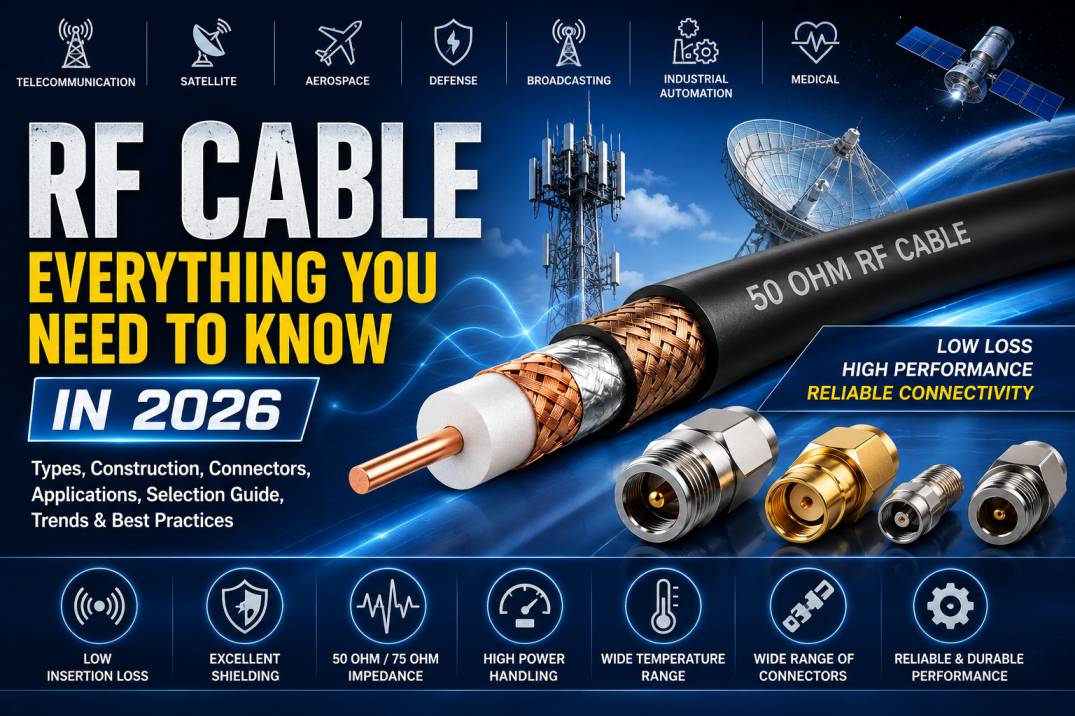
RF Cable is one of the most critical components in modern communication systems. From 5G networks and satellite communication to defense, aerospace, medical equipment, broadcasting, and laboratory testing, RF cables ensure that high-frequency signals travel with minimal loss and maximum reliability.
As wireless technologies continue to evolve in 2026, the demand for high-performance RF Cable solutions has increased significantly. Engineers and system designers require cables capable of supporting higher frequencies, lower insertion loss, better shielding, and longer service life.
This comprehensive guide explains everything you need to know about RF Cable, including its construction, types, applications, performance parameters, connectors, selection criteria, maintenance, and future trends.
What is RF Cable?
RF Cable, also known as Radio Frequency Cable, is a specially designed coaxial cable used to transmit radio frequency signals between electronic devices while maintaining signal integrity.
Unlike ordinary electrical wires, RF cables are engineered to minimize signal attenuation, electromagnetic interference (EMI), and impedance mismatches. They are commonly designed with a characteristic impedance of either 50 Ohms or 75 Ohms depending on the application.
These cables can operate from a few kilohertz to frequencies exceeding 110 GHz using advanced connector technologies.
Why RF Cable is Important
Without high-quality RF cables, communication systems experience increased signal loss, reflections, poor transmission efficiency, and reduced system performance.
Major benefits include:
- Low insertion loss
- Excellent impedance stability
- High shielding effectiveness
- Reduced signal reflections
- Superior phase stability
- Long operational life
- Reliable performance in harsh environments
- High power handling capability
How RF Cable Works
An RF cable transfers electromagnetic energy from one device to another.
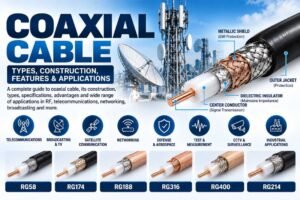
The center conductor carries the RF signal while the outer conductor acts as a shield and return path. Between these conductors is a dielectric material that maintains spacing and controls impedance.
This coaxial construction protects signals from external electromagnetic interference while preventing internal signal leakage.
Construction of RF Cable
Center Conductor
The center conductor carries the RF signal and is usually manufactured using:
- Copper
- Silver-plated copper
- Copper-clad steel
- Solid copper
Silver-plated conductors are commonly used in high-frequency applications because they reduce conductor losses.
Dielectric Insulation
The dielectric separates the center conductor from the outer conductor.
Common dielectric materials include:
- PTFE
- Foam PTFE
- Polyethylene
- Low-density foam
- Air dielectric
Foam dielectrics generally provide lower insertion loss.
Outer Conductor
The outer conductor provides shielding and completes the electrical circuit.
It may consist of:
- Braided copper
- Tinned copper braid
- Aluminum foil
- Double braid
- Triple shield
- Corrugated copper tube
Protective Jacket
The outer jacket protects the cable against environmental damage.
Common materials include:
- PVC
- FEP
- PE
- LSZH
- Polyurethane
Different jackets are selected depending on indoor, outdoor, industrial, or military applications.
Types of RF Cable
Flexible RF Cable
Flexible RF cables are designed for applications requiring frequent movement and easy installation.
Applications include:
- Laboratory testing
- Test benches
- Instrumentation
- Wireless systems
Advantages include excellent flexibility and easy routing.
Semi-Rigid RF Cable
Semi-rigid cables use a solid metal outer conductor that provides excellent shielding and phase stability.
Applications include:
- Aerospace
- Defense
- Radar
- Microwave systems
Semi-Flexible RF Cable
Semi-flexible cables combine the advantages of rigid and flexible constructions.
They are often used where custom bending is required during installation.
Low Loss RF Cable
Low loss cables are optimized to reduce attenuation over long cable runs.
Typical applications include:
- Cellular base stations
- Broadcasting
- Satellite communication
- Telecom infrastructure
Phase Stable RF Cable
These cables maintain electrical phase even when subjected to temperature changes or mechanical movement.
Used extensively in:
- Vector Network Analyzers
- Aerospace testing
- Defense calibration
- Precision measurement
Cryogenic RF Cable
Cryogenic RF cables operate at extremely low temperatures and are widely used in:
- Quantum computing
- Space research
- Scientific laboratories
Common RF Cable Connectors
RF cables can be terminated using many connector types depending on frequency and power requirements.
Popular connector families include:
- SMA
- 2.92mm
- 2.4mm
- 1.85mm
- N Type
- TNC
- BNC
- SMP
- SMPM
- MCX
- MMCX
- QMA
- 4.3-10
- 7/16 DIN
- UHF
- F Type
Each connector is designed for specific operating frequencies and mechanical requirements.
Common RF Cable Impedance
50 Ohm RF Cable
Most commonly used in:
- RF communication
- Microwave equipment
- Defense
- Aerospace
- Wireless systems
75 Ohm RF Cable
Primarily used in:
- Television
- Broadcasting
- CCTV
- Video transmission
Key Performance Parameters
Insertion Loss
Insertion loss measures the reduction in signal power as it travels through the cable.
Lower insertion loss means higher efficiency.
Return Loss
Return loss indicates how much signal is reflected back due to impedance mismatch.
Higher return loss indicates better performance.
VSWR
Voltage Standing Wave Ratio measures impedance matching.
A lower VSWR indicates minimal reflections.
Shielding Effectiveness
Good shielding prevents external interference from affecting transmitted signals.
Phase Stability
Critical for precision measurement systems and phased array applications.
Power Handling
RF cables are rated for maximum continuous and peak power depending on frequency.
Factors Affecting RF Cable Performance
Several factors influence cable performance including:
- Operating frequency
- Cable length
- Connector quality
- Installation method
- Temperature
- Moisture
- Mechanical stress
- Bending radius
- Manufacturing quality
Applications of RF Cable
RF cables are used in nearly every industry involving wireless communication.
Telecommunications
Used for:
- 4G networks
- 5G infrastructure
- Cellular towers
- Distributed Antenna Systems
Aerospace
Applications include:
- Aircraft communication
- Navigation systems
- Avionics
- Satellite payloads
Defense
Widely used in:
- Radar
- Electronic warfare
- Missile systems
- Secure communication
Satellite Communication
Supports:
- Ground stations
- VSAT systems
- Satellite terminals
- Space communication
Medical Equipment
Used in:
- MRI systems
- Diagnostic instruments
- RF therapy equipment
Industrial Automation
Supports wireless monitoring and control systems operating in harsh environments.
Broadcasting
RF cables transmit television and radio signals with minimal signal degradation.
Scientific Research
Laboratories rely on precision RF cables for accurate microwave measurements.
How to Choose the Right RF Cable
Selecting the correct RF cable depends on multiple engineering factors.
Consider:
- Operating frequency
- Power level
- Cable length
- Environmental conditions
- Connector compatibility
- Required flexibility
- Shielding effectiveness
- Insertion loss
- Budget
- Future scalability
Choosing the wrong cable can significantly reduce overall system performance.
Installation Best Practices
Proper installation increases cable life and improves signal quality.
Recommended practices include:
- Avoid excessive bending
- Maintain minimum bend radius
- Use proper torque tools
- Prevent moisture ingress
- Support long cable runs
- Protect connectors during installation
- Inspect connectors regularly
- Avoid crushing or twisting cables
Common RF Cable Problems
Typical issues include:
- High insertion loss
- Connector damage
- Poor VSWR
- Water ingress
- Corrosion
- Loose connectors
- Cable fatigue
- Physical damage
Routine inspection helps prevent unexpected failures.
Maintenance Tips
Regular maintenance improves long-term reliability.
Maintenance includes:
- Cleaning connectors
- Checking torque values
- Inspecting cable jackets
- Measuring insertion loss
- Verifying VSWR
- Replacing worn connectors
- Protecting outdoor installations
Emerging RF Cable Trends in 2026
The RF industry continues to evolve with new technologies.
Key trends include:
- Higher frequency cable assemblies above 110 GHz
- Ultra-low-loss dielectric materials
- Improved shielding technologies
- Lightweight aerospace cables
- Flexible phase-stable cable designs
- Advanced cryogenic cable solutions
- High-density interconnect systems
- AI-assisted RF network optimization
- Enhanced 5G and upcoming 6G infrastructure
- Greater adoption of environmentally compliant cable materials
Manufacturers are also focusing on precision manufacturing, tighter tolerance control, and improved connector performance to meet the demands of next-generation communication systems.
Why Quality RF Cable Matters
A high-quality RF Cable improves signal transmission, reduces maintenance costs, enhances equipment reliability, and extends system life. Whether used in telecom infrastructure, defense, aerospace, medical systems, or laboratory testing, selecting the right cable ensures optimal performance and long-term operational efficiency.
As communication technologies continue to advance in 2026, investing in precision-engineered RF Cable solutions has become essential for achieving reliable, low-loss, and high-frequency signal transmission.
Frequently Asked Questions
What is an RF Cable?
An RF Cable is a coaxial cable designed to transmit high-frequency radio signals while minimizing signal loss and interference.
What is the difference between 50 Ohm and 75 Ohm RF Cable?
A 50 Ohm RF Cable is commonly used for RF communication and wireless systems, while a 75 Ohm RF Cable is mainly used for television, video, and broadcasting applications.
Which connector is best for high-frequency RF applications?
Connectors such as 2.92mm, 2.4mm, and 1.85mm are suitable for very high-frequency applications, while SMA and N Type connectors are widely used for general RF systems.
How long can an RF Cable be?
The maximum length depends on the cable type, operating frequency, and acceptable signal loss. Low-loss cables are recommended for longer distances.
Can RF Cable be used outdoors?
Yes. Outdoor-rated RF cables with UV-resistant and weatherproof jackets are specifically designed for external installations.
What causes RF Cable signal loss?
Signal loss is caused by cable length, operating frequency, poor connectors, impedance mismatch, moisture, and low-quality cable construction.
How often should RF Cables be inspected?
Critical RF systems should be inspected periodically for connector wear, cable damage, corrosion, and electrical performance to ensure reliable operation.