RF cables are one of the most important components in modern communication systems. Whether you are designing a 5G network, building a defense communication system, setting up laboratory test equipment, or installing a broadcasting network, selecting the right RF cable directly impacts signal quality and system performance.
With numerous cable types, impedance options, shielding configurations, and connector styles available, choosing the ideal RF cable can be challenging. This comprehensive RF Cable Buying Guide explains everything you need to know, including cable types, important specifications, applications, buying tips, and maintenance practices.
What is an RF Cable?
An RF cable, also known as a Radio Frequency cable, is a specially engineered coaxial cable designed to carry high-frequency electrical signals with minimal loss. Unlike conventional electrical cables, RF cables are optimized to maintain signal integrity across frequencies ranging from a few megahertz (MHz) to several gigahertz (GHz).
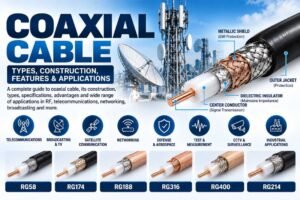
A standard RF cable consists of four primary layers:
Center Conductor
Carries the RF signal from one device to another. It is typically made from copper, silver-plated copper, or copper-clad steel.
Dielectric Insulator
Maintains consistent spacing between the conductor and the shield while preserving impedance.
Outer Shield
Protects the signal from electromagnetic interference (EMI) and radio frequency interference (RFI).
Outer Jacket
Provides mechanical protection against moisture, abrasion, UV exposure, and harsh environmental conditions.
Why Choosing the Right RF Cable Matters
Selecting an unsuitable RF cable can result in:
High insertion loss
Signal attenuation
Poor VSWR
Reduced transmission distance
Interference from nearby equipment
System instability
Lower communication efficiency
A properly selected RF cable ensures reliable signal transmission, lower maintenance costs, and improved overall system performance.
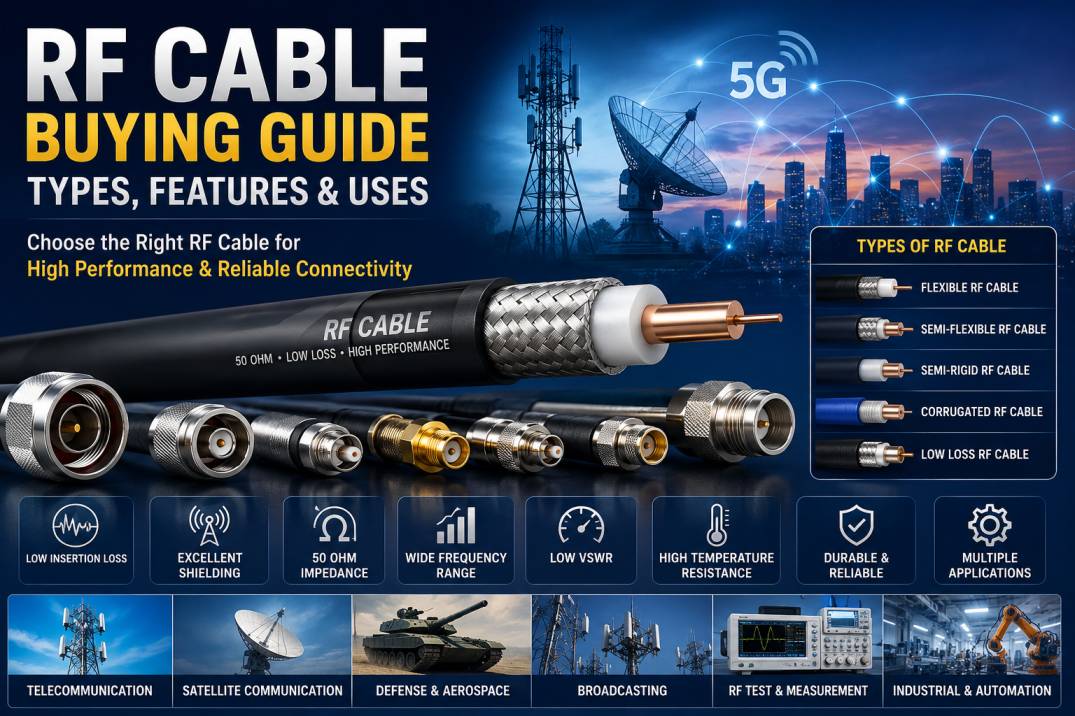
Types of RF Cables
Flexible RF Cable
Flexible RF cables are designed for installations requiring frequent movement or routing through tight spaces. Their flexible construction makes installation simple while maintaining good electrical performance.
Applications include:
Telecommunication systems
Wi-Fi installations
Laboratory equipment
Indoor communication systems
Portable RF devices
Advantages
Easy installation
Good flexibility
Available in multiple connector options
Cost-effective
Semi-Flexible RF Cable
Semi-flexible cables provide better electrical performance than flexible cables while still allowing limited bending during installation.
Applications include:
Military equipment
Radar systems
Satellite communication
Industrial RF systems
Advantages
Lower insertion loss
Excellent shielding
Stable electrical performance
Long service life
Semi-Rigid RF Cable
Semi-rigid cables use a solid metal outer conductor, providing maximum shielding and excellent phase stability.
Applications include:
Microwave systems
Defense electronics
Space applications
High-frequency instrumentation
Advantages
Very low signal loss
Excellent phase stability
Superior shielding effectiveness
High-frequency capability
Corrugated RF Cable
Corrugated cables are widely used in outdoor base station installations where low attenuation and weather resistance are required.
Applications include:
Cell towers
Distributed antenna systems
Broadcasting
Outdoor communication networks
Advantages
Long-distance transmission
Weather resistance
Low attenuation
Excellent durability
Low Loss RF Cable
Low loss cables are engineered using advanced dielectric materials and superior shielding to minimize attenuation over long cable runs.
Applications include:
5G networks
High-speed wireless systems
Data centers
GPS systems
IoT infrastructure
Advantages
Excellent signal preservation
Reduced attenuation
High power handling
Improved efficiency
RF Cable Classification by Impedance
50 Ohm RF Cable
Most common in RF communication systems.
Applications
Wireless communication
Defense
Satellite communication
Test equipment
Radar
Microwave systems
75 Ohm RF Cable
Primarily used for video transmission.
Applications
Cable TV
Broadcasting
Digital video
CCTV systems
Important Features to Consider Before Buying RF Cable
Frequency Range
Always ensure the cable supports your operating frequency. Higher frequencies require lower-loss cable constructions.
Insertion Loss
Insertion loss determines how much signal is lost during transmission. Lower values indicate better cable performance.
Shielding Effectiveness
Effective shielding protects the cable from external interference while minimizing signal leakage.
Multiple shield layers generally provide superior performance.
VSWR
Voltage Standing Wave Ratio indicates impedance matching.
Lower VSWR means:
Better signal transfer
Reduced reflections
Higher system efficiency
Connector Compatibility
Verify compatibility with connectors such as:
SMA
N Type
TNC
BNC
2.92mm
2.4mm
1.85mm
SMP
SMPM
MCX
MMCX
Cable Flexibility
Applications involving repeated movement require highly flexible cables.
Permanent installations often benefit from semi-rigid or corrugated cables.
Temperature Rating
Industrial and defense systems frequently operate in extreme environments.
Choose cables with appropriate temperature ratings.
Power Handling
Higher power RF systems require cables capable of safely transmitting increased RF energy without overheating.
Common RF Cable Applications
RF cables are used across numerous industries.
Telecommunication Infrastructure
RF cables connect antennas, base stations, repeaters, and communication equipment.
5G Networks
Modern 5G infrastructure requires ultra-low-loss RF cables capable of supporting high-frequency operation.
Satellite Communication
Satellite ground stations depend on precision RF cables for reliable signal transmission.
Military and Defense
Radar systems, electronic warfare, tactical communication, and surveillance equipment rely heavily on high-performance RF cables.
Broadcasting
Radio and television transmitters use RF cables for high-quality signal distribution.
Medical Equipment
MRI systems, imaging equipment, and diagnostic instruments require precision RF signal transmission.
Industrial Automation
Wireless automation systems depend on reliable RF interconnections.
Laboratory Testing
Vector Network Analyzers, Spectrum Analyzers, Signal Generators, Oscilloscopes, and RF measurement equipment all require precision RF cables.
How to Select the Right RF Cable
Determine Operating Frequency
Choose a cable rated above your maximum operating frequency.
Calculate Cable Length
Longer cables create additional attenuation.
Whenever possible, minimize cable length.
Evaluate Environmental Conditions
Consider:
Outdoor exposure
Moisture
Temperature
UV resistance
Chemical exposure
Mechanical vibration
Select Proper Connectors
Ensure connectors match both equipment interfaces and cable specifications.
Review Electrical Specifications
Important parameters include:
Insertion Loss
Return Loss
VSWR
Impedance
Shielding Effectiveness
Power Rating
Consider Future Expansion
Purchasing slightly higher-performance cables today can simplify future upgrades.
Common RF Cable Connector Types
SMA Connector
Widely used for microwave and laboratory applications.
N Type Connector
Suitable for medium to high-power outdoor installations.
BNC Connector
Popular in laboratory equipment and video systems.
TNC Connector
Provides improved weather resistance compared to BNC.
2.92mm Connector
Supports frequencies up to 40 GHz.
SMP Connector
Ideal for compact high-frequency applications.
MMCX Connector
Common in compact wireless devices.
Mistakes to Avoid When Buying RF Cable
Selecting cable based only on price
Ignoring insertion loss
Using incorrect impedance
Choosing incompatible connectors
Buying excessive cable length
Ignoring environmental ratings
Using low-quality shielding
Overlooking frequency limitations
Maintenance Tips for RF Cables
Inspect connectors regularly.
Avoid excessive bending.
Protect outdoor cables from water ingress.
Keep connectors clean.
Replace damaged cables immediately.
Avoid sharp cable bends.
Store unused cables properly.
Perform periodic VSWR testing.
Benefits of High-Quality RF Cables
Stable signal transmission
Lower insertion loss
Excellent shielding
Long operational life
Reduced maintenance costs
Better system reliability
Improved network efficiency
Higher power handling
Excellent mechanical durability
Industries That Depend on RF Cables
Telecommunications
Defense
Aerospace
Broadcasting
Railways
Medical Equipment
Research Laboratories
Industrial Automation
Internet Service Providers
Data Centers
Satellite Communication
Smart Cities
Oil and Gas
Marine Communication
Automotive Electronics
Why Choose SRFS Teleinfra RF Cables?
SRFS Teleinfra manufactures and supplies premium-quality RF cables engineered for demanding communication environments. Our RF cable solutions are designed to deliver low insertion loss, excellent shielding, stable impedance, and outstanding mechanical durability for applications in telecom, aerospace, defense, satellite communication, broadcasting, industrial automation, and laboratory testing. We offer a wide range of flexible, semi-flexible, semi-rigid, low-loss, and custom RF cable assemblies with multiple connector options to meet diverse project requirements.
Frequently Asked Questions
What is the purpose of an RF cable?
An RF cable transmits radio frequency signals between antennas, transmitters, receivers, and RF equipment while minimizing signal loss and interference.
Which RF cable is best for long-distance transmission?
Low-loss and corrugated RF cables are generally preferred for long cable runs because they provide lower attenuation.
What is the difference between 50 Ohm and 75 Ohm RF cables?
A 50 Ohm cable is commonly used for RF communication and wireless systems, while a 75 Ohm cable is mainly used for television, broadcasting, and video applications.
Can RF cables be used outdoors?
Yes. Outdoor-rated RF cables feature UV-resistant jackets, moisture protection, and weather-resistant construction.
Why is insertion loss important?
Lower insertion loss means more signal reaches the destination, improving communication performance and reducing power loss.
Which connector is commonly used with RF cables?
Common RF connectors include SMA, N Type, TNC, BNC, 2.92mm, SMP, SMPM, MCX, and MMCX connectors.
How long do RF cables last?
High-quality RF cables can operate reliably for many years when properly installed and maintained.
Can I use any RF cable for 5G applications?
No. 5G systems often require low-loss RF cables capable of supporting higher frequencies with excellent shielding and stable electrical performance.
How do I reduce RF cable signal loss?
Use shorter cable lengths, choose low-loss cables, maintain proper connector installation, and select cables with high shielding effectiveness.
Where can I buy high-quality RF cables in India?
SRFS Teleinfra offers a comprehensive range of RF cables and cable assemblies designed for telecom, aerospace, defense, laboratory, and industrial applications, delivering reliable performance and high manufacturing quality.