RF Cable is one of the most critical components in modern communication systems. From cellular base stations and satellite communication to military radar and aerospace electronics, RF cables ensure reliable transmission of radio frequency signals with minimal loss. The performance of an RF system largely depends on the quality, impedance stability, shielding effectiveness, and frequency handling capability of the RF cable used.
As wireless communication continues to evolve with technologies such as 5G, IoT, satellite internet, and high-frequency radar, selecting the correct RF cable has become increasingly important. Engineers require cables that deliver low insertion loss, excellent phase stability, high shielding effectiveness, and reliable performance even in harsh environmental conditions.
This comprehensive guide explains everything you need to know about RF Cable, including its construction, working principle, types, specifications, applications, advantages, and selection criteria.
What is an RF Cable?
An RF Cable, also known as a Radio Frequency Cable, is a specially designed coaxial cable used to transmit high-frequency electrical signals with minimal attenuation and electromagnetic interference.
Unlike ordinary electrical cables, RF cables are engineered to maintain a constant impedance, minimize signal reflection, and preserve signal integrity across a broad frequency range.
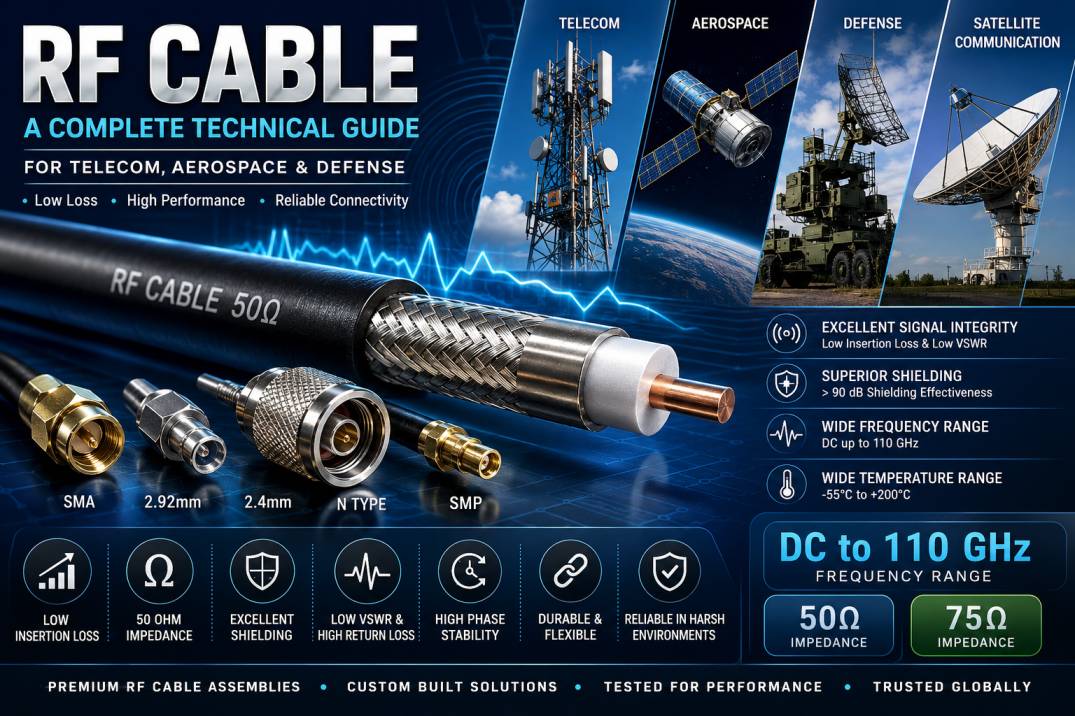
Most RF cables are designed with either 50 Ohm or 75 Ohm impedance depending on the application.
How Does an RF Cable Work?
An RF cable transfers electromagnetic energy from one RF component to another while maintaining controlled impedance throughout its length.
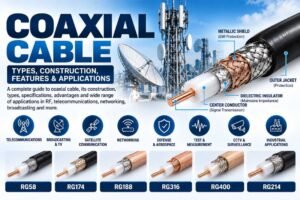
The center conductor carries the RF signal, while the outer conductor acts as the return path and electromagnetic shield. The dielectric material separates both conductors and determines the cable’s characteristic impedance.
This construction prevents external electromagnetic interference from affecting the transmitted signal while minimizing radiation losses.
The result is efficient transmission of microwave and radio frequency signals with low insertion loss and excellent return loss.
Construction of an RF Cable
An RF cable consists of several precisely engineered layers.
Center Conductor
The center conductor carries the RF signal.
Common materials include:
Copper
Silver-Plated Copper
Copper-Clad Steel
Silver-Plated Beryllium Copper
Dielectric Insulator
The dielectric maintains conductor spacing and controls impedance.
Common dielectric materials include:
PTFE
Foamed PTFE
PE
Foam Polyethylene
Air Dielectric
Outer Conductor
The outer conductor shields the signal from EMI and RFI.
Types include:
Braided Copper
Double Braided Shield
Triple Shield
Corrugated Copper
Solid Copper Tube
Outer Jacket
The outer jacket protects the cable against environmental damage.
Popular jacket materials include:
PVC
FEP
LSZH
Polyurethane
TPE
Types of RF Cable
Flexible RF Cable
Flexible RF cables are designed for repeated bending and routing in compact equipment.
Applications include:
Wireless communication
Test laboratories
Medical equipment
Aerospace electronics
5G infrastructure
Semi-Flexible RF Cable
Semi-flexible cables offer lower attenuation while allowing limited bending during installation.
Applications include:
Base stations
Radar systems
Defense electronics
Satellite equipment
Semi-Rigid RF Cable
Semi-rigid cables use a seamless metal outer conductor for maximum electrical stability.
Advantages include:
Lowest insertion loss
Excellent phase stability
Outstanding shielding
High-frequency operation
Low Loss RF Cable
Low loss RF cables reduce attenuation over long distances.
Applications include:
Telecommunication towers
Outdoor antenna systems
Wi-Fi infrastructure
Broadcast communication
Phase Stable RF Cable
These cables maintain consistent electrical performance under temperature changes and mechanical movement.
Ideal for:
Calibration systems
Test and measurement
Military radar
Satellite communication
Common RF Cable Impedance
50 Ohm RF Cable
Used in:
Wireless communication
Defense
Radar
RF testing
Industrial automation
75 Ohm RF Cable
Used in:
Broadcast television
Video transmission
Cable television
Digital video systems
Frequency Range of RF Cables
Depending on construction and connector type, RF cables can support frequencies from DC up to 110 GHz.
Typical operating ranges include:
DC to 3 GHz
DC to 6 GHz
DC to 18 GHz
DC to 26.5 GHz
DC to 40 GHz
DC to 50 GHz
DC to 67 GHz
DC to 110 GHz
Important Electrical Specifications
When selecting an RF cable, engineers evaluate several critical parameters.
Characteristic Impedance
Maintains signal integrity and minimizes reflections.
Typical values:
50 Ohm
75 Ohm
Insertion Loss
Represents the signal power lost during transmission.
Lower insertion loss improves communication system efficiency.
VSWR
Voltage Standing Wave Ratio indicates impedance matching quality.
Lower VSWR means better RF performance.
Return Loss
Higher return loss indicates lower signal reflections and improved transmission quality.
Shielding Effectiveness
Good shielding protects signals from EMI and RFI.
Premium RF cables typically provide shielding effectiveness greater than 90 dB.
Power Handling
Determines the maximum RF power the cable can safely transmit.
Phase Stability
Essential for radar systems, military communication, and precision RF measurements.
Operating Temperature
High-quality RF cables commonly operate between:
-55°C to +200°C
Common RF Cable Connectors
RF cables are available with various connector types.
Common connector interfaces include:
SMA
2.92mm
2.4mm
1.85mm
N Type
TNC
BNC
MCX
MMCX
SMP
SMPM
QMA
QN
7/16 DIN
4.3-10
U.FL
IPEX
Advantages of RF Cable
High-frequency signal transmission
Low insertion loss
Excellent shielding performance
Controlled impedance
High reliability
Superior mechanical durability
Excellent flexibility options
Wide frequency coverage
Suitable for indoor and outdoor applications
Available with numerous connector configurations
Supports harsh environmental conditions
Ideal for precision microwave systems
Applications of RF Cable
Telecommunications
RF cables connect antennas, amplifiers, filters, duplexers, repeaters, and base stations.
5G Infrastructure
Modern 5G networks require low-loss RF cables capable of handling high-frequency millimeter-wave signals.
Aerospace
Aircraft communication, navigation, telemetry, and onboard radar systems rely on precision RF cable assemblies.
Defense
Military systems use RF cables for radar, electronic warfare, secure communication, missile guidance, and surveillance equipment.
Satellite Communication
Satellite ground stations require high-performance RF cables for low-loss microwave signal transmission.
Test and Measurement
Laboratories use RF cables with Vector Network Analyzers, Signal Generators, Spectrum Analyzers, Oscilloscopes, and Power Meters.
Medical Equipment
MRI systems, diagnostic imaging equipment, and RF monitoring instruments depend on precision RF cable assemblies.
Broadcasting
Television and radio broadcasting infrastructure uses RF cables for high-power signal distribution.
Industrial Automation
Wireless sensors, remote monitoring systems, and industrial communication equipment utilize RF cable assemblies.
Scientific Research
Particle accelerators, laboratories, and research facilities require ultra-low-loss RF cables for high-frequency experiments.
How to Select the Right RF Cable
Selecting the correct RF cable depends on several technical considerations.
Operating frequency
Insertion loss
Cable flexibility
Connector compatibility
Environmental conditions
Cable length
Power handling
Shielding effectiveness
Temperature range
Mechanical durability
Budget
Installation requirements
Choosing the wrong cable can increase signal loss, reduce communication range, and negatively affect overall system performance.
Maintenance Tips
Avoid excessive bending.
Use the recommended bend radius.
Keep connectors clean.
Inspect cable assemblies regularly.
Protect cables from moisture.
Avoid unnecessary mechanical stress.
Store cables properly.
Use protective dust caps on connectors.
Replace damaged cable assemblies immediately.
Future of RF Cable Technology
The demand for high-frequency RF cables continues to increase with emerging technologies such as:
5G Advanced
6G Networks
Satellite Internet
Autonomous Vehicles
Military Communication
Artificial Intelligence Infrastructure
Quantum Computing
High-Speed Data Centers
Manufacturers are developing lighter, lower-loss, phase-stable, and higher-frequency RF cable assemblies capable of supporting frequencies beyond 110 GHz.
Why Choose SRFS Teleinfra RF Cables?
SRFS Teleinfra manufactures high-quality RF Cable assemblies engineered for demanding RF and microwave applications. Every cable is designed using premium materials, precision manufacturing techniques, and strict quality control processes to deliver outstanding electrical and mechanical performance.
SRFS Teleinfra offers customized RF cable assemblies with a wide range of connector combinations, including SMA, N Type, 2.92mm, SMP, SMPM, MCX, MMCX, and many more. Whether your application requires flexible, semi-rigid, low-loss, phase-stable, or high-frequency cable assemblies, SRFS Teleinfra provides reliable solutions for telecom, aerospace, defense, satellite communication, medical equipment, industrial automation, and RF test laboratories.
Frequently Asked Questions
What is an RF Cable?
An RF Cable is a specially designed coaxial cable used to transmit high-frequency radio frequency signals with low loss and controlled impedance.
What is the difference between RF Cable and normal cable?
RF cables are engineered for controlled impedance, low attenuation, excellent shielding, and high-frequency signal transmission, unlike standard electrical cables.
What impedance is commonly used for RF cables?
The most common impedance values are 50 Ohm and 75 Ohm.
What is the maximum frequency supported by RF cables?
Depending on the design, RF cables can support frequencies ranging from DC up to 110 GHz.
Which industries use RF cables?
Telecommunications, aerospace, defense, satellite communication, broadcasting, healthcare, industrial automation, and research laboratories.
What causes signal loss in RF cables?
Signal loss can result from cable length, operating frequency, poor shielding, low-quality materials, damaged connectors, and improper installation.
Can RF cables be customized?
Yes. RF cable assemblies can be customized with different cable types, connector interfaces, lengths, and performance specifications.
Why is shielding important in RF cables?
Shielding protects transmitted signals from electromagnetic interference and prevents signal leakage.
Which connector types are commonly used with RF cables?
SMA, N Type, 2.92mm, SMP, SMPM, MCX, MMCX, BNC, TNC, QMA, 4.3-10, and U.FL connectors are among the most widely used.
Why choose SRFS Teleinfra RF Cables?
SRFS Teleinfra provides precision-engineered RF cable assemblies with low insertion loss, excellent shielding, high reliability, and customized solutions for telecom, aerospace, defense, satellite, medical, and industrial applications, ensuring consistent performance in demanding RF and microwave environments.