New RF & Spectrum Frontiers – RF Antenna
Radio Frequency (RF) antennas are the backbone of modern wireless communication. From mobile networks and satellite systems to military radar and IoT devices, RF antennas enable reliable transmission and reception of electromagnetic waves. As communication technologies continue to evolve, the demand for advanced RF antennas capable of operating across wider frequency ranges with greater efficiency is rapidly increasing.
The emergence of 5G, 6G, artificial intelligence, autonomous vehicles, satellite internet, smart cities, and defense modernization has opened new RF and spectrum frontiers. Today’s RF antennas are expected to deliver higher bandwidth, lower latency, superior gain, and excellent signal integrity across multiple frequency bands.
This article explores how RF antennas are shaping the future of wireless communication and why they remain one of the most important components in next-generation RF systems.
What is an RF Antenna?
An RF antenna is a device that converts electrical RF signals into electromagnetic waves for transmission and converts received electromagnetic waves back into electrical signals.
It acts as the interface between RF equipment and free space.
Whether it is a cellular base station, radar system, Wi-Fi router, satellite terminal, or military communication platform, every wireless system depends on high-performance RF antennas.
Why RF Antennas are More Important Than Ever
The modern communication landscape demands:
- Higher frequencies
- Faster data rates
- Lower latency
- Wider bandwidth
- Better signal coverage
- Improved spectral efficiency
- Multi-band operation
- Compact antenna designs
RF antennas have evolved significantly to meet these demanding requirements.
Evolution of RF Antennas
First Generation
Early RF antennas were designed primarily for voice communication using narrow frequency bands.
Applications included:
- Radio broadcasting
- Television
- Basic military communication
Second Generation
As wireless communication expanded, antennas became more specialized for:
- Cellular communication
- GPS
- Wi-Fi
- Bluetooth
Third Generation
The arrival of 4G LTE introduced:
- MIMO technology
- Higher bandwidth
- Better coverage
- Reduced interference
Fourth Generation
Today’s advanced RF antennas support:
- 5G
- Satellite internet
- IoT
- Massive MIMO
- Beamforming
- Millimeter Wave communication
- Defense applications
Future RF antennas will support 6G networks operating at even higher frequencies.
Understanding RF Spectrum
The RF spectrum includes frequencies ranging from approximately 3 kHz to 300 GHz.
Different frequency ranges serve different applications.
| Frequency Range | Applications |
|---|---|
| HF | Long-distance communication |
| VHF | FM radio, aviation |
| UHF | Television, mobile communication |
| SHF | Radar, satellite, Wi-Fi |
| EHF | Millimeter Wave, 5G, 6G |
Efficient use of RF spectrum is becoming increasingly important due to the rapid growth of wireless devices.
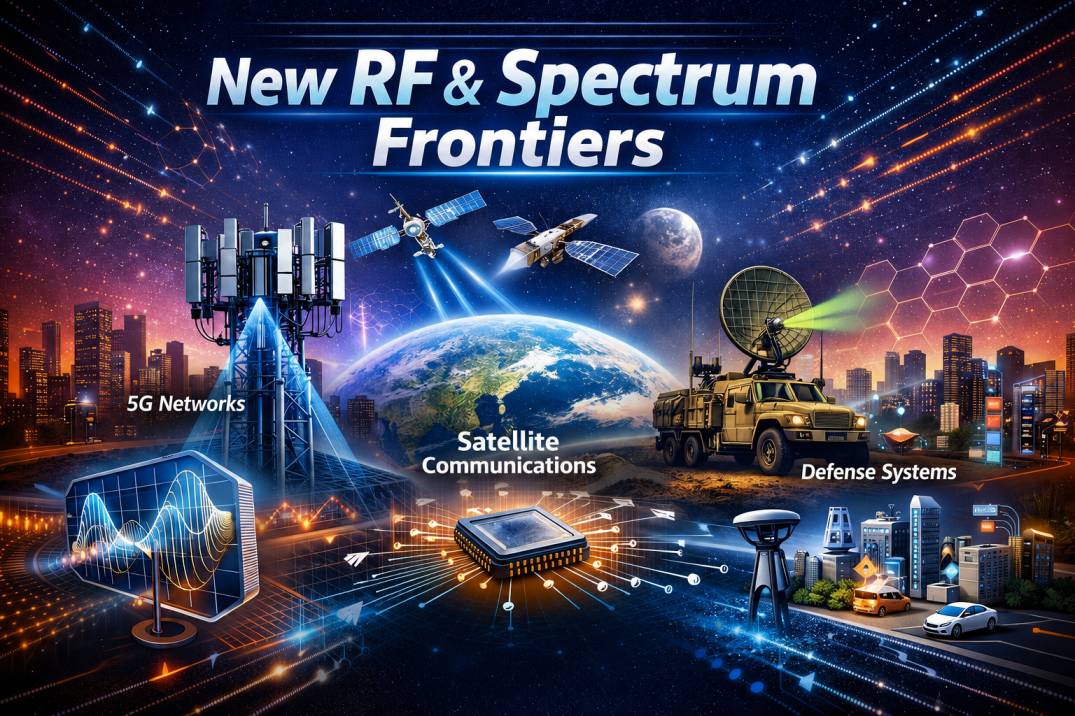
New RF & Spectrum Frontiers
Several emerging technologies are driving innovation in RF antenna design.
1. 5G Networks
5G requires antennas capable of:
- High gain
- Beam steering
- Massive MIMO
- Millimeter wave operation
- Low latency communication
2. 6G Communication
Future 6G networks are expected to operate above 100 GHz, demanding entirely new antenna architectures.
Expected capabilities include:
- AI-assisted communication
- Holographic communication
- Ultra-high-speed connectivity
- Integrated sensing
3. Satellite Internet
Modern Low Earth Orbit (LEO) satellites require antennas that can maintain continuous communication with moving satellites.
Applications include:
- Global broadband
- Maritime communication
- Aviation internet
- Remote connectivity
4. Smart Cities
RF antennas support thousands of connected devices within smart cities.
Applications include:
- Smart lighting
- Traffic management
- Public safety
- Environmental monitoring
- Connected infrastructure
5. Internet of Things (IoT)
Billions of connected devices rely on compact, efficient RF antennas.
Examples include:
- Smart homes
- Industrial automation
- Agriculture
- Healthcare monitoring
- Asset tracking
6. Defense Systems
Military RF antennas are designed for:
- Radar
- Electronic warfare
- Tactical communication
- Missile guidance
- Secure communication
- Surveillance systems
Types of RF Antennas
Omnidirectional Antenna
Radiates equally in all directions.
Ideal for:
- Wi-Fi
- Indoor communication
- Cellular networks
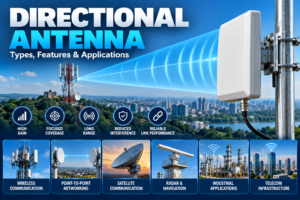
Directional Antenna
Focuses energy in one direction.
Applications include:
- Long-distance communication
- Microwave links
- Radar
Horn Antenna
Offers high gain and wide bandwidth.
Commonly used for:
- Microwave testing
- Satellite communication
- EMC testing
Patch Antenna
Compact and lightweight.
Applications:
- GPS
- RFID
- Mobile devices
Yagi Antenna
High directional gain.
Used for:
- Television reception
- Amateur radio
Log Periodic Antenna
Supports wide frequency ranges.
Applications:
- Spectrum monitoring
- EMC testing
- Defense
Parabolic Dish Antenna
Provides extremely high gain.
Applications:
- Satellite communication
- Deep-space communication
- Radar
Key Performance Parameters
Frequency Range
Determines the operational spectrum of the antenna.
Gain
Higher gain improves communication distance and signal strength.
VSWR
A lower VSWR indicates better impedance matching and reduced signal reflection.
Bandwidth
Defines the frequency range over which the antenna performs efficiently.
Polarization
Can be:
- Vertical
- Horizontal
- Circular
- Dual polarization
Radiation Pattern
Determines how energy is distributed in space.
Efficiency
Higher efficiency means more transmitted power and less energy loss.
Emerging RF Antenna Technologies
Massive MIMO
Supports dozens or hundreds of antenna elements to improve network capacity.
Beamforming
Directs RF energy toward users instead of broadcasting uniformly.
Benefits include:
- Improved coverage
- Reduced interference
- Higher data rates
Phased Array Antennas
Electronically steer beams without mechanical movement.
Widely used in:
- Radar
- Satellites
- Defense
- Aerospace
Reconfigurable Intelligent Surfaces
An emerging technology that dynamically controls wireless propagation.
AI-Based RF Antennas
Artificial intelligence enables:
- Self-optimization
- Dynamic beam steering
- Spectrum management
- Predictive maintenance
Applications of RF Antennas
Telecommunications
- 4G
- 5G
- Future 6G
- Mobile towers
- Network infrastructure
Satellite Communication
- Earth stations
- Satellite internet
- Broadcast systems
- Navigation
Aerospace
Aircraft communication systems depend on reliable RF antennas.
Defense
Military applications include:
- Tactical radios
- Radar
- Electronic warfare
- Secure communication
Healthcare
Medical systems use RF antennas in:
- MRI equipment
- Wireless patient monitoring
- Telemedicine
Automotive
Modern vehicles integrate RF antennas for:
- GPS
- Vehicle-to-Everything (V2X)
- Autonomous driving
- Connected transportation
Industrial Automation
Factories use RF antennas for:
- Wireless sensors
- Robotics
- Process automation
- Remote monitoring
Smart Buildings
RF antennas enable:
- Building automation
- Access control
- Wireless security
- Energy management
Challenges in RF Spectrum Management
Growing wireless demand creates several challenges:
- Spectrum congestion
- Interference
- Limited bandwidth
- Regulatory compliance
- Electromagnetic compatibility
- Increasing device density
Advanced RF antenna technologies help overcome many of these issues.
Future Trends in RF Antennas
The future of RF antennas includes:
- AI-controlled antennas
- Terahertz communication
- Quantum communication research
- Flexible antennas
- Wearable antennas
- Graphene-based antennas
- Metamaterial antennas
- Software-defined antennas
- Reconfigurable antennas
- Intelligent beam management
These innovations will define the next generation of wireless communication.
Benefits of Advanced RF Antennas
- Higher communication range
- Better signal quality
- Reduced interference
- Greater bandwidth
- Faster wireless speeds
- Improved reliability
- Enhanced network capacity
- Lower power consumption
- Multi-band capability
- Support for emerging technologies
Why Choose SRFS Teleinfra RF Antennas?
SRFS Teleinfra offers high-performance RF antenna solutions engineered for demanding communication environments. Our products are designed for telecommunications, defense, aerospace, industrial automation, satellite communication, testing laboratories, and next-generation wireless infrastructure.
Our RF antenna solutions provide:
- High gain performance
- Low VSWR
- Wide frequency coverage
- Rugged construction
- Superior durability
- Precision manufacturing
- Reliable outdoor performance
- Support for custom RF solutions
- Compliance with international quality standards
- Long operational life
Conclusion
The rapid expansion of wireless technologies has pushed RF engineering into entirely new spectrum frontiers. From 5G and satellite communications to autonomous vehicles, defense systems, IoT, and future 6G networks, RF antennas continue to be the foundation of every wireless communication system.
As spectrum becomes increasingly valuable and communication demands continue to grow, advanced RF antennas featuring beamforming, massive MIMO, phased arrays, and AI-driven optimization will play a critical role in delivering faster, smarter, and more reliable connectivity. Organizations investing in innovative RF antenna technologies today are preparing for the next era of global wireless communication.
Frequently Asked Questions (FAQs)
1. What is an RF antenna?
An RF antenna is a device that transmits and receives radio frequency electromagnetic waves, enabling wireless communication between electronic systems.
2. Where are RF antennas used?
RF antennas are widely used in 5G networks, satellite communication, radar systems, IoT devices, Wi-Fi, defense, aerospace, automotive systems, healthcare equipment, and industrial automation.
3. What are the main types of RF antennas?
Common types include omnidirectional, directional, horn, patch, Yagi, log-periodic, parabolic dish, phased array, and dipole antennas.
4. Why are RF antennas important for 5G?
5G networks require RF antennas that support beamforming, massive MIMO, high-frequency operation, and increased bandwidth to deliver faster speeds and lower latency.
5. What is beamforming in RF antennas?
Beamforming is a technology that focuses RF signals toward a specific user or device, improving signal strength, coverage, and network efficiency.
6. What is Massive MIMO?
Massive MIMO uses multiple antenna elements to simultaneously serve many users, significantly increasing network capacity and data throughput.
7. Which industries use RF antennas?
Industries such as telecommunications, aerospace, defense, automotive, healthcare, broadcasting, manufacturing, research, and smart city infrastructure rely on RF antennas.
8. What factors determine RF antenna performance?
Important parameters include frequency range, gain, bandwidth, VSWR, efficiency, radiation pattern, impedance, and polarization.
9. What are the future trends in RF antenna technology?
Future developments include AI-enabled antennas, terahertz communication, metamaterial antennas, reconfigurable intelligent surfaces, software-defined antennas, and 6G-ready antenna systems.
10. How do I choose the right RF antenna?
Consider your operating frequency, application, gain requirements, polarization, environmental conditions, mounting options, bandwidth, and desired communication range to select the most suitable RF antenna.