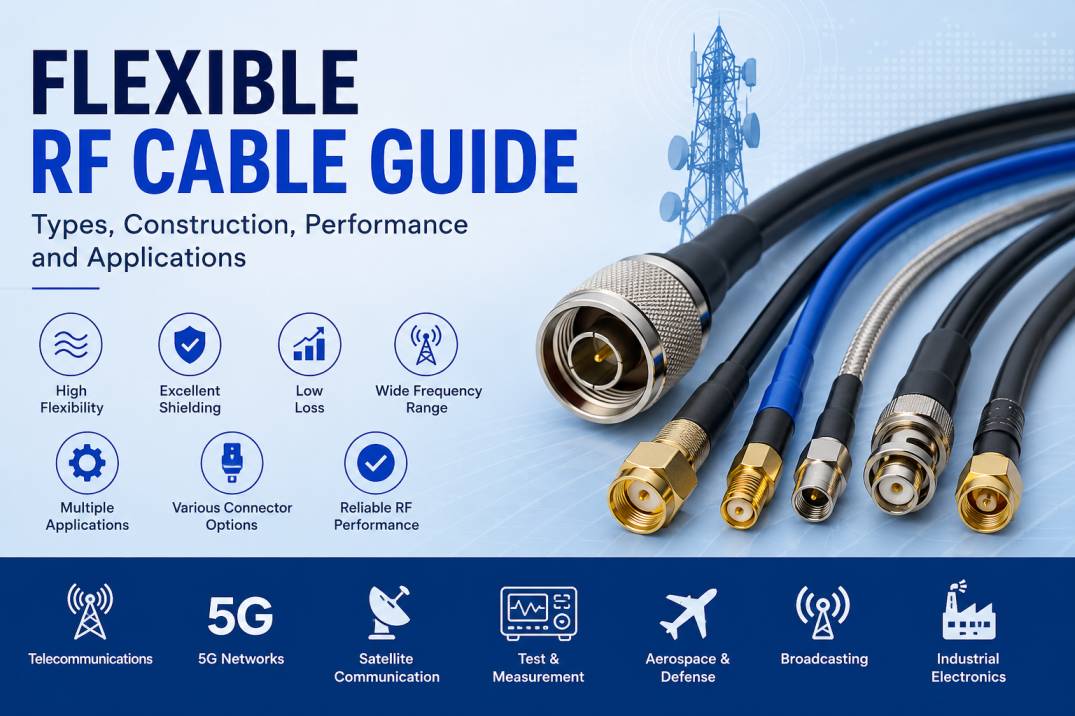
Flexible RF cables are essential components in modern radio frequency and microwave systems where reliable signal transmission, mechanical flexibility, and controlled electrical performance are required. Unlike rigid or semi-rigid coaxial cables, flexible RF cables are designed to withstand repeated bending, routing, movement, and installation constraints while maintaining stable RF characteristics.
Flexible RF cables are widely used in telecommunications, 5G infrastructure, wireless networks, test and measurement equipment, aerospace, defense, satellite communication, broadcasting, industrial electronics, medical equipment, and RF laboratory applications.
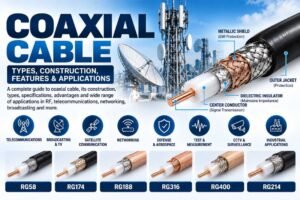
A typical flexible RF cable consists of a center conductor, dielectric material, outer conductor or shielding system, and protective outer jacket. The materials, dimensions, connector configuration, shielding structure, and dielectric construction determine the cable’s frequency range, insertion loss, impedance, power handling capability, flexibility, phase stability, and environmental performance.
For RF engineers and system designers, selecting the correct flexible RF cable is important because cable performance directly affects signal integrity, return loss, attenuation, electromagnetic shielding, and overall system reliability.
What Is a Flexible RF Cable?
A flexible RF cable is a coaxial transmission cable specifically engineered to carry high-frequency electrical signals while allowing the cable to bend during installation and operation.
The term RF refers to radio frequency signals, which can range from relatively low frequencies used in wireless communication to microwave and millimeter-wave frequencies used in radar, satellite communication, aerospace systems, and high-speed test equipment.
Flexible RF cables maintain a controlled characteristic impedance, most commonly 50 Ohms in RF and microwave systems. This controlled impedance allows RF signals to travel efficiently between components such as antennas, radios, amplifiers, filters, attenuators, connectors, switches, and test instruments.
The major advantage of a flexible RF cable is its combination of electrical performance and mechanical flexibility.
Why Flexible RF Cables Are Important
Modern RF systems often have limited installation space and complex cable routing requirements. A cable may need to pass around equipment, through cabinets, between modules, or around moving components.
A rigid cable can provide excellent electrical performance but may not be practical where movement or tight routing is required. Flexible RF cables solve this problem by allowing controlled bending without significantly compromising RF performance.
Key advantages include:
High mechanical flexibility
Easy installation and routing
Controlled characteristic impedance
Reliable RF signal transmission
Good shielding effectiveness
Low insertion loss options
Wide frequency capability
Compatibility with multiple RF connectors
Resistance to vibration and mechanical stress
Availability in different cable sizes and constructions
Flexible RF cables are therefore an important part of both fixed and dynamic RF systems.
Construction of a Flexible RF Cable
The construction of a flexible RF cable normally includes four primary elements: center conductor, dielectric, outer conductor, and protective jacket.
Center Conductor
The center conductor carries the RF signal through the cable.
Common conductor materials include copper, silver-plated copper, tin-plated copper, and copper alloys. The selection depends on electrical conductivity, flexibility, operating temperature, corrosion resistance, and application requirements.
Stranded conductors are frequently used when maximum flexibility is required. A solid conductor can provide excellent electrical characteristics but is generally less flexible than a finely stranded construction.
For high-frequency applications, conductor dimensions and surface quality become increasingly important because RF current tends to concentrate toward the outer surface of a conductor due to the skin effect.
Dielectric
The dielectric separates the center conductor from the outer conductor and determines important electrical characteristics such as impedance, velocity factor, capacitance, and signal propagation speed.
Common dielectric materials include polyethylene, foamed polyethylene, PTFE, FEP, and other low-loss fluoropolymer materials.
PTFE and similar high-performance materials are commonly selected for demanding RF applications because of their low dielectric loss, temperature resistance, and stable electrical characteristics.
The dielectric material has a direct effect on cable attenuation and phase behavior, particularly at higher frequencies.
Outer Conductor and Shielding
The outer conductor provides the return path for the RF signal and protects the signal from external electromagnetic interference.
Flexible RF cables may use braided shields, foil shields, multiple shield layers, or combinations of these structures.
A single braid provides flexibility and reasonable shielding performance. Double-braided and multi-layer shielding configurations can provide improved shielding effectiveness and reduced signal leakage.
For demanding applications, a cable may use foil and braid combinations to achieve a balance between flexibility, shielding effectiveness, and mechanical durability.
Outer Jacket
The outer jacket protects the internal cable structure against mechanical damage, moisture, chemicals, abrasion, and environmental exposure.
Common jacket materials include PVC, PE, PUR, FEP, and other specialized materials.
The jacket material should be selected according to the installation environment. Outdoor telecom applications may require UV and weather resistance, while aerospace or defense applications may require low-smoke, flame-resistant, low-outgassing, or high-temperature materials.
Characteristic Impedance of Flexible RF Cable
Characteristic impedance is one of the most important specifications of an RF cable.
Most RF systems use 50 Ohm impedance, while some video and broadcast applications use 75 Ohm impedance.
A 50 Ohm RF cable must be properly matched with the connected RF components. An impedance mismatch can cause signal reflections, increased VSWR, reduced power transfer, and degraded system performance.
Characteristic impedance is determined primarily by the relationship between the center conductor diameter, dielectric properties, and inner diameter of the outer conductor.
For this reason, changing the physical construction of an RF cable can affect its electrical performance.
Frequency Range
The frequency range defines the maximum operating frequency for which the cable is designed to maintain acceptable RF performance.
Flexible RF cables are available for applications ranging from low-frequency RF systems to microwave and millimeter-wave systems.
For example, a cable designed for a few gigahertz may not provide acceptable attenuation or phase performance at 20 GHz, 40 GHz, or higher frequencies.
When selecting a cable, engineers should consider the highest operating frequency rather than only the nominal frequency of the system.
Insertion Loss and Attenuation
Insertion loss describes the reduction in signal power caused by the cable.
Cable attenuation is normally expressed in dB per unit length, such as dB/m or dB/100 ft.
Attenuation generally increases with frequency and cable length. Smaller cables can provide greater flexibility but may have higher attenuation than larger low-loss cables.
Factors affecting insertion loss include:
Conductor resistance
Dielectric loss
Cable diameter
Shield construction
Operating frequency
Cable length
Temperature
Connector performance
For long RF cable runs, low-loss flexible cables are often preferred to minimize signal degradation.
Return Loss and VSWR
Return loss and Voltage Standing Wave Ratio are important indicators of impedance matching.
A high return loss generally indicates better impedance matching and lower reflected power.
A low VSWR indicates that the RF system has fewer impedance discontinuities.
Connector quality, cable construction, manufacturing tolerances, bends, and installation practices can all influence VSWR.
For precision RF systems, cable assemblies should be tested to verify their actual RF performance.
Shielding Effectiveness
Shielding effectiveness describes how effectively the cable prevents electromagnetic energy from entering or escaping the cable.
High shielding effectiveness is especially important in environments containing strong electromagnetic interference.
Applications such as military communication, aerospace electronics, cellular infrastructure, RF laboratories, and test equipment may require highly shielded cable assemblies.
Multi-layer shielding can provide excellent protection while maintaining sufficient flexibility for installation.
Flexibility and Minimum Bend Radius
Flexibility is one of the primary advantages of flexible RF cables.
However, every cable has a specified minimum bend radius. Bending a cable below this limit can permanently alter its geometry and degrade RF performance.
Excessive bending may cause:
Impedance variation
Higher VSWR
Increased insertion loss
Shield deformation
Dielectric damage
Connector stress
Reduced cable life
For this reason, cable routing should always respect the manufacturer’s recommended bend radius.
Types of Flexible RF Cables
Flexible RF cables can be categorized according to construction, application, diameter, frequency range, and flexibility.
Standard Flexible Coaxial Cable
Standard flexible coaxial cables are designed for general RF signal transmission.
They are commonly used in wireless equipment, communication systems, laboratory instruments, antennas, and electronic devices.
They offer a practical balance between flexibility, attenuation, shielding, and cost.
Low-Loss Flexible RF Cable
Low-loss flexible RF cables are designed to minimize signal attenuation over longer cable runs.
They generally use larger conductors, optimized dielectric materials, and low-loss construction.
These cables are widely used in telecom infrastructure, base stations, antenna systems, RF distribution networks, and wireless communication installations.
Ultra-Flexible RF Cable
Ultra-flexible cables are designed for applications requiring repeated bending or tight routing.
They may use specially designed stranded conductors and flexible shielding structures.
Typical applications include test equipment, moving instrumentation, RF modules, laboratory systems, and applications where cables are frequently connected and disconnected.
Phase-Stable Flexible RF Cable
Phase-stable cables are designed to maintain consistent electrical phase characteristics when exposed to mechanical movement or temperature changes.
They are particularly important in applications involving precise phase measurement.
Typical applications include:
Vector network analyzers
Radar systems
Phased-array antennas
Satellite communication
Aerospace test systems
RF measurement equipment
Electronic warfare systems
High-Frequency Flexible RF Cable
High-frequency flexible RF cables are designed for microwave and millimeter-wave applications.
At high frequencies, small changes in cable geometry can significantly affect RF performance. Therefore, these cables require precision manufacturing and high-quality connectors.
They are commonly used with high-frequency test equipment, microwave modules, antennas, radar systems, and communication equipment.
Flexible RF Cable Assembly
A flexible RF cable assembly combines the cable with RF connectors installed at one or both ends.
Common connector types include:
SMA
SMP
SMPM
N Type
TNC
BNC
MCX
MMCX
2.92mm
2.4mm
1.85mm
QMA
QN
The connector should be selected according to frequency, impedance, mechanical configuration, installation requirements, and mating interface.
Flexible RF Cable vs Semi-Rigid RF Cable
Flexible and semi-rigid RF cables are both used for RF signal transmission, but they are designed for different mechanical requirements.
Flexible RF cables are easier to route and can tolerate bending. Semi-rigid cables provide excellent shielding and mechanical stability but normally require controlled forming during installation.
Flexible cables are generally preferred for applications involving movement, frequent installation, or complex routing.
Semi-rigid cables are often preferred inside RF modules and systems where stable geometry and high shielding are priorities.
Flexible RF Cable vs Rigid RF Cable
Rigid coaxial cables offer excellent electrical performance and are commonly used in high-power RF transmission systems.
However, rigid cables require careful mechanical installation and are not suitable for applications requiring significant flexibility.
Flexible RF cables provide easier installation and routing while offering suitable RF performance for a wide range of applications.
The appropriate cable depends on frequency, power, distance, mechanical movement, environmental conditions, and system architecture.
Applications of Flexible RF Cables
Flexible RF cables are used across numerous industries.
Telecommunications
Flexible RF cables are used for antenna connections, radio units, RF distribution systems, wireless infrastructure, and communication equipment.
5G Networks
5G infrastructure requires reliable high-frequency interconnections between radios, antennas, filters, combiners, and other RF components.
Flexible RF cable assemblies can simplify routing and installation in compact 5G equipment.
RF Test and Measurement
Test laboratories use flexible RF cables to connect signal generators, spectrum analyzers, VNAs, power meters, attenuators, and devices under test.
Phase-stable and low-loss cables are particularly important for precision measurements.
Aerospace and Defense
Aerospace and defense systems require cables capable of operating under demanding mechanical and environmental conditions.
Flexible RF cable assemblies are used in radar, avionics, electronic warfare, satellite systems, communication equipment, and test systems.
Satellite Communication
Satellite systems use RF cable assemblies to connect antennas, transceivers, filters, amplifiers, and other microwave components.
Low-loss and temperature-stable cable designs are important because signal performance can be critical in satellite communication systems.
Broadcasting
Flexible coaxial cable assemblies are widely used for radio, television, wireless communication, and broadcasting equipment.
Industrial Electronics
Industrial RF systems may require flexible cables for sensors, automation equipment, wireless modules, RF heating systems, and instrumentation.
How to Select the Right Flexible RF Cable
Choosing a flexible RF cable requires evaluation of both electrical and mechanical specifications.
Determine the Operating Frequency
Select a cable whose rated frequency comfortably covers the system’s maximum operating frequency.
Select the Correct Impedance
Confirm whether the system requires 50 Ohm or 75 Ohm impedance.
Evaluate Cable Length
Longer cable lengths produce greater attenuation. Select a low-loss cable when signal levels are critical.
Check Maximum Power
The cable must be capable of handling the expected RF power at the operating frequency and temperature.
Check Bend Radius
Ensure that the cable can be routed within the available space without exceeding its minimum bend radius.
Consider Shielding
Select an appropriate shielding construction when electromagnetic interference or signal leakage is a concern.
Select the Correct Connector
Connector selection should consider frequency, interface type, gender, mounting method, mechanical requirements, and impedance.
Consider Environmental Conditions
Temperature, humidity, UV exposure, chemicals, vibration, altitude, and outdoor installation can influence cable selection.
Evaluate Phase Stability
For precision measurement and phased-array applications, phase stability can be more important than basic flexibility.
Common RF Cable Connector Configurations
Flexible RF cable assemblies can be manufactured with numerous connector combinations.
Examples include:
SMA Male to SMA Male
SMA Male to SMA Female
SMA Female to N Male
N Male to N Male
N Female to SMA Male
SMP Male to SMP Female
SMPM Male to SMPM Female
2.92mm Male to 2.92mm Male
2.4mm Male to 2.4mm Male
1.85mm Male to 1.85mm Male
The connector configuration should match the equipment interface to prevent unnecessary adapters and additional insertion loss.
Importance of RF Cable Assembly Quality
The performance of an RF system depends not only on the cable but also on the quality of the cable assembly.
Poor connector installation can create impedance discontinuities and increase VSWR.
High-quality RF cable assemblies require controlled stripping, termination, crimping or soldering, connector attachment, and testing.
Typical quality checks may include:
Continuity testing
Insulation testing
VSWR measurement
Return loss measurement
Insertion loss measurement
Connector inspection
Dimensional inspection
Cable assembly pull testing
Environmental testing where required
Flexible RF Cable for High-Frequency Applications
As RF systems move toward higher frequencies, cable construction becomes increasingly important.
At microwave and millimeter-wave frequencies, small dimensional variations can affect impedance and phase.
Connector interfaces become particularly critical because the connector itself can introduce reflections and insertion loss.
For high-frequency applications, engineers should select cable assemblies specifically characterized for the required frequency range rather than assuming that a physically compatible cable will provide acceptable performance.
Flexible RF Cable for 5G and Wireless Infrastructure
5G networks operate across multiple frequency bands, including sub-6 GHz and higher-frequency ranges.
Flexible RF cables are used in antenna systems, remote radio units, distributed antenna systems, small cells, RF test equipment, and network infrastructure.
Important selection parameters include:
Frequency range
Low insertion loss
50 Ohm impedance
Shielding effectiveness
Connector compatibility
Mechanical flexibility
Outdoor durability
Temperature performance
PIM performance where applicable
Low PIM Flexible RF Cable Applications
Passive intermodulation can become a major concern in cellular and high-power RF infrastructure.
Low-PIM cable assemblies are designed and manufactured to reduce unwanted nonlinear signal products generated by passive components.
Cable construction, connectors, plating, mechanical interfaces, and manufacturing quality can all influence PIM performance.
For cellular infrastructure, selecting a cable assembly specifically rated for low PIM applications can help maintain network signal quality.
Maintenance of Flexible RF Cables
Proper handling can significantly extend cable life.
Avoid sharp bends, excessive twisting, pulling the cable by its connector, crushing the cable, or repeatedly bending the same section beyond the specified limit.
RF connectors should also be handled carefully. Excessive tightening can damage connector interfaces, while insufficient tightening can result in poor electrical contact.
For precision RF systems, calibrated torque tools may be used to ensure consistent connector mating.
Advantages of Flexible RF Cables
The major advantages of flexible RF cables include:
Excellent installation flexibility
Easy routing around equipment
Availability in multiple diameters
Wide range of frequency options
Compatibility with many RF connectors
Good shielding performance
Low-loss options
Custom cable assembly configurations
Suitability for test and measurement
Availability for high-frequency applications
Limitations of Flexible RF Cables
Flexible RF cables also have certain limitations.
Repeated bending can eventually affect cable performance if the cable is not specifically designed for dynamic applications.
Very small flexible cables may have higher attenuation than larger cables.
High-frequency performance can be sensitive to cable geometry and connector quality.
Improper installation can increase VSWR and insertion loss.
Therefore, cable selection should always be based on the complete electrical and mechanical requirements of the application.
Future Trends in Flexible RF Cable Technology
The increasing adoption of 5G, advanced radar, satellite communication, aerospace electronics, and high-frequency testing is driving demand for improved RF cable assemblies.
Future cable technologies are expected to focus on:
Lower insertion loss
Higher operating frequencies
Improved phase stability
Better shielding
Smaller cable diameters
Higher flexibility
Improved environmental resistance
Low-PIM performance
Higher power handling
Precision high-frequency connectors
These developments will allow RF engineers to build smaller, faster, and more reliable communication and measurement systems.
Why Choose a Professional RF Cable Manufacturer?
A professional RF cable manufacturer can provide cable assemblies based on specific electrical, mechanical, and environmental requirements.
Instead of selecting a cable only by connector type, engineers can specify frequency, impedance, cable length, attenuation, bend radius, shielding, connector configuration, operating temperature, and application requirements.
A specialized RF manufacturer can also support custom cable assemblies for applications where standard off-the-shelf configurations are unsuitable.
Conclusion
Flexible RF cables provide an important combination of high-frequency electrical performance and mechanical flexibility. They are used extensively in telecom, 5G, aerospace, defense, satellite communication, RF testing, broadcasting, and industrial systems.
When selecting a flexible RF cable, engineers should evaluate frequency range, impedance, insertion loss, return loss, VSWR, shielding effectiveness, power handling, bend radius, environmental requirements, connector type, and phase stability.
For demanding RF applications, the cable should be considered as part of the complete RF transmission path rather than as a simple interconnection component. A correctly selected and professionally manufactured flexible RF cable assembly can help maintain signal integrity, reduce reflections, simplify installation, and improve overall system reliability.
Frequently Asked Questions About Flexible RF Cables
What is a flexible RF cable?
A flexible RF cable is a coaxial cable designed to transmit radio frequency signals while allowing bending and flexible routing during installation or operation.
What impedance is commonly used for flexible RF cables?
50 Ohm is the most common impedance for RF and microwave systems. Some broadcast and video applications use 75 Ohm cables.
What is the difference between flexible and semi-rigid RF cable?
Flexible RF cable is designed for easier bending and routing, while semi-rigid cable provides greater mechanical stability and shielding but generally requires controlled forming during installation.
Can flexible RF cables be used for 5G?
Yes. Flexible RF cables are widely used in 5G infrastructure, RF test systems, antenna connections, radio equipment, and wireless communication systems, provided the cable’s frequency and performance specifications match the application.
What affects flexible RF cable insertion loss?
Insertion loss is affected by cable length, conductor resistance, dielectric material, cable construction, operating frequency, temperature, and connector performance.
What is the minimum bend radius of an RF cable?
The minimum bend radius is the smallest recommended radius at which a cable can be bent without risking mechanical or electrical damage. It varies according to cable construction and manufacturer specifications.
Are flexible RF cables suitable for high-frequency applications?
Yes. Specialized flexible RF cables are available for microwave and millimeter-wave applications. High-frequency systems require carefully engineered cable and connector assemblies.
What connectors can be used with flexible RF cables?
Common connectors include SMA, N Type, TNC, BNC, SMP, SMPM, MCX, MMCX, QMA, QN, 2.92mm, 2.4mm, and 1.85mm connectors.
What is a phase-stable flexible RF cable?
A phase-stable flexible RF cable is designed to minimize changes in electrical phase caused by cable movement, bending, or temperature variations. It is commonly used in precision RF measurement, radar, and phased-array applications.
How can flexible RF cable performance be maintained?
Avoid exceeding the specified bend radius, twisting, crushing, excessive pulling, or improperly mating connectors. Use the appropriate connector torque and inspect cable assemblies regularly.
Are low-loss flexible RF cables available?
Yes. Low-loss flexible RF cables are available for applications where minimizing signal attenuation is important, including telecom, antenna systems, RF distribution networks, and long cable runs.
Why is shielding important in an RF cable?
Shielding reduces electromagnetic interference and limits RF signal leakage. High-quality shielding is particularly important in sensitive RF systems and environments with strong electromagnetic interference.
Can flexible RF cable assemblies be customized?
Yes. RF cable assemblies can be customized by cable type, length, connector combination, connector orientation, frequency range, impedance, shielding, and other electrical or mechanical requirements.