Radio Frequency (RF) testing is a critical process used to evaluate the performance, reliability, and compliance of wireless communication systems. From mobile networks and satellite communication to defense, aerospace, IoT, and medical devices, RF testing ensures that radio frequency components operate efficiently across their specified frequency ranges.
As wireless technologies continue to evolve with 5G, 6G, Wi-Fi 7, radar systems, and satellite communications, accurate RF testing has become essential for maintaining signal integrity, reducing interference, and ensuring regulatory compliance.
This guide explains the significance of RF testing, various frequency ranges, testing equipment, and modern detection techniques used across industries.
What is RF Testing?
RF Testing is the process of measuring and verifying the electrical performance of radio frequency devices, components, and systems operating between 3 kHz and 300 GHz.
The objective of RF testing is to determine whether an RF device performs according to its design specifications under different operating conditions.
RF testing includes evaluating:
- Frequency response
- Signal strength
- Output power
- VSWR
- Return loss
- Insertion loss
- Gain
- Phase stability
- Harmonics
- Spurious emissions
- Electromagnetic compatibility (EMC)
Why is RF Testing Important?
RF testing plays a vital role throughout the product lifecycle.
Ensures Product Reliability
Testing verifies that RF components perform consistently under real-world conditions.
Improves Signal Quality
Proper testing minimizes:
- Signal loss
- Noise
- Reflection
- Distortion
- Crosstalk
Regulatory Compliance
Products must comply with international standards such as:
- FCC
- CE
- ETSI
- MIL-STD
- ISO
Reduces Manufacturing Defects
Manufacturers can detect defective components before shipment, reducing warranty claims and customer complaints.
Supports High-Speed Communication
Modern wireless systems demand:
- Low latency
- High bandwidth
- Stable connections
RF testing ensures these requirements are met.
RF Frequency Range
Radio Frequency covers an extremely wide spectrum.
| Frequency Band | Range | Typical Applications |
|---|---|---|
| VLF | 3–30 kHz | Navigation |
| LF | 30–300 kHz | Maritime Communication |
| MF | 300 kHz–3 MHz | AM Radio |
| HF | 3–30 MHz | Shortwave Communication |
| VHF | 30–300 MHz | FM Radio, Aviation |
| UHF | 300 MHz–3 GHz | Mobile Networks, Wi-Fi |
| SHF | 3–30 GHz | Radar, Satellite, 5G |
| EHF | 30–300 GHz | Millimeter Wave, 6G Research |
Key RF Parameters Measured During Testing
Frequency Accuracy
Verifies whether the transmitter operates at its intended frequency.
Output Power
Measures transmitted RF power.
Measured in:
- dBm
- Watts
Return Loss
Indicates reflected signal energy.
Higher return loss indicates better impedance matching.
Insertion Loss
Measures power lost while passing through an RF component.
Lower insertion loss indicates better performance.
Voltage Standing Wave Ratio (VSWR)
VSWR indicates impedance matching quality.
Ideal VSWR:
1:1
Typical acceptable value:
Below 1.5
Gain
Measures signal amplification.
Expressed in:
- dBi
- dBd
- dB
Noise Figure
Indicates how much noise an RF device introduces into a signal.
Lower values provide better receiver sensitivity.
Phase Noise
Critical for:
- Oscillators
- Frequency synthesizers
- Radar systems
Types of RF Testing
Functional RF Testing
Verifies overall operation of the RF system.
Includes:
- Transmission
- Reception
- Connectivity
Performance Testing
Measures:
- Sensitivity
- Power
- Gain
- Linearity
Compliance Testing
Ensures compliance with government and industry regulations.
Environmental Testing
Evaluates RF performance under:
- High temperature
- Low temperature
- Humidity
- Vibration
- Shock
Production Testing
Performed during manufacturing to verify every product.
Common RF Testing Equipment
Vector Network Analyzer (VNA)
Used to measure:
- Return loss
- VSWR
- Insertion loss
- Impedance
- S-Parameters
Applications:
- RF cables
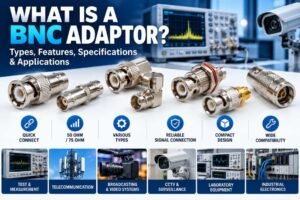
- Connectors
- Filters
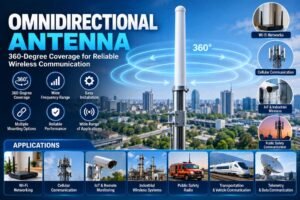
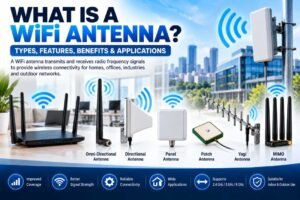
- Antennas
Spectrum Analyzer
Displays RF signals in the frequency domain.
Measures:
- Harmonics
- Signal bandwidth
- Noise
- Spurious emissions
Signal Generator
Produces calibrated RF signals for testing receivers and amplifiers.
Oscilloscope
Used for waveform analysis.
Power Meter
Measures RF output power accurately.
RF Load
Provides a matched termination during testing.
EMI Receiver
Measures electromagnetic interference.
RF Detection Techniques
Modern RF systems use various detection techniques depending on the application.
Envelope Detection
Extracts amplitude information from RF signals.
Applications:
- AM receivers
- RF power monitoring
Peak Detection
Measures the highest RF signal level.
Used in:
- Spectrum analyzers
- Radar systems
Average Detection
Calculates average RF signal power over time.
Useful for communication systems.
RMS Detection
Measures true RF power regardless of waveform shape.
Provides highly accurate measurements.
Logarithmic Detection
Converts wide dynamic-range RF signals into logarithmic outputs.
Common in:
- RF detectors
- Power monitoring circuits
IQ Detection
Separates signals into:
- In-phase (I)
- Quadrature (Q)
Essential for:
- 5G
- LTE
- Wi-Fi
- Software Defined Radio (SDR)
Digital RF Detection
Uses DSP algorithms for:
- Signal identification
- Demodulation
- Spectrum monitoring
Advanced RF Measurement Techniques
S-Parameter Measurement
Determines how RF signals behave within a network.
Includes:
- S11
- S21
- S12
- S22
Widely used for:
- Filters
- Amplifiers
- Cable assemblies
- Connectors
Time Domain Reflectometry (TDR)
Detects:
- Cable faults
- Impedance discontinuities
- Connector damage
Near Field Measurement
Measures electromagnetic fields close to RF devices.
Useful for PCB design.
Far Field Measurement
Used for antenna radiation pattern testing.
Applications of RF Testing
Telecommunications
- 4G LTE
- 5G
- Private Networks
- Base Stations
Satellite Communication
Tests:
- Transponders
- Ground stations
- Satellite antennas
Aerospace
Ensures communication reliability in aircraft systems.
Defense
RF testing supports:
- Radar
- Electronic warfare
- Missile guidance
- Secure communication
Medical Equipment
Used in:
- MRI systems
- Wireless patient monitoring
- Medical telemetry
Automotive
Supports:
- ADAS
- V2X
- GPS
- Radar
IoT Devices
Verifies wireless connectivity for smart devices.
Challenges in RF Testing
Increasing Frequency
Millimeter-wave testing requires highly precise equipment.
Miniaturization
Smaller RF components demand higher measurement accuracy.
Signal Interference
Modern environments contain numerous wireless signals.
Calibration
Incorrect calibration can lead to inaccurate measurements.
Thermal Effects
Temperature variations can affect RF performance.
Best Practices for RF Testing
- Use calibrated instruments.
- Select high-quality RF cables and connectors.
- Minimize cable bending during testing.
- Perform regular instrument calibration.
- Maintain proper impedance matching.
- Reduce external electromagnetic interference.
- Verify connector cleanliness.
- Follow international testing standards.
- Record measurement data for traceability.
- Test products under actual operating conditions.
Benefits of Professional RF Testing
Professional RF testing offers numerous advantages:
- Higher product reliability
- Improved signal performance
- Reduced manufacturing defects
- Better customer satisfaction
- Compliance with international standards
- Increased product lifespan
- Enhanced wireless communication
- Lower maintenance costs
- Faster troubleshooting
- Greater confidence in product quality
Future Trends in RF Testing
Emerging wireless technologies are transforming RF testing methods.
Key trends include:
- AI-powered automated RF testing
- 6G communication testing
- Terahertz frequency measurements
- Cloud-based remote testing
- Digital twin simulation
- Massive MIMO verification
- OTA (Over-the-Air) testing
- Machine learning for signal analysis
- Real-time spectrum monitoring
- Automated production-line RF testing
Conclusion
RF testing is the foundation of reliable wireless communication systems. Whether testing antennas, RF cable assemblies, connectors, filters, or complete communication networks, accurate RF measurements ensure optimal performance, regulatory compliance, and long-term reliability.
As wireless technologies continue to advance into 5G, satellite communication, defense systems, autonomous vehicles, and future 6G networks, RF testing will remain an indispensable process for achieving high-quality signal transmission and dependable system operation.
Frequently Asked Questions (FAQs)
1. What is RF testing?
RF testing is the process of measuring the performance, quality, and compliance of radio frequency devices and communication systems.
2. What frequency range does RF testing cover?
RF testing generally covers frequencies from 3 kHz to 300 GHz, depending on the application and test equipment.
3. Which instruments are commonly used for RF testing?
Common RF testing instruments include Vector Network Analyzers (VNAs), Spectrum Analyzers, Signal Generators, Oscilloscopes, Power Meters, RF Loads, and EMI Receivers.
4. What is the purpose of RF detection?
RF detection identifies, measures, and analyzes radio frequency signals to evaluate power levels, signal integrity, modulation quality, and interference.
5. What is VSWR in RF testing?
VSWR (Voltage Standing Wave Ratio) measures how well an RF system is impedance matched. A lower VSWR indicates better signal transmission and reduced reflections.
6. Why is calibration important in RF testing?
Calibration ensures accurate, repeatable measurements by aligning test instruments with recognized measurement standards.
7. Which industries rely on RF testing?
RF testing is widely used in telecommunications, aerospace, defense, automotive, satellite communications, healthcare, broadcasting, semiconductor manufacturing, and IoT industries.
8. What is the difference between RF testing and EMC testing?
RF testing focuses on signal performance and component functionality, while EMC testing evaluates electromagnetic emissions and immunity to ensure devices do not interfere with one another.
9. What are S-parameters in RF testing?
S-parameters (Scattering Parameters) describe how RF signals are transmitted and reflected through components such as antennas, connectors, filters, amplifiers, and cable assemblies.
10. Why is RF testing important for 5G and future wireless technologies?
5G and future 6G systems operate at higher frequencies with greater bandwidth and stricter performance requirements. RF testing ensures signal quality, minimizes interference, validates antenna performance, and confirms compliance with international communication standards.