
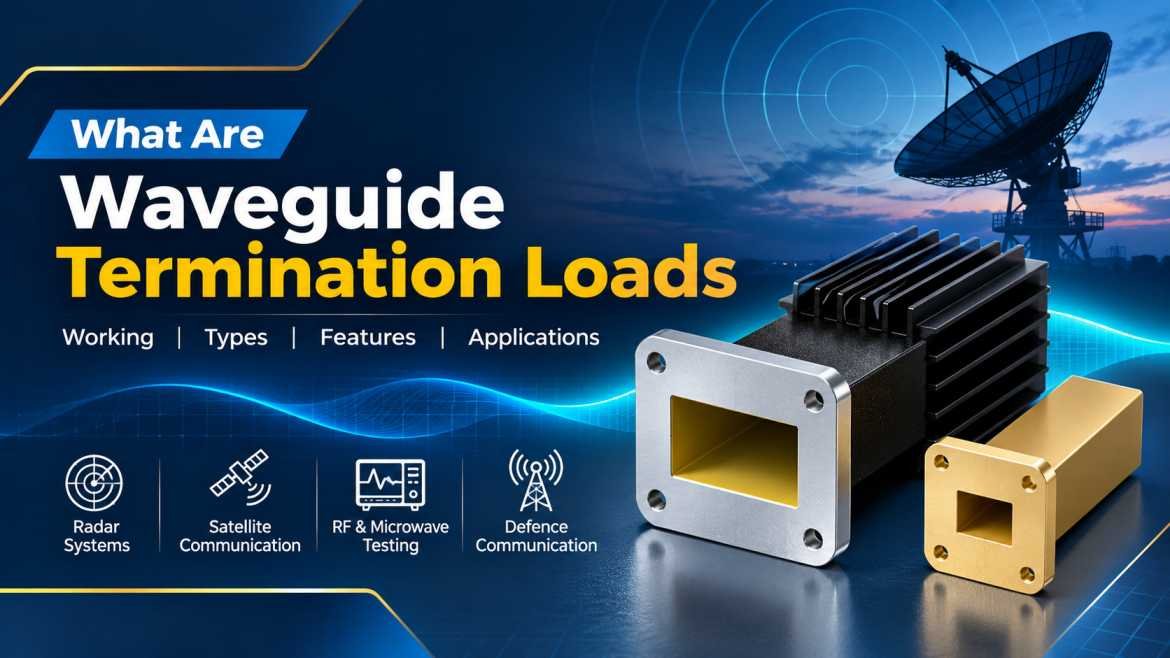
Waveguide Termination Loads are specialized microwave components designed to absorb electromagnetic energy travelling through a waveguide transmission line while minimizing unwanted signal reflections. They are used in RF and microwave systems to provide a matched termination at the end of a waveguide, ensuring that the transmitted energy is absorbed rather than reflected back towards the source.
In high-frequency communication and microwave applications, maintaining proper impedance matching is essential for achieving reliable signal transmission and minimizing signal loss. Waveguide Termination Loads help maintain system performance by absorbing incident microwave power and reducing standing waves caused by impedance mismatches.
These components are widely used in radar systems, satellite communication, microwave testing equipment, defence communication systems, RF laboratories and industrial microwave applications.
How Do Waveguide Termination Loads Work?
Waveguide Termination Loads operate by absorbing microwave energy travelling through a waveguide transmission system. They are generally installed at the end of a waveguide section to prevent electromagnetic signals from reflecting back into the transmission path.
When microwave energy enters a Waveguide Termination Load, the internal absorbing material converts the electromagnetic energy into heat. This process minimizes reflected power and helps maintain a stable transmission environment.
The working principle involves the following steps:
- Signal Transmission: Microwave energy travels through the waveguide towards the termination load.
- Energy Absorption: The electromagnetic energy enters the absorbing material inside the termination load.
- Reflection Reduction: The internal design minimizes the amount of energy reflected towards the signal source.
- Heat Dissipation: The absorbed microwave energy is converted into heat and dissipated through the component’s thermal structure.
- System Protection: Reduced reflected power helps improve measurement accuracy and protects sensitive RF and microwave equipment.
A properly selected Waveguide Termination Load provides effective power absorption across its specified operating frequency range.
Types of Waveguide Termination Loads
Waveguide Termination Loads are available in different configurations depending on their frequency range, power-handling requirements, waveguide dimensions and application.
1. Matched Waveguide Termination Loads
Matched Waveguide Termination Loads are designed to provide a low-reflection termination for microwave transmission systems. They absorb incident electromagnetic energy and help maintain proper matching within the waveguide.
These loads are commonly used in microwave communication systems, laboratory testing and RF measurement applications.
2. Low-Power Waveguide Termination Loads
Low-Power Waveguide Termination Loads are designed for applications where microwave signal power levels are relatively low. They are commonly used in RF laboratories, testing equipment and measurement setups.
Their compact construction makes them suitable for applications requiring controlled microwave energy absorption.
3. High-Power Waveguide Termination Loads
High-Power Waveguide Termination Loads are engineered to absorb higher levels of microwave energy without compromising thermal stability or electrical performance.
They generally incorporate specialized absorbing materials and heat-dissipation structures to manage the thermal energy generated during operation.
These loads are widely used in radar systems, defence electronics, high-power microwave transmitters and communication infrastructure.
4. Broadband Waveguide Termination Loads
Broadband Waveguide Termination Loads are designed to operate across a specified wide frequency range. They provide effective microwave energy absorption over multiple frequencies within their rated operating bandwidth.
They are useful in broadband microwave testing systems, research laboratories and multi-frequency communication applications.
Key Features of Waveguide Termination Loads
Waveguide Termination Loads are designed to deliver reliable performance in demanding RF and microwave environments.
Important features include:
- Low VSWR: Helps minimize reflected microwave energy and maintain effective impedance matching.
- High Power Handling: Available in configurations suitable for different microwave power levels.
- Wide Frequency Coverage: Designed to operate across specified waveguide frequency bands.
- Efficient Energy Absorption: Internal absorbing materials convert microwave energy into heat.
- Thermal Stability: Designed to manage heat generated during continuous or intermittent operation.
- Reliable Construction: Manufactured to withstand demanding operating environments.
- Low Reflection: Helps reduce standing waves and improve microwave transmission performance.
- Precision Engineering: Designed to meet the dimensional and electrical requirements of waveguide systems.
Important Technical Specifications of Waveguide Termination Loads
When selecting Waveguide Termination Loads, it is important to evaluate their electrical, mechanical and thermal specifications to ensure compatibility with the intended microwave system.
| Specification | Description |
|---|---|
| Product Type | Waveguide Termination Load |
| Operating Frequency | Depends on the waveguide band |
| Waveguide Interface | Depends on the selected waveguide size and flange |
| Frequency Band | WR Series / Standard Waveguide Bands |
| VSWR | Depends on product design and frequency |
| Power Handling Capacity | Depends on load configuration |
| Impedance Matching | Designed for matched waveguide termination |
| Absorbing Material | Microwave energy-absorbing material |
| Cooling Method | Natural or forced-air cooling, depending on design |
| Construction | Precision-engineered microwave assembly |
| Application | RF and microwave transmission systems |
Note: Actual specifications vary depending on the waveguide size, frequency band, power rating and manufacturer. Always refer to the product datasheet for confirmed technical specifications.
Applications of Waveguide Termination Loads
Waveguide Termination Loads are essential components in several high-frequency electronic and microwave systems. Their primary purpose is to absorb unwanted microwave energy and reduce signal reflections.
1. Radar Systems
Waveguide Termination Loads are used in radar equipment to absorb microwave signals and provide controlled termination points. They help reduce reflected power and support reliable radar system operation.
2. Satellite Communication
Satellite communication systems operate at high microwave frequencies and require reliable signal transmission. Waveguide Termination Loads are used in microwave assemblies, testing systems and communication equipment to maintain proper termination.
3. RF and Microwave Testing Laboratories
In RF laboratories, Waveguide Termination Loads are used during testing and measurement procedures. They provide a matched endpoint for waveguide circuits and help minimize unwanted reflections that may affect measurement results.
4. Defence and Military Communication
Defence communication equipment requires reliable microwave components capable of operating under demanding conditions. Waveguide Termination Loads are used in radar assemblies, microwave communication systems and electronic testing equipment.
5. Microwave Transmitters and Receivers
Waveguide Termination Loads help absorb microwave energy in transmitter and receiver assemblies. They are used in test configurations and unused waveguide ports to minimize unwanted signal reflections.
6. Industrial Microwave Systems
Industrial microwave equipment uses waveguide components to transfer high-frequency electromagnetic energy. Termination loads help absorb microwave power in controlled system configurations.
Benefits of Using Waveguide Termination Loads
Using properly selected Waveguide Termination Loads offers several advantages in RF and microwave applications.
1. Reduced Signal Reflections: They absorb incident microwave energy and help minimize reflected signals within the waveguide.
2. Improved System Performance: Proper termination helps maintain stable microwave transmission characteristics.
3. Better Measurement Accuracy: They provide controlled termination conditions for RF and microwave testing equipment.
4. Equipment Protection: By reducing reflected power, they help prevent excessive reverse power from reaching sensitive microwave components.
5. Reliable Power Absorption: They are designed to absorb specified microwave power levels while maintaining thermal stability.
6. Improved Operational Stability: Properly matched waveguide systems help reduce unwanted standing waves and support consistent operation.
How to Select the Right Waveguide Termination Load?
Selecting the correct Waveguide Termination Load is important for achieving reliable electrical performance and long-term operational stability.
Consider the following factors before purchasing:
1. Operating Frequency Range
Check the operating frequency of your microwave system and select a termination load compatible with the required waveguide frequency band.
2. Waveguide Size and Flange Type
Ensure that the termination load matches the waveguide dimensions and flange interface used in your existing system. Common waveguide sizes include WR-90, WR-75, WR-62 and other standard waveguide configurations.
3. Power Handling Capacity
Determine the maximum microwave power that the termination load must absorb. Select a model with an appropriate power rating to avoid overheating and performance degradation.
4. VSWR Requirements
Evaluate the Voltage Standing Wave Ratio (VSWR) specifications. A lower VSWR generally indicates better impedance matching and reduced reflected power.
5. Cooling Requirements
For high-power applications, consider the cooling arrangement, heat dissipation capability and thermal management requirements of the termination load.
6. Environmental Conditions
Consider operating temperature, humidity, vibration and installation conditions to ensure that the selected component is suitable for the intended environment.
Difference Between Waveguide Termination Loads and Waveguide Attenuators
Although Waveguide Termination Loads and Waveguide Attenuators are both used in microwave systems, their functions are different.
| Parameter | Waveguide Termination Loads | Waveguide Attenuators |
|---|---|---|
| Primary Function | Absorb microwave energy at a termination point | Reduce signal power by a specified amount |
| Main Purpose | Minimize reflected microwave power | Control microwave signal levels |
| Installation | Generally installed at the end of a waveguide | Installed within the microwave transmission path |
| Signal Output | Terminates the waveguide signal | Allows an attenuated signal to pass through |
| Typical Applications | Testing, radar and microwave systems | Signal control, testing and measurement |
| Performance Parameter | VSWR and power handling | Attenuation in dB and VSWR |
Why Are Waveguide Termination Loads Important in RF and Microwave Systems?
Waveguide Termination Loads play an important role in maintaining the electrical performance of microwave transmission systems. Without proper termination, unused waveguide ports or transmission endpoints can create unwanted signal reflections.
These reflections may produce standing waves, affect impedance matching and interfere with the operation of connected RF and microwave equipment.
By absorbing incident electromagnetic energy, Waveguide Termination Loads help create controlled operating conditions, improve measurement reliability and support efficient microwave system performance.
Their importance increases in applications where frequency stability, power handling, low reflection and reliable signal transmission are critical.
Conclusion
Waveguide Termination Loads are essential RF and microwave components designed to absorb electromagnetic energy and minimize unwanted signal reflections in waveguide transmission systems. Their ability to provide matched termination makes them valuable in radar systems, satellite communication, defence electronics, microwave testing laboratories and industrial microwave applications.
Selecting the appropriate Waveguide Termination Load requires careful consideration of operating frequency, waveguide size, power handling capacity, VSWR, cooling requirements and environmental conditions.
For reliable microwave system performance, it is important to choose precision-engineered termination loads that meet the electrical and mechanical requirements of the intended application.
Frequently Asked Questions (FAQs)
1. What is a Waveguide Termination Load?
A Waveguide Termination Load is a microwave component designed to absorb electromagnetic energy travelling through a waveguide and minimize unwanted signal reflections.
2. What is the main purpose of Waveguide Termination Loads?
The primary purpose is to provide a matched termination at the end of a waveguide, absorb microwave power and reduce reflected signals.
3. Where are Waveguide Termination Loads used?
They are commonly used in radar systems, satellite communication, defence electronics, microwave testing laboratories, RF measurement equipment and industrial microwave systems.
4. What is the difference between a waveguide load and a waveguide attenuator?
A waveguide load absorbs microwave energy and terminates a waveguide, whereas a waveguide attenuator reduces signal power by a specified amount while allowing the signal to continue through the transmission path.
5. What is VSWR in Waveguide Termination Loads?
VSWR stands for Voltage Standing Wave Ratio. It indicates the degree of impedance matching between the waveguide and the termination load. A lower VSWR generally indicates lower signal reflection.
6. How do I choose the correct Waveguide Termination Load?
Consider the operating frequency, waveguide size, flange type, power handling capacity, VSWR, cooling requirements and environmental conditions before selecting a suitable model.
7. Can Waveguide Termination Loads handle high microwave power?
Yes. High-power Waveguide Termination Loads are available with specialized absorbing materials and thermal management designs. Their maximum power rating depends on the specific product configuration.
SEO Keywords Used
Primary Keyword:
Secondary Keywords:
- Waveguide Termination Load
- RF Waveguide Termination
- Microwave Termination Loads
- Waveguide Matched Loads
- Microwave Absorbing Loads
- High Power Waveguide Loads
- RF and Microwave Components
- Waveguide Components
- Microwave Testing Components
- Waveguide Load Applications
Suggested Image Alt Text (for future use): Waveguide Termination Loads for RF and Microwave Applications
SEO Recommendation: Use “Waveguide Termination Loads” naturally in the page title, first paragraph, at least one H2 heading, URL slug, meta description and relevant internal links. Avoid excessive keyword repetition to maintain readability and search quality.