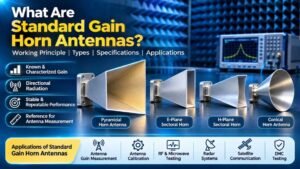
Standard gain horn antennas are widely used microwave antennas designed to provide a known and stable antenna gain over a specified frequency range. They play an important role in RF testing, microwave measurements, antenna calibration, radar systems and wireless communication applications.
These antennas are particularly valuable in applications where accurate antenna gain measurements, predictable radiation patterns and reliable signal transmission are required. Their simple construction, directional radiation characteristics and well-defined electrical performance make them an important reference antenna in laboratories, research facilities and RF engineering environments.
Unlike ordinary antennas designed primarily for communication or signal reception, standard gain horn antennas are often used as reference antennas for measuring and evaluating the performance of other antennas.
Standard gain horn antennas are available in different frequency ranges and gain configurations to support various RF and microwave testing requirements. They are commonly used in antenna measurement systems, anechoic chambers, electromagnetic compatibility (EMC) testing and microwave communication systems.
In this article, we will explore what standard gain horn antennas are, their working principles, different types, technical specifications, advantages and applications in modern RF and microwave systems.
What Is a Standard Gain Horn Antenna?
A standard gain horn antenna is a directional microwave antenna designed to provide a precisely characterized and repeatable gain over a specified operating frequency range.
It generally consists of a waveguide connected to a gradually expanding metallic structure called a horn. This flared structure allows electromagnetic waves travelling through the waveguide to radiate efficiently into free space.
Standard gain horn antennas are manufactured with carefully controlled dimensions to achieve predictable gain, radiation patterns, polarization and impedance characteristics.
They are commonly used as reference antennas in RF and microwave testing because their gain characteristics are known and can be used for comparison and calibration.
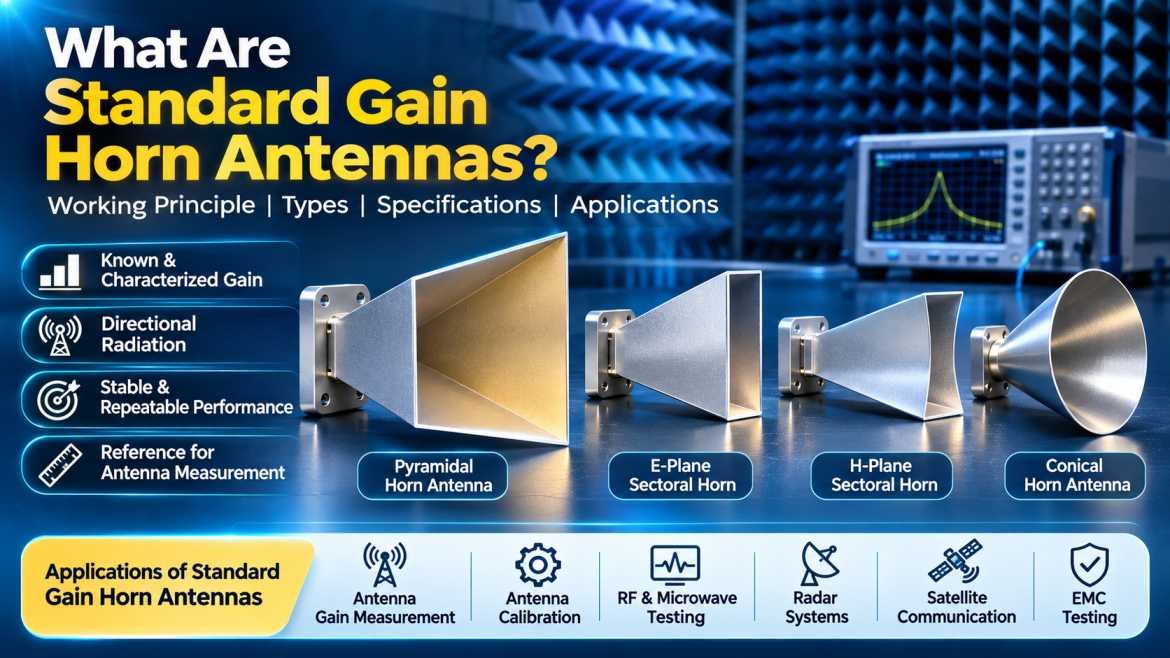
The most common design is the pyramidal horn antenna, which expands in both the E-plane and H-plane to produce a directional radiation pattern.
Standard gain horn antennas are available for different microwave and millimeter-wave frequency bands, depending on the waveguide size and antenna design.
How Does a Standard Gain Horn Antenna Work?
A standard gain horn antenna operates by converting electromagnetic energy travelling through a waveguide into radiated electromagnetic waves.
The antenna uses a flared metallic opening to provide a gradual transition between the confined electromagnetic field inside the waveguide and the radiation field in free space.
The working principle involves the following stages:
1. RF Signal Input
An RF or microwave signal is supplied to the antenna through a compatible waveguide or coaxial-to-waveguide transition.
The electromagnetic energy travels through the waveguide towards the horn structure.
2. Waveguide Transmission
The waveguide carries electromagnetic energy in a controlled propagation mode, typically the dominant TE10 mode in a rectangular waveguide.
The waveguide dimensions determine the supported frequency range and propagation characteristics.
3. Electromagnetic Wave Expansion
As the signal reaches the flared section, the electromagnetic field gradually expands.
The horn geometry provides a transition from the waveguide aperture to a larger radiating aperture, helping control reflections and improve radiation characteristics.
4. Directional Radiation
The electromagnetic energy radiates through the horn aperture in a focused direction.
The larger aperture generally produces higher directivity and a narrower radiation beam, depending on the antenna dimensions and operating frequency.
5. Signal Reception
When used as a receiving antenna, the horn captures incoming electromagnetic waves through its aperture and couples the received energy into the waveguide.
This makes standard gain horn antennas suitable for both transmitting and receiving microwave signals.
Different Types of Standard Gain Horn Antennas
Standard gain horn antennas are available in different configurations depending on their geometry, operating frequency, gain requirements and measurement applications.
The most common types include the following.
1. Pyramidal Standard Gain Horn Antenna
A pyramidal standard gain horn antenna is one of the most commonly used horn antenna designs in RF and microwave measurement systems.
It features a rectangular waveguide that gradually expands in both the E-plane and H-plane, creating a rectangular aperture.
This design provides controlled directivity, predictable gain and stable radiation characteristics.
Key Characteristics:
- Rectangular horn aperture
- Flared structure in both E-plane and H-plane
- Directional radiation pattern
- Linear polarization
- Well-characterized gain performance
- Suitable for microwave frequency measurements
Applications:
- Antenna gain measurement
- Microwave laboratory testing
- Radar systems
- EMC and EMI testing
- RF antenna calibration
- Wireless communication research
2. Sectoral Horn Antenna
A sectoral horn antenna expands in only one principal plane while maintaining a constant dimension in the other plane.
Depending on its geometry, it is classified into two major configurations.
E-Plane Sectoral Horn Antenna:
This antenna expands in the electric-field plane while maintaining a constant dimension in the magnetic-field plane.
It produces a narrower beam in the E-plane.
H-Plane Sectoral Horn Antenna:
This antenna expands in the magnetic-field plane while maintaining a constant dimension in the electric-field plane.
It produces a narrower beam in the H-plane.
Applications:
- Microwave antenna research
- Directional radiation studies
- Waveguide measurement systems
- RF laboratory experiments
3. Conical Horn Antenna
A conical horn antenna uses a circular waveguide that expands into a cone-shaped radiating structure.
Unlike a pyramidal horn, which has a rectangular aperture, a conical horn has a circular aperture.
It is generally used with circular waveguide modes and can provide rotationally symmetric radiation patterns under suitable excitation conditions.
Key Characteristics:
- Circular aperture design
- Conical flared structure
- Symmetrical geometry
- Suitable for circular polarization when appropriately designed and excited
- Available for microwave and millimeter-wave applications
Applications:
- Satellite communication
- Microwave measurement systems
- Radar technology
- Radio astronomy
- Antenna testing laboratories
4. Gain Horn Antenna
A gain horn antenna is designed to provide a specific directional gain over a particular frequency range.
Although the terms gain horn and standard gain horn are sometimes used interchangeably, not every gain horn is a calibrated standard gain antenna.
Standard gain horn antennas are manufactured and characterized to provide known reference gain values, making them particularly suitable for measurement and calibration applications.
Applications:
- RF signal transmission
- Microwave testing
- Antenna characterization
- Communication systems
- Radar applications
Important Technical Specifications of Standard Gain Horn Antennas
When selecting a standard gain horn antenna, it is important to understand its electrical, mechanical and environmental specifications.
These parameters determine the antenna’s suitability for a particular RF or microwave application.
1. Frequency Range
The frequency range defines the operating frequencies over which the antenna is designed to provide its specified performance.
Standard gain horn antennas are available across different microwave and millimeter-wave frequency bands.
Selecting the correct frequency range is essential for achieving reliable antenna performance.
2. Antenna Gain
Antenna gain describes the ability of an antenna to concentrate radiated energy in a particular direction compared with a reference antenna.
It is generally expressed in dBi, which represents gain relative to an isotropic radiator.
Standard gain horn antennas provide known gain characteristics, making them suitable for antenna gain measurements and calibration.
3. Directivity
Directivity describes how effectively an antenna concentrates its radiated energy in a particular direction.
A higher-directivity horn antenna generally produces a narrower radiation beam.
This characteristic is useful in microwave measurements and directional communication applications.
4. Voltage Standing Wave Ratio (VSWR)
VSWR indicates how effectively the antenna is impedance-matched to its feeding transmission line or waveguide system.
A lower VSWR generally indicates better impedance matching and reduced signal reflections.
5. Polarization
Polarization describes the orientation of the electric field of the radiated electromagnetic wave.
Standard gain horn antennas commonly support linear polarization, including horizontal or vertical orientations, depending on their installation and feeding configuration.
6. Half-Power Beamwidth (HPBW)
Half-power beamwidth refers to the angular width of the main radiation beam measured between the points where the radiated power decreases by 3 dB relative to its maximum value.
It is generally specified separately for the E-plane and H-plane in pyramidal horn antennas.
7. Cross-Polarization
Cross-polarization refers to the unwanted radiation component with polarization orthogonal to the intended polarization.
Low cross-polarization is desirable in precision antenna measurements and polarization-sensitive communication systems.
8. Impedance
Impedance is an important parameter for ensuring compatibility between the antenna and its RF feeding system.
Waveguide-fed standard gain horn antennas are generally specified by their waveguide interface, while coaxial-fed designs may use a specified characteristic impedance, commonly 50 ohms.
9. Connector or Waveguide Interface
The feeding interface determines how the antenna connects to the RF or microwave system.
Common interfaces include:
- Rectangular waveguide flanges
- Circular waveguide interfaces
- Coaxial connectors
- Waveguide-to-coaxial transitions
The interface must be compatible with the connected equipment.
10. Mechanical Construction
Standard gain horn antennas are commonly manufactured using conductive metallic materials such as aluminium or copper.
Important mechanical parameters include aperture dimensions, overall length, mounting arrangement, material, surface finish and mechanical stability.
Standard Gain Horn Antenna Specifications Table
The following table presents commonly specified parameters for standard gain horn antennas. Actual values depend on the selected model and frequency band.
| Specification | Details |
|---|---|
| Product Type | Standard Gain Horn Antenna |
| Antenna Design | Pyramidal / Sectoral / Conical |
| Frequency Range | Multiple Microwave and Millimeter-Wave Bands |
| Antenna Gain | Model and Frequency Dependent |
| Polarization | Linear / As Specified |
| Radiation Pattern | Directional |
| Half-Power Beamwidth | E-Plane and H-Plane, Model Dependent |
| VSWR | Model Dependent |
| Impedance | Waveguide Interface or Specified Coaxial Impedance |
| Waveguide Type | Rectangular / Circular |
| Connector Interface | Waveguide Flange / Coaxial Interface |
| Antenna Material | Aluminium / Copper / Other Conductive Materials |
| Application | RF Testing, Antenna Measurement and Microwave Systems |
Note: This is a general reference table, not a specification sheet for a particular antenna model. Actual electrical and mechanical values should be confirmed from the manufacturer’s datasheet.
Applications of Standard Gain Horn Antennas
Standard gain horn antennas are widely used in industries and research environments where accurate RF and microwave measurements are required.
Their predictable radiation characteristics and known gain make them valuable in the following applications.
1. Antenna Gain Measurement
One of the most important applications of standard gain horn antennas is measuring the gain of other antennas.
A standard gain horn antenna can serve as a reference antenna in gain comparison measurements.
By comparing the received signal strength of the antenna under test with that of a reference antenna under controlled conditions, engineers can determine the relative gain.
This technique is commonly used in antenna testing laboratories and research facilities.
2. Antenna Calibration
Standard gain horn antennas are used as reference antennas during calibration and verification of antenna measurement systems.
Their known gain characteristics help engineers evaluate measurement accuracy and maintain consistency in RF testing procedures.
They are particularly useful in anechoic chambers and controlled measurement environments.
3. RF and Microwave Testing
RF engineers use standard gain horn antennas to test and evaluate microwave components and antenna systems.
They can be integrated into measurement setups for:
- Antenna radiation pattern testing
- Gain measurement
- Polarization measurement
- Frequency response evaluation
- Microwave transmission testing
4. Radar Systems
Radar systems use directional antennas to transmit and receive electromagnetic waves.
Standard gain horn antennas are used in radar research, antenna characterization and microwave testing.
They help engineers evaluate radiation characteristics and validate radar antenna performance.
5. Electromagnetic Compatibility (EMC) Testing
Standard gain horn antennas are used in electromagnetic compatibility testing to evaluate radiated emissions and immunity over appropriate frequency ranges.
They can be used to transmit controlled RF signals or receive radiated emissions during laboratory measurements.
Their directional radiation characteristics help support controlled testing procedures.
6. Satellite Communication
Satellite communication systems operate across microwave frequency bands and require accurate antenna measurements.
Standard gain horn antennas are used in testing and characterization of satellite communication equipment, microwave subsystems and antenna assemblies.
They help engineers verify gain, radiation patterns and other antenna characteristics.
7. Millimeter-Wave Research
With the increasing use of millimeter-wave frequencies in advanced wireless communication and sensing technologies, standard gain horn antennas are important tools in high-frequency testing.
They are used for:
- Millimeter-wave antenna characterization
- High-frequency propagation studies
- RF component testing
- Wireless communication research
- Laboratory measurement systems
8. Radio Astronomy
Standard gain horn antennas and related horn antenna structures are used in radio astronomy research and microwave measurement applications.
They support the reception and characterization of electromagnetic signals at selected frequencies.
Advantages of Standard Gain Horn Antennas
Standard gain horn antennas offer several advantages that make them suitable for professional RF and microwave applications.
1. Known Antenna Gain: Their characterized gain makes them suitable as reference antennas for measurement and calibration.
2. Directional Radiation: Their horn-shaped structure concentrates electromagnetic energy in a preferred direction.
3. Wide Frequency Availability: Different models are available for various microwave and millimeter-wave frequency bands.
4. Stable Performance: Properly manufactured antennas offer repeatable electrical characteristics under controlled operating conditions.
5. High Directivity: Their aperture design helps achieve directional radiation patterns.
6. Simple Construction: The metallic horn structure provides a mechanically straightforward antenna design.
7. Measurement Accuracy: Their well-characterized performance supports accurate RF and microwave antenna testing.
8. Versatile Applications: They can be used in radar, satellite communication, EMC testing, antenna laboratories and microwave research.
Standard Gain Horn Antenna vs. Conventional Horn Antenna
Although standard gain horn antennas and conventional horn antennas have similar physical structures, their intended applications and performance characterization can differ.
| Parameter | Standard Gain Horn Antenna | Conventional Horn Antenna |
|---|---|---|
| Primary Purpose | Reference measurements and calibration | General RF transmission and reception |
| Gain Characteristics | Known and characterized gain | Design dependent |
| Radiation Pattern | Well-characterized directional pattern | Depends on design |
| Manufacturing | Controlled dimensions and performance | Application dependent |
| Testing Applications | Antenna gain measurement and calibration | General RF and microwave testing |
| Frequency Range | Specified operating band | Depends on design |
| Typical Usage | Reference antenna | Communication, radar and microwave systems |
A standard gain horn antenna is particularly useful when predictable and characterized antenna performance is required.
How to Select the Right Standard Gain Horn Antenna
Choosing the right standard gain horn antenna requires careful evaluation of the measurement requirements and operating conditions.
Consider the following factors before selecting an antenna.
1. Operating Frequency
Identify the required microwave or millimeter-wave frequency range.
The selected antenna must cover the complete frequency range of the intended application.
2. Required Antenna Gain
Determine the gain needed for the measurement or communication setup.
Select an antenna with a suitable gain specification across the required frequency range.
3. Polarization Requirements
Check whether horizontal, vertical or another specified polarization configuration is required.
The polarization should match the antenna under test and the measurement setup.
4. Radiation Pattern
Evaluate the E-plane and H-plane beamwidths to ensure that the antenna provides the required directional coverage.
5. VSWR and Impedance Matching
Check the impedance characteristics and VSWR to minimize unwanted reflections and improve measurement reliability.
6. Waveguide or Connector Compatibility
Ensure that the antenna interface is compatible with the connected RF equipment, waveguide assemblies or coaxial adapters.
7. Mechanical Dimensions
Consider the aperture size, mounting arrangement, antenna length and available installation space.
8. Calibration and Measurement Requirements
For reference applications, verify that the antenna has suitable gain characterization, calibration information and supporting manufacturer documentation.
Standard Gain Horn Antennas in Modern RF and Microwave Systems
The demand for accurate RF and microwave measurement solutions continues to increase with the development of advanced wireless communication technologies.
Modern communication infrastructure, radar systems, satellite networks and millimeter-wave applications require antennas that provide predictable and repeatable performance.
Standard gain horn antennas support these requirements by providing characterized gain and directional radiation properties.
They are expected to remain important components in:
- 5G and emerging 6G research
- Millimeter-wave communication systems
- Satellite communication infrastructure
- Advanced radar and sensing systems
- EMC and EMI testing laboratories
- RF and microwave research facilities
- Antenna calibration and measurement systems
As RF technologies continue to evolve, standard gain horn antennas will remain valuable tools for engineers involved in antenna development, testing and performance verification.
Frequently Asked Questions About Standard Gain Horn Antennas
1. What is a standard gain horn antenna?
A standard gain horn antenna is a directional microwave antenna with known and characterized gain over a specified frequency range. It is commonly used as a reference antenna for RF and microwave measurements, calibration and testing.
2. What is the working principle of a standard gain horn antenna?
It works by converting electromagnetic energy travelling through a waveguide into radiated waves through a gradually expanding metallic horn structure. The flared aperture helps control radiation and produce a directional beam.
3. What are the different types of standard gain horn antennas?
Common horn antenna configurations include pyramidal, E-plane sectoral, H-plane sectoral and conical horn antennas. Pyramidal standard gain horn antennas are particularly common in microwave measurement applications.
4. What is the main application of standard gain horn antennas?
Their primary application is antenna gain measurement and calibration. They are also used in RF testing, microwave research, EMC testing, radar systems and satellite communication equipment.
5. What is antenna gain in a standard gain horn antenna?
Antenna gain represents the ability of an antenna to concentrate electromagnetic energy in a particular direction relative to an isotropic radiator. It is generally expressed in dBi.
6. Why are standard gain horn antennas used in RF testing?
They provide known and repeatable gain characteristics, making them useful as reference antennas for evaluating the performance of other antennas and RF measurement systems.
7. What frequency ranges are supported by standard gain horn antennas?
Standard gain horn antennas are available across a wide range of microwave and millimeter-wave frequencies. The actual operating range depends on the antenna design, waveguide size and model.
8. What is the difference between a pyramidal and a conical horn antenna?
A pyramidal horn antenna has a rectangular aperture and expands in both E-plane and H-plane. A conical horn antenna has a circular aperture and expands in a cone-shaped structure.
9. Are standard gain horn antennas used in 5G testing?
Yes. They can be used in 5G and millimeter-wave research for antenna characterization, gain measurements, radiation pattern evaluation and RF testing.
10. What parameters should be checked before purchasing a standard gain horn antenna?
Important parameters include operating frequency, gain, VSWR, polarization, beamwidth, waveguide interface, aperture dimensions, cross-polarization and calibration documentation.
Conclusion
Standard gain horn antennas are important components in RF and microwave engineering because of their known gain characteristics, directional radiation patterns and reliable measurement performance.
They are widely used in antenna calibration, gain measurement, microwave testing, radar research, EMC testing and satellite communication applications.
Different configurations, including pyramidal, sectoral and conical horn antennas, offer flexibility for different frequency ranges and measurement requirements.
When selecting a standard gain horn antenna, engineers should carefully evaluate operating frequency, gain, polarization, VSWR, beamwidth, waveguide compatibility and calibration requirements.
For organizations involved in RF engineering, telecom infrastructure and microwave system development, selecting the right antenna is essential for achieving accurate measurements and reliable system performance.
SRFS Teleinfra provides RF and microwave components, connectors, cable assemblies and telecom infrastructure solutions for modern communication and engineering applications.
Explore RF and microwave components at https://www.srfsteleinfra.in/.